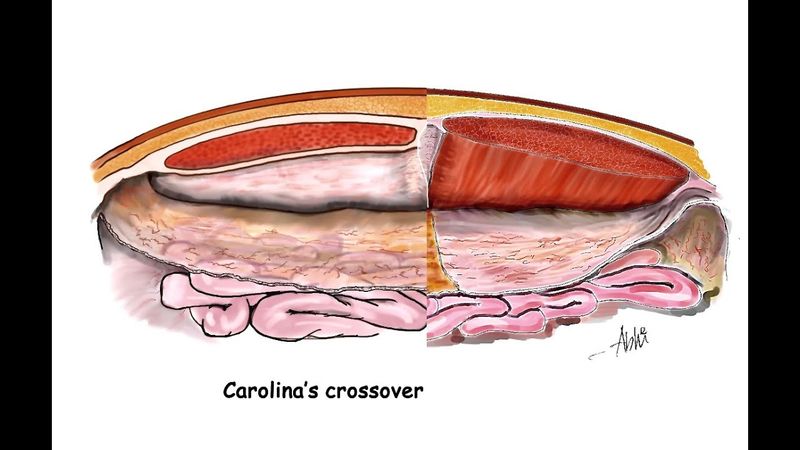
We performed an eTEP (extended Totally Extraperitoneal) precostal access with retromuscular dissection on one side and preperitoneal-pretransversalis dissection on the other side for a 45-year-old male patient with a BMI of 33. The patient presented with a symptomatic umbilical hernia that was progressively enlarging and associated with diastasis recti.
We believe that this approach is most suitable for moderate central hernias accompanied by moderate diastasis recti, particularly in cases where a limited retrorectus space may necessitate the use of a PCS-TAR technique solely to accommodate a larger mesh. This method is also advantageous in circumstances involving parastomal hernias on one side, as it allows for mesh extension without introducing additional complexity.
Carolina's modification may serve as an excellent alternative for young, thin, muscular patients, such as athletes or those concerned about cosmetic outcomes after eTEP Rives repair. Additionally, incorporating investing sutures can further enhance cosmetic results. We believe that post-repair bulging is multifactorial, with significant contributions from muscle atrophy and trauma to the neurovascular bundle.
Regarding concerns about asymmetric mesh placement with this approach, we do not perceive it as a clinical issue. Biologically, retrofascial mesh integration may take slightly longer than retromuscular integration; however, both techniques provide the same sublay position, isolating the mesh from intraperitoneal contents. These methods offer well-known advantages, including a reduced need for fixation, decreased postoperative pain, and less reliance on costly prosthetics.