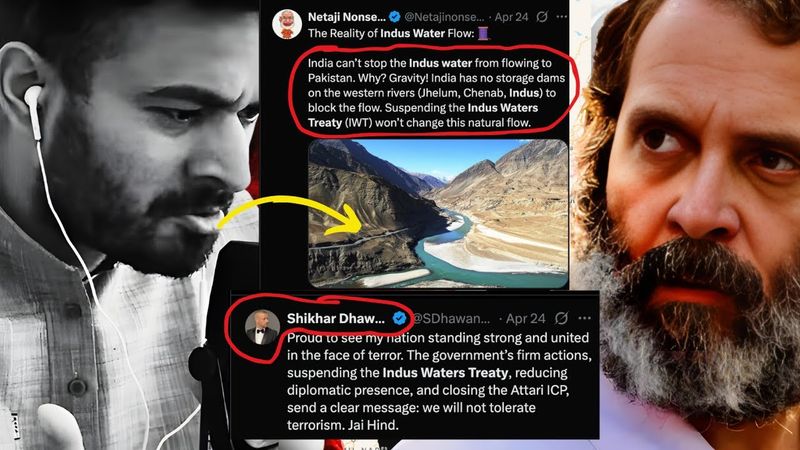
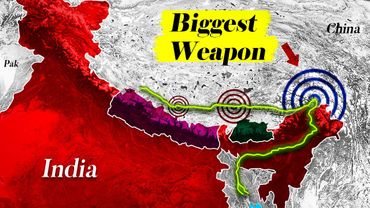
The Indus Waters Treaty (IWT) is often cited as one of the most successful and durable water‑sharing agreements in the world. Signed in 1960 between India and Pakistan and brokered by the World Bank, it was hailed as a symbol of cooperation amid conflict—a rare moment of civility between two nations that had already gone to war once and were destined to do so again. Over sixty years later, this treaty raises a much deeper and more uncomfortable question: Why does India, the upper riparian state, continue to honour an agreement that Pakistan has used not as a gesture of peace, but as a tool of provocation and international leverage? The treaty divides the six rivers of the Indus basin. India gets control over the eastern rivers—Ravi, Beas, and Sutlej—while Pakistan gets the western ones—Indus, Jhelum, and Chenab. Despite being the upper riparian, India agreed to let Pakistan use over 80% of the water flowing in the Indus basin. India can use its share of western rivers only for limited purposes like irrigation, hydropower (without storage), and navigation. It cannot divert or store water for agriculture or domestic use beyond a certain limit. In simpler terms, India agreed to tie its own hands—even during times of war, terrorism, or border escalation. The treaty was signed in 1960, followed by the 1965 war, the 1971 war, Kargil in 1999, and countless terrorist attacks such as Uri, Pulwama, and 26/11. Yet the treaty survived. India never stopped the flow of water; Pakistan never stopped the flow of terrorists. In fact, Pakistan began to use the treaty itself as a weapon—dragging India to international arbitration again and again, especially when India tried to build hydropower projects on its own territory. But this isn’t just about Pakistan. The real story lies upstream—in Tibet. The Indus River originates in the Tibetan Plateau, which is controlled by China. And while the IWT is an India‑Pakistan agreement, it conveniently ignores the elephant in the room—that China holds the source of this mighty river. If China decides to divert or dam the Indus at its origin, there is little either India or Pakistan can do. Over the last two decades, China has aggressively built hundreds of dams on rivers flowing out of Tibet, including the Brahmaputra. The future of Asia’s water security is now in the hands of a country that has made no secret of its disregard for international treaties or environmental consequences. That brings us to the big strategic dilemma facing India: Should the Indus Waters Treaty still be considered sacred? Or should it be re‑evaluated in the context of modern geopolitics, Chinese aggression, and Pakistan’s continued use of non‑state actors against Indian civilians? The Modi government has, on multiple occasions, hinted at rethinking the IWT. In 2016, after the Uri attack, Prime Minister Modi declared: "Blood and water cannot flow together." It was a bold statement—and yet, no action followed. The treaty remained untouched. In 2019, post‑Pulwama, the government announced that India would stop the unutilized flow of eastern rivers to Pakistan. But in practice, no major structural change was enforced. Diplomacy remained cautious. Retaliation was confined to airstrikes. The water kept flowing. Why? Because revoking or modifying the treaty is easier said than done. It would damage India’s image as a responsible international actor. It could provoke global backlash, especially from environmental groups and development banks. It may even push Pakistan to threaten war—not over land, but over rivers. And yet, the question remains: How long can India maintain the moral high ground while Pakistan continues to use the treaty as both shield and sword? Now add China to the equation, and the chessboard gets even more complicated. Imagine a situation where India is at war with Pakistan, and China—either directly or through its leverage in Gilgit‑Baltistan—decides to manipulate water flows. Or consider a future where Chinese companies, operating in Pakistan‑occupied Kashmir under the China‑Pakistan Economic Corridor (CPEC), begin damming or rerouting the flow of Jhelum and Indus to benefit downstream projects—ignoring Indian objections completely. At that point, is the treaty still a symbol of peace? Or is it a relic of a naïve time? This episode will take you deep into the history, the legal framework, and the geopolitical stakes surrounding the Indus Waters Treaty. We’ll explore the original negotiations between Nehru and Ayub Khan, the World Bank’s involvement, and how the IWT has evolved (or failed to evolve) since the 1960s.