
Why Russia's Su-34 Dominates DESPITE Its Design

Why Russia's Su-34 Dominates DESPITE Its Design32:57

Informations de téléchargement et détails de la vidéo Why Russia's Su-34 Dominates DESPITE Its Design
Auteur :

Quantum Arsenal

Publié le :

09/11/2025

Vues :

17.5K

Description :

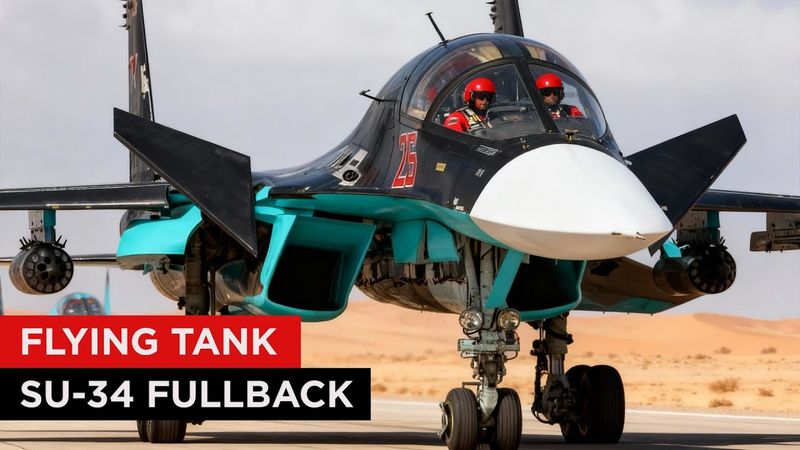
In the grand taxonomy of military aviation, few machines are as polarizing or as paradoxical as the Sukhoi Su-34. NATO, with its typical flair for imposing nomenclature, christened it the "Fullback", a name that evokes an image of a stalwart, powerful defender. Its own crews, however, know it by a far less dignified, if more descriptive, set of nicknames: Utkonos, the "Platypus," or Utyonok, the "Duckling." This comical dissonance is the perfect introduction to the aircraft, because one look at its bizarre, flattened, "duckbill"-shaped forward fuselage confirms that this is no ordinary machine. That strange nose is not an aesthetic indulgence; it is the physical manifestation of a radical design choice, a clue that what you are looking at is not truly a fighter at all, but a "flying tank" with the DNA of a heavy bomber, surgically grafted onto the high-performance airframe of the legendary Su-27 Flanker. This is an aircraft designed for a very specific, brutal kind of war, a war of low-level, high-speed penetration under a hail of enemy fire. It was a concept born in the final, paranoid twilight of the Soviet Union, and when it was finally asked to perform that exact mission decades later in the skies over Ukraine, it failed, catastrophically. Yet today, the Su-34 dominates the ground-attack mission, not because of its specialized, armored nature, but in spite of it. Its story is not one of linear success, but of failed assumptions, a brutal crucible, and a late-life adaptation that turned a failed 1980s-era penetrator into a terrifyingly effective 21st-century standoff killer.