Украинский вопрос и российская оппозиция, а также другие события недели I Фёдор Крашенинников ON AIR
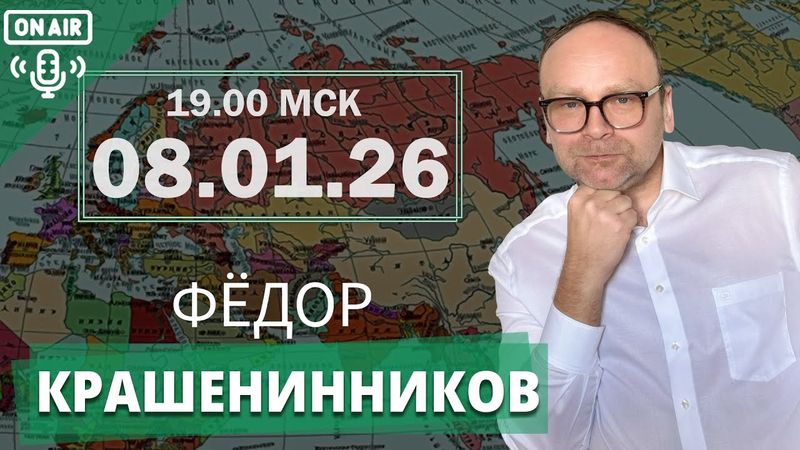
Украинский вопрос и российская оппозиция, а также другие события недели I Фёдор Крашенинников ON AIR01:58:39

Informasi unduhan dan detail video Украинский вопрос и российская оппозиция, а также другие события недели I Фёдор Крашенинников ON AIR

Pengunggah:

Федор Крашенинников

Diterbitkan pada:

5/1/2026

Penayangan:

10.4K

Deskripsi:

The episode covers a wide range of current events and political discussions. At 00:00 the host greets the audience and begins the broadcast. At 01:53 the discussion turns to the tragic suicide of journalist Evgeny Safronov in France. At 06:17 the host examines Venezuela and why President Putin did not intervene to rescue Nicolás Maduro. At 10:17 the topic shifts to the Russian shadow fleet. At 12:41 the conversation explores how Putin, Trump, and Xi may have already divided the world into spheres of influence. At 17:58 the host discusses Greenland and the threat of its occupation by the United States. At 24:41 the focus moves to Denmark and Europe’s potential response to U.S. demands to return Greenland. At 31:12 the host explains why President Trump is interested in Greenland. At 35:21 the discussion turns to criticism of the Russian Democratic Movement (RDK) and Ukrainian authorities voiced by Volkov in a private correspondence. At 46:00 the host addresses the claim that RDK leader Kapustin is not an opposition figure but an agent of Ukrainian intelligence. At 50:58 the conversation covers Lithuanian authorities’ reaction to Volkov’s statements. At 53:45 the host argues that Lithuania is not an ideal place for active political activity by Russian opposition figures. At 1:01:35 the discussion turns to values and freedom of speech. At 1:04:20 the host considers what Russian political emigration will do once the war ends. At 1:09:35 the host explains why pathists cannot be expelled from Germany. At 1:11:20 the conversation covers Taiwan, the so‑called “Russian Taiwan,” and passports for “good Russians” issued by Kaspаров. At 1:20:37 the host discusses the pan‑European party Volt. At 1:24:03 the conversation examines how Russian‑speaking and American bloggers and media perceive the EU as a single state. At 1:29:37 the host talks about the granddaughter of Khrushchev, who actively presents herself as an expert on the situation in Venezuela. At 1:33:40 the discussion turns to the threat of Volkov losing his residence permit in Lithuania. At 1:34:55 the host reflects on why he does not criticize Putin as strongly as Ukrainian authorities. At 1:38:15 the conversation addresses why Latvia and Lithuania are in the EU if they do not share core values. At 1:40:30 the host discusses how Soviet/Russian nomenclature gives opportunities to its grandchildren by taking them from ordinary people. At 1:46:20 the conversation explores the difference between freedom of speech and propaganda. At 1:51:07 the host questions whether Yekaterinburg owes its success to Yeltsin. At 1:54:06 the host debates whether freedom of speech helped Hitler achieve his goals.