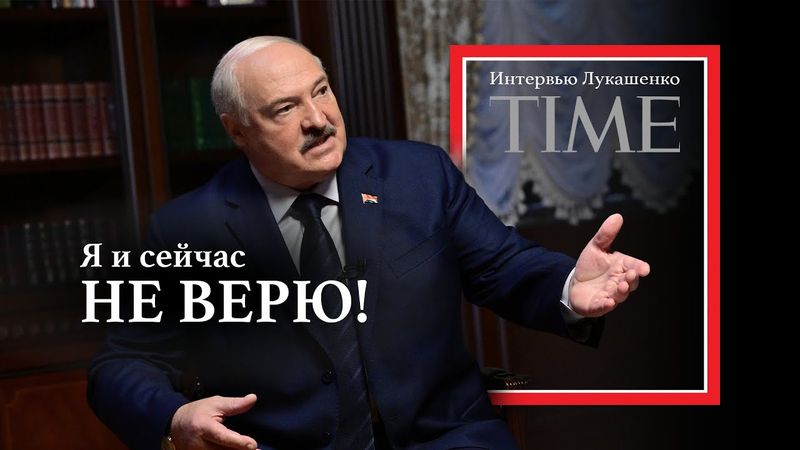
During a comprehensive interview with Belarusian President Alexander Lukashenko, aired by Time, the conversation covers a wide range of geopolitical issues. At 00:00 Lukashenko opens by claiming that diplomats are also CIA agents, while at 01:22 he vows to warn special services about border checks and the Kremlin’s occupation. He explains at 03:24 why Time journalists were invited, and at 04:14 he recounts playing hockey with U.S. ambassadors as a metaphor for deteriorating U.S. relations. At 06:19 he discusses Iran’s stance in the Emirates, sanctions, and a strike‑exchange agreement, and at 08:04 he reveals what he believes Ukrainian forces do not trust. He details at 11:14 what Putin told him when the special military operation began, and at 12:58 what fears Putin had. At 14:36 he explains why Putin did not inform him of the operation in advance, and at 15:36 he accuses Americans of lying. He continues with remarks about a meeting with Turchinov at 18:02, the start of U.S. dialogue at 18:48, and the role of Russian specialists in negotiations with Ukrainians at 21:03. He discusses his decision to engage with Americans at 23:24, the change in tone under Trump at 25:59, and his skepticism about American seriousness at 27:56. He touches on Soros and recruitment at 28:53, the taboo topics politicians avoid at 30:37, and the request for him to pass information to Putin at 31:05. He questions the possibility of talking with Putin at 31:57, praises Putin’s non‑bloodthirsty nature at 35:36, and describes the brutality of the Bucha massacre at 36:52. He comments on Russian reactions to Belarus‑U.S. dialogue at 38:27, his view of Putin’s safety at 40:29, and the potential consequences of crossing the Ukrainian border at 42:01. He warns against Russia and Belarus attacking Ukraine or neighboring countries at 45:35, urges Russia not to interfere in relations at 46:07, and discusses Trump’s need to meet Lukashenko at 48:29. He offers advice to Trump at 49:28, declares himself a Trumpist at 50:31, criticises Biden at 51:17, and addresses opposition at 54:01. He mentions pardons at 55:36, the lack of American requests for Tikhonov’s release at 56:36, the cost of the special military operation at 57:38, and his own view of Afghanistan and the burning of Russians in Ukraine at 59:21. He continues with remarks on Iraq at 1:01:48, Ukraine’s inability to forgive Russia and Belarus at 1:02:21, the impossibility of a Nuremberg‑style trial at 1:04:38, Russia’s lack of mobilisation at 1:05:14, Trump’s underestimation at 1:06:34, and the fate of Ukrainian refugees at 1:08:48. He discusses Putin’s request for Belarusian troops at 1:09:21, the absence of Russian help at 1:11:15, North Korean troops at 1:13:28, the liberation of Kursk at 1:15:08, the price of Belarus to Russia at 1:17:48, the return of nuclear weapons at 1:20:40, the potential damage to Poland, Lithuania, Latvia, and Estonia at 1:22:46, the unwillingness to use nuclear weapons at 1:25:08, his sense of future at 1:26:56, the visit of Xi at 1:29:30, the difference with Zelensky at 1:31:36, the occupation of Ukraine at 1:33:26, the lack of a successor at 1:35:56, his hope for a sane successor at 1:36:57, the possibility of another presidential term at 1:38:48, the payment of migrants in Poland at 1:40:31, the killing of people at 1:42:26, the future border with Ukraine at 1:43:51, Putin’s speed at 1:46:47, the consequences of continued war at 1:47:43, Putin’s desires at 1:50:07, the lack of Russian defeat at 1:53:18, the need to convince him of a non‑spectacle at 1:54:24, the discussion of Zelensky at 1:55:44, the Istanbul negotiations at 1:57:18, the world’s disbelief at 2:00:52, Trump’s personal insult at 2:02:51, the seriousness of the 50‑day dispute at 2:04:07, and the preparation for a meeting at 2:05:07, concluding with a critique of Trump’s talkativeness at 2:09:26.