
ایران در بنبست سیاسی؟ | مناظره صادق زیباکلام و هاشمی گلپایگانی
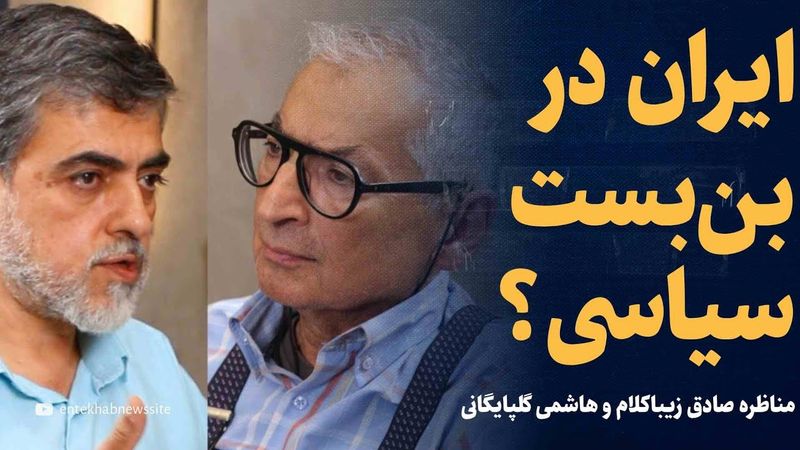
Інформація про завантаження та деталі відео ایران در بنبست سیاسی؟ | مناظره صادق زیباکلام و هاشمی گلپایگانی
Автор:
Entekhab | انتخابДата публікації:
22.10.2025Переглядів:
56.2KОпис:
The debate opens at 00:00 with an overview of Iran’s alleged political stalemate, setting the stage for a discussion on ideology, power structures, and civil society. At 02:42 the speakers note that the war’s immediate concerns—food and safety—overshadowed political debates. By 07:35 they criticize the opposition’s simplistic view of the 12‑day war, and at 10:48 they lament that post‑war optimism failed to materialize. At 12:13 they observe that hard‑line forces were weakened, yet the public retained a sense of stability. The conversation shifts to the term “political stalemate” at 14:25, which the speakers trace back to the Rafsanjani era, and at 16:39 they discuss the emergence of Ahmadinejad from Khatami’s political milieu. At 19:17 they claim that doctors have no control over the situation, while 19:48 highlights that 80 % of respondents feel hopeless. At 22:03 the speakers describe the public’s smile as a blue that does not heat up during elections, and at 23:11 they note that for 46 years the only thing said was death. At 25:52 they argue that when people are deemed unimportant, it signals a stalemate, and at 26:52 they question why reforms seek power under such conditions. The discussion of women’s rights at 28:28 shows how undefined demands arise, and at 30:14 the speakers accuse repeated ideological rhetoric of becoming criminal. The main problem of westernized versus religious thinking surfaces at 33:21, followed by a defense of authoritarianism under the guise of ideology at 33:57. At 38:22 they assert that foreign policy is driven by ideology rather than interests, and at 41:31 the debate centers on the word “West.” At 43:35 they ask whether relations with Iraq can be funded by the U.S., while 44:30 suggests that foreigners might wear ties in the next cabinet. At 44:58 the speakers claim they want to be “sir” rather than “servant.” At 48:37 China’s example shows that the first place is not Libra, and at 49:42 they note that leftist ideologies were once desirable post‑revolution. At 56:04 they accuse the opposition of shouting slogans while taking embassies, and at 56:53 they claim everyone else is an American servant except them. At 57:38 those who took embassies are now reformists, and at 59:21 they question why negotiations between the wolf and the lion end in stalemate. The discussion turns to missile policy at 01:01:49, with Trump’s remark at 01:03:28 urging Sadegh to buy missiles. At 01:06:37 they state they did not abandon America, and at 01:08:47 they criticize the lack of water. At 01:11:03 they ask about drones, while at 01:13:22 they question the relevance of enrichment. At 01:16:06 they claim that pouring water on Israel led to an attack, and at 01:19:43 they discuss the “Libra” as their existence. At 01:23:03 they mention reading the Quran, and at 01:23:59 they emphasize the importance of public sentiment. At 01:27:19 they compare Pakistan’s hope to theirs, and at 01:28:20 they note the revolution’s one side and Raisi’s three years as another. At 01:30:09 they say doctors cannot act, and at 01:31:28 they describe reformists as more reformist. At 01:33:35 they mention Jalili’s package, and at 01:36:43 they say the last nail was hammered. At 01:40:03 they claim the absence of Gheshtarashad means retreat, and at 01:42:50 they argue hijab serves power. At 01:45:10 they say the basis is only Jalili’s votes, while at 01:45:58 they claim democracy cannot rule. At 01:46:56 they state that they have more freedom than the West, and at 01:49:33 they say the West gave them freedom. At 01:51:19 they note Gheshtarashad signed Khatmi, and at 01:53:43 they discuss the hijab as a gate. At 01:56:07 they claim that killing America is a desire for an Iranian platform, and at 01:58:54 they mention separating the carrot. At 01:59:46 they advise learning from Pakistan, and at 02:06:02 they admit problems. At 02:06:34 they warn that excessive falling reveals flawed thinking, and at 02:07:43 they note ideology claims 7 billion people do not understand. At 02:09:29 they say ideology prevents seeing truth, and at 02:09:44 they question whether ideology contradicts science. At 02:12:42 they accuse the opposition of playing games, and at 02:14:20 they claim managers are similar to Japan, indicating stalemate. At 02:16:19 they conclude that money is poured but students become more rude.
Схожі відео: ایران در بن
از اوین و دوربینهای دادگاه تا احمد جنتی و ۱۴ سال ممنوعالتصویری | ناگفته های محمود شهریاری
ناگفتههای معتمد مهندس بازرگان از استعفای او پس از اشغال سفارت آمریکا | نقش دو روحانی مهم و قطبزاده
بخش دوم پسا جنگ
«ممکن است سناریوی عراق را روی ایران پیاده کنند» | گفتگو با غلامرضا حداد
ایران و نگاه به شرق | گفتگو با علی فکری