خشتِ خام ۲۶ | علی فلاحیان و حسین دهباشی | نسخه کامل و بدون سانسور | بخشِ دوم
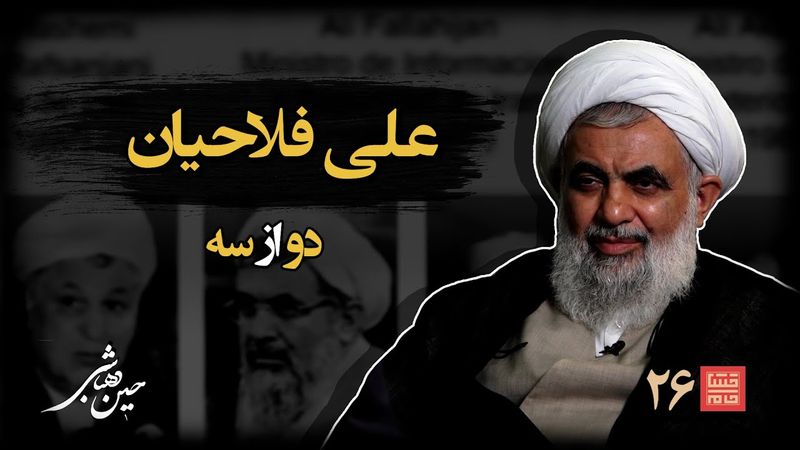
Download information and video details for خشتِ خام ۲۶ | علی فلاحیان و حسین دهباشی | نسخه کامل و بدون سانسور | بخشِ دوم
Uploader:
Tarikh Online | تاریخ آنلاینPublished at:
4/24/2025Views:
19.6KDescription:
Video Transcription
The Islamic Republic was destroyed in the end.
But at the same time, the army entered.
What did you do?
Did you work in intelligence?
Yes, intelligence.
The idea is that the hypocrites enter the regime.
It was their own decision, or they had made a mistake on this side as well.
They were not politically free to come and advertise, but they had necessarily agreed to the culture.
And when it came to their agreement, they said it was up to them.
Rajarit was giving a bribe saying that you should not fight.
Well, we say that they did not accept the end of the message.
No, the message was collected.
I could have done the least terror there.
After two or three years, how did you decide to become a founder?
When there was a sign here in the conversations that I came to the revolution committee because I was the leader of the revolution.
You said Mr. Mahdavi.
Mr. Mahdavi asked me because the government had changed.
At that time, it was discussed that other committees should be gathered.
Ayatollah Mahdavi was against this issue.
There were many various sessions.
What is the challenge of intelligence and what is the challenge of the administrative force?
One idea was that we should organize committees, strengthen them, and form a revolutionary police force.
And the gendarmerie and the municipality should be in this position.
This was the idea.
I came to the committee with this vision.
Of course, it was also the opposition's opinion that the committees should be gathered.
Did any of these opinions break the consensus?
I mean, did the opinion that the committee should be gathered from the clear people break it?
Well, I don't have clear people in my mind now.
But they had pressure that all the administrative bodies, for example, found stability.
The gendarmerie has its own conditions.
There is also a gendarmerie, and this other committee is not necessary, because the first committee that was formed had a lot of institutions in it.
Well, the army was formed from the committee itself.
Or, for example, the support sections and other things were all concentrated in the Revolutionary Committee at the beginning.
There were other security issues, whether it was social security or political security.
After that, it was his opinion and a lot of others that these committees should remain.
When did the committees actually be abolished?
In 1969?
They were not abolished.
They were reprimanded.
Yes, they were reprimanded.
They didn't answer the first question until the next question.
Because of the committees.
It becomes clear, it becomes clear.
Well, now we know what we are saying.
What did we come from?
It was from my opinion.
I was more connected to Mr. Hashemi at that time.
And they said that if this happens, it would be very good.
Some of the children were convinced that if we could create a kind of revolutionary organization, it would be better.
These are the things that now have a mind on them.
We came up with a very big idea to strengthen the committee.
Some of them supported us, of course.
As far as you are concerned, the budget of the committee has increased a lot, right?
Yes, they supported us, because we wanted to take all the steps slowly.
Therefore, I came to say that
Both the work of the gendarmerie and the municipality, I was slowly preparing the committee to take over.
Our first effort was to have an officer.
We established a university for the committee.
Then I know that the gendarmerie
Sherevani had an aircraft unit.
I tried to build an aircraft unit for the comet.
We were in Mars.
One of the important issues that came up at that time was that our Mars was empty.
The gendarmerie was small, but, for example, it was 40 kilometers or 90 kilometers away from the police station.
It was uncontrollable.
Reza was involved in the case of Mersa.
We established a major department that did a great job in its time.
We made ten teams of traffic and police.
In other words, it became a great achievement of the country.
We succeeded there.
At that time, when Mr. Aqebat Rafat, the governor of Istanbul, told me, you have brought me a loader, it is very important here.
Now we have taken about 100 loaders and loaders every night.
We took ten groups and built roadways.
I myself went from Chakhormar to Tis.
It's over, it's over there.
I came to Sarags.
We went to all the parts of Gezik and all the roads here.
And finally we built roadways.
We have made a lot of facilities and we have a lot of control over the eastern border.
But when there was no such thing, there was a sea, so we made some for the protection of the sea.
Why don't you let these facilities be built?
The same gendarmerie has not been renovated yet.
Yes, I told you that a few years ago...
There is an explosion inside the country, in the border that they were there.
The police of the revolution still have that meaning, and our work continues.
There was a gendarmerie, but it didn't have so many opportunities to protect the waters of the sea.
He can't do it now either.
Reza is coming to Qashagha.
He wants a lot of opportunities.
What about the opportunities that were given to them?
We had a lot of opportunities, but we didn't have enough money to give them.
We couldn't work everywhere.
There was a lot of chaos.
When did you go to Jandar?
It didn't happen at that time, because some people say, for example, the first series of anti-terrorist vehicles actually came at that time, or something like that.
Didn't this happen at that time?
Yes, some of the security personnel were involved in the committee.
And it turns out that now it was not the case against Gululey.
But in the time of Ayatollah Mahdavi, a government was passed.
Because we had some ships in Khiabon.
There was a ship called Qa'em 1 and 2.
These were mainly export cars.
Or maybe the cars that had been stolen.
Their weapons were the same.
For example, the weapons that were in the hands of the committee or of the municipality were the same as the ones that were stolen by the hypocrites or others, or they themselves had taken them, they were in their hands.
In fact, they did not have mechanical weapons, they did not have mechanical cars.
It was intended for them to buy 200 cars.
At the time of Ayatollah Mahdavi, this budget was also approved and published.
Are our patrols around the same time or are they after us?
No, they are not at all.
Now the patrol is after them.
I bought the patrol.
It was for the transition of Jondolah, right?
No, now those patrols were for the transition of Komita.
Those cars were bought and the cars that were in the hands of the children, which were stopped,
It was either the foundation, or it was the property of someone, or they stopped it.
Or they took their weapons.
It was not their property.
I was successful at that time.
There was a cult for the commitee.
I was involved in the SIXER cult.
The SIXER was the best German police cult.
They said they wouldn't give it to us, but we took it.
Did you buy it from Germany?
We bought it from Germany, but they didn't give it to us.
We bought it for Portugal, and we took it from there.
Then we bought clothes for them.
Some of them were safe, but we trained one of them, Nasr's footman, there.
Because in the past, the guards were ordinary guards.
No one, for example, had a security period.
They saw security, their cars were fine, their weapons were fine, and they accepted the responsibility.
At that time, we even made a type of Musab al-Jaffar.
Yes, we made it so that the committee would finally open and he would try to be a very strong and powerful boy.
Some of the people who were working in the committee later wrote in their memories, I want to build a black building here so that they can accuse us.
What was the name of the black building?
He wanted to accuse us, but we were in charge, we were not informed.
He had a debt.
His debt was that the man was with his boss.
I couldn't be with him, so he left.
He was very angry with us.
He said, for example, I hurt my foot.
There was something under my foot.
He said, under your foot, for example, in your head.
He didn't tell you his name?
No, he didn't tell me his name, because he was part of the Revolutionary Guards.
I am not used to the Revolutionary Guards.
If they do something bad to me, I will tell them their name.
He said to me, for example, I did not get the right from the committee.
Well, I got the right from Dastetani, my right was half, my right was the same.
Well, I did not leave the car.
The same man, when he wanted to leave, he took a car and left.
Well, but now he took it from us that we are the people of Tashrifat, I did not have a person of Tashrifat.
Then, I would like to tell you that
We had expanded the committee to this extent so that it can be replaced.
In this work that was going on, the issue of the Ministry of Intelligence was brought up.
Did the security agencies come together?
No, the Ministry of Intelligence was brought up and its law was approved.
I don't think so.
The Ministry of Intelligence was actually the Ministry of Defense and the Ministry of Foreign Affairs and the Ministry of Foreign Affairs and the Ministry of Foreign Affairs and the Ministry of Foreign Affairs and the Ministry of Foreign Affairs and the Ministry of Foreign Affairs and the Ministry of Foreign Affairs and the Ministry of Foreign Affairs and the Ministry of Foreign Affairs and the Ministry of Foreign Affairs
At first, I was recommended to be the Minister of Intelligence.
Mr. Mohandas Mousavi was also recommended to you.
Yes, he was recommended.
Where did Mr. Mohandas Mousavi know you?
Well, I used to be the head of the committee.
Did he know your committee?
Yes, he was a member of the party before.
He was a member of the party, so I knew him.
Where did you know the Imam?
Imam?
Well, I went to the bottom of the 10th district in Khanaraniya in 1943.
He was recommended to you by the Ministry of Intelligence.
I don't know how much the imam was involved in this matter.
We were there afterwards, but I don't know the beginning of it.
Then I said that since I was going to return to Qom, and I didn't want to stay, I gave a few suggestions.
I said that they should come, and I will come to help them for a year, and they should be formed.
Then we will go again.
Who was Mr. Rehshahri?
Mr. Rehshahri... Who were the other people?
The people who... Who you recommended?
I recommended Mr. Rehshahri.
There were other people too.
I don't remember.
They told me, they told me like this.
They said, if you agree, you will cooperate.
I said yes.
Then Mr. Rehshahri invited me.
You became the deputy of security.
At the beginning, I became the security assistant of the Ministry of Defense.
At first, it was a council to form a part of me.
And the part that was related to me, which I fell in love with, was that since I was in charge of security, I had to declare for the security of the country.
I said, we are ready to secure security.
And my minister announced, after his representative said, and then the rest of the staff were employed to take charge of all their forces and intelligence capabilities.
I did this.
After we did this,
That's exactly what I wanted to ask.
For example, the Prime Minister did not have any resistance?
But they were a part of the law.
They tried to keep some places for themselves.
For example, the Nakhut Vizier was a follower of this.
Until the end, they also suffered a lot.
For example, they kept the Ghozarname for themselves.
They kept it.
But later they changed it.
Some of the works, some of the works are only related to the south.
Was the Ministry of Foreign Affairs officially under the jurisdiction of the Ministry of Intelligence?
What?
The Ministry of Foreign Affairs was officially under the jurisdiction of the Ministry of Foreign Affairs.
You see, the Ministry of Foreign Affairs has an executive branch, which has an administrative state, which is all under the jurisdiction of the Ministry of Foreign Affairs.
But it has an intelligence branch, which at that time, well, there is also this political intelligence, that is, the Ministry of Foreign Affairs and the Ministry of Foreign Affairs.
And this was actually the Ministry of Foreign Affairs.
And, well, there was a bit of resistance.
Or, for example, all the other offices, in the end, had a series of duties for themselves.
For example, the army, well, it is true that it had an organization in the security department.
But, well, it also had the main parts of intelligence.
It had military intelligence, it had health intelligence, and then
Even regarding these issues, there was a kind of obligation in the law to assign a force to the army.
Maybe most of the forces were assigned to the army.
It was a story, and the story itself could have been a resistance.
We didn't know if we were an officer of the Judiciary Force or if we were independent.
But the Judiciary Force is officially in charge of the crime detection.
If we want to do something, we have to act as an officer.
It was a very difficult job.
But God helped us a lot.
They cooperated.
It was also a difficult job.
But we did it quickly.
After the night, I would go to the falcon with four horses to take a walk and make sure it was safe.
In other words, this part was a bit tongue-tied, but the other parts, such as the selection of forces, were very important, which was done by the rest of my friends.
Did you use the former forces?
No.
Not at all?
Not at all.
Even in the foreign forces?
Some friends said that there are some translators, for example, we do not have a Chinese translator, for example, we had it in the past, which they later secured, but they were in the translation line.
Some say that there are a number of good sources in SABAK.
These sources were discussed, whether they should be discussed or not, because they were not part of SABAK either.
For example, Khabar Chinoi was part of SABAK.
Whether they should be used or not, the ministry itself made sure.
In terms of organizational structure, is it the same as it was in the past or has a new structure been created?
In terms of administrative and organizational structure.
Because later there was a discussion that the organizational structure is similar to the structure of the German East Security Organization of our Ministry of Intelligence, right?
No, in terms of whether there is a ministry or an organization that makes more and more ministries in the east.
For example, what does the Ministry of Intelligence have now?
Of course, some countries, including the east, have an organization.
The organization can be a deputy, for example, the president or deputy, but if it is the ministry, it is the minister.
The body, for example, is not a cabinet.
It is at this level.
The internal structure is almost the same as the general manager, but the styles are different.
Now, for example, in the East, for you to get to know a little bit, you have to understand that taking resources is like creating a network.
But, for example, black or black, for example, mainly takes a single source, an intelligence officer in connection with a source.
It does not network.
For example, from these traditions, we understand that this side is an American spy or a German spy or a Russian spy.
Their traditions are different.
Our tradition was Eastern.
What?
Our tradition was Eastern.
We can't talk about our tradition, but now that your heart is happy, let's say it was Makhloud.
Very well.
Anyway, it seems that there is a tradition that
the establishment of the Islamic Republic of Iran, Mr. Erteshbot Fardous also played a role.
Absolutely.
After the formation of Fardous, there was a discussion that
Let's go to Fardous and get his memories.
It's been a few months since he got his memories.
When did this book come out?
The first book came out.
But it's not like that.
Fardous is right to take the position of Sobhakhud.
But there was a letter for each department and all the departments there.
There was no need for these.
For example, whether we want to use them or not.
Mr. Fallakyan, Fardost was executed in the lower ranks after the revolution.
Why wasn't Fardost executed?
Well, he was dead.
He died in prison.
Well, I guess he was that old.
He didn't get to trial.
He was old, very old.
After all, for example, when the former president was executed, the two former presidents who were executed... Well, the first revolution was something that we wanted to strike a blow, and maybe these people...
it would have been necessary to hit the head of Gunda.
Yes, but after that, if there was an intelligence officer with experience or someone who had intelligence, there was no hurry to execute him.
Yes, Arshavat, you also said one point, if I may say so, that
We had connections with other services such as KGB, German intelligence services, France, Spain and Islamic countries, and we carried out work for world peace and security.
And there were discussions about our approach to the issues that showed us this sense of power.
I didn't understand, how did it work in the field of world peace?
You see, basically, it is the same now.
In the world and always in the same way that initially in global issues, especially security issues, the opinions of intelligence agencies are important for the decision-makers.
For example, if a diplomatic office is active, it does not mean that it is not effective.
However, the presence of intelligence agencies is more reliable and reliable.
The results are not real.
For example, there is a lot of corruption.
But not the intelligence services.
They have a lot of influence in the governments.
So, for example, if the intelligence services of the United States of America,
It means that they are threatening you with this or that country or that disease.
They show this as a serious action.
Do you understand?
Because it is based on hidden sources.
Sources that exist in those countries and have accurate information.
not on the basis of public information, because these are terms that are not related to information.
Therefore, if the intelligence agencies cooperate everywhere, both in relation to drugs, terrorism,
and security issues can be very useful.
Therefore, we decided to cooperate with intelligence services and neighbors.
For example, we had an intelligence exchange with Turkey.
In fact, we had a part in the military called the exchange of information.
Even with Iraq, after the war was over, there was an exchange of information.
We had with Syria, we had with Russia.
I used to go with them.
Then with Germany, with France, we did good things.
But the countries that we didn't give them a way, they were very annoying, they were doing bad things.
The country of choice depends on whether or not someone cooperates.
For example, France and England are almost on the same level in foreign policy with us, but you took the name of France and cooperated with security, but you took the name of England.
Well, one of the common interests of the two countries is that they have services.
They are more like the British than the Americans.
And the French and the Germans are not the same?
Not that they are not the same, but they are a little more independent.
They have other views.
Do you understand?
And now we had this, we expanded it.
In general, we had cooperation with China.
And it was very useful.
Arshabat, as you said before, you allowed us to record a one-minute video of you and you understood that I should ask your other questions.
It is possible that some of the questions that I have asked you here have been answered by mistake and are not relevant to your time.
Therefore, if you allow me, I will answer them, but if it was not relevant to your time, let's move on to it.
Or if you were here, please explain about it.
One of the questions that you asked me in the last few months
After the release of the audio file of Mr. Mahmoud Montazeri and some of the respected men who had gone before him, in fact, more questions were raised.
Was this the point of view of the intelligence ministry to serve our president, to actually deal with the hypocrites in prison?
There were several issues.
First of all, at that time, I was the head of the armed forces organization.
I was more of a leader in the JPA.
I remember at that time, apparently, this issue was at the same time with the operation of Mersad.
Yes.
Or as the hypocrites call it, the sale of Javidan.
I was in Char Zabar, and I was in Kermusha, and I was here.
We have to make some issues in this regard clear.
Because they didn't make it clear.
And well, I can't do all this because there is no one person who can say it in a collective way.
Now I have my own collective.
Now it may be up and down in some places.
Friends, if they want to reform, they can do it.
In relation to the hypocrites and all the groups that are fighting, the order is the order of execution.
Instead of accepting the opinion of others.
Yes.
Imam said that all the narrators have this opinion.
The Quran also says the same thing.
The beginning of the army and the end of it.
Yes, the end of it.
This is a part of it.
At that time, there was a debate.
Mr. Musavi, who was the narrator of the story, said that he did not want a court.
And for this reason, we do not want a court that is fighting with us, which does not mean that we have a court.
There was another claim from Mr. Motelet that now, in any case, I would like to inform you that those who are arrested will be tried.
Now, it was either a matter of caution, or it was their fatwa, or whatever it was.
It was an Islamic mercy.
But Imam Manat Taman insisted that they should be careful not to get into their hands.
If they go, they will kill this person.
This is a must for the Muslim world.
Indeed, Imam Manat Taman always said this, be careful from this side.
Because we are about...
We have to be careful.
How do we have to be careful?
For example, if someone is killed or not killed, it is a suspicion.
That is, they are not killed.
That is, according to the limits, it is a suspicion.
And when it comes to their benefit, they say it is.
I know these people.
They are not allowed to do this.
They are not allowed to do this.
They are not allowed to do this.
They are not allowed to do this.
This was his reign.
Neither before or after the massacre of 1967.
Some of the prisoners were in prison for years.
How were they executed at that time?
I will explain this to you.
So this is a discussion that some say that they were sentenced and sentenced to death.
What happened?
Why were they sentenced to death twice?
So, first of all, it should be in the mind that the sentence is death.
Even if the judge of the city does not give the sentence of death, he is against it.
Because the person is dead.
Or now he is saying, if I am free, what am I going to do?
I will kill.
Well, if a person is arrested,
Is it his command to kill or not to kill?
They say it is his command to kill Even if he did not kill But if he came and surrendered
He may not have killed him.
Allow me to say this, because if I don't say this, it will remain in the minds of people and they will ask the same question.
He says, مَنْ قَبْلَ اَنْ تَغْدَرُواْ عَلَيْهِمْ That is, if he comes to repent before him, he will be sentenced to death and will not be killed.
We had arrested them in prison.
It occurred to us that in order for this organization to be broken in their own minds and in the minds of the society, I myself did the first thing in Kermoush.
We discussed repentance in prison.
And the first trial broke out from Kermoush.
There were high-ranking officers who came to the trial, and they came to the prison and confessed.
After two or three months, the trial broke out.
This path is the wrong path for the hypocrites.
This has a great impact that many come to repent.
And now it was decided to accept it, whether it was a government order or the opinion of the governor of the city.
Not that they are not executed at all.
Now, because they did this service, for example, some of them, despite the fact that their governor was executed, but because they did services, for example,
They gave intelligence assistance, many teams and groups were arrested and it was proved that the less crimes they committed, the less they were reduced.
So let us all remember that Munafiq Muharra was sentenced to death.
This is the fatwa of both Imam and all scholars and Marajah.
One of the Marajah, even Ayatollah Montazeri himself, says that he was also sentenced to death.
What happened in 1967?
In 1967, when the operation of Mersad was carried out, there was a rebellion in the prison.
All the prisons were destroyed.
Yes, all the prisons were destroyed.
The hypocrites understood that the operation was very strange and dangerous in relation to themselves.
Right?
Yes.
The operation of Mersad was very dangerous.
Near Char Zabar, near Hiromusha, they came to Islamabad.
They did a crazy thing.
It was clear that Saddam had told them that it was clear that Mahkoum had been defeated.
But they were shocked and thought that they would come to Tehran the next day.
But you knew that I couldn't come to Tehran.
Well, we were Nizami.
Now, whether Nizami knows or not, it's a war.
Yes, we say that we will take over the whole world.
You are saying that we know.
We say, what do you want to take from it?
So they did this in prison.
There was a discussion about those who were executed and were not executed and those who were executed but were not sentenced to death Why did you keep a group of Imams who were close to him?
Those who are in prison say that if you release me, I will go to prison as soon as I get my hands on you
They didn't talk about it.
They said our war is over with you.
Now those who say these words, those who are on the subject, at least kill them.
It doesn't mean that you have to keep them.
Then again, what did the men do?
I don't know, the same pressure that, sir, now they are in prison, so-and-so, and so-and-so, a group has been decided, and the men tell them that these are, for example, the order of, I don't know, the murderers, they don't know, these have been decided again by a group.
Three people from the ministry, that is, from the people who were judges and came in, and the story of these people will be watched by someone.
If he is forgiven and can not be executed, he cannot be executed.
Well, that was the job of this group.
It was not the job of the executioner.
I mean, it was an obligation to the executioner.
I'm sorry, I don't know if I understood correctly.
It was an obligation to the executioner in general, and this group was responsible for not committing a series of murders.
They were responsible for being careful, that is, to pay attention, to talk to the party, to see if there is or is not Sar-e-Moze.
Sar-e-Moze, they called it Sar-e-Moze.
Why did they call it Sar-e-Moze?
Why did they call it Sar-e-Moze?
Sar-e-Moze was that I accepted the organization,
I don't accept you either, I will be released, and I will fight against you.
Well, this is madness.
Did they do madness?
I said, I took him to the side, in the name of Abu Hussein, who was in a mosque.
It's not madness, 32 people, usually he was killed in the street.
I said to myself, why should I care about the poor people?
Maybe they have nothing to do with the government.
They just thought of killing each other.
They wanted to create chaos.
That's what I understood.
So the point is that some of them were asking what is the reason for being imprisoned.
One side said, for example, I am a Mujahid.
The other side said, I am not a Mujahid, I am not a hypocrite, I am a Mujahid.
The other side said, you are on the subject.
No, these three people have to be very careful with their judgment.
They read the case and talked to the party.
If they were really on the subject, then they had nothing to do with not being on the subject.
Despite the fact that their judgment was executed.
So, in this way, those who had previously repented have not been executed?
No, those who have repented and accepted the sentence, yes.
I mean, they gave this easing and they did not need to give this easing.
But I made it easier.
I was the first person to discuss this issue.
How many people are we talking about?
How many people have been executed?
I don't know exactly how many people have been executed.
If you want to say how many of them have been killed?
They killed 17,000 of us.
They killed 17,000 of us.
I don't know how many of them we killed.
Because they were killed in the streets, they were killed in the operations, they were killed in the prisons.
No, in the prison, for example, our number was also 17,000.
I don't think so.
I mean, they must have asked the whole of Afghanistan.
But how many thousands are there in that number?
I don't know.
Right.
Well, you did a very good job.
In fact, Mr. Raisi, who had a membership in that council, what were the other members of the council?
Because at the end of the last elections, his name was removed.
Yes, God's servant.
He said, I don't give orders, he gave orders to him before.
He didn't want anyone to listen to him.
And I think they are innocent now.
But they were killing people.
It was their order.
They were actually fighting.
If we didn't kill them, there would be no country, no country.
This is not my talk, it is the talk of the Imam, it is the talk of all the greats.
Let me ask you a question, if you don't mind, we will remove it later.
If the members of the munafiq women had not been married before and were married and were killed, would they go to the grave?
As you can see, I am telling you the truth.
They have created an institution in this regard, which is under the compulsion of...
This is the institution of our companions.
I was in the intelligence department.
I had never heard or seen anything like this.
After that, these things came to light.
They are still building a building like this.
Yes.
Haji Ahmad Agha also said in his memoirs that there was a place where they said that they had broken 300 bricks here.
And he said that if you break the bricks, the other side will die from the pain.
And you can't have a life.
In fact, the atmosphere was like this.
At that time, you...
I told him that I was organizing a committee for the revolution police and he told me that you are organizing black organizations.
I told him that you are organizing black organizations and he told me that you are organizing black organizations and he told me that you are organizing black organizations and he told me that you are organizing black organizations and he told me that you are organizing black organizations and he told me that you are organizing black organizations and he told me that you are organizing black organizations and he told me that you are organizing black organizations and he told me that you are organizing black organizations and he told me that you are organizing black organizations and he told me that you are organizing black organizations and he told me that you are organizing black organizations and he told me that you are organizing black organizations and he told me that you are organizing black organizations and he told me that you are organizing black organizations and he told me that you are organizing black organizations and he told me that you are organizing black organizations and he told me that you are organizing black organizations and he told me that you are organizing black organizations and he told me that you are organizing black organizations and
The ruling of the rest, the ruling of the person who is the rest, is the execution.
And the Montezeri people had the same opinion.
So how did they object to this point?
How did they object to the issue of the executions of 1967?
How did they know about this ruling?
How did they understand this story and did they not know about that story?
I would like to say that a discussion that I myself have initially discussed,
It was that if we, after the inauguration, were to be accepted and they came to discuss and expose the nature of the organization, because they have several benefits for us.
One is that they are exposed to the public and their power of attraction goes away.
And then, according to you, they will not find anyone again in history to say that these people did a rightful job Because they are their gods, they come and say these things
These things had an impact.
One of them was in the deportation of the hypocrites.
I mean, we said, at that time, they said, is this deportation or not?
I mean, is there any preparation to cooperate or not?
These things had a lot of impact.
Their information had an impact.
We came here, what did we do?
We came here, now we call it the order of Sanavi.
We gave him the order of Sanavi.
What I am saying is that this is the first sentence.
This is the second sentence.
You understand that these people have not been executed.
Yes.
Where was Mr. Montazeri's involvement?
Mr. Montazeri had another issue for him.
And there was an opinion that these executions will ultimately cause history to criticize us, to criticize Islam.
Therefore, we have to be careful.
It is good that we do not do this so that later the pen falls into the hands of the enemy and does not end us in this way Imam said that you should perform your religious duty and do not wait for the trial of history I just want to ask for my own assurance that all those who were killed were captured with weapons, that is, they did not fight
All of them were armed revolts, but most of them were in teams.
We went there and there were no more than one or two of them.
Or we took them on the ground, for example.
How did they become armed revolts?
They were part of that organization.
So they had to do this on their own?
No.
When someone is a part of an army, for example,
The armed forces are fighting, no matter how armed they are.
Yes, they should have taken a newspaper.
Yes.
They were part of that organization.
They had the readiness for operation.
Now someone might go and buy bread for this team's house today.
Someone might go and find other opportunities.
Or they shouldn't be an operational force, they should be a propaganda force.
Yes, they are part of it.
When one of them is fighting, everyone has something else.
Everyone has nothing.
Right?
They also have to be prepared.
They are not considered prisoners.
No.
Right.
Mr. Falakhan, did you replace Mr. Emami?
No.
He was one of your managers.
My defense was because of him.
He didn't kill himself.
So who killed him?
First they say it was me.
I say it happened to me after a year and a half.
If it was under pressure, in the court, when the sentence was read, I will accept the sentence without defense.
Mr. Montazer, for example, defended a bit.
First he said they were not very good people.
They were part of the freedom movement.
This was also part of their program.
From before.
They had this foreign experience with the Palestinians.
I don't say that our time was not bad, but did the corruption go up or not?
Yes, these are their own interests.
One of the incidents that happened during your time is the incident of the Mikonos restaurant in Germany.
It is a very complicated story.
Similar videos: فلاحیان و حسین
خشتِ خام ۲۶ | علی فلاحیان و حسین دهباشی | نسخه کامل و بدون سانسور | بخشِسوم
خشتِ خام ۲۶ | علی فلاحیان و حسین دهباشی | نسخه کامل و بدون سانسور | بخشِاول
البث المباشرحسينية وموكب ام الحسن عليها السلام - اليلة الثالثة
نفوذ در جمهوری اسلامی! | گفت و گو با فیض الله عرب سرخی و محمد عطریانفر
املي | الملا محمد باقر الخاقاني