700R4 / 4L60E Rotor and Slide Differences
Download information and video details for 700R4 / 4L60E Rotor and Slide Differences
Uploader:
Nick's TransmissionsPublished at:
9/13/2023Views:
1.8KDescription:
Video Transcription
Hey there everyone.
Welcome back to the channel.
Thanks again for watching.
I'm going to do a quick video here on the differences between 700R4 and 4L60E pump kits.
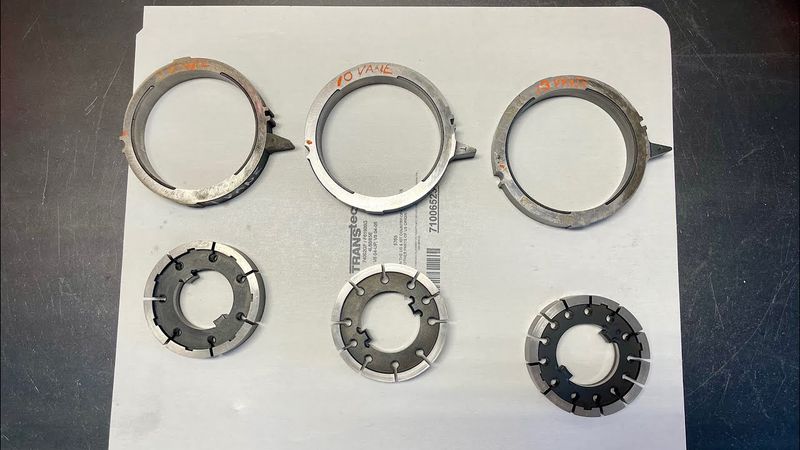
So here we have a combination of rotor slide for a 7-vane, a 10-vane, and a 13-vane pump.
So, telling the difference between the rotors is self-explanatory.
Obviously, the number of slots for vanes indicates what kind of rotor you have.
So, 7 vane obviously has 7 slots and 10 and 13 and so forth.
But what may not be as obvious to the eye is the differences in the slides.
So I'll cover that real quick, and then I'll discuss interchangeability between these three different rotor slide combinations.
So here we have a seven-vane slide.
These were installed in all 704s between 1982 and 1986.
and then they moved to a 10-vane rotor slide combination I believe in 1987 or 1988.
I'm not 100% sure what year that was so I'll annotate once I determine it to be whatever that is to be accurate.
Then in either 1996 or 1997 they moved to a 13-vane slide for the 4L60Es and
The change was primarily to increase fluid pressures at wide open throttle.
With the 10 vanes, you have a little bit more volume.
With the 13 vanes, you have a little bit more pressure.
The 13 vane pumps were also intended to be a little quieter than the 10 vanes.
So when you're driving around in a vehicle, you know, car, truck, SUV, I don't, you know, you're not going to notice a difference.
I mean, maybe you might, but it's highly unlikely.
It's going to be like, you know, something that's going to jump out at you.
But those are the reasons that GM made the changes that they did.
Let me talk a little bit about how you can tell these three slides apart, especially if you need either a used rotor or a good used slide for your pump assembly and you're not sure which slide.
If you're at a parts store or maybe at a junkyard or whatever and a parts bin and this is all you see, then this way you can tell the difference.
If we're looking at the seven vein slide here, notice here, and I'm going to have all these slides with the spring stop at the three o'clock position, and you'll notice here I have a little dot.
In this area of the slide, it is a given thickness.
Take our calipers, and this is a crude way of doing it.
You really want to do this with a micrometer, but, I mean, it's close enough for our purposes.
Okay, so here's the thickness.
Looks like it's 340 thousandths thick in that location.
And you'll notice the ten vein, by eye, it's noticeably thicker.
So in the same area, we're going to measure where the dot is.
You notice it's 438,000, 437,000, somewhere in there.
So by eye, it's noticeably thicker.
And of course, we measured and we determined it to be thicker measurably.
And for our 13-vein, this is going to come in at
410 thousandths thick, 420 thousandths thick, somewhere in there.
So, it's easy to tell the 7-vane slide apart from the 10 and the 13-vane.
Okay, you just look in this area here at the 9 o'clock position with the spring stop at the 3 o'clock position.
And, I mean, just by eye you can tell that it's noticeably thinner if you're looking at a whole bunch of slides from all various years.
The one thing that is relatively common between the 10 and the 13 vein slides are these porting slots right here.
So you'll notice the porting slots on the 10 vein and the 7 vein are going to be largely the same length.
Okay, they're the same length.
I mean I guess I can get out like a protractor and confirm that they're exactly the same length but by eye they're going to be very similar to almost being distinguishable if they are in fact different.
Contrast that with the 13 vane slide and you'll notice the porting slots are much longer.
You see along here.
And the portion where there is free of porting slot cutout is much smaller on the 13-vane slide at the 6 o'clock position than it is on the 10-vane slide.
So here's the 10-vane slide.
You notice the area without any slots is much larger than that of the 13-vane.
Okay, those are the visual differences.
We turn them upside down.
There's no major difference in terms of where the relief cut or the pocket is for your support O-ring and your O-ring cover.
That's all the same.
Same goes for the location for your little Teflon bumper spring.
know square spring back or whatever you want to call it or you know um you know i'll annotate whatever the correct terminology is but
The point is, is that for the most part, these slides are all identical.
You have a little bit thinner webbing here at the nine o'clock position and at the three o'clock position on the seven vein compared to the 10 and the 13 vein on the 10 vein and the seven vein, the porting slots are for the most part, the same length.
However, they're much longer on the 13 vein slide than they are on the previous two.
Okay.
Rotors.
no different in terms of how they're configured on the backside other than the fact that they differ in the number of slots.
They all use rotor guides that are designed specifically for whichever rotor they go to.
Alright, now let's talk about interchangeability.
So you can interchange
a 13-vane kit, which means a rotor and a slide, and retro it back to a 4L60E or 700R4 pump housing that originally took a 10-vane or even a 7-vane rotor slide.
There's some benefits to doing that, especially for the 7-vane.
The benefits to me aren't as clear or as obvious when going from a 10-vane to a 13-vane retroing a 13-vane kit into a 10-vane pump.
It's usually not necessary.
You're not worth the extra added expense of purchasing an additional pump kit and then having the pump housing machine to that when assuming the 10-vane rotor slide combo is fine.
Over the majority of the time, you don't need to do it.
As far as the seven vanes, these rotors are physically the strongest type of rotor you can run.
The more slots you cut into the rotor, obviously, the weaker it is in proportion.
But these rotors, all three of them, generally speaking, will hold up to a lot of RPM.
The main thing you want to make sure is that you
Keep faithful to your clearances that you meet your rotor to pump body deck surface and your slide to pump body deck surface clearance No matter what combination of rotor and slide you're using.
Okay, so you can take a 13 vane rotor And you can stick it in a 10 vane slide in a pump that took originally a 10 vane rotor slide and it'll work fine Okay, and vice versa
And same with the seven vein.
Again, there's no material
adverse impact to swapping rotors amongst slides or entire service packs and retroing back to previous applications or prospectively installing 10 vane rotor slide combos into pumps that took 13 vanes although again that's where you say that why do it right there's no real reason to do it other than if you're in some kind of jam and you know this let's just say i don't know broke
But by some miracle, the working surfaces are perfectly fine, which is very, very, very, very unlikely to be the case.
And this is all you had laying around, then I guess you could do it.
But I mean, again, that's a very, very oddball scenario where the probability of that being the case is near zero.
But you can also purchase billet rotors.
are i guess somewhat controversial i mean i hear accounts of them actually breaking and being more prone to failure than the factory rotors but i've used billet rotors in various high horsepower high rpm race applications and i mean one has yet to come back to me for failure so i don't know um you know it's kind of a judgment call on your part as far as if you want to upgrade the rotor from the factory to the billet
The main thing is clearance.
So for your rotor, you want to be between one and one and a half thousandths clearance between the top of the rotor here and the deck surface of the pump body.
And the slide gets one to two thou clearance top of the slide to the deck surface.
And you measure it just like you see these
rotor slide combos here.
In other words, no support O-ring, no cover, just stick it in there, just like this, and then do your measurements with a straight edge.
I have a separate video that shows you how to do that, so if you're interested, you can check that out.
I think it's like 700R4, 4L60E, measuring clearance for your pumps, or something to that effect.
But anyway, that's a quick video.
I wanted to cover that because, you know, every once in a while I'll get questions about this and sometimes I have questions of my own.
So, you know, I'm doing a course of research.
This is what I found as it relates to both fitment and interchangeability as well as telling them apart.
Anyway, if you have any questions, comments for me, go ahead and leave them below.
If there's anything else you want me to cover in more detail, also feel free to post what that is, and I'll do a separate video on it.
As always, thank you so much for watching.
I appreciate your viewership and your time.
Have a great rest of your day or evening, and we'll see you on the next video.
Similar videos: E Rotor and Slide Differences
700R4 4L60E Sprag Rotation #shorts
How to Buy a 4L60E - Changes and Interchange Rules
700R4 Valve Body Differences, Changes and Updates from 1982 to 1993

RC CRAWLER TOYOTA LC79 MN82 VS TOYOTA LC80 C54 OFF-ROAD 4X4 COMPARATIVA CRAWLER RC
700R4 & 4L60E Low Reverse Air Check and Install Pointers