
Accented Arpeggio Exercise (Villa-Lobos Etude No. 1)
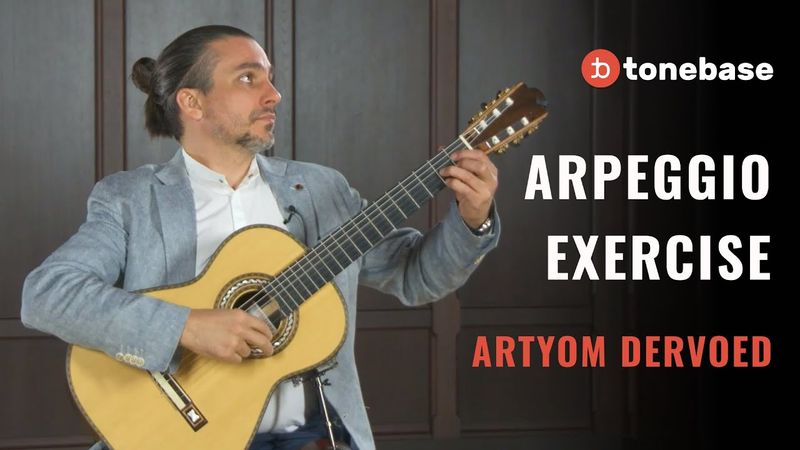
Download information and video details for Accented Arpeggio Exercise (Villa-Lobos Etude No. 1)
Uploader:
tonebase GuitarPublished at:
6/2/2021Views:
19.7KVideo Transcription
Each time the thumb plucks the string, we do an accent.
Arpeggio is really good for the right hand.
And now an example of the first study by Eitor Villalobos.
I'll show you how to learn putting control in each finger of the right hand.
Let's start with the thumb.
So, we take just the first two harmonies from the study.
And each time the thumb plucks a string, we do an accent.
The rest of the fingers are playing really quiet.
We need just to stress all those notes which thumb plucks.
Well, this one is pretty easy.
The next one is the I finger.
This one is most difficult.
so each time i finger plug the note we do an accent and the rest of fingers are playing piano
Of course you can accelerate or play in any comfortable tempo for you, but for the beginning always the good tempo is the slow tempo.
Now we move to M finger.
And another easy part is the A finger.
And in the end we can try to combine.
So we play one round with thumb, one round with I finger, one round with M finger and another one with A finger.
This is it.
And then, when you get used to all these tricky things and accents in the right hand, you can increase the tempo.
So the most important thing is that when we do something fast we don't have any control because we don't have that good connection between our brain and the muscles here and we cannot think that fast.
But using this exercise we can work out
this problem and try to make different accents or microdynamics or whatever we need in music playing in a fast tempo because this for example this first study is pretty fast
Of course we cannot play it without any control even in that fast tempo.
Sometimes we need to stress some of the notes or we want to do it.
Or the second.
Or we want to do the dynamic waves.
Or backwards.
So this exercise trains our brain and right hand to do any of those things without extra effort.
So good luck with practicing and remember that slow tempo is the key to any fast tempo.
Good practicing!
Similar videos: Accented Arpeggio Exercise
5 Classical Guitarists FIX Your Arpeggio Problems

SSG-48 Open Source adaptive gripper
30 Minute Full Body Flexibility Routine V4! (FOLLOW ALONG)
How to Rig: The Head (Harmony)
René Izquierdo: Warming up for Practice, Concerts and Competitions