All 76 weapons at China 2025 military parade explained. 47 are brand new.
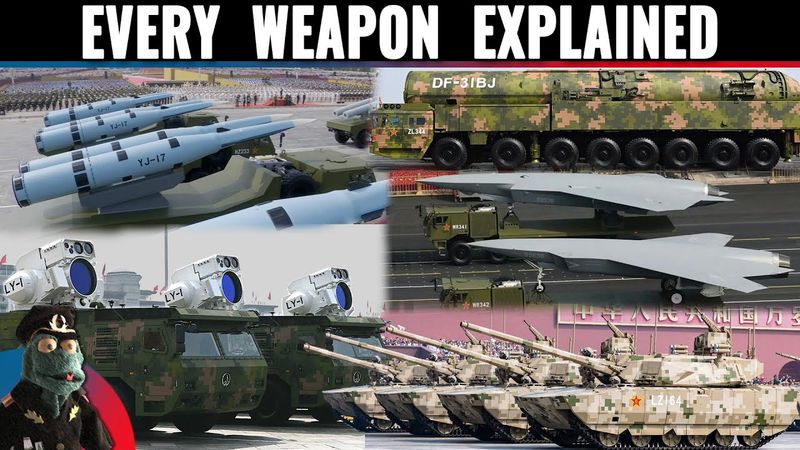
Download information and video details for All 76 weapons at China 2025 military parade explained. 47 are brand new.
Uploader:
Binkov's BattlegroundsPublished at:
9/4/2025Views:
799.2KVideo Transcription
The Chinese military is fairly secretive, so when they do a grand military parade, everyone watches.
And on September 3rd, China decided to send a political message.
This was their biggest parade in recent history and one of the largest modern high-tech weapon displays in the world, with many never-before-seen weapons shown.
The parade included several unmanned fighter jets, unmanned subs, unmanned combat vehicles, hypersonic missiles, new time systems, new tanks and so on.
This video will go over every weapon shown and provide some details on most.
A designation, when it entered service, its possible use case and if the weapon is a big deal, just how big of a deal it is.
Inventory number estimates will also be provided visually when available.
So, buckle up.
First, what this video won't cover.
Various communications, support and logistics vehicles and systems.
Sensor vehicles will seldom be mentioned unless they're a big deal.
Also, we'll skip various historical and infantry units, coupled with their firearms.
There's too much stuff, so something's gotta give.
Parade announcers did say every system shown is in service.
Though in reality, for certain systems like fighter jet drones, that's a stretchy term.
Off we go.
The parade started off with helicopters.
Z-20 is the new standard medium-sized helicopter of the Chinese military, a 10-ton Chinese analog to the US Black Hawk.
Many variants exist like utility, search and rescue, anti-submarine, and so on.
The Z-10 is a medium attack helicopter.
To compare, the US Apache is roughly 50% heavier.
Though smaller, the Z-10 still carries advanced guided missiles and sensors, probably compromising on range and armor.
Next came the Z-19s.
Those are scouting and light attack helicopters.
Usually present in the same units operating the Z-10.
They too carry advanced ATG missiles.
Next came a formation of Z-20T helicopters.
This parade showing is sort of their premiere.
They are a cross between an air assault and air attack helicopter.
retaining troop transport ability while adding missiles and sensors to guide them.
Lastly, three Z-8L large transport helicopters, with the widened fuselage possibly in the 14-15 ton class range.
It's China's biggest helo to date, sort of an analogue to the Augusta Westland 101.
After the helicopters, the ground parade started.
As said, we are skipping to vehicle formations, which started off with the heavy stuff.
Type 99 tanks.
This is apparently a novel B sub variant.
It's China's heaviest tank, probably in the 55 ton range.
Roughly analogous to Russia's most modern T-90 variant.
Then came the brand new Type 100 tank, premiering at the parade.
We just did a detailed video analysis on it.
In short, it probably weighs around 45 tons, it's full of sensors, has an unmanned turret with 105mm gun and a highly armored crew compartment in the hull.
The equally new Type 100 infantry fighting vehicle followed.
Seems to share the same platform with the new tank.
It's likely among the heaviest current IFVs in the world.
It's also full of all-around sensors and, curiously, may lack guided AT missiles.
Next, ZTL-11 assault gun vehicle, used in Chinese wheeled brigades to provide direct fire support with its 105mm gun.
The vehicle is amphibious, based on the ZBL-8 baseline chassis, which was also shown.
ZBL-8 is an amphibious infantry fighting vehicle, though seemingly it got new flotation devices.
ZBL-8s have sometimes been seen in beach landing exercises.
They are one of most produced fighting vehicles China fields.
Then the PLL-9.
It's a compact 122mm howitzer mounted on the ZBL-8 platform, providing indirect fire support to Chinese wheeled brigades.
It's also amphibious.
Next, a trio of new generation airborne assault vehicles.
First, an armored personnel carrier, lightly armed, sporting a pair of missiles, a grenade launcher and a machine gun, but also an active protection system.
Then the next-gen infantry fighting airborne assault vehicle.
It has an unmanned turret APS system, two different guided missile types and a 30mm autocannon.
The third airborne vehicle seems to be a gun mortar for indirect fire support.
That's a class of vehicle Chinese airborne corps didn't use before, and it's the lowest tech vehicle of the three.
But it's apparent China is investing in its airborne assault assets more heavily, replacing a single basic vehicle, the old ZBD-3, which was in turn similar to Soviet BMD-3, with three different new airborne assault vehicles.
Then came the PHL-191, China's heaviest multiple rocket launcher system.
Various loadouts are possible, but the two heaviest ones were shown.
One featured eight 370mm rockets, precision-guided, probably reaching 300 or so kilometers.
That pretty much puts 90% of Taiwan within system's reach from China's mainland.
The other loadout showed two big boxes.
Those hold 750 mm wide ballistic missiles, probably reaching 500 km or more.
Apparently, both an anti-ship and a cheaper ground strike missile is available.
Basically, they are a bit bigger analogs of the US Prism missile.
The PHL-191 is a big deal as it enabled the Chinese rocket force to slowly get rid of its older ballistic missiles and entrusted the army with the short-range ballistic missile barrage mission.
Then Navy's assets followed.
Navy's air defense missile mockups were shown on truck stands.
The first was labeled HHQ-9C.
The regular HQ-9C lacks the booster that this shown naval variant has, possibly pointing to an expanded role.
Given its slim size, it's likely this new missile can be multi-packed in VLS cells on ships.
Next was the HQ-16C.
It should equip Navy's 054A frigates and a few of their older destroyers.
It is roughly analogous to the latest Russian Buk missiles.
Next, a whole missile launcher mockup for HQ-10 missiles was shown on a truck.
Those launchers are designed for ships and usually hold up to 24 HQ-10 missiles.
They're used for close-range self-defense against incoming anti-ship missiles.
Then came a laser system on a large truck, which may help defend naval bases, but apparently the same model has been tested on ships.
The huge lens suggests long-distance focusing, and the large truck power plant may allow for a 60-100 kW laser.
Next came anti-ship missile mockups, most of which have never been seen before.
YJ-15 seems to be a ramjet-powered supersonic missile, compact enough to be fired from tactical aircraft, like the J-15 Flankers, or it might be fired from ships if a rocket booster stage is added.
YJ-19 seems to be a hypersonic cruise missile with a booster, possibly small enough to be used from submarine torpedo tubes, or bomber aircraft.
This is the first time China showed a hypersonic cruise missile, so this is a fairly big deal.
YJ-17 is a hypersonic glider on top of a large booster, yet seemingly compact enough to fit into Chinese universal VLS cells found on most of their destroyers.
China now has several different hypersonic glider models, including dedicated anti-ship variants.
YJ-20 is the only missile that was known from before.
It's a ballistic missile with a large booster, likely again sized for the universal VLS system.
Probably used both for anti-ship and ground strike missions.
Then came new generation lightweight anti-submarine torpedoes on truck stands, possible designation U-12.
Such small torpedoes are used by surface ships, helicopters and planes in their anti-submarine missions.
Next up, a rocket-assisted anti-submarine torpedo, used by ships to quickly airdrop anti-sub torpedoes, usually up to 30 kilometers away.
China has used similar systems for a decade now, but it's unknown if this is some new variant.
Then a heavy torpedo, which should be the U-10, that's a rough analog to the US ADCAP torpedo, to be used from submarines against both ships and enemy subs.
Next, a torpedo-looking system, which is in fact a smart autonomous sea mine, launched from torpedo tubes.
Then some anti-air assets, this time from the Air Force.
We will skip through various new radars for brevity.
First SAM shown was the HQ-11, probably for immediate defense of bases and valuable locations against incoming munitions, like cruise missiles, glide bombs and so on.
It also has an unshown gun component.
HQ-20 hasn't been unveiled before this parade.
It seems to be a medium range system, but not much else is known.
Plausible uses are either an anti-ballistic missile oriented system, like a more specialized Chinese PAK-3 equivalent, or some general purpose SAM, akin to Russian S-350.
HQ-22A was also shown.
The HQ-22 family is a cheap mass-produced medium-range SAM to fill the gaps between more expensive HQ-9s.
Next, HQ-9C launchers.
C denotes a new slim-form missile, probably used alongside bigger HQ-9 missiles.
Similar to how US Patriot units use both Pak-2 and Pak-3 missiles.
Unlike Pak-3, due to its length and single stage, the HQ-9C missile doesn't seem to be optimized for anti-ballistic missile missions.
HQ-19 was next.
That's a dedicated anti-ballistic missile system known for a few years now.
Its missiles are a bit larger than the US THAAD, perhaps closer to what THAAD-ER proposal was.
Basically, it seems designed against medium to intermediate range ballistic missiles.
HQ-29 was also shown.
This is the first time its missile containers have been clearly visible.
The 29 forms the upper part of China's anti-ballistic missile defenses.
Containers seem sized for missiles in between the US GBI and Russian S-500 missiles.
Basically, the HQ-29 is likely to be used against both intermediate-range and intercontinental-range ballistic missiles.
Army air defenses were next.
A Mengshi all-terrain vehicle was shown with a 10-kilowatt laser, probably used against very small drones like FPV drones at short range.
Then Type 625 air defense system was shown.
It serves in medium class brigades as part of the air defense battalions.
Using a 25-millimeter gun and MANPAD missiles, it defends from incoming munitions and unlucky drones and helicopters.
than a system previously known as FK-3000 that seems to be a larger anti-attack drone slash anti-munition system for protection of not-so-mobile assets.
Besides the 30mm gun, it seems to sport possibly as many as 96 small-form SAM missiles.
Next, a larger cousin to the 10kW laser, mounted on a large truck.
From previous manufacturer's materials we know that's a 50kW laser, probably for defense of not very mobile assets against small and medium sized attack drones.
Finally, a system was shown, which is apparently a microwave emitter weapon, basically a short-range anti-drone asset, which can fry multiple targets at once, within a quadrant.
Its parent vehicle again suggests it's not meant to protect maneuvering forces, but less mobile assets.
After some support, jamming and communication units that we will skip for brevity, it was time for unmanned vehicles.
A small tracked unmanned ground combat vehicle was shown, sporting a machine gun and missiles.
It was followed by two separate wheeled unmanned ground combat vehicles, again armed with machine guns and missiles.
Then an unmanned mine clearing vehicle followed.
And finally an unmanned utility slash cargo vehicle with a large quadcopter on top of it.
And paired with a couple of robotic dogs.
Then came unmanned naval vessels.
First a 20 meter long unmanned submarine, fairly wide and probably serving as a proper unmanned submarine for coastal areas.
This was the first time anything of that size and complexity was shown in China.
Then an unmanned slash optionally manned boat, also a premier.
The important part is at the rear where the boat is to hold TOD sensors, plausibly a passive anti-submarine sonar or an active mine hunting sonar.
Finally, a 20 or so meter long unmanned submersible was shown, which does look a lot like the Russian Poseidon nuclear platform, but it is apparently a conventional powered mine laying unmanned submarine.
The last unmanned section featured large unmanned aircraft.
First was the GJ-21, that's a subsonic stealthy ground strike drone.
GJ-11 was shown all the way back in 2019 parade, but this seems to be a slightly different naval variant.
GJ-3 followed, which is a medium-sized recon drone with the ability to carry weapons, similar to the US Reaper.
Then came four completely new, never before seen unmanned fighter jets, or mockups.
They all appear to have stealthy features, with two not featuring tails, possibly pointing to very stealthy airframes.
Most appear to be made for supersonic flight.
Overall, four fighter jets were shown, with one more strike jet making a total of five unmanned combat jets.
But interestingly, during the parade preparations, a few more unmanned fighter jets were shown, but for some reason they were not included in the final parade.
All these drone fighters got to premiere at this parade.
Their size ranges from 10 to 16 meters in length.
And their widely different layouts obviously cover a wide array of missions and use cases.
It's plausible that some, if not most of these are still in the development phase, just like GJ-11 was back in 2019.
Finally, the unmanned aircraft ended with a helicopter, roughly the size of Bell 407, but obviously a dedicated unmanned design.
The shown variant seems to be a navy helo, sporting a variety of sensors for a recon role.
Again skipping the logistics vehicles, Parade's last vehicle formations featured various strategic missiles.
First came the CJ-28 cruise missile mockup.
Said missile is fired from H-6 bombers.
Think of it like a slightly larger Tomahawk missile, but air-launched.
A completely new cruise missile labeled YJ-18C was also shown.
It shows off stealthy shaping and is almost as long as the CJ-20.
It's a heavy missile like USAGM-129, now retired.
Its designation is curious as the rest of the YJ-18 family doesn't look anything like this and is used by the Navy from ships.
Another world premiere was the CJ-1000.
Those are hypersonic cruise missiles, likely similar to but larger than the shown naval hypersonic cruise missile.
CJ-1000 also probably superseded the CJ-100 supersonic cruise missile in production, seen in the 2019 parade.
A ballistic missile mock-up labeled YJ-21 was also shown.
Said missile has been observed on H-6 bombers for a few years now.
Think of it as the Chinese counterpart to the Russian Kenjal.
Then the DF-17, a hypersonic glider missile, first unveiled six years ago, plausibly featuring a range of close to 2,000 miles.
Still probably amongst the hardest to intercept non-ICBM missiles in the world.
Next, the DF-26D, an intermediate range precision ballistic missile.
The D variant is new, though not much else is known.
DF-26 production rate has gone up considerably in recent years, and it's one of China's most important missiles.
than the JL-1 nuclear-tipped ballistic missiles displayed on trucks.
Those are launched by H-6N bombers carrying one missile under the belly.
In theory, due to the in-air refueling, such a missile could be launched thousands of miles away from China and fly a thousand or two miles more.
JL-3 was also shown.
That's the latest generation of submarine launched ICBMs, carrying nuclear warheads.
It is used from Type 094 strategic strike submarines.
Apparently, it features longer range than the JL-2, despite the same size.
It's not confirmed or likely that it holds multiple warheads.
DF-61 came next, a big road launched ICBM, which effectively seems to be a DF-41 variant.
DF-61 is completely new and unknown, while the DF-41 is the mainstay of Chinese strategic strike, featuring very long range and multiple warheads.
Another big surprise is the DF-31BJ, silo-based ICBM.
Despite its name, it's much larger than the other DF-31 missiles and probably close to DF-41 in size.
This was the first time it was shown properly, though it's been serving in China's ICBM silos for a year or two now.
Finally, various components of the massive DF-5C ICBM were also shown, carried on trucks.
The liquid rocket motor stages and the warhead bus stage.
The C is the latest and never before shown variant of the old 1970s design.
DF-5 is still China's biggest and most powerful ICBM.
The C probably holds many warheads while providing the greatest range.
After the ground display, the aerial display continued.
Impressive, but at the same time aircraft in development are hard to hide, so pretty much all were known about from before.
Still, it was an interesting and fairly comprehensive lineup.
A KJ-500A flew, which is among the most modern AWACS-like planes China has in use, and probably among the most capable such platforms in the world.
It's the only Chinese AWACS that can be refueled in air, enabling a few time longer surveillance missions.
Massive numbers of AWACS-like platforms seem central to Chinese air combat doctrine, which was alluded to in the parade as well, because alongside the AWACS-type planes,
several J-16 multirole fighters flew as well.
J-16 is like a very advanced C-30 and probably the most modern flanker variant there is.
It features all sorts of novel Chinese sensors and weapons equally geared towards air combat and ground strike missions.
Next came the KJ-600 carrier-borne AWACS-like plane, basically the Chinese analog to US E-2D Hawkeye.
Such a class of planes should greatly enhance capability of Chinese aircraft carriers, enabling them to see threats hundreds of miles away.
Alongside it, J-15T fighters were shown.
Those feature similar sensors to the J-16, but are designed to be used from aircraft carriers.
The T variant is the most modern, also designed to be launched using carrier catapults, meaning it can also operate from the upcoming Fujian aircraft carrier.
Next came bombers.
NK and J variants of H6, China's only bomber.
K was the first redesigned H6 receiving newer engines.
The H6 airframe is based on the old Tupolev 16, but 70 years later it's been quite a bit modernized.
Think of it as a much smaller B-52.
The K variant is basically a cruise missile and small ballistic missile carrier, though it retains the central bomb bay.
It was also observed carrying anti-ship missiles.
The J variant is a somewhat modernized K variant that initially started off as an anti-ship variant, but is largely similar.
The N variant bomber is the most interesting one.
It has a deleted central bomb bay.
Instead, very large ballistic missiles can be carried there, as well as large recon drone aircraft.
The N variant is the only Chinese bomber that can be refueled in air.
Then came YY-20 refueling aircraft, that is the dedicated tanker variant of the Y-20, using Russian engines.
When the fighter formation, featuring radar and comm sensing pods, and a variety of advanced jamming pods.
Perhaps more interesting is the J-35 following it.
It's a medium-sized fighter, China's second stealth design.
The shown A variant is the Air Force's plane.
It probably mirrors J-20's long-range missile loadout, though without dedicated short-range missile bays and without as much fuel carried.
It's plausibly still in very limited service.
Next came J-20S.
That's a twin-seater J-20, but given that training hundreds of regular J-20 pilots didn't seem to have warranted a training variant, it's likely this S variant serves a different purpose.
Like a command and slash or sensor node for other aircraft information.
Say, unmanned fighters.
A few more J-20s came with it, notably a pair of J-20As.
That is a recently redesigned J-20.
Internally, it likely contains new sensors and electronics.
The service status is currently likely limited, but it's also probably the most lethal fighter China currently has.
The fighter formation display ended with a carrier-borne aircraft.
J-15DH is a J-15 designed for electronic jamming.
Basically a carrier version of J-16D.
It serves on China's two ski-job carriers, as it can't be catapulted.
J-15DT is largely the same but can use catapults.
Then came J-35, that's without the A designation.
Those are carrier-borne variants, ready for catapult operations.
The plane is also a bit redesigned, with larger folding wings.
Again, the type is likely in very limited service.
Important to note is that many, many systems China uses were not shown.
Most of the systems shown seem to be very new, entering service this year, or maybe being just a few years old.
In some instances, it's plausible certain systems are still not in widespread service, like we said, but most seem to be.
In the end, parades like this are political, showing China is only accelerating when it comes to the arms race.
both in quantity of weapons, but also in quality and novel technological approaches.
And remember, Binkov may talk about war, but only real peace can bring us all together.
Similar videos: weapons at China
Fortress Guam: How/Why is US military turning the island into a Pacific bastion
USAF doesn’t want stealthy drones, despite China's stealth fleet. Why?
How come China caught up to US' 6th gen fighter development?

Here’s proof that China is building a nuclear aircraft carrier, as big as US Ford class
Despite Patriots, Ukraine admitted its missile defenses aren’t that good.