
Basic Electricity - What is an amp?
Download information and video details for Basic Electricity - What is an amp?
Uploader:
AfrotechmodsPublished at:
10/24/2011Views:
2.5MDescription:
Video Transcription
This video series is going to be all about the basics of electricity, and I'm going to explain what amps, volts, ohms and watts are.
In this video we're just going to start with amps.
So you probably know that everything around you is made up of tiny particles called atoms.
The simplified model of an atom has a positively charged center called the nucleus and you have negatively charged electrons orbiting around it.
The terms positively charged and negatively charged are arbitrary and the important thing to know is that things with opposite charges attract each other and things with the same charge repel each other.
So the positive nucleus of the atom will attract negative electrons, but if electrons get too close to each other, they'll push each other away.
In most solid materials, the atoms and their electrons just sit there and don't really move around.
But in metals, like copper, the electrons have the ability to move around.
The positive nuclei stay in the same place, preserving the structure of the metal, but the electrons can drift around from atom to atom.
But since the negatively charged electrons repel each other, when you move one electron from atom to atom, you'll also move other electrons from atom to atom.
For example, let's say you have a wire that's only one atom thick.
And just so you know, I'm massively oversimplifying things here by showing you only one electron per atom.
Then let's say that you force the first electron in line to jump to the second atom in line.
The electrons will all push each other around at the same time, kind of like a conga line.
Even though each electron is only jumping a tiny, tiny distance, this overall flow happens close to the speed of light.
And that's basically what the flow of electricity is.
When electrons are flowing through something, you can say that electric current is flowing.
Now how do we measure electric current?
Well, you've probably heard of the term amp, which is short for ampere.
An ampere refers to the amount of electrons that are flowing per second through something that conducts electricity.
1 ampere is equivalent to 6.24 times 10 to the power of 18 electrons flowing per second.
You don't really need to memorize that number, but you should understand that electrical current refers to the amount of electron flow, and that 1 amp means that a lot of electrons are flowing.
And obviously 2 amps means that twice the electrons are flowing.
And if you want, you can use the analogy of the amount of water flowing through a pipe.
Okay, just so you have a frame of reference, here are a few examples of different currents you might encounter in your day-to-day life.
Alright, now's the perfect time to talk about electric circuits.
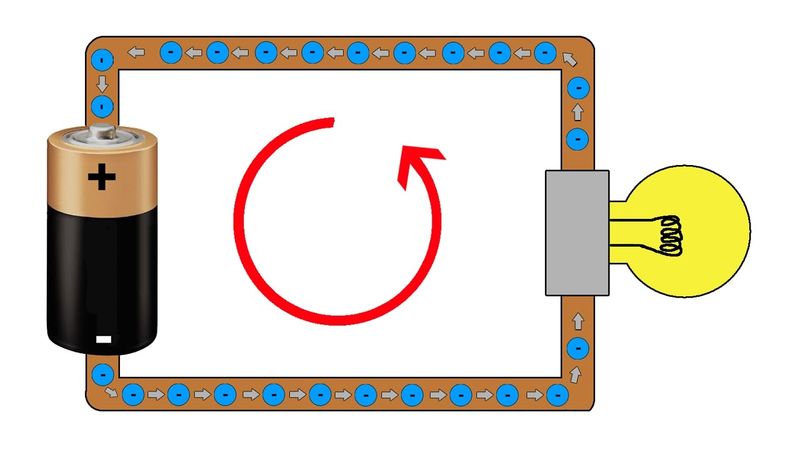
An electric circuit is a closed loop where current can flow around.
In this example of a flashlight, electrons can flow from the battery, through the copper wire, through the light and through another piece of wire to the other side of the battery.
Now remember, when current is flowing here, all the electrons are moving at the same time.
Over here, the negative terminal of the battery is pushing the negative electrons away, and those electrons are pushing other electrons away.
And this keeps happening throughout the circuit, allowing energy to be transferred from the battery to the light.
But if you were to cut one of the wires here, you would no longer have a complete circuit.
The electrons can't just jump through the air from one wire to another.
So if electrons can't push each other around in a complete loop, no current can flow.
When there's no current flowing, there can't be any transfer of energy, so the light stays off.
And this is how electric switches work.
The switch has two pieces of metal inside it and when the pieces of metal touch you get a complete circuit and the light turns on.
When the pieces of metal are pulled apart it becomes an open circuit and the light turns off.
And this is also how fuses work.
Right now I have 5 amps flowing through this fuse which is rated for 15 amps.
But when I suddenly draw 30 amps, the fuse melts, opens the circuit, and prevents any current from flowing until the fuse is replaced.
Very handy for when you don't want to die in a terrible fire.
Now there's one more tricky thing about electric current that most people don't know.
There are actually two naming systems for electric current.
One is called conventional current and the other is called electron flow.
You may have heard that current flows from positive to negative, so you might imagine that with this circuit, current is flowing from the positive side of the battery towards the negative side of the battery.
This system of current flowing from positive to negative is what all electrical engineers use, and it's called conventional current.
However, conventional current is wrong!
Back in the early days when scientists were still figuring out the basics of electricity, they didn't know whether it was the protons or the electrons that were flowing.
They made a guess and thought that current flowed from positive to negative, but the reality is that the actual flow of electrons goes from negative to positive.
Unfortunately, every single formula that we use in electronics is based around the mistake of assuming that current flows from positive to negative.
The good news is that the formulas are consistent and whenever we do any math in electrical engineering we use this system of conventional current and it works.
So you can just pretend that electrons are moving from positive to negative even though that's backwards to reality.
Alright, so amps are easy to understand, it's just the flow of electrons.
In my next video I'm going to explain what voltage is.
Similar videos: Basic Electricity

🔌 Basic Electricity - What is voltage?

Лекция 010-1. Элементы электрических цепей и их свойства
650$ за работу. #электрик #electrician #diy

Лекция 020-6. Мощность в цепях постоянного тока. Баланс мощности

Precyzyjne wykonanie otworów na puszki elektryczne w glazurze