
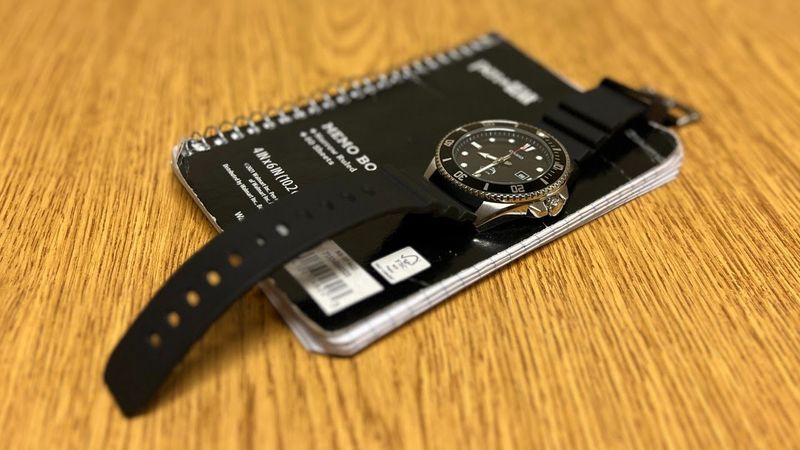
change habits with a watch and a notebook
Download information and video details for change habits with a watch and a notebook
Uploader:
KT on TrackPublished at:
11/17/2024Views:
851.7KDescription:
Video Transcription
I never considered myself a watch guy.
I always thought that they looked weird and that they felt uncomfortable in my wrist.
That was until my cousin gave me an old beater Casio digital watch of his.
It was nothing special and already had a ton of scratches, but he told me to give it a shot.
It took a little while to get used to the feeling of it, but after a week, it felt weird to not be wearing it.
I surmised that I had been avoiding watches not because I was actually naturally averse to them, but because I was worried about damaging them.
That day was over five years ago.
The advice that I'd give you is to not spend more than $50 on your first watch.
There's a ton of different options you could choose from, but my personal recommendations in three pretty affordable price tiers would be the Casio F91W, which is only $15 to $20.
You can get these at Walmart.
Timex Expedition, you can get those at Walmart too.
And slash or a Casio Duro, which is a really cult classic dive watch you can get for $50.
Maybe a square G-Shock.
It's outside the price range by about $5, but I can't help myself.
It's so good.
I wore this watch daily for three years.
Now, aside from the point, you don't have to find watches interesting to get use out of one is what I'm going to try to get at here.
I'm going to explain to you why.
Just find one that you like, one that you like wearing, one that you think you would actually put on.
Right now, I only have three watches, with the most expensive one being that $55 square G-Shock.
and that's after over three years of wearing it.
So why am I telling you about watches?
Well, see, an interesting thing happened to me when I started wearing a watch.
I noticed how long it took me to do things, how much time I wasted.
I started to know when I was running late and when I was using my time effectively.
See, unlike your phone, you can't ignore your watch.
It is always in the peripheral of your vision, edging you on to be present in your situation.
They also have useful features like stopwatches on timers on some digital watches or you can get more expensive analog chronographs if that's your thing.
Again, getting off topic here, but they just force you to be more aware of yourself and how you use your time throughout the day.
My recommendation would be to get a watch and wear it for a month.
See how you feel.
See if any of your habits start to change.
You will naturally start to notice what things work and what things don't for you and your productivity.
Once this happens, you're ready for stage two, the notebook.
Like the watch, it doesn't have to be anything special.
In fact, it really shouldn't because it's going to get beat up.
You can get these particular notebooks from Walmart for just under $2, and trust me, it's money well spent.
I use my notebook to plan out my day, every day, minute by minute.
This can sound daunting at first, but again, this is something that will be habit after a week.
Doing this every night before bed was the best thing I could have ever done to assist me in time management.
In the beginning,
It's easy to try and budget small intervals of time for things in the effort to squeeze as much into one day.
A great quote that I heard once was, you overestimate what you can get done in a day, but underestimate what you can get done in a year.
And the notebook makes that really clear.
Because when you start to break it down into time intervals, you can't do a lot in the 16 or 18 waking hours that you spend.
Preferably 16, you know, because getting eight hours of sleep is good, but...
Over time, if you have efficient time management, you will get a lot done.
What I've learned is to give myself five to 10 minutes more for each thing than I think will be enough.
By doing this one simple thing, by thinking through and organizing your day the night before, you will save yourself so much time and headache in planning out your schedule.
That time can be used for doing stuff that you actually like to do.
And perhaps more importantly, it will help you get everything done when you have a packed day instead of stressing out getting to the next thing.
But the notebook does more than just act as a planner.
It also acts as a journal.
When you have something on your mind, even if it's superficial, you can write about it in your notebook and put your thoughts into words instead of mulling them over, distracting you from other things you have to do.
Getting a watch and a notebook isn't going to solve all your problems.
I can't promise you that in exactly one month you will have a multi-million dollar company and be the happiest person on earth because of doing these things.
What I can tell you is that I use them every day and they alleviate a lot of stress for me and I hope they can do the same for you.
They are little things that are not difficult to incorporate into your day-to-day life and over time the habits they build can lead to some very noticeable changes.
If you liked this video, please subscribe so I can know if I should make more like it.
Thanks for watching.
Similar videos: change habits with a watch and a notebook

КАК НЕ ПРО*** СВОЮ ЖИЗНЬ? МЕНЯЮ ЖИЗНЬ ЗА 30 ДНЕЙ | Мотивационное Видео

Люди помогите: поведение Волочковой удивило всех
Занятие №2 Схема-терапия с Максимом Милославским

#юмор #шуточное #прикол

Всего 95 минут коротких видео в день — и мозг начинает меняться
