
Death Stranding 2: On the Beach Review
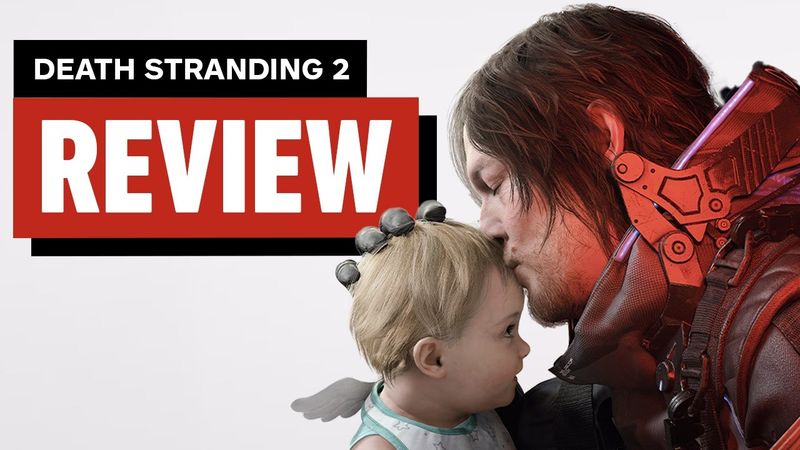
Download information and video details for Death Stranding 2: On the Beach Review
Uploader:
IGNPublished at:
6/23/2025Views:
3KDescription:
Video Transcription
Platypus Seaman A talking crash test dummy A puppet soaking in a hot spring This ugly bastard Norman Reedus' nips No, these aren't straitjacket blabberings due to another vicious bout of temporary madness.
Instead, they're just 10% of the bizarre things I've seen in Death Stranding 2 on the beach.
But it would be far too easy to dismiss Hideo Kojima's works as acts of weirdness alone.
I think we should encourage such wild creativity, and be excited that someone is willing to show us things we'd never even thought of seeing.
When viewed this way, Death Stranding 2 stands as an almighty achievement.
A triumphant combination of complex sci-fi storytelling and thrillingly evolved stealth action that impressively builds upon the experimental foundation of its predecessor.
It's beautiful, horrific, nuanced, and crucially, a lot of fun.
Simply put, it's everything I wanted Death Stranding to be.
The rhythm of Death Stranding 2 will be familiar to those who played the original.
Redus is back as sample to Bridges, once again on a mission to make deliveries across treacherous terrain, often facing human and otherworldly threats along the path.
It requires you to be prepared for what faces you on each mission by studying your map and packing accordingly.
See a river too deep to walk through in your way?
Bring a ladder or two along to cross with it.
Spot a warning that BTs, the ghostly threats that stalk certain rainy spots, lurk in that area.
Pack a few blood grenades to lob at them.
It's this loop of preparation, overcoming both geographical and human-slash-former-human hurdles, and reaching your goal that makes up much of Death Stranding 2's 35-hour runtime when mainlining its story missions.
After a brief tutorial chapter in Mexico, Sam is given the goal of connecting Australia to the chiral network, the online system knitting civilization together after a near-world-ending event, much like he did with the USA in the original.
Why is he doing that, and who is he doing that for?
You'll just have to find out yourself.
From halfway around the world, how are we supposed to do that again?
This new continent offers a far greater variety of locations, as it shifts in its appearance and the challenge it presents with regularity.
It further adds to the feeling of combating nature with this future tech, as the Earth itself seems to be fighting back against its increasingly digital future.
Should we have connected?
It's a resounding no, it seems, from Mother Nature.
What in the world?
The dangerous desert expanses of the Road Warrior are no doubt an inspiration, and the guest appearance of Mad Max's creator George Miller is more than a mere coincidence.
These are not just cinematic influences for the sake of it, as they inform and instruct Kojima's approach to gameplay too, and are reflected in an altogether more action-heavy evolution of the original Death Stranding's template.
What initially presents itself as a pretty rudimentary style of stealth gameplay, mainly consisting of crouching in tall grass and performing silent takedowns, rapidly reveals its layers as your arsenal grows.
For example, there's the introduction of a game-changing tranquilizer sniper rifle, which is something I found super satisfying to pick bandits off with.
It may never truly become the stealth action playground of creativity that Metal Gear Solid V The Phantom Pain is, but it frequently evokes that same feeling in brief moments, delighting me each time it does.
Death Stranding 2 offers a lot more flexibility in your approach compared to the original Death Stranding, making its combat much more engaging as a result, and you'll need to become accustomed to a variety of approaches as well, because there's no avoiding confrontation and the many forms it takes this time around.
Enemies develop as you progress, and knowing which are armoured, which have higher mobility, and what ammo type they're vulnerable to adds variables to each encounter, meaning you can't always rely on the same rinse and repeat tactics.
That being said, if you're a decent enough shot with a sniper rifle, you can clear out most bases before enemies have time to reach you.
Crucially though, it's just as fun when it goes wrong as when it goes right.
There's a satisfaction in a perfectly planned attack going smoothly as you pick off each guard with a Trank Dart, but a thrill when one shot goes awry and you're made to scramble, juggling your arsenal as enemies descend upon your position.
Shooting the driver of an onrushing vehicle before stealing it to run over his friend is always fun.
as is dancing around them in a machine gun-turreted off-roader of your own design.
Overall, there's a playfulness in Death Stranding 2's approach to combat that just wasn't present in the original's simpler, less imaginative system.
It brings a dash of power fantasy to the mix, adding to the fun and making it a wholly more enjoyable game to play.
Enemy AI may still not be the sharpest, but it does enable some of that playing with your feud energy that's always welcome.
I played on normal difficulty and never really found any fighter challenge, until things cranked up a little towards the end.
This lack of friction is deliberate though, with the increased toolset including many different gun and grenade types of varying loudness, allowing you to get through its story at a good pace.
In fact, even boss battles can be skipped entirely if that particular challenge isn't what you're here for.
This isn't something I'd recommend though, as they offer some of the most striking spectacles Death Stranding 2 has to offer.
A giant tentacle mech is an early favourite, but there are many more monstrosities following later that I'll keep hidden here.
Your action chops are also firmly put to the test in the sections that have you face off against newcomer Neil, played with a subtle intensity by Italian actor Luca Marinelli.
They're particularly stunning stages full of flame and beauty that made me feel I was briefly taken away to a different game.
But those lashings of cinematic style are painted across each encounter, and the many, many cutscenes that bookend them.
Having time slow down after dispatching an enemy is not only very helpful when faced with multiple threats,
but adds a slick layer of style to each gunfight.
No aspect of Death Stranding 2 is left untouched by its blockbuster aspirations.
But as both elements and entities fight against you with more vigour this time around, you're in turn given new abilities to combat them with.
Unlike the first game's relatively barebones character progression, now skill points can be used to unlock fresh tools and boost your stat sheet.
Death Stranding 2 is by no means an RPG, but it does offer greater and much appreciated variety when it comes to building out how you want your Sam to play.
Want to be sneaky Sam?
Invest in the ability to cover your tracks by scrubbing out your footprints.
Want to be shooty Sam?
a heavier punch.
You'll ultimately be treading the same set of missions as every other player, but the ways you can choose to approach each one are far more varied this time around.
These perks can also be freely plugged in and out, reminiscent of how Nier Automata's fantastic chip system functions, and offers great flexibility, further enhancing your freedom when preparing for specific types of missions.
Upgrades get unlocked in accordance with how you've been playing.
For example, if you take a combat-heavy approach, you'll be rewarded with new skills like a semi-automated lock-on ability for your guns.
It's a nice touch that further makes Death Stranding 2 feel like an experience that is in step with you, and another indication of its formerly rough edges being sanded down for a much more enjoyable time.
On top of perks, there is also no shortage of gadgetry and weaponry available to Sam.
Completing side missions and increasing your star ranking with each of the outposts dotted around the map unlocks these options at a consistently good rhythm, as well as some that open up when you complete certain story events.
The tools get weird and wild too, coming at such irregularity that you'll be moving on from one shiny tool of destruction or subterfuge to the next with each mission.
But it isn't just in combat that these accessories have their uses either.
Because no matter how much Death Stranding 2 has cranked up the action this time around, it is still fundamentally about porting cargo from one location to another across Australia.
That vast expanse naturally leads to new delivery systems.
Yes, turns out there really is nothing on Earth like a genuine bonafide electrified six-car monorail.
This new structure is a godsend when it comes to a handful of missions that require shipping hundreds of kilos of chemical materials over a rocky coastline, but it does require quite the combined construction job between you and the online community.
That being said, I did settle on traveling on foot as little as possible quite quickly.
On the Beach is very kind in the way that it gives you a vehicle very early on this time around.
especially when compared to the many hours it took to fire up an engine in the original.
The missions themselves are incredibly Moorish, with that just one more job itch that I always had to scratch.
There's a great sense of forward momentum which aids this sensation hugely, with backtracking thankfully a rarity in the sequel.
Varied mission conditions also keep things fresh.
These range from having to complete orders within a set time limit, or being extra careful with fragile cargo.
Again, these parameters force you to adjust how you prepare for each mission, and ensure you can't just use the same toolset and methods on every run.
It's this consistent drive along a drip-feed of new equipment that makes the whole experience more rewarding.
The overall structure of Death Stranding's 2 campaign is leaps and bounds above what came before, and whether it's unleashing bullets into a teleporting mech or gently navigating a river, it all feels intertwined beautifully and serves the complex sci-fi story it aims to tell to fantastic effect.
I guess I'm homeward bound.
Missing little Lou that badly?
Set 11 months after the events of the original, On The Beach's twisting tale begins with Sam attempting to settle into a quiet life off the grid with baby Lou.
Where it goes from there, I won't even dare to spoil, but I guarantee you won't see even half of its reveals coming.
I can say, though, that there's an ongoing trend of viscosity throughout.
Tar, sludge, oil, blood, you'll wade through it all.
But it's also thick with intrigue,
as the secrets continue to be uncovered in a flurry of ideas so dense I struggle to point to its like elsewhere.
The themes it tackles are multifold.
Some focus on a more personal level and others are global.
The latter is a treatise on modern life and how technology infests every part of it.
It's a strong story of how increased existence in the digital world eats away at our souls as humans, as physical interactions, especially in a post-COVID environment, became all the more precious.
I can't help but feel that Kojima is bristling with thoughts about how art and individual expression can never be replaced by artificial intelligence, no matter how it's forced upon us.
And then there's the commentary on gun culture and our world's obsession with building bigger and better weapons.
These are of course themes Kojima has been writing about for decades now, all the way back to the original Metal Gear Solid in 1998, but still remain frustratingly topical and worthy of continued commentary on in a modern context.
It's a credit to the storytelling that all of these concepts shine through, without getting too bogged down or obscured by the sci-fi trappings they could so easily sink into.
But Death Stranding 2 doesn't only look outwards.
It's as introspective as any of Kojima's work to date.
Metal Gear Solid always looked at geopolitical and nuclear issues on a wide scale, and the original Death Stranding challenged our ability to connect as humans in a digital age.
But On the Beach asks questions about the issues posed in that original text.
It's self-analytical, but rarely gazes at its navel, delivering a knockout story that works on so many levels.
The theme of connectivity fittingly weaves each disparate part together by exploring not only how we connect to each other, but with our own pasts as well, what we choose to hold onto, and what we choose to let go.
I don't think it's any coincidence that Neil resembles Solid Snake, a character whom Kojima has had to make peace with cutting ties with ever since his departure from Konami a decade ago.
Death Stranding 2 almost feels like a funeral for his beloved bandana operative.
Norman Reedus continues his stoic portrayal of Sam Porter Bridges, and anchors the story with a calm, centered approach.
I do find Sam a fairly impenetrable character to connect with on an emotional level though, as he again serves as a vehicle for the story rather than the personal heart of it.
He is given more range to work in this time around,
but is not too high, not too low performance, once again allows for the supporting cast to shine.
Lea Seydoux beguiles as fragile, a layered character that the French actress elevates even further.
Elle Fanning is fantastic as the enigmatic tomorrow, and the mysterious Red Samurai is dripping with cool.
It's the kind of sleek style we've come to expect from artist Yoji Shinkawa,
ever since Cyborg Ninja first dashed onto the screen in 1998.
He's a master character designer on top of his game, and Death Stranding 2 really gives him the opportunity to cook again and again.
I also have a soft spot for the aforementioned Doleman, who makes the journey a little less lonely by accompanying you at all times on your utility belt.
He's effectively a version of God of War's Mimir, but instead of funny retellings of myths and legend, we're treated to high school level interpretations of the themes of Moby Dick, and occasionally telling you that you stink.
The standout performer this time around though has to be Troy Baker's return as Higgs, who pretty much steals every scene he enters.
He's been given license to bring an even more operatic edge to the character this time around, complete with a chilling mask and crimson electric guitar to match.
A ready Van Halen, if you will.
It's a big role in every way, and matches the grandeur of the story being told.
But in truth, there's not a single poor performance to be found within the cast, each being given moments to shine in both loud and quiet pockets.
For as much cargo as there is being logged around this world, it's the emotional baggage of the characters that weighs the heaviest, and that pressure builds and builds until its jaw-dropping final few hours, of which I can safely say I've never seen anything quite like before.
While I love how it ends, I do wish it started a little thicker and faster.
It's so full of mystery that going a couple of hours of deliveries before finding out the next big nugget of the main plot can feel a little agonizing.
Multiple hours can go by without seeing key characters, and there are a handful of instances when your home-based ship is grounded and you need to complete some deliveries before it can get on the move again.
These do hinder momentum at times, but never bring things completely to a halt.
Those parts are quickly forgotten though, because On The Beach does go to some legitimately batshit places, as well as some classic Kojima fourth wall breaking antics, and I frankly couldn't get enough of that.
It's willingness to show us things we simply haven't seen before is something I appreciate so much, because when big creative swings are taken with a budget of equal magnitude behind them, there's nothing else that quite hits the same when they land.
The original Death Stranding held promise, a complex, often confusing but never contrived first draft.
A reflective journey across a lost America, it established a world and its rules with a flourish, even if I found it stumbled along the path.
But in Death Stranding 2 On The Beach, Australia plays host to an expanded vision and is a more accomplished achievement in nearly every facet.
It removes almost all of the friction that weighed down its rookie effort, delighting with a truly unpredictable story full of intrigue and malleable stealth-action playgrounds hidden in a vast, hauntingly beautiful version of Australia.
Yes, at times it is unapologetically weird, but that isn't what defines it.
It's an inventive journey packed full of both shock and awe, the sort of bold work that deserves to be encouraged.
No, it isn't perfect, but it's incredibly exciting and original.
never once straying from the path less trodden, and I love it all the more for it.
Executive Reviews Editor Tom Marks here with Simon Cartier, a reviewer of Death Stranding 2 on the beach, to talk a little bit more about his tastes in the genre and Kojima games in general.
Why he wanted to review this one, all that stuff.
Simon, you've probably seen on IGN before, he reviewed Astro Bot, Spider-Man 2, God of War Ragnarok, also shooters like Overwatch 2, Marvel Rivals.
You've reviewed at least two Call of Duty single-player campaigns, I think, in there.
But let's talk about Death Stranding specifically.
What drew you to this one?
Why did you want to review the sequel here?
Because you didn't review the original, that was Tristan Ogilvie, but had similar-ish thoughts, kind of roughly in line with what his review of that was.
Yeah, I didn't.
Yeah, I kind of felt similarly to Tristan about Death Stranding 1.
I may be slightly more positive about Death Stranding 1 than Tristan, but I wouldn't say by a whole bunch.
I think there's a lot of great ideas, and I was into the world and the story of the original Death Stranding, and that's kind of what...
drew me to Death Stranding 2 like every trailer that released of Death Stranding 2 like I started off thinking oh I don't know if I'm ready to go back into this world again but like every trailer that released I was like hmm maybe I'm more and more excited for Death Stranding 2 and it got to the point where I don't know a month ago the most recent trailer I was like do you know what I really I want to get my teeth back into this and it was that promise I think of the original game and there was the real rough draft of a great first game in that first one for me and
that hope that the second one would be able to do it, and I'm very grateful they did, really.
In interviews leading up to this, Kojima has even himself said, you know, he's almost disappointed by this idea that this one was testing better, that it was, people were thinking of it as more of a, you know, this is harsh, but like functional, normal style game, whereas the first one was a little bit more experimental and different, and
What do you make of that?
Do you think there is something that has been lost there?
Do you think he's overreacting?
I think he's overreacting because I feel like, yeah, if you really didn't get along with the first Death Stranding, I don't think this does enough new things or makes it a completely different game to the point where you're going to go, oh, this is, you know, it is making it more welcoming.
to newcomers and people who already did this first time like it doesn't spend 10 hours teaching you how to deliver one parcel again you know it gets you straight back into it and like gives you an assault rifle and a bike pretty much in the first hour and says right kind of do your own thing it is kind of more and i do allude to it a bit in my review there is a bit of you know i don't want to go over the top of it but there is a bit of the phantom pain in there there is a bit of that sandbox nature and that bit of like do it how you want to nature which i feel like kind of
was lost in the first one I feel like there was maybe ambitions in Death Stranding 1 for it to be a bit more do it how you want but ultimately there kind of was just a few paths you should have taken but I feel like this has done pretty much everything it should of in terms of making a sequel to the original this isn't Metal Gear it is not trying to be Metal Gear it is its own thing it's a very different thing but
On the Beach is a lot more of a stealth action game.
And so let's talk about your tastes there, right?
What do you like about stealth action games?
What do you think makes them tick?
What stood out to you about The Phantom Pain that makes it a game you still sort of reference back to?
I think it's the malleability of stealth action games I love the most.
It's those moments.
Because I love stealth action games.
I would never say I'm the best at them.
So I kind of love when a stealth action game still lets you go and keep going and do your own thing once you inevitably get caught and kind of get back into stealth if you need to.
So Phantom Pain is obviously a great example of that.
I also think...
For as much as The Last of Us 2 gets its plaudits in a lot of areas, I think it's actually a fantastic stealth action game.
I think the actual gameplay mechanics of that game are brilliant and the way you can get in and out of stealth.
I also look at something like Dishonored 2 is one of my favorite games ever.
Just again, the malleability, the different ways you can approach every situation.
This, you know, like we said, Death Stranding 2 isn't quite on the level of those games as a pure stealth action game.
It is kind of, you know, 70%, you know, Snow Runner or Mud Runner with 30% of the Phantom Pain in there.
But it's those flashes of it that I was getting where, you know, I was throwing my little doll man into the air and using him as like an eagle in the sky and then getting a sniper rifle and picking people off and then getting into some grass.
It's kind of...
I liked that, you know, you could look at any sort of enemy in Camden and go, right, there are literally 20 different ways I could approach this.
And that's what I loved about it.
And normally it would go wrong and I'd have to get in a big truck and mow people down.
But yeah, that's what I'm into.
So speaking of Kojima and Metal Gear specifically, do you have sort of a favorite amongst those games or a favorite, you know, top two, three, maybe?
It's always one and three in my mind.
Those are the ones I feel like three.
I was at the perfect age when it came out to be like fully obsessed of it when it came out on PS2.
And that was the one for the longest time.
I thought was the best.
I'm really looking forward to the remake of that.
But I think the last couple of years, I recently replayed Metal Gear 1, a mega solid one.
And I kind of feel like that's my favorite now, just because you can see where everything came from.
It is, you know, not many
more games more influential in the world than that game and just the amount of different things it's doing back in 1998 i just think it's astonishing so one of three are the top two and i feel like now i i would say metal gear solid one controversially i i do for as much as i've mentioned the phantom pain here i do think it's like absolutely one of the best stealth action games ever made i would never say it's one of my favorite games ever made though just because sadly it's kind of unfinished and the story isn't really there so
like if we were doing an actual Kojima ranking you know at this point in very time I would say I prefer Death Stranding 2 to the Phantom Pain which may be you know may prick some people's ears up but you know I've I've said it now so I can't take it back can I
I don't know.
It's hard to beat tying balloons to people and sending them off into the sky for me.
I'll just say that.
Last but not least, I want to ask you about, you know, maybe there's some people who are new to Death Stranding who didn't finish the first one, who fell off in the middle of it, whatever.
Do you have to have beaten it?
Do you think that it's an okay odd ramp if somebody just sort of wants to get into this shinier version of it?
I'd always hesitate to say, no, you can't play without playing the first because you always can really, but there is a lot of terminology and story to catch up on this.
There is a recap at the start of the game.
It's very brief.
It's kind of like a PowerPoint presentation of the first game.
Kind of bare bones.
You won't really understand the full impact of Death Stranding 2 if you just have that as your intro, I think, but...
I would recommend, and I think IGN have one, like an in-depth proper story recap of Death Stranding 1.
If you haven't played it, like a good 15, 20 minutes at least, just to understand, you know, what the Chiral Network is, what a Stillmother is, what the Odra deck is.
These are all words that don't exist, right?
That you will kind of need to know because they don't get explained to you one at a time in the sequel.
But I think there's still plenty to enjoy if you didn't play the first one.
So I'd hesitate to say
don't give it a go because I do think it's definitely one of the best games I've played so far this year.
Well, Simon, thank you very much for joining me, talking a little bit about your tastes, your stealth action tastes, Metal Gear tastes, all that jazz.
If you want a different kind of sci-fi, we have reviews of The Altars and Mind's Eye.
And for everything else gaming, keep it right here on IGN.
Similar videos: Death Stranding
I'm Reviewing Death Stranding 2, Here's What I Thought of the Original

DEATH STRANDING 2 ON THE BEACH Прохождение 10 ᐅ Хиггс вернулся.

DEATH STRANDING 2 ON THE BEACH Прохождение 13 ᐅ Легендарный доставщик.

One night, one mistake... The fight for survival begins! 🎬 The best thriller plot 🎬 Full MOVIE 🎬 4K

DEATH STRANDING 2 ON THE BEACH Прохождение 12 ᐅ Хиральный гонщик.