Death Stranding 2 - The 23 Biggest Changes Since DS1
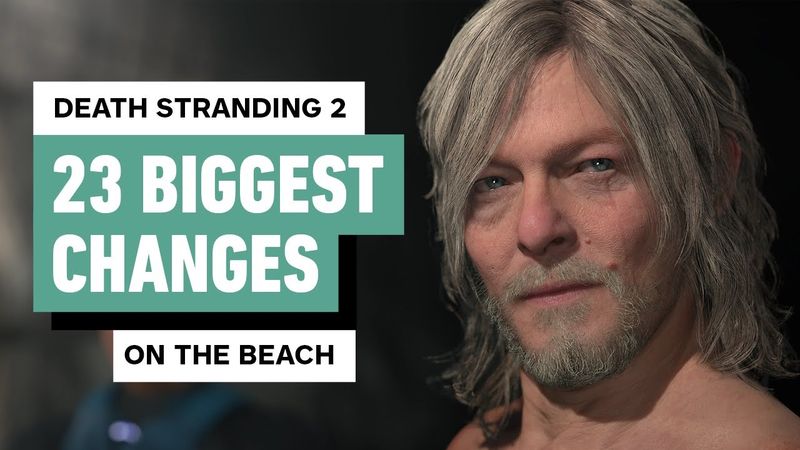
Download information and video details for Death Stranding 2 - The 23 Biggest Changes Since DS1
Uploader:
IGNPublished at:
6/24/2025Views:
157Description:
Video Transcription
Everyone's favourite apocalypse delivery simulator is back with a sequel, in Death Stranding 2 On The Beach.
The series' signature style and unique gameplay mechanics make a return after more than five years, but there are some major changes in the new game that help it stand apart from the previous generation's efforts.
Here are the biggest changes that we found between Death Stranding 1 and Death Stranding 2.
Let's start with some of the surface level stuff.
In Death Stranding 1, Sam was tasked with reconnecting American cities and communities by traveling across the whole continent, connecting people to the chiral network.
That doesn't need to happen in Death Stranding 2 because, well, it's already done.
In Death Stranding 2, you'll be working to extend the network past America's borders and into Mexico before traveling through a nearby plate gate to then connect all of the continent of Australia.
You'll still be crossing rivers, trying not to fall over, and using structures built by other players in the world, but some of the landscapes and climates are drastically different to the first game, and so are the people that you meet.
Mate, I hope you're ready to hear a lot more voices that sound like me.
Which means the only way to fix it is to link up all of Australia.
you'll be working with Fragile's new team called Drawbridge.
Fragile now has an extra set of hands around her neck for some reason, and a new ship, the DHV Magellan.
This thing rides the tar currents thanks to Tarman at the helm, and will also act as your new home and means of fast travel across Australia.
This is a much more convenient method of fast travel than the beach jumping that Fragile offered you in the first game, as now you'll be able to bring all of your materials, equipment storage and vehicles with you wherever you go by storing them on the ship.
Cargo for deliveries doesn't fare super great while riding the currents though, so that is best delivered the old fashioned way.
You can rely on the vessel as a place to find a private room and equipment fabrication whenever you need it though.
While there was a weather system in the first game, it basically just consisted of rain and not rain.
Now the world feels a bit more alive, with a constant day-night cycle in effect, as well as drastic environmental changes.
Rivers will rise in certain areas depending on how much rain has fallen nearby.
Gatequakes strike the earth with increasing frequency and severity.
Dust storms can obscure your vision and slow you down, and bushfires can even start spontaneously due to chiral cinders.
All of these not-so-natural disasters can damage structures and complicate your deliveries, almost making you wish for the simple threat of BTs on a cloudy day.
Almost.
When things are calm though, and you're walking through the outback, you may come across local wildlife.
There were no animals to be found in Death Stranding 1, except for cryptobiotes and a flock of birds in the opening cutscene.
So it's great to get to know Australia's quirky cast of critters in the sequel.
You can even bundle them up and deliver them to an animal sanctuary for safekeeping and observation, which is important because all animals are endangered species in this world now.
And yes, don't worry, they can all breathe in their fancy padded cargo boxes while on Sam's back.
When it comes to gameplay, Death Stranding's unique style of traversal mechanics are preserved in the sequel.
but many aspects of the combat, stealth and cargo management systems have been added to, adjusted or completely overhauled.
Combat was an option in the first game, but you were heavily incentivized to avoid fighting, lest your cargo was damaged or maybe even stolen.
While those risks are still present, there are now so many additional tools and abilities at your disposal, you might start choosing to pick a fight instead.
When you were fighting up close, you could now block or dodge incoming attacks, counterattack, charge at enemies to knock them back,
as well as employ various mid-air attacks like a Death Stranding Director's Cut.
You can now equip various electric rod weapons like the ones that the mules use.
Great for close-range fights or even for throwing at foes to shock them from afar.
And of course, you can still use cargo carried in your hands to bash people with or throw at others.
To complement Sam's vastly expanded arsenal and combat abilities, there are new and different types of enemies for Sam to fight.
Humans are more frequently covered in armor, and BTs have leveled up since last time, as now larger-than-life Watchers dot the Australian landscape.
They have a lot more health than the standard Gazers from the first game, and will overcome you much faster if they get their hands on you.
Mechs are new for the series as well, responding entirely differently than BTs or humans do to other firearms.
You no longer need to craft specific anti-BT versions of weapons either, but different weapons will have different efficacy against the different types of enemies, so make sure you have all damage types covered if you're heading out into the unknown.
Alongside returning weapons like the standard assault rifles and shotguns, bowler gun and maser pistol, there's now a suite of lightweight weapons that take up less space and are easier to carry.
You'll have various decoy grenades and pistols to choose from, plus an expanded category of weapons that shoot tranquilizer rounds.
The first game made use of tranquilizer grenades shot from a grenade launcher, which does make a return here, but now you can also make use of a silenced tranq pistol and a tranq sniper rifle, which is an entirely new class of rifle for the series.
These weapons function very similarly in Death Stranding as they do in Metal Gear Solid, where a headshot will knock a target out instantly, while a shot anywhere else in the body will still work, just a bit more slowly.
In general, silenced weapons were easy to unlock in the last game, but they're a bit harder to obtain in Death Stranding 2.
So make sure you're ready to go loud or stay on the move when you pull an unsilenced weapon out.
But let's say you want to approach things more quietly.
Stealth infiltration has been greatly improved thanks to the tranq pistol, but takedowns have been simplified too.
In Death Stranding 1 you had to have your strand item equipped and at the ready to knock someone out from behind.
And while you can still do that in 2, you're also able to simply press the circle button when behind an unaware enemy to bind them in a flash.
This means you can move faster behind someone and there's no more need for equipping the item, aiming and then attacking every time just to take someone out.
Sam can now tag enemies permanently by looking at them either through the compass mode, or through observation towers.
The towers are best for this, as you only need to look vaguely in the right direction to tag someone, even through walls, but that does cost resources to build.
A free alternative you can use, however, is your new companion, Dollman.
He's a friend you'll be paired up with when you reach Australia, and you bring him along almost in the same way that Kratos brings Mimir with him in the recent God of War games.
While he's good for small bits of information or conversation even, you can also equip him from the item menu.
Toss him into the sky and just like that you'll have an airborne view of the surrounding area.
He can't tag enemies through walls, but using him to get the lay of the land is invaluable when approaching unfamiliar, hostile territory.
You can also use him to distract enemies by tossing him directly into the fray.
Gone is the iconic trike from the first game.
Instead, you'll be using the new tri-cruiser as your first vehicle in Death Stranding 2.
It may look a bit less stylish, but this vehicle is infinitely more practical for porters.
Sam can now pick up nearby cargo and materials while driving at speed, thanks to the exposed driver's seat.
You could technically pick things up while riding the trike in the last game, but you had to get very close to the item in question and slow down dramatically.
For larger vehicles you will still have to get out and pick things up on foot, just like in the last game.
The TriCruiser holds as much extra cargo and attachments as the old Trike did, and seems to go just about as fast too, so it's basically a straight upgrade.
And that's not the only improvement.
Because all vehicles now feature this exposed driver's seat position, Sam is able to wield firearms while driving.
You can only use some types of weapons, but the controls function in a way that allows you to continue driving with full control while aiming and shooting your weapon at the same time, which feels really badass.
It's a bit of a pat your head, rub your tummy situation, so you might well crash, but it is a good option to make use of when you're in a pinch.
Eventually you'll also be able to construct gun attachments for your vehicles that aim and fire autonomously.
This is great for rolling through an enemy camp, but you can also make a sticky gun that picks up nearby cargo and materials for you, leaving Sam Free to kick back and enjoy the cinematic views.
The first game's cumbersome cargo menu has been adapted in the second game to make it much easier to use.
You no longer need to open the full cargo menu just to optimize what Sam's carrying where, before backing all the way out of the menus again.
Now there's a cargo quick menu you can access that includes an auto-arrange cargo button.
Here you'll also find various quick offload options, allowing you to offload all material containers, drop all non-usable items, or even take your backpack off entirely.
This could be useful if you want to stash your deliveries somewhere safe while you deal with a hostile camp of brigands or a cluster of BTs.
And for those situations where you do need the full cargo menu, there's even a quick option for accessing it in this radial wheel too.
Road pavers return from the first game, allowing you to create a more permanent path for vehicles to travel on, but now it's complemented by a new monorail transportation system as well.
The monorail system is great for transferring materials, your vehicles and yourself from one large hub to another.
Not all roads go all places, and neither do the monorails, so you'll need to reconstruct both networks to have complete freedom across the Australian landscape.
Ziplines also make their return and are still invaluable for traversing the mountains and creating fun shortcuts through the middle of the map.
And you can use the attached monorail ziplines at ground level to travel underneath the carts above.
Double the transportation infrastructure means double the amount of materials you'll need in order to complete these pathways, but thankfully there are more ways to gather and move large quantities of resources in Death Stranding 2.
Mines are now dotted across Australia, each taking chiral crystals in exchange for an output of different materials that you'll need to use.
Once you've loaded yourself up with literal tons of stuff, you can then use the DHV Magellan or the Monorail systems to shift vast quantities of materials to anywhere you've already connected with, making it much simpler to gather materials from the whole continent and bring it to where you need it the most.
You can also now ask other players to give you certain items or materials, which is perfect when you need just a few more ceramics to finish that new stretch of road.
Thank goodness it's easy to move stuff, because these roads and monorails are not cheap.
The five-pointed star porter system returns in Death Stranding 2, but the rewards it gives you are a bit different this time.
Instead of giving you small passive increases to carrying capacity, like limits and so on, you'll now unlock various A-pass enhancements to choose from.
These enhancements are perks that you can activate and deactivate as you see fit in order to tailor your gameplay to your liking.
These perks include things like increased bullet damage, better floating carrier handling while riding, vehicle auto-driving, and much more.
You can only have so many perks equipped at once, but there's no limit on when you can activate and deactivate certain perks, so you can tailor these skills to certain situations at a moment's notice.
The passive stat bonuses are now handled in a new Sam's Stats menu.
You'll gain proficiency in skills like carrying capacity, lung capacity, and aptitude for certain weapon types based on how frequently you use these mechanics, much like the way it works in Bethesda RPGs like Skyrim.
Now to finish this video off, here are a few smaller details that we still wanted to mention.
Whether placing them horizontally or vertically, you can choose to double the length of equipped ladders by connecting two ladders together.
You can also use mechanized holds to automatically travel up and down ladders, or rapidly climb up and down ropes on an anchor.
There's a much greater emphasis now on not killing people, in that you are given fewer weapons capable of firing lethal munitions.
If you do manage to create a corpse out in the world, you can take them to a normal distribution center for disposal, making purpose-built incinerators from the first game obsolete.
Normal ziplines made with PCCs are a little more flexible now, so objects don't as easily block your path.
There's some very light curve that you can add between the zipline viewpoints.
Death Stranding 2 has a new Corpus menu, which simplifies the first game's unwieldy databank.
You can read extensive lore and world-building text entries here, as well as story recaps and tips for how to play.
You can even access this menu during cutscenes whenever you like, much like Final Fantasy 16's active time-lore system.
There are now dialogue options to choose from when talking with other characters during some cutscenes, or when visiting various people throughout the chiral network.
You can choose if you want to chat a bit more, or just get straight back on the road.
Chiral creatures, or CCs, have started appearing in the world, and while they're mostly harmless, they will swarm you and degrade your battery and boot durability if you come into contact with them.
They'll even attack your vehicles.
Sam gets given a portable music player early in the game, which was completely absent from the first title, despite its iconic soundtrack.
You can now listen to songs that you've unlocked wherever you are in the world, so long as you're inside the network and not in combat.
Holy Dooley!
That's a cracker of a list detailing two humongous games.
I'm all tuckered out now.
I might lie down for a kip after this.
For more Death Stranding 2, check out our expanding wiki for guides, tips and interactive maps, or our review.
And for all other things gaming, stick with IGN.
Similar videos: Death Stranding
70 КРУТЫХ ИНСТРУМЕНТОВ, КОТОРЫЕ ВЫШЛИ НА СЛЕДУЮЩИЙ УРОВЕНЬ
New Verion - Killerbody LC70 | Rc Land Cruiser | Crawler Rc
Metal Gear Solid Delta - Ultimate Guide for Stealth and Combat
Metal Gear Solid Delta: Essential Gear You SHOULDN’T Miss Early On!
NCS10 Best Of NCS MIX | NCS - Copyright Free Music