
Defence News | K-4: The Big Boom | CTRL ALT Defence Episode 28
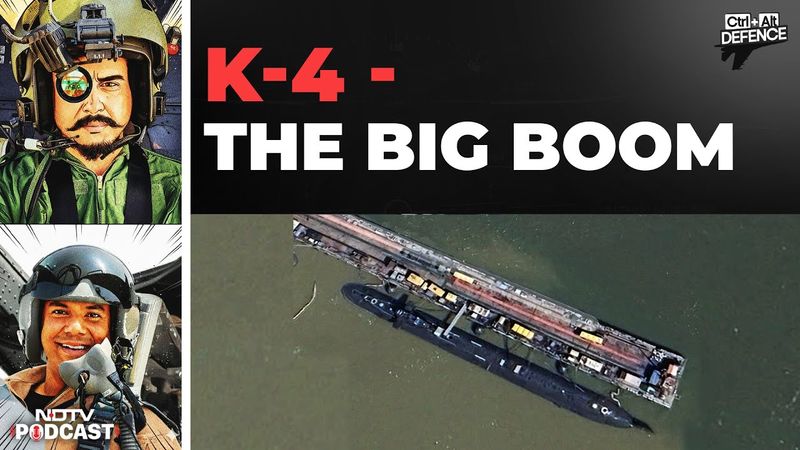
Download information and video details for Defence News | K-4: The Big Boom | CTRL ALT Defence Episode 28
Uploader:
NDTVPublished at:
11/29/2025Views:
21.2KVideo Transcription
Hello and welcome back to the Control Alt Defense podcast.
This is episode 28.
If you've just joined this podcast, welcome.
I invite you to look at all of our previous episodes.
It is the most watched military and weapons podcast in the country.
Vishnu and I love bringing you this podcast every single week.
Vishnu.
topic this time that we've been this is a topic well control all defense you know a lot of people have been asking about uh control all defense much so vishnu had this bright idea of going out and uh printing our fabulous logo on some sweatshirts this is just the beginning right yeah there's going to be a lot more which is coming out and this is because a lot of you have actually suggested this
So I don't know if it was my idea or Shiv's idea first, but I did take it upon myself to drive our producer up the wall, Pavitra, and get her to make this.
And it wasn't fitting properly, and then we got it to fix.
Yeah, we're new to the merch game, but I promise you we're going to have a lot of really cool stuff.
And not the usual.
This is just us wearing these sweatshirts.
There's going to be some really nice giveaways and goodies and things that we're going to put out for you, the listener and viewer.
which you'll get a chance to grab.
So that's going to be very soon.
Look out for that here on the podcast.
We will drop some information on that very, very soon.
But let's...
Vishnu, get to our topic for episode 28.
And I'm very excited about this.
I know you are too, because it's something that, you know, we've sort of poked at in other episodes on nuclear submarines and missiles and things, but we haven't done a dedicated episode on this and that's why I'm very happy about it.
It's timely because there's a notification for a missile test
in the Bay of Bengal, stretching all the way into the Indian Ocean, the South Indian Ocean, for this absolutely massive long-range missile test, scheduled for somewhere between December 1st and 4th, which means it's going to happen somewhere over those three days.
But it's an absolutely colossal mission.
missile test because they've apparently extended the range as well so why don't you break the suspense and tell us what because it hasn't the government hasn't announced what missile this is or what test this is which is usually the case there is usually just a you know notification to airmen saying look we're going to be testing this weapon this is the range this is the safety area and you know aircraft etc need to be
mindful and watchful and stay away from the area during this time window.
What is being tested, Vishnu?
The most important missile in India's nuclear armory.
What is it called?
How far is it going to fly?
It's probably the missile called the K4.
And if it works, it'll fly to about 4000 kilometers.
Wow.
So simply, what is the K4?
The K4 is a submarine-launched ballistic missile.
The K4 is India's primary submarine-launched ballistic missile.
Just a handful of countries around the world have ballistic missiles which you can launch from submarines.
This is the most critical missile and engineering missile.
development that any country can actually get to.
We managed to get there.
And now we want to test this.
This is the larger of two submarine-launched ballistic missiles that we have.
The other one's called the K-15 that flies out to less than a thousand kilometers.
This one is the big boomer.
This is why you build a ballistic missile submarine because you want a missile on it.
The missile is finally here.
One assumes that the tests will go off successfully.
And I'll talk a lot about the missile, whatever I know, part speculation, part fact.
But this is it, because this is the naval leg of our nuclear deterrence.
So we've got the Agni series of missiles, which are nuclear capable, ground-based.
We've got nuclear weapons, which can be deployed from our fighter aircraft.
We've had this for a while, bombs and things like that.
And now this.
Once you've got this fixed and sorted and employable and deployable,
Then you've got the ability to target China from deep within the Indian, the Bay of Bengal, which has fabulous depths, which certainly enhance the operation of submarines like the SSBN.
The submarine launched the ballistic missile submarines.
The Americans call them boomers.
Yeah.
And that's so it's all great to have nuclear powered submarines, nuclear powered ballistic missile submarines.
But it only makes sense if you've got the missiles.
So this is now.
So this basically means that India's two ballistic missile submarines, the INS Arihant and the INS Arihant,
Aridaman is the third one that's coming.
So if you discount the K-15, let's put that missile aside for a second because it's a bit of a baby missile with a range of under a thousand kilometers, as Vishnu said.
So these nuclear submarines are basically like revolvers
which didn't have bullets and now with the k4 being tested between december 1st and the 4th those bullets are being tested so the gun is ready the gun is deployed but these are the bullets because what is a ballistic missile without its ballistic ballistic missile submarine without its ballistic missiles that's what's being tested vishnu makes a very important point which is that
This is primarily a nuclear capable missile because why else would you need something that travels that far and secretly hidden inside a submarine.
This is the third leg of what we call the nuclear triad, Vishnu.
We've already nailed the ground leg with our Agni series.
The air leg, as you mentioned, has been operational for a long time from our Mirage 2000 fighters and others.
The sea lag is something that we've struggled a bit to nail and for various reasons there are technological challenges etc.
What is this missile, this K4 that's being tested now, what is it going to be launched from?
Is it going to be launched from the INS Arihant or the INS Arigat?
So, or the INS Aridhaman.
Okay.
Because, which is at an advanced stage of sea trials.
Now, our nuclear submarines are our biggest secret and the ballistic missile and the missiles themselves on board are an even bigger secret, I would suggest.
The government won't talk about it.
They certainly won't take journalists there at the moment, but we shall see.
But that would be a dream, right?
Anyhow, but the ability to actually launch a ballistic missile flying out to a range of 4000 kilometers from a submerged platform, which is what India is trying to do this time, is very difficult because of various reasons.
Firstly, the ability to eject a very large missile weighing several tons from underwater.
at a decent depth, not very deep, but comes to a hovering position, but it remains underwater.
For the missile to actually leave the silo and be ejected up, it's usually through a stream of air, but there are different techniques as well, to break the surface of the water and then have its rocket motor ignite and then propel it forward, number one.
Number two,
You don't make a missile of this class in 2025 unless you want it to be MIRV capable.
In other words, multiple independent reentry vehicle capable.
In other words, nuclear bomblets on board.
MIRV is technology for use on a nuclear ballistic missile where you've got four mini, call them bomblets or mini warheads.
In fact, that's what they are.
Not mini, they are warheads.
Each one with a separate nuclear mechanism.
And separately guidable.
And potentially separately guidable.
And that's really cutting edge stuff.
Which...
which sort of separate from the main missile and then move out and target a particular area, whether it is actually maneuverable or not.
And independently, you know, that's another thing.
But these are multiple independent because they're separate of each other.
And they obviously cover a large area if that's what you want.
And, you know, I mean, technically they can fly off to great distances from each other.
India's developing that has been for a period of time.
The sense is that this is going to be a MIRV-capable ballistic missile.
This is the K4.
And how do we know it?
Because the NOTAM or the Notice to Airmen and Sailors extends from an area just outside Vishakhapatnam, deep into the Indian Ocean.
And so it's between the first and the fourth.
I would suggest...
that there is only a 50-50% chance that the government is going to say anything about this launch.
They will not say if it's a success.
They will not say if it's a failure.
If they do actually come out and say, if it's a failure, I would suggest that they won't say anything at all.
India doesn't typically do that.
If it is a resounding success, then I think that would be interesting to see.
But whether they would actually offer footage or photos of this is something which is doubtful.
Our colleague Pallav Bagla was perhaps the only journalist who's or one of very, very few who's actually seen the pontoon launch of the earlier missile, the K-15.
And he saw it break the surface of the water several years back, ignite its motor and then fly away.
Yeah, this is.
way bigger missiles.
So this needs to work.
I would be very surprised if video footage or an announcement would come out because testing a strategic missile of this kind is right off the bat will be seen as a provocation.
Especially in the current geopolitical churn.
Maybe that's not the kind of message India might want to send out.
Even though India has done so in the past.
Especially under this government announcing
unconventional weapons as it were, whether it was the anti-satellite test or others, these things have come out.
So we don't know.
We don't know if the government will actually announce it, but we'll be keeping an eye on it.
Vishnu, the integrated guided missile program of India is widely seen as one of the most, it's been a bit of an outlier.
It's been successful in delivering
you know, a baseline of quality missiles, not just to your conventional forces, but also to your nuclear command.
You've got the Agnis, you've got the Prithvis, you've got a ballistic missile defense program, which we've done a separate episode on as well.
The K4 that is being tested now, which becomes the main bullet in your nuclear revolvers at sea,
Are they a derivative of the Agnis or were they completely separate missiles?
No, I think they're separate missiles, but there would be some elements of the basic technology which would still be there.
Some of the rocketry would be very similar.
But again, the way it's deployed makes it significantly different.
The nature of the warhead, assuming it is MIRV, would mean that it's a new system being developed.
The exact size of the missile is one that needs to fit into the silos of either the Arihant, Arighat or Aridhaman.
Aridhaman is a bit larger.
It can potentially carry up to eight missiles.
And so that's something that needs to be looked at.
We're progressively making larger ballistic missile submarines.
So we've got the Arihant, which was really a tester sort of nuclear submarine, a baby boomer.
Then we've got the Arihant in the water now for a period of time.
and the aridaman which is larger as i understand it we've also got something called the s4 plus which is even larger coming up and then we'll have ultimately the s5 the s5 is big yeah 13 000 tons many more nuclear ballistic missile submarines and then of course separately you've got a line of fast attack submarines as well the technology you have
with the submarines themselves, easily lend themselves to India constructing our own indigenous fast attack boats, nuclear powered.
However, one needs to have more versatile reactors.
It is believed that the reactors of the Arihant class were at about 80 megawatts, 80 MW.
they need to go up to 190 200 or so ultimately the important part is that these are indigenous yeah in as much as there is a sense that these were russian designs uh and perhaps built with an element or more than an element of russian collaboration
the reactors were Indian, built by BART.
In fact, in Kalpakkam, there is the prototype of one and the picture of which has been publicly released.
We need that to be a more powerful reactor.
Why?
Because in the case of fast attack boats, you need an instant availability of power for sustained high speeds.
And given the fact that these are heavy submarines, large submarines, you need to have a lot of that available on tap.
So that's essentially why you need that.
And obviously you need to progressively, and this technology again, not off the shelf, you build it yourself.
You need to improve the quality of the reactors, their endurance, whether a single reactor can last the life of a submarine, or you get into that very complex nuclear fuel refueling sort of setup, which is challenging.
But that's the submarine.
And of course, that's the most difficult, arguably the most difficult piece of military engineering any country does.
And then, of course, there's the missile.
But the point that I want to make, Shiv, and I've actually brought up some stats, is that ballistic missile submarine tests
Ballistic missiles, submarine-launched tests of ballistic missiles fail all the time.
So the Trident II D5... Oh, they have a high failure rate.
Massive, massive.
The Trident II D5 development program, the Trident II D5 is the primary ballistic missile submarine-launched of the United States.
They had three failures between 87 and 89 during the initial 19 tests which were done.
Many of these were land-based tests.
In 1989, the first sea test
of the Trident II D5 from the USS Tennessee failed.
The third sea test of the Trident II D5 resulted in another failure.
June 2016, just not that many years ago as things stand.
In the monstrously long development cycles of submarines, HMS Vengeance, which also fired, I think, the same missile, that failed.
January 2024, HMS Vanguard, a test launch from this missile failed as well.
It was described in a very British way as an anomaly.
Anomaly, I beg your pardon.
The Bulava SLBM, the Russian SS ballistic missile, it's called the R-30, NATO calls it SSNX-30, that had a roughly 50% failure rate.
These things don't really work very well.
Yeah.
But you really do need them to work because God forbid if you ever deploy them and they don't work, then, you know, you land into all sorts of trouble.
Yeah.
But God help us all if one actually works in the event of a war because these are city killers.
Yeah.
These are the ultimate, most destructive and deadly weapon system that the world has come up with, militaries have come up with.
Where do these missiles fail?
It's the last line of defense.
Is it the technology in getting the missile out of the submarine, through the water?
switching its motors on and rising up from the sea or is it is it more like during flight and navigational and that kind of thing well some of these have been navigational errors some of these have been errors in the ejection of the submarine uh some of these have been problems with the rocket motor all of it this is just it's like crazy engineering yeah but the the the the missiles that you've just named like the bulava and the trident etc
Those are operational missiles now.
They've been through their difficulties.
They've been through the development cycle.
We've tested, I believe we've tested the K4 before.
No one knows whether that succeeded or failed.
Right.
And so we're going to have to wait and see what finally happens.
This is going to go on for a while.
What I would be very interested in seeing is are they firing a single missile?
Of course, I would like to see it.
The Mandarins are watching.
Yeah, yeah, yeah.
We know you'd like to see.
Wouldn't you really, right?
We'll have a drone in the air.
It's a very American way of saying talking.
What I'd like to see is like, who the hell are you?
Anyhow, so I'm just an enthusiast as is Shiv.
But what I'd like to see is whether it's a single missile fired or more than that.
Yeah.
You know, the idea of failure is also an interesting thing when it comes to weapons testing because you've just thrown light on how failure is a close friend of SLBMs in tests.
Imagine what the Pakistanis would do if there was a failure of an Indian missile system and we put a press release and said, unfortunately, this missile test has failed, but we'll try again.
You know.
No, no.
See, the thing about failure is, and Vishnu and I have spoken to so many people who've been involved in missile tests and aircraft tests and drone tests and things like that.
And they're very sensitive about the word failure.
They say that things not going your way in a development trial and test is very much sort of,
catered for or accounted for in your planning.
And especially in a missile case, they don't say failure.
They say that, like you said, an anomaly, which brings with it a wealth of learning.
So you improve it for the next test.
Obviously, in an ideal world, every test would beat all criteria, tick all the boxes in terms of what you're expecting from it.
The missile behaves in exactly the way that you want it to.
But
you know happens right it never goes that way all the time especially in development where oftentimes you're reaching into the dark uh but in in in the case of the k4 like you said there's been one test before we don't know how it went whether it was an anomaly or it was
completely successful.
But the fact that there is this other test obviously means that the technical team is confident enough to do that test, which in itself is a big affirmation, is it not?
Or it could be a test of a new submarine.
It could be Aridhaman testing.
Right.
We don't know if that's the same missile which has been tested.
You want to test it of all your submarines.
You have just a handful.
You may as well test all of them.
And there are subtle, not subtle, there are differences between the submarines.
Each one is an evolution in many ways of the other.
One is larger than the other.
The Aridhaman is believed to be somewhat longer.
Right.
The Arigat, if it could fire the K4, it would carry only four.
Then I beg your pardon, Arihant only four, Arigat possibly more and Aridhaman definitely eight.
Right.
So that's the way I see it.
So whether four or eight is a bit of a, you know, because it's longer, I believe one of them is about 20 meters longer than the other, which is very significant if you look at, you know, the overall size of a submarine.
But the sense is that you needed to double the ability.
I mean, it's not really considered very meaningful if you have the ability of flying, firing or carrying four submarine launch ballistic missiles.
You want to get to 16, right?
ultimately.
So eight is halfway there.
That might meet your requirements.
You know, Vishnu,
sometimes when we cover and we've covered viewers there's no reload at sea on this this sort of thing yeah watch crimson tide if you want to know all about that but but the uh the amazing thing about uh covering defense is sometimes we get so deep into the topic some of the more obvious questions kind of yeah fly past us and yeah i was actually fascinated because someone asked me recently a few weeks ago during another similar missile test a few months ago maybe about
When these missiles are fired, what happens?
Who's watching?
How are they watching?
How is it being tracked?
What kind of telemetry happens?
I love that word, telemetry.
Are there boats out at sea or ships out at sea keeping a watch?
Are there space-based sensors watching, tracking?
Paint us that picture.
I know you know how that works.
But we've got ships with sensors that are looking at these missiles.
And these are, I mean, 4,000 kilometers.
That's a crazy amount of range.
So who's watching?
How is it being tracked?
How is it being assessed as being a success or an anomaly?
What are we using to do that?
So we've got a couple of platforms.
One of them is the INS Dhruv.
Dhruv, yeah.
And there's a sister ship as well.
And these are extremely advanced floating radars which have the ability to track over the horizon incoming ballistic missiles, get the exact data on the trajectory.
If there are MIRVs involved, then to track these multiple independent re-entry vehicles as well.
And to gather all sorts of data, all sorts of data across multiple parameters.
There's also the entire business of the trajectory that the missile fires in and flies in.
Is it going to be a normal trajectory?
Is it going to be something called a depressed trajectory, which is sometimes used to simulate a longer range, but isn't a longer range itself?
And so that's where you want this, because in terms of coordinating the launch efforts of a massive test like this, you need to have state of the art platforms.
That's another naval platform we want to get onto.
I mean, it's just incredible technology.
Again, that's one that they will not let a journalist anywhere close to.
Absolute state-of-the-art radars operating across different bands.
This is one of the primary...
I mean, it's also linked up perhaps to the deployment of sea-based interceptors as part of a futuristic...
um you know missile shield we call it sudarshan chakra yeah but we're also on that as well yeah we've uh we've also um got those if those ships are deployed out at range in the sea then they provide advanced early warning which fits into the overall command and control iaccs network
uh of eyes which actually peer into china pakistan wherever else and then if you've got endo and exo atmospheric missiles or interceptors which is another super high high-end sort of development that we're looking at um those could be queued on the basis of of missile of radar data coming off a ship like the drove one more point there are about four four at least four chinese vessels
in the Indian Ocean right now?
Fishing vessels.
They've come here for the fish.
Or fishing vessels, right.
But I asked a friend and it appears to me that these aren't missile tracking boats.
Now, ships.
In the past, it said missile tracking ships.
We'd cancel the NOTAM.
They'd go back.
And we'd make a big fuss of them docking in Sri Lanka.
And we'd tell the Sri Lanka.
And sometimes they'd land up in other areas as well.
But I don't believe there's a very large Chinese missile tracking.
They've got state of the art ships, you know, ship right now in the Indian Ocean region.
But there are at least four ships with the ability to peer deep into the depths of the ocean.
because that's what the chinese are doing in the indian ocean they are i mean their underwater maps at this stage of uh are are incredible probably because they have systemically been mapping the uh the undersea uh under the water in the the bay of bengal in the arabian ocean and other parts of the indian ocean why very simple yeah they see this as a future area of very very active uh submarine operations again that's those are charts that
Nobody's giving the Chinese.
So they go and do it themselves.
Building them slowly.
What lies as a huge advantage to India is that the waters of Vizag quickly become incredibly deep.
And therefore, you are able to dive your submarines and keep them
very deep, as deep as they can go for a long period of time.
You're not all that far away from your home base, which is Vizag.
Now it's going to be Rambili in a way near future, which is this another incredible base that they're building that's about a few hundred kilometers or maybe even less than that south of Vizag, which is a submarine base carved into a hill.
Think about that.
We've actually done that.
Yeah, we've talked about that.
And so there are advantages for us.
But if the Chinese have mapped out the Bay of Bengal, which they have, certainly east and west of the Andaman and Nicobar Islands, then you certainly need to have fast attack boats, nuclear powered, accompanying your submarines.
If these are bombers, you need fighters escorting them.
And so if we do get another Chinese, a Russian Akula-class submarine, why one?
We should get more because it's going to take some time for our own fast attack boats to come online.
Then those are absolutely essential in guarding some of our most precious, expensive, complicated, sophisticated assets.
I'm not just saying military assets.
These are national assets.
Does a 4,000-kilometer submarine
range submarine launched ballistic missile like the K-4 and I'm not talking about, you know, the MERV capabilities, like you said, you know, we can slap on a lot of capabilities to this missile, but at a 4,000 kilometer range, is that all we need in terms of our third leg or
Are there plans to build a longer range missile?
There are plans to build one in terms of our nuclear.
There are plans to build a 6,000 kilometer range submarine launched ballistic missile.
But this is what I find of open literature.
I'm not very sure where we stand with that.
I think they need to get this particular test out of the way, number one.
Number two, are they being honest about the range of the missile?
Have we actually got a missile which flies longer?
And are we just flying it out to what the NOTAM says, 4,000 kilometers.
We don't have to fly it out to the entire range.
You never really want to, you know, but you see, they will also know about the range of the missile on the basis of this test.
It might be able to fly longer and farther than what you expect with this.
But you can target most of what you need to in China with 6,000 kilometers from a submarine fired in the north way of Bengal.
So you're saying that there is probably a 6,000-kilometer range.
Yeah, I think people talk about the K5 and onward, the series that's there.
But as things stand, Vishnu, with our Strategic Forces Command, which is what India's nuclear command is called,
Are there any gaps?
Are there any gaps in terms of delivery systems and warheads and things like that, that we know of?
Because when one talks about the Agni, which is basically a primary ground-based organization,
nuclear delivery system.
One hears now and then about improvements like the MERV tests or the prime tests, et cetera, of the Agni.
What else is going on?
Agni prime is a fantastic missile.
It's almost like a new thing.
It is essentially, but that's a different, that's a conversation for another day.
Yeah.
Well, somewhere our national planners, to answer your question, have figured out the number of nuclear warheads we need to have, number one.
That is split across in the way that the government feels that it needs to be.
There's a nuclear command that takes place.
There is a chain of command in that.
These structures have now graduated.
There is a nuclear command authority in
There is a structure in place, obviously, which directs the delivery or the use or the clearance to use nuclear weapons, whether it's a briefcase with the codes for the prime minister or, you know, it's something else or some football shaped device.
I mean, whatever it is, these are things which no country gets into.
And we certainly are not going to get into that in our country.
um so whether or not india has an optimum number of nuclear warheads is again classified every year uh sipri comes out with a number of uh estimated warheads it's believed that india has a few more warheads than what pakistan has both sides have enough warheads to destroy and obliterate each other many times over yeah that's a bit of a silly number if you ask me um however
Do we have enough missiles?
Are we confident enough about their capabilities?
We do test all the time.
I mean, that's clear.
If you see the number of NOTAMs that you see out in the Bay of Bengal, we test all the time.
You know, I mean, I can make out that many of these are Brahmos tests.
Because you look at the range of the missile, you say, ah, okay, we know what that is.
But we test frequently.
And the Strategic Forces Command have operational tests of these.
It's proper training.
So it's not enough to have the missile.
The men and women who fire that missile have to have the ability to actually launch them under all conditions and circumstances.
These ballistic missile submarine people will need to be trained to a level which is of precision, which can never go wrong, right?
So that includes a couple of other things.
Very low frequency communication, ultra low frequency communication,
between the submarine and ground stations, we've got a couple of the VLF and ULF sort of receivers which have been set up.
The ability to transmit through burst communications, the ability to be able to have an idea of where your submarines are using satellites,
You know, it all comes as one very expensive, one very complicated and technologically challenging package.
I would say that the next big thing we need to do is to get that INS Nambali sorted out.
So that instead of our submarines being out in the open for the Chinese to see 24-7, we actually sail them out and put them into their underground pens.
I mean, under the mountain pens.
Amazing.
What a facility.
Yeah.
And I'm told it's absolutely incredible insight.
That's as much information as I got.
genuinely like a sort of James Bond setting it's going to be.
Whenever I hear about it, I think about these cabins.
So I asked somebody, so you know, I mean, could you tell me what it looks like inside?
And first there was that look of, oh, you know, he's seriously asking me this question.
And then that person said, it's incredible.
So that's a scoop for you viewers.
Wouldn't expect anything less.
But one final question.
It's not done as yet, though.
I think it's still some time away.
Imagine the level of earthworks and technical proficiency that would be required for it to be... And sustain a nuclear hit from the top.
Hidden, away from eyesight, protective for your incredible submarine.
So it's taking its time.
And I think it's going to be something really incredible by the end of it.
Last question, Vishnu, which is...
Again, whenever we talk about submarine-launched ballistic missiles and missiles in general, there's always chatter about India's no first-use policy.
And we hear about it every now and then.
Why do we still have a no first-use policy?
you will have those who advocate that, no, that is the right thing to do because we're a responsible power and we will not be the ones who fire the first shot because India is a peace loving country, we'll never fire the first nuclear bullet, et cetera, et cetera, et cetera.
But there are very reasonable people
who wonder why India has a no first use policy in a region that has been in sort of stability free fall for a while.
We saw the Trump Pakistan thing recently.
You know, China is on its own track.
Is that even something that's on the table?
Are the decision makers even looking at India's nuclear policy and thinking of tweaking it?
Well, I think that Trump's statement was quite interesting when he said that several countries, including Pakistan, have been testing nuclear weapons deep underground.
And whether that would result in a Pandora's box being opened and whether that would result in India conducting future nuclear tests.
The fact of the matter is that we announced a unilateral moratorium on that after the last round of tests in Pokhran.
we are able to replicate presumably tests for missiles, for bombs, the warheads of nuclear weapons, the nuclear warheads.
Therefore, would that necessarily be required right now?
I think, so that's one part of it.
And as far as the larger theory is concerned of whether you want to have a no first use or have a first use sort of philosophy, I don't think there's been a profound change in that at the moment.
I think we need to mature in terms of the technology.
And I think between the first and the fourth, if this takes place, but again, it may not take place at all.
I mean, something goes wrong, you don't have optimum conditions, you choose not to, you postpone the thing or you run into a technical issue.
And then, you know, you sail the boat back and then you try and fix it or whatever it is and take months or years.
Well, hopefully not yours.
But that's where things stand.
But it is important if this happens.
I hope it happens.
I hope it happens.
I hope it happens successfully.
And, you know, like I said, there are lots of disclaimers when you talk about success and failure in technological trials because many things may go right, one thing may go wrong, and it'll still be seen as not having...
completed all its test points as they call it in these weapons trials but we wish our scientists the very best we do know that they work under incredible challenges sometimes with resources though not in the nuclear program I do know that in the nuclear program they're given everything that they want because this is literally sovereignty weapons as they call them
that these men and women are building far away from the public eye.
So a big salute to them because they've made India not only proud of these weapons, which nobody ever gets to see.
Vishnu and I have been lucky enough to actually see something like the INS Arihant with our own eyes.
There are probably maybe 20 other people.
I never have.
I was there when Manmohan Singh and Gurshar and Kaur were there for the launch ceremony of the INS Arihant.
Very lucky to do it.
We were able to draw pictures because there were no cameras permitted.
I've also seen it but I wasn't there that day.
So it's amazing.
It's a program that the country can be very proud of.
It's good that not very much is known about it.
I love how India's nuclear submarine program for the first major part of its life was called something innocuous like advanced technology vessel or something like that.
And whenever you ask the government, are we building nuclear submarines?
You know what the answer was?
No, we aren't.
And then somebody found the office where it was happening.
When it said ATV.
It said Director ATV or something like that.
Brilliant.
But I just love how ironic and yet accurate it is.
Advanced technology vessel does...
indicate what it is, but it's just such a Sarkari name for a nuclear submarine.
I just think it's delightful.
I think we should still call it ATV as a tribute to our old... Our ATV and our LCA.
LCA, yeah.
Fabulous.
So it's...
This has been fun, Vishnu.
Wishing our scientists the very best.
We'll keep a watch on that.
In the next episode, we'll update you on how and if this test actually went off with whatever we can gather about it.
And remember...
There's merch coming your way from Control or Defense.
Vishnu and I are very active on social media.
Please keep talking to us.
Please keep commenting and telling us about what you'd like us to do our future episodes on.
As you can see, even with this episode, we are always, always listening.
Thank you so much for tuning in.
Goodbye.
Similar videos: Defence News

Indian Air Force | IAF Tanker Quest, 25 Years Of `Any Day Now' | CTRL ALT Defence Ep 32

S 400 Air Defence System | S-400: India's Pak AWACS Killer | CTRL ALT Defence Ep 29

India's First Dolby Cinema Opens in Pune: Here's What Makes It Special

India Attacked Pak Nukes, They Begged For Ceasefire | DGMO Press Conference | Ajeet Bharti LIVE

29 june 2025 | Aaj Ki 25 Sabse Badi Khabrein | Top 25 Breaking News Today | Nitin Shukla live