
Desperate Reality to Job Market Collapse in the USA!
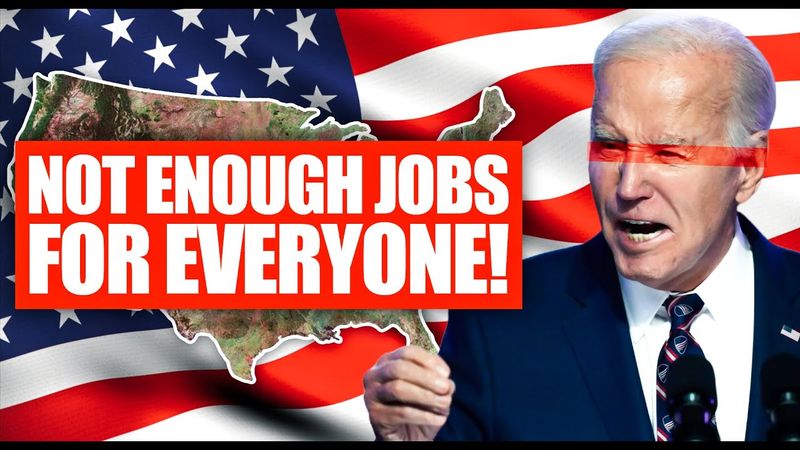
Download information and video details for Desperate Reality to Job Market Collapse in the USA!
Uploader:
Debacle EconomicsPublished at:
6/18/2024Views:
959Video Transcription
When you look at the soft data, Americans tend to be a little bit less optimistic about how the economy is doing it, in particular about the job market.
Politicians just talking about how the economy is so great.
I just want to scream from the rooftops.
And how come no one can find a job?
The American dream, a promise of opportunity, prosperity and stability.
For generations, it fueled the hopes and aspirations of millions.
But today, that dream is slipping away, replaced by a harsh and unsettling reality.
The once vibrant American job market, longed the envy of the world and the engine of the nation's prosperity, is showing alarming signs of weakness and dysfunction.
Behind the glossy veneer of political talking points lies a darker reality and a growing sense of despair among millions of American workers.
This is not a passing phase, but a shift that threatens to undermine the very foundations of the American dream.
The numbers tell a story of a job market increasingly failing to deliver its promises.
According to data from the Bureau of Labor Statistics, the labor force participation rate, the share of adults who are either working or actively looking for work, has been on a steady decline since the turn of the millennium, falling from a peak of 67.0% in early 2000 to just 62.2% in May of 2023.
This represents a staggering 5.1 percentage point drop, equivalent to more than 13 million Americans who have given up on finding a job altogether.
Even more troubling is the plight of young Americans just entering the workforce.
A recent analysis found an increase in the country's unemployment rate,
with the current unemployment rate at 3.90%, compared to 3.80% last month and 3.40% last year.
But the raw unemployment numbers only tell part of the story.
Equally concerning is the growing prevalence of underemployment and precarious work arrangements.
According to a report by the US Government Accountability Office, the share of American workers engaged in
alternative work arrangements, including temp workers, part-time workers and independent contractors, has risen from 10.1% in 2005 to 15.8% in 2015 and is projected to reach exponential heights in coming years.
For many Americans, this grim reality hits close to home.
Many have been forced to cobble together a series of part-time and temp jobs just to make ends meet, or worse, settle with no jobs at all.
The once clear path to financial stability and upward mobility is fast becoming a maze of uncertainty.
In this video, we will delve into the heart of the crisis, exploring why the US job market is failing, and uncovering the unsettling truth behind the struggles countless Americans face daily.
As the years have passed, the unemployment line has become an increasingly popular destination, with millions of Americans finding themselves involuntarily enrolled in the Jobless Adventures Club.
These intrepid explorers, armed with resumes and a healthy dose of gallows humor, embark on a quest for gainful employment, navigating through a landscape filled with rejections, false leads, and the occasional glimmer of hope.
Along the way, they swap stories of their adventures, sharing tales of the elusive,
perfect job and the mythical living wage.
According to a survey by the National Association of Colleges and Employers, just 50.2% of the college class of 2020 had secured a full-time job within six months of graduation, down from 55.3% for the class of 2019 and the lowest rate since the survey began in 2014.
And for those who do find work, the median starting salary has barely budged in recent years, rising just 1.2% in 2020 to $55,260, a far cry from the robust wage growth of previous generations.
The situation is even more precarious
for those without a college degree.
A recent report found that the unemployment of high school graduates not enrolled in college is much higher than the national unemployment rate in the United States.
As of 2021, unemployment in the U.S. was at 5.3%, down from a high of 9.6% unemployment in 2010, the highest yearly rate in 10 years.
Not only were there more than 7.5% of high school dropouts unemployed in 2021, but working high school dropouts earned less on average than individuals of any other level of educational attainment.
In 2020, mean earnings of individuals who had not graduated from high school were about $26,815 annually.
compared to $39,498 among high school graduates and $73,499 among those with a bachelor's degree.
Nationwide, unemployment is worst among farming, fishing, and forestry occupations, with a rate of 5.1% in May 2022, followed by construction and extraction occupations and transportation and material moving occupations.
But the job market woes are not confined to entry-level positions.
Even experienced workers are finding it increasingly difficult to secure stable, well-paying jobs in their fields.
A report by the consulting firm McKinsey & Company found that the share of American jobs at risk of being automated or displaced by technology could reach outrageous heights by 2030, with the most vulnerable workers being those in low-wage, low-skill occupations.
The research estimates that demand for clerks could decrease by 1.6 million jobs, in addition to losses of $830,000 for retail salespersons, $710,000 for administrative assistants, and $630,000 for cashiers.
This finding also accentuates that activities accounting for up to 30% of hours currently worked across the U.S. economy could be automated.
a trend accelerated by generative AI and that an estimated 11.8 million workers currently in occupations with shrinking demand may need to move into different lines of work by 2030.
This growing job insecurity is taking a toll on American workers and their families.
46% of Americans say they have experienced some form of job or wage loss due to the pandemic, with 28% saying that they have been laid off or lost a job and 33% saying that they have had to take a pay cut or reduce their hours.
More than half of those who lost a job say they are still unemployed, while nearly a third say they have had to rely on unemployment benefits or other government assistance to make ends meet.
The psychological and social costs of this job market dysfunction are also mounting.
A study by the Brookings Institution found that the share of American men aged 25 to 54 who are not working
has nearly tripled since the 1960s, amounting to around 7 million American men.
The large number of prime-age men on the sidelines is a problem that predates the Great Recession.
This trend has been linked to a host of negative outcomes, from lower marriage rates and higher rates of substance abuse
to greater political polarization and social unrest.
At the same time, the job market has become increasingly bifurcated, with a growing divide between high-skill high-wage jobs and low-skill low-wage jobs.
According to a report by the MIT Task Force on the Work of the Future,
The share of American jobs and occupations with median wages below $15 per hour has risen from 29% in 1979 to 36% in 2019, while the share of jobs and occupations with median wages above $40 per hour has fallen from 27% to 24% over the same period.
This polarization has been driven in part by the decline of middle-skill, middle-wage jobs, particularly in manufacturing and other blue-collar industries.
A study by the Georgetown University Center on Education and the Workforce found that the share of good jobs held by workers without a BA, though, has declined from 60% to 45% of all good jobs.
A good job is expected to pay an average of $55,000 per year and a minimum of $35,000 annually.
The result of this is a job market that is increasingly stratified and unequal, with fewer opportunities for upward mobility and a growing sense of economic insecurity among American workers.
A survey by the Federal Reserve found that 40% of Americans would struggle to come up with $400 in an emergency, while 78% of full-time workers say they live paycheck to paycheck.
This economic insecurity is exacerbated by the rising costs of living, particularly in areas like housing, healthcare, and education.
97% of confirmed bachelor's degree earners graduate within six years.
The six-year average cost of attendance is $229,620.
Students who are unable to work full-time have lost a median annual income of $46,748.
Relative to the size of the economy, healthcare costs have increased over the past few decades, from 5% of GDP in 1962 to 17% in 2022.
Housing costs have also skyrocketed, with the median home price rising by 54% since 2019, far outpacing wage growth over the same period.
For many American workers, this combination of stagnant wages, rising costs, and job insecurity has created a perfect storm of economic stress and anxiety.
A survey by the American Psychological Association found that 72% of Americans cite money as a significant source of stress, while 22% say they have experienced a reduction in their wages or income in the past year.
The impact of this economic stress is not just financial, but also physical and mental.
A study by the National Bureau of Economic Research found that every one percentage point increase in the unemployment rate is associated with a 2% increase in the suicide rate and a 3.6% increase in the rate of drug overdose deaths.
The study also found that job loss and financial insecurity are associated with higher rates of depression, anxiety, and other mental health problems.
Despite these alarming trends, many politicians and pundits continue to paint a rosy picture of the job market, touting low unemployment rates and record stock market highs as evidence of a booming economy.
But for the millions of American workers struggling to make ends meet, these headline numbers ring hollow.
America's job machine is going stronger than ever, the US President Joe Biden once said.
However, this statement doesn't capture the people who have given up looking for work or the people who are working part-time or in temporary jobs because they can't find full-time permanent employment.
When you factor in those groups, the picture looks much less rosy.
Indeed, a closer look at the data reveals a job market that is far from healthy.
According to the Bureau of Labor Statistics, the U6 unemployment rate, which includes not only the officially unemployed,
but also discouraged workers, part-time workers who would prefer full-time work, and other marginally attached workers stood at 11.2% in April 2023, nearly double the official unemployment rate of 6.1%.
Similarly, the labor force participation rate for prime-age workers aged 25 to 54 has declined from 84.1% in January 2000
to 81.7% in April 2023 and 83.5% in April 2024, respectively, suggesting that a growing share of Americans in their prime working years are either unable or unwilling to work.
This trend is particularly pronounced among men, with the prime-age male labor force participation rate falling from 91.6% in January 2000 to 88.3% in April 2023.
The reasons for this decline are complex and multifaceted, but they include factors like the opioid epidemic, mass incarceration, and the rising cost of childcare and eldercare, which have made it harder for many Americans to participate in the workforce.
A study by the American Action Forum found that the opioid crisis alone has cost the US economy more harm than good.
The total economic cost of the opioid epidemic in the U.S. was estimated at $684.6 billion in 2017.
This was 3.5% of the nation's total GDP of nearly $19.5 trillion in 2017.
More recent research by the Joint Economic Committee estimates the opioid epidemic cost the United States nearly $1.5 trillion in 2020 alone, up 37% from 2017 when the CDC last measured the cost.
A culmination of all these factors presents a dystopian image of the squeamish job market most able-bodied Americans grapple with daily.
The once vibrant economy,
the envy of the world now stands on the precipice of ruin, its foundation shaken by the relentless march of joblessness.
As the great American philosopher John Dewey once wrote, the ultimate aim of production is not production of goods, but the production of free human beings associated with one another in terms of equality.
By this measure, the American job market is falling far short of its potential, leaving too many workers behind and undermining the very foundations of its own democracy.
If you liked this video, hit the like button and help us spread the word.
And don't forget to subscribe to get notifications on our latest news and analysis.
In the meantime, check out one of these videos here to learn more.
Thanks for watching.
Similar videos: Desperate Reality to Job Market Collapse in the USA

Почему Корейская война закончилась

Deadgod% попытка 6 день 2 (стрим #2709)

What are the challenges facing cross-border European rail construction? | Portrait EP36

ЧТО ВЫРЕЗАЛИ ИЗ ИСТОРИИ ИГРУШЕК? | Злой Вуди и другие ранние наработки | РЕАКЦИЯ НА СЫЕНДУКА
![СУМАСШЕСТВИЕ ПРЕДВЫБОРНОЙ РЕКЛАМЫ 2021 [Голубой Яд] | РЕАКЦИЯ НА Chuck Review](https://videodownloadbot.com/images/video/635/roifvwi73puhnd28iufsrn1ontk99ryo_medium.jpeg)
СУМАСШЕСТВИЕ ПРЕДВЫБОРНОЙ РЕКЛАМЫ 2021 [Голубой Яд] | РЕАКЦИЯ НА Chuck Review