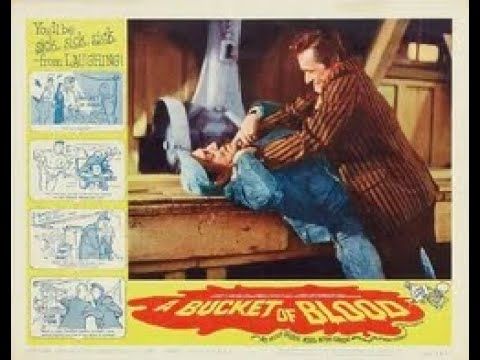
Dick Miller in Roger Corman's "A Bucket of Blood" (1959) - feat. Bert Convy

Download information and video details for Dick Miller in Roger Corman's "A Bucket of Blood" (1959) - feat. Bert Convy
Uploader:
Donald P. BorchersPublished at:
5/31/2025Views:
922Description:
Set in the West Coast beatnik culture of the late 1950s at The Yellow Door café. Impressionable busboy Walter Paisley (Dick Miller) hears poet Maxwell H. Brock (Julian Burton) with admiration. Paisley is in love with the hostess, Clara (Barboura Morris), and attempts to create a sculpture of her face. He stops when he hears the landlady's, Mrs. Swickert (Myrtle Vail) cat, Frankie, stuck in the wall. Walter attempts to get Frankie out using a knife, but accidentally kills it. Instead of a proper burial, Walter covers the cat in clay, leaving the knife stuck in it. The next morning, Walter shows the cat to Carla and his boss Leonard de Santis (Antony Carbone). Carla convinces Leonard to display it in the café. Walter receives praise from the beatniks. An adoring fan, Naolia (Jhean Burton), gives him a vial of heroin, and he is followed by an undercover cop, Lou Raby (Bert Convy). Thinking Lou is about to shoot him, Walter panics, and hits him with the frying pan he is holding, killing Lou. Meanwhile, Walter's boss discovers the secret behind Walter's Dead Cat piece when he sees fur sticking out of it. The next morning, Walter says he has a new piece, the Murdered Man. Carla critiques it as "hideous and eloquent" and deserving of a public exhibition. Leonard is aghast, but realizes the potential for wealth. The next night, Walter is treated like a king, except by a blonde model, Alice (Judy Bamber). Walter offers to pay her to model. At Walter's apartment, Alice strips nude and poses. Walter strangles her, and creates a statue of Alice which impresses Brock, and he throws a party in Walter's honor. After the party, Walter later stumbles towards his apartment. Still drunk, he beheads a factory worker with his own buzzsaw to create a bust. When he shows the head to Leonard, the boss realizes that he must stop Walter's murderous rampage and promises Walter a show to offload his latest "sculptures". At the exhibit, Carla finds part of the clay on one figure has worn away, revealing Alice's finger. She flees, Walter chases, and the others at the exhibit learn Walter's secret and join the chase. Haunted by the voices of Lou and Alice, Walter stops chasing Carla, and runs home. The police, Carla, Leonard, Maxwell, and the others break down Walter's apartment door only to find that Walter has hanged himself. Looking askance at the hanging, clay-daubed corpse, Maxwell proclaims, "I suppose he would have called it Hanging Man ... his greatest work." A 1959 American Black & White comedy horror film (a/k/a "'The Living Dead") produced & directed by Roger Corman, written by Charles B. Griffith, cinematography by Jacques R. Marquette, starring Dick Miller, Barboura Morris, Antony Carbone, Julian Burton, Ed Nelson, John Brinkley, John Herman Shaner, Judy Bamber, Myrtle Vail, Bert Convy, and Jhean Burton. Released by American International Pictures. The guitar player (and singer) at the night club is Alex Hassilev, who was soon to form the popular folk trio The Limeliters with Louis Gottlieb and Glenn Yarbrough. Shot in five days, this was the first of a trio of collaborations between Corman and Griffith in the comedy genre, including "The Little Shop of Horrors" (which was shot on the same sets as this film) and "Creature from the Haunted Sea". The genesis of the film was an evening Corman and Griffith spent drifting around the beatnik coffeehouses, observing the scene and tossing ideas and reactions back and forth until we had the basic story. By the end of the evening they developed the film's plot structure, partially basing the story upon "Mystery of the Wax Museum" (1933). The film is a satire not only of Corman's own films but also of the world of abstract art as well as low-budgeted teen films of the 1950s. Corman had made no previous attempt at the genre, although past and future Corman productions in other genres incorporated comedic elements. One of a wave of "cheap teen movies" released for the drive-in market, American International Pictures' theatrical marketing campaign emphasized the comedic aspects of the film's plot, proclaiming that the audience would be "sick, sick, sick—from laughing!", a reference to cartoonist Jules Feiffer's popular Village Voice comic strip and his 1958 book with the same title. The film's poster consists of a series of comic strip panels humorously hinting at the film's horror content. This was remade for television in 1995 under the same name, directed by comedian Michael McDonald and starring Anthony Michael Hall and Justine Bateman. Set in the Beat milieu of 1950s Southern California, this dark comic satire is an honest, undiscriminating portrayal of the many facets of beatnik culture, including poetry, dance, and a minimalist style of life. This macabre satire on beatniks and teenage horror films has some particularly adroit dialogue and tragi-comic situations. Dick Miller gives a performance of sustained poignancy as the half-wit hero. Considered Corman's best work.
Similar videos: Dick Miller in Roger Corman
Jennifer Jones, Joseph Cotten, Ethel Barrymore & Lillian Gish in "Portrait of Jennie" (1948)
Boris Karloff, Ralph Byrd & Anne Gwynne in "Dick Tracy Meets Gruesome" (1947)
Warner Oland in "Charlie Chan in Egypt" (1935) - feat. Rita Hayworth & Stepin Fetchit
Fear and Loathing in Las Vegas (3/10) Movie CLIP - The Hotel on Acid (1998) HD

Zachary Scott in Jean Renoir's "The Southerner" (1945)