Diesel Engine, How it works ?
Download information and video details for Diesel Engine, How it works ?
Uploader:
Sabin Civil EngineeringPublished at:
7/2/2014Views:
7.4MDescription:
Video Transcription
An internal combustion engine transforms the chemical energy in fuel to mechanical energy.
Diesel engines, which have been serving mankind for over a century, are the most versatile and economical IC engines.
To release the chemical energy in diesel effectively, an atomized form of the fuel is made to contact with high temperature and high pressure air.
this energy is effectively transferred as mechanical rotational energy so the operation of a diesel engine is all about producing high temperature and high pressure air continuously we will see how this is achieved in this video piston connecting rod
cylinder form a mechanism called slider crank mechanism here the linear motion of the piston is transformed to a rotary motion at the crank in an IC engine this mechanism is properly supported in an engine block cylinder head valves and fuel injector are fitted above the engine block
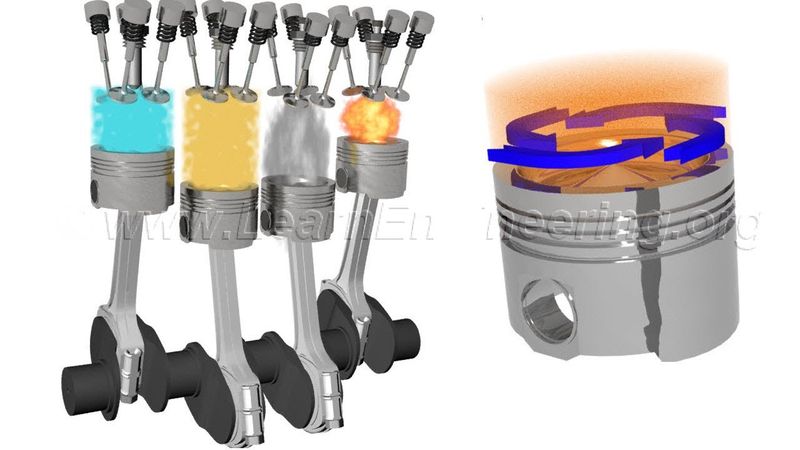
When the piston moves downwards, inlet valves open and fresh air from outside is sucked in, or in other words, the engine breathes.
During the return stroke, inlet and exhaust valves are closed and the air inside the cylinder gets compressed.
During the compression stroke, the piston does work on the air, so the temperature and pressure of the air will rise to a level which is higher than the self-ignition value of the diesel.
An atomized form of diesel is injected into this compressed air.
The fuel gets evaporated and undergoes an uncontrolled spontaneous explosion.
As a result, the pressure and temperature rise to high level values.
The high energy fluid pushes the piston downwards.
The hot air does work on the piston and energy in the fluid is converted to the mechanical energy of the piston.
This is the only stroke where the piston absorbs power from the fluid.
Due to inertia of the system, the piston moves upwards again.
This time, the exhaust valves open and the exhaust is rejected.
again the suction stroke happens this cycle which has a total four strokes is repeated over and over for continuous power production you may have noticed that a bowl is provided on top of the diesel engine piston during the compression stroke this bowl helps produce air that is rapidly swirling
thus the injected fuel gets mixed with the air effectively the mechanical design of IC engines particularly that of diesel engines is a challenging and interesting task since the combustion process in diesel engines is never uniform and smooth they are prone to more vibration and noise compared to petrol engines
Thus diesel engines require a rugged structural design.
Out of the four strokes, it is only during the power stroke that a tremendous amount of force is exerted on the piston.
So a single cylinder engine will always have high force non-uniformity as shown.
Similarly, the output power will also have a fluctuating nature.
But with more number of cylinders, one can overcome these problems.
Consider this four cylinder engine.
Here, four different strokes can occur at a time.
so the power stroke is always present in the engine.
As a result, a four cylinder engine will have better force and power uniformity.
In short, the more cylinders an engine has, the smoother it will operate.
A four cylinder engine generally operates on the following firing order.
A heavy flywheel which acts like a power reservoir further helps in smoothing out non-uniformity of power.
A huge unbalanced force arises in the form of dynamic unbalance due to the excessive mass at the connecting rod side.
This is negated by providing counterweights on the crank side.
Opening and closing of valves are accurately controlled by a pair of camshafts.
Camshafts derive motion from the engine.
It is clear that the camshafts need to rotate at half the speed of crankshafts.
We hope you had a nice introduction on the working of diesel engines.
Thank you.
Similar videos: Diesel Engine
Переделка двигателя ДВС под работу НА ВОЗДУХЕ - air engine
Хронические неисправности ТНВД Lucas EPIC на Mercedes Benz E Class W210 2.0d OM604
The Strongest Inline-Six Engine Is...

Powerful turbojet engine #jetengine #enginemodel #jetengines #turbojetengine #engine #diy #rc
Чем отличаются бензин, дизель и керосин?— три топлива, три разных мира