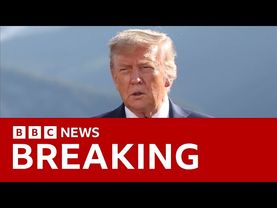
Donald Trump hails 'bullseye' strikes on Iranian nuclear sites | BBC News
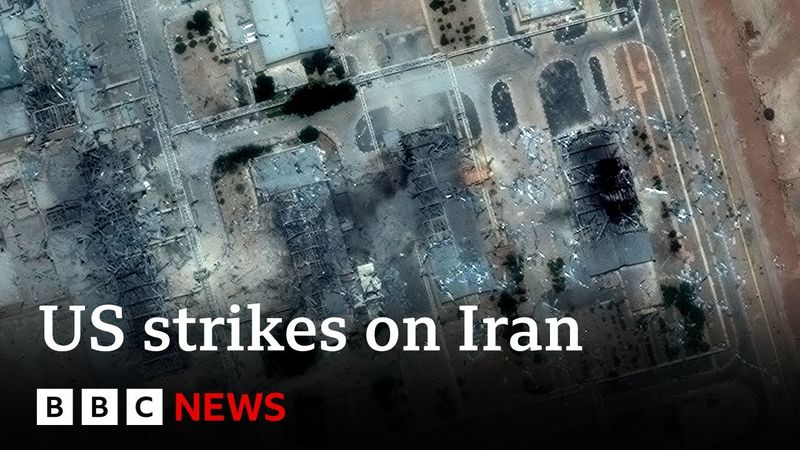
Download information and video details for Donald Trump hails 'bullseye' strikes on Iranian nuclear sites | BBC News
Uploader:
BBC NewsPublished at:
6/23/2025Views:
1.9KDescription:
Video Transcription
President Trump has raised the possibility of regime change in Iran despite his administration insisting that was not the aim of its strikes on the country.
At an emergency session of the United Nations Security Council, Iran condemned the attacks as blatant aggression.
It comes as American stealth bombers return to base in the United States after striking those nuclear facilities.
The B-2 planes were involved in a 37-hour round-trip flight with multiple mid-air refuelings and a series of decoys.
The UN says the full extent of the damage is not yet clear.
Although in the last few hours, President Trump posted that monumental damage was done, adding obliteration is an accurate term.
He said the biggest damage took place far below ground level, ending his post with the word bullseye.
At the United Nations Security Council emergency meeting, the Iranian ambassador accused the US of waging war under an absurd pretext.
The US envoy said any Iranian attack, direct or indirect, against Americans or American bases will be met with devastating retaliation.
At the same time, President Trump, in a post on social media, hinted at regime change in Iran.
The British Prime Minister, Sir Keir Starmer, spoke on the phone to President Trump last night and agreed Iran must never have nuclear weapons.
It comes as one of the big questions is, will Iran try to close the strategic straits of Hormuz that would certainly have major economic, political and military consequences?
Coming up, we'll look at what Iran might do next.
But let's start with that UN Security Council emergency meeting.
Russia and China pushed for an immediate ceasefire, with Beijing condemning the US strikes as violations of international law.
Iran's ambassador called them a blatant aggression.
The United States, a permanent member of this council,
The depository of the NPT and the only state that has ever used nuclear weapons, murdering millions in two cities, has now once again restored it to illegal force, waged a war against my country under a fabricated and absurd pretext, preventing Iran from acquiring nuclear weapons.
What a bitter and tragic irony.
Dorothy Shia represents the U.S. at the United Nations.
She said that in recent weeks, Iranian officials had intensified their hostile bluster and rhetoric.
The time finally came for the United States, in the defense of its ally and in the defense of our own citizens and interests, to act decisively.
The Iranian regime cannot have a nuclear weapon.
Let us be clear.
Iran should not escalate.
As President Trump said, any Iranian attack, direct or indirect, against Americans or American bases will be met with devastating retaliation.
Israel's U.N. representative said the U.S. strikes had changed history.
The United States, the leader of the free world, removed the greatest existential threat facing the free world.
Just like our Operation Rising Lion, this was not a war of choice.
This action was a necessity.
It was a righteous act for the United States, for Israel, for the Middle East and for the world.
But there were stark warnings from the UN chief, Antonio Guterres, and the head of the nuclear watchdog, Rafael Grossi.
From the outset of the crisis, I have repeatedly condemned any military escalation in the Middle East.
The people of the region cannot endure another cycle of destruction.
And yet, we now risk descending into a rathole of retaliation after retaliation.
To avoid it, diplomacy must prevail.
Civilians must be protected.
Safe maritime navigation must be guaranteed.
We must act immediately and decisively to halt the fighting and return to serious, sustained negotiations on the Iran nuclear program.
We have a window of opportunity to return to dialogue and diplomacy.
If that window
closes, violence and destruction could reach unthinkable levels and the global nonproliferation regime as we know it could crumble and fall.
Rafael Grossi there and the International Atomic Energy Agency has called for a crisis meeting that will take place today.
They'll discuss the risks posed to those nuclear sites in Iran.
President Trump has hinted that there could eventually be regime change in Iran.
Writing on his social media platform Truth Social, the U.S. president said...
It's not politically correct to use the term regime change, but if the current Iranian regime is unable to make Iran great again, why wouldn't there be a regime change meager?
Well, following the U.S. airstrikes on the Iranian nuclear sites, Mr. Trump insisted the U.S. was not pushing to remove Iranian leaders from office.
With his thoughts on President Trump's post, here's our North America correspondent, Anthony Zirka.
Marco Rubio, the Secretary of State, J.D.
Vance, the Vice President, and Pete Hegseth, the Secretary of Defense, they were on television here in the United States on Sunday morning assuring the country that they were not interested in regime change.
And then, as you mentioned, Donald Trump came out with that
post on Truth Social, raising the question the way he often does.
It was a question, not a statement, but raising the prospect of regime change.
And I think if you ask administration officials, they will tell you that Donald Trump is the only one who speaks for Donald Trump and for the administration.
If there was a concerted strategy this morning to downplay regime change, maybe Donald Trump just changed his mind, saw something on Fox News that made him think that this was a more realistic possibility and something that he wanted to float out there to get a conversation started.
Iran and Israel have continued to trade fire with military sites targeted from both sides.
If we look this morning at the scene in Tel Aviv, this is now there at nearly ten past eight.
A few hours ago, sirens were sounding across central Israel because of a missile launch from Iran.
In the last half an hour, the Israeli army has said it was striking military sites in West Iran.
The U.S. has issued a worldwide caution for Americans, saying the conflict between Israel and Iran could put those traveling or living abroad at increased security risk.
Protesters gathered outside the White House to protest the U.S. strikes on Iran's nuclear facilities.
They're urging the Trump administration to stay out of the region.
One founder of the anti-war group, Code Pink, said they're terrified this could lead to a World War III or a nuclear war.
Hundreds of protesters also marched through New York's Times Square, many chanting, no war on Iran, to show their opposition to the US bombing of the three nuclear sites.
Many at the demonstrations also criticized the close relationship between the US and Israel.
These pictures are from the Greek capital, Athens, where hundreds of demonstrators, many carrying red flags, banners and smoke grenades, marched to the US embassy in a protest.
It was organised by a group called the Youth Organisation of the Communist Party of Greece.
Well, whilst in Israel a number of landmarks were lit up in U.S. flag colors, they included the Parliament Building, the Knesset, Tel Aviv City Hall also lit up windows to display the U.S. and Israeli flags, whilst the stars and stripes were also projected on the walls of the Old City of Jerusalem.
Well, let's go live to Jerusalem now.
Our correspondent Dan Johnson is there this morning.
Hello to you, Dan.
Just talk us through what was going on overnight.
We were just reporting there that sirens were going off across central Israel again.
Yes, there was an air raid alert at about 3am here for a large part of the country, but it turned out that that was just one single missile, it appears, that was fired by Iran and successfully intercepted by the Israeli air defences.
There is also a report this morning of a drone having been sent towards Israel in the southern city of Eilat, but that
is also reported to have been successfully downed without causing any damage or injury.
We saw a huge barrage of missiles fired by Iran yesterday in initial response to these US attacks.
There was significant damage and a large number of injuries, more than 80 people
caught up in those attacks, but overnight it's been much quieter despite the continued Israeli airstrikes on different targets across Iran.
Most of them military targets, the Israelis trying to further deplete the Iranian capability for storing and launching the sorts of missiles that it has been using in its attacks on Israel every day since this conflict started.
So perhaps the fact that we've had such a
a relatively quiet night shows that the Iranian capabilities have been depleted over the 10 days of this conflict or that the Iranian leadership is just marking time whilst considering exactly what it is going to do next.
There are those
signs and pictures that you've talked about saying, thank you, Mr. President.
Donald Trump's picture is on advertising screens here.
The Israeli population, or probably a majority of it, expressing their gratitude to the U.S. president for having got involved.
But nobody here expects that to be an end of this conflict.
The Israeli military is still involved this morning.
in further airstrikes over Iran.
And all Israelis know that Iran can still pose a threat to this country with ballistic missiles.
It's just a question now of how many of those missiles Iran has left, what its capability is to launch and target them, and where it is going to aim them.
Will it be at this country?
Will it be at other potential US targets around the Middle East?
And that is already having a destabilising impact on the region.
There are further evacuation flights planned today for diplomats and for citizens of different nations.
who need to get home.
And there are also international flights being cancelled to places like Dubai because of the potential risk in the skies above the Middle East.
Okay, for now, thank you very much.
Dan Johnson there in Jerusalem for us.
Well, as we mentioned, the Prime Minister, Sir Keir Starmer, and President Trump have spoken on the phone since the US strikes on Iran.
Let's go live to Westminster now.
Our Chief Political Correspondent, Henry Zeffman.
A very tricky line the Prime Minister has to walk here.
Yeah, that's right.
And I think that's reflected in what we're told by Downing Street about what the prime minister and the US president discussed.
So Downing Street are saying that they reiterated the grave risk posed by Iran's nuclear program to international security.
They discussed the actions taken by the United States.
namely bombing of Iran's nuclear facilities, and agreed that Iran must never be allowed to develop a nuclear weapon.
It goes on to say they discussed the need for Iran to return to the negotiating table as soon as possible and to make progress on a lasting settlement.
And I think what you see in that account of that phone call is this slightly unusual position the U.K. finds itself in of agreeing
with the ends.
They agree with the US that Iran must be a non-nuclear country, but they don't agree quite in the same way at all on the means.
Namely, the UK was urging a diplomatic means to reaching that, and the US decided to participate in, or indeed to launch, its own strikes on Iran's nuclear facilities.
But I assume many in Parliament are quite nervous and concerned about what might happen next and where Britain will get drawn in.
Yeah, I mean, in some ways, the UK was given a sort of reprieve on that issue for now by the US, because the way in which it launched its strikes, flying those bombers all the way from Missouri, refueling midair, meant that the US did not end up asking the UK's permission to use the Diego Garcia Air Base, which the UK controls on the Chagos Islands,
to carry out those strikes.
That is something that there was a lot of sensitivity about in the UK government in the days in the run-up to these strikes, because that would have required the UK to make a decision.
Sure, it wouldn't have been UK fighter planes carrying out the strikes, but still it would have required the UK to say yes or no.
That didn't happen, but that's not to say it won't happen in the coming days or weeks.
Similar videos: Donald Trump hails
Donald Trump approves plans to attack Iran, CBS reports | BBC News
Iran and Israel exchange fire as Trump warns Iranians to evacuate Tehran | BBC News
US bombs Iran nuclear sites and Tehran warns of 'everlasting consequences' | BBC News
Tramps paziņo par ASV iesaisti karā pret Irānu; bombardēti Irānas kodolobjekti (ar subtitriem)
США атакували ядерні об'єкти в Ірані | Журналістка про реакцію Ізраїлю, Ірану та американців