Emmet Cohen Trio Featuring Benny Golson (Full Concert)
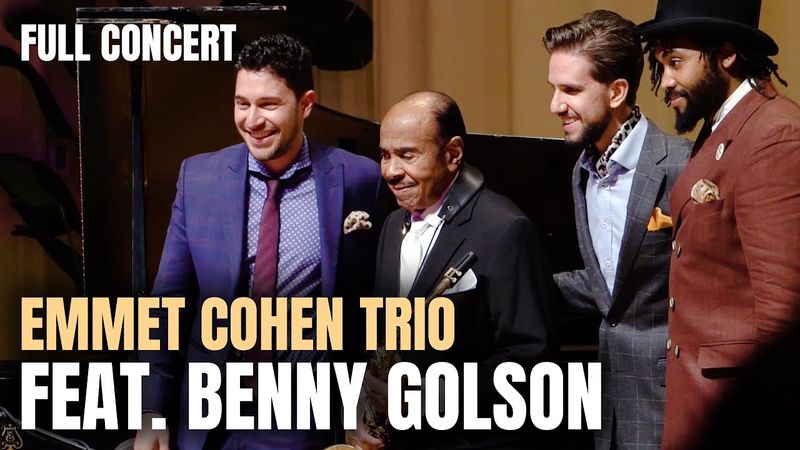
Download information and video details for Emmet Cohen Trio Featuring Benny Golson (Full Concert)
Uploader:
Emmet CohenPublished at:
9/24/2024Views:
23.2KVideo Transcription
Please join me in welcoming the Emmett Cohen Trio.
Mugenheim.
Robin Z.
Bye.
Thank you.
Thank you.
Thank you.
Bye.
Thank you.
Bye.
so
Thank you.
Hello, Grand Rapids.
Thank you all so much.
It's a pleasure to be back in this fantastic venue and in this soulful city of Grand Rapids.
I'd love to introduce you to these musicians on stage, some of the great jazz musicians in the world today, playing the drums and cymbals from Milburn, New Jersey, just down the road from where I grew up in Montclair, New Jersey.
We began playing together in high school, fell in love with this music together at the same time.
Went to go hear all the greats.
at the Village Vanguard, at the Blue Note, at Small's Jazz Club, at Smoke Jazz Club, we explored.
He went on from there to play with the great late Roy Hargrove, with Ron Carter, with Jimmy Heath, with many of the other jazz masters.
And it's a real joy to have been working with him for over a decade, making music and exploring the possibilities of jazz all over the world.
Please put your hands together for the fantastic Mr. Evan Sherman on the drums.
Playing the double bass this evening from Kingston, Jamaica, by way of Miami, Florida, where we also met in our formative years.
He was only a senior in high school and I was in college.
And he was out playing all the other bass players in town, in the whole school, in the whole city, in the whole state, probably.
And just a natural talent, made of music, made of art.
He's not only a great bass player, but he also sings.
He also is a vegan chef.
He also is a poet.
He's also an accomplished dancer.
He really is a Renaissance man.
And...
And, you know, we have to have a little humor up here.
But all those things are true.
That's why it's funny.
Because he can get really great at anything he puts his mind and his hands on.
And it's just been a pleasure to watch his life and his career take off.
After moving to New York, he went to the Juilliard School of Music, got a degree from there, and went on to perform with Jonathan Batiste on The Late Night Show with Stephen Colbert.
as well as Wynton Marsalis, Branford Marsalis, and many, many, many others, and just came out with his own album and his own new project, so we welcome him into this world as a band leader as well.
And it's been a joy to be with him all those years and to grow together, which is what this music is about.
Please put your hands together for Mr. Russell Alexander Hall.
And on the piano, yours truly, Emmett Cohen.
Thank you very much.
And tonight is very, very, very special.
Well, I'll tell you what we played first.
We played a song, old standard, entitled Time on My Hands.
We started with that.
And then that second one was from the Hebrew lexicon, something that Evan and I conceived that he heard in Hebrew school once upon a time, a long time ago, that we created a jazz version of.
And that's called the Hatsi Kaddish.
And this night is very, very special because we have with us one of the great jazz musicians of all time, one of the most special composers and musical minds and artistic American figures to ever grace the stage.
And he
celebrated 90 years on this earth last year and has another celebration of another year coming up this month in just a few days.
And still traveling, still fresh as ever.
Fresh as daisies, we like to say.
And he is just a complete human being and an improviser full of so much love, full of so much soul, and so generous with his time, his music, and his efforts to make the world a better place.
And we'd like to welcome to the stage one of the grand masters of jazz of all time.
Please put your hands together for Mr. Benny Golson.
That's Benny Golson.
At this point, I usually say it's good to be back, but I don't remember being here before.
But that doesn't matter, we're here now.
And our nexus is the music that we lovingly call jazz.
And we are now, for the next few months, going to be a metaphorical family.
And we're going to, from this stage, share things that we have in our minds and in our hearts with you.
And we hope that they satisfy you.
Yeah, in a sense, I guess it's good to be back because maybe you've heard our records.
Anyway, it's an honor for me to be playing with this trio here.
They're the best.
And that's what we want to involve ourselves with.
But you know, as musicians, we travel the world over.
We come in contact with different cultures and different people and even different foods.
But I'll tell you, we don't need any translators when we play this jazz.
And it's my contention that if
Everybody on the face of this earth were jazz fans.
We'd have no more wars.
We was gonna sit down and listen to Bird and Diz and Miles and Coltrane and then get up
with your gun and go out and kill somebody you've never seen before.
Yeah, it's too bad.
But we're trying.
And you know, I was talking with Sonny Rollins, oh, a while ago.
And you know, when musicians get together, we invariably talk about the music, of course.
And Sonny, during the conversation, said to me, you know, Benny, there's no end to this music we play.
And I thought, yeah, he's right.
No musician that I've ever known has said, well, I'll know there is.
I know all there is to know and there's no need to know anymore.
No, we're always trying to move ahead.
And Hank Jones, the late Hank Jones, the pianist, he said to me, Benny, you know, this music that we play and love so much, it's like the horizon.
Now, that's pretty philosophical.
It's like the horizon.
What did he mean?
And I thought about that.
And then I thought to myself, nobody ever says, well, here we are at the horizon.
There is no such a thing, you know?
But in our hearts, we'll never arrive at the horizon.
And realism says that we won't.
And tonight, we're going to reflect on that by playing our first tune.
And guess what the title is?
Horizon Ahead.
As the evening goes on, you'll see I like to talk.
And my wife says I talk too much.
But she's not here.
I'm from Philadelphia, and as a youngster, an amateur,
The old timers used to give us tips.
Don't do this when you play, do that when you play.
And then one day, one of the fellows said to me, now son, when you play, make it look difficult.
And I said, why?
Because if you make it look difficult, your audiences will appreciate you more.
you
Thank you.
You know, many of us musicians are composers.
Sometimes an idea comes and you wind up with a gem.
And sometimes nothing comes and you wind up with nothing.
But one day when I was a part of Dizzy Gillespie's band, we were playing in Boston,
I woke up with many ideas running through my mind, and I rushed over to the club.
Nobody was in the club, of course, except the bartender washing glasses, you know, like you see in the movies.
And I sat down to the piano, and it was one of those days.
I had so many ideas that I could hardly write them down.
And I'd come up with a tune in about 30 minutes,
And then I realized nobody writes a tune in 30 minutes.
This can't be worth anything.
And somehow Dizzy heard it and he liked it.
Well, what do you know?
We started to play it in the band.
And don't you know, we recorded it.
And then other people started to play it.
Now, my songs usually have a story to them, but this particular tune had no story.
There were just two words that I liked, and I made that the title.
And those two words were, whisper not.
And when I think about that tune, I think about the tune that means absolutely nothing.
And we're going to play that tune that means absolutely nothing, Whisper Not.
You said it sounded like Plato, one of the great philosophers.
Oh, we're getting personal now.
Did I make it look difficult?
Thank you.
Thank you.
Bye.
I've been working with this group for quite a while and I've been wondering all this time how the bass player was able to play all that stuff on the bass.
Tonight I've figured it out.
It's the hat.
I'll have to get one just like it.
And now I'd like to share my broken heart of a few years ago.
It wasn't a love affair, it was something else.
I was playing at the Apollo Theater in New York with Dizzy Gillespie's band, and during the break,
at the rear of the theater on 126th Street.
We were standing out there lollygagging, and we saw our piano player, the late Walter Davis Jr., come from around the corner on 8th Avenue.
Now, around that corner was, it was an oasis.
There were palm trees, there were camels,
There were sheiks.
Well, it was a bar.
And he was coming from the oasis.
And as he was walking toward us, we noticed that he was walking quite unstably.
And we thought, oh, Walter had been with the wine just a bit too long.
And sometimes that used to happen.
But we could cover pretty much that
With 15 men there, you could cover it.
But when he got a little closer, we noticed that he was crying, crying.
Walter Davis, Jr., a hulk of a man, at least 275 pounds, crying on the streets during the daylight hours.
Something had to be amiss.
And he got ever closer, and we heard the words coming from him.
Clifford Brown had been killed in an automobile accident.
Oh no, my goodness.
It couldn't be.
It had to be one of those rumors.
You heard that Joe died.
And you saw him the next day on the street, Joe, Joe, I thought you were dead.
Ron Carter told me he died twice.
But just then the bell rang and it was time for us to take our places behind the closed curtain while some unknown voice was telling you how great the band was.
all the psychological ploy to get the audience in the mood as the curtain swung open and the band went into what's known as a flag wave or something loud, something fast.
But while all this seeming happiness was going on, many of us were crying because with great incertitude, we were about to play that show
And all of that fast, loud sounding music didn't mean a thing because we loved Clifford.
Nobody called him Clifford in those days.
He was just brownie.
Was he really gone?
That was the weirdest show I ever played in my life.
But when the show was over,
Yes, Clifford Brown had been killed.
It was all on the television and newspapers and our hearts sank low, low.
We had two or three more days left at the Apollo and we would be heading to California to play a two week engagement there.
And when we got there,
I thought to myself, we're going to be here for two weeks.
Maybe I could write a song about my fallen hero who was taken away at 25 years of age much too soon.
Now, during those days, I was writing a lot of songs.
And you think I'm some kind of a genius.
But that's only because you never heard the dogs that I wrote.
I mean, during those days, if somebody sneezed, I would write a song about it.
But this song had to be different.
And it took me almost entire two weeks to put it together.
Now, I came in early to work and brought my uniform with me that night.
because I know I wouldn't be going back to the hotel.
And it so happened that Diz came in early.
Now, sometimes you think you have a gem and you don't.
I'm going to ask Diz what does he think about this tune.
And I told him my premise, what I was doing, Clifford Brown.
Do you have a moment to hear this?
He said, sure.
Just the two of us and the bartender washing glasses like you see in the movies.
He put his trumpet on the table and I began to play.
After about seven or eight bars, he opened his trumpet case and took his trumpet out.
And I'm thinking, oh my God, he loves it so much he's going to try to play it and he doesn't even know the tune.
But he fooled me.
He took out a plastic
that he had filled with kerosene.
And he used it to lubricate his valves.
And while I was playing my heart out, that's what he was doing, lubricating his valves.
And then he poured a little kerosene down the bell of the horn and blew into it.
The kerosene got all over me and the piano.
Oh, I was so disgusted.
But I finished the tune.
And when I finished, he put his trumpet down and he said, Benny, that's beautiful.
What is it?
What?
Oh my goodness.
He was listening.
He said to me something that I never expected him to say.
My heroes asked me, could he record it?
He didn't know when I was in high school, I used to keep his picture right on the wall at the foot of my bed, dreaming that same dream over and over.
Maybe one day I'd be good enough to play with Dizzy Gillespie.
And now my hero had come down off the wall and asked me, could he record my song?
Nobody knew who Benny Colson was during those days.
I could have come right here up on this stage buck naked.
Nobody would have paid any attention to it.
And then he asked me, what was the name of the tune?
I said, well, I don't have a name, Diz, but since it's about a friend of mine and ours, Clifford Brown, I might call it I Remember Clifford.
But at the same time, we had an 18-year-old trumpet player in the band who was from Philadelphia.
And Blue Note heard about him because he was hot.
Now, Dizzy had his first recording coming up in a month with Norman Grants.
You might remember Norman Grants, jazz the Philharmonic.
But now this fellow had his first recording coming up in two weeks with Blue Note Records.
And that was the late Lee Morgan who was playing trumpet with Dizzy.
He heard it.
Lee was the first to record it, followed by Dizzy Gillespie.
And you might remember a trumpet player named Donald Byrd.
He was number three.
I got a big surprise for that fourth recording because I'd written a piece about a trumpet player
And I thought that a trumpet player would be recording it.
Sonny Rollins recorded it.
Now, that was a big surprise.
And thereafter, many people started to record it.
Now, we're talking about quite a while ago.
But during that time, I went to Japan with Ron Carter.
And while I was there,
Now let me tell you about the Japanese.
If any one of them are a jazz fan, you could walk up to any one of them and ask, who played third alto with Benny Goodman in 1937?
Wham, they'd tell you like that.
And one of them asked me, Mr. Goldson, do you know how many recordings there are on I Remember Clifford?
I had no idea.
Never knew what's going to happen.
About a year later, right there in Manhattan, I was asked the same question.
Over 400 recordings.
Wow, incredible.
And they still ask me that question.
Last year, sometimes it was over 500 recordings on I Remember Clifford.
And I also found out during the interim that among musicians,
They play it at weddings.
Unfortunately, they play it at funerals.
They don't play them at divorces.
I remember I was on my way to play a gig in Copenhagen.
And sometimes a few people stand there with albums, something, and they want you to sign before they go in.
And this fellow was standing there by himself, and as I passed him, he said, may I speak with you just a moment, Mr. Goldstone?
And yes, I had time, of course.
And he told me that his wife had died
two weeks before, and they played it at her funeral.
And then they went into great detail.
And don't you know, both of us stood outside of that club crying.
Crying, yeah.
That happened because of I Remember Clifford.
Well, we're not going to cry now, but we are going to remember Clifford Brown.
one of my dearest friends whom I still miss to this very moment.
I've played this tune myriad times, but every time I play it, I wonder what would have happened had he not been killed.
And I tell many people I wish I'd never written it.
What do I mean by that?
If he hadn't been killed, I would have had no reason to write it.
That's why I remember Clifford.
I'll tell you why I'll do this.
Later.
?
?
Bye.
um um
.
.
A few years ago, oh, I didn't, I'm gonna tell you about.
Where is it?
People think I put it there to affect the sound of the horn somehow.
Years ago, I used to take it and lay it on the piano, on the drums,
And I used to lose them all the time.
Now I don't lose it anymore.
You know, a few years ago, I had the pleasure of going to Warsaw, Poland.
Yeah, lots of things there having to do with musical history.
And there was a fellow there
who played the accordion not too well.
And I came back to the States, and lo and behold, a short while later, I saw this fellow on TV playing to 10 million people every Saturday.
Thankfully, he left his accordion behind.
And his show began with a close-up on a glass of champagne with the bubbles rising to the top.
Yes, it was old Lawrence Welk.
But the music he'd put these musicians together
And the music was absolutely horrible.
And my wife's grandmother, she was there every Saturday.
And then time went by and I thought to myself, maybe I'm not being fair to old Lawrence.
I decided to listen in one Saturday.
And without my knowing, I had picked a Saturday whereby Lawrence was going to be hip.
Hip Lawrence Welk.
And what made him hip?
He was going to play Duke Ellington's theme song, Take the A-Train.
And we're about to play it now, but I want to tell you what happened.
He had his own way of introducing that song to 10 million people.
This is what he said.
Ladies and gentlemen, no musical program would be complete without a song from Duke Ellington.
And we're going to play his theme song for you now.
Take a Train.
Thank you.
Thank you.
Thank you.
I've played with groups before, and there's often at least one show-off in the group.
But three?
They're so good, we put up with it, yeah.
No, many years ago,
I joined Dizzy Gillespie's band.
In fact, during that time, I moved from Philadelphia to New York.
And I was rather green.
I had much to learn.
And we played at a club called Birdland quite often.
And the way the club was set up, the way the bandstand was set up,
As we were playing, we could see the people coming in, and I kept noticing a certain kind of guy.
Somehow he was always a black guy.
He had his hair quaffed, his fingernails manicured with expensive rings on his fingers.
expensive suits, expensive alligator shoes.
His Eldorado was being parked by the attendant upstairs.
And he usually had a woman with him draped in furs.
Sometimes he had one on each arm.
And he set the bar up and he paid with large bills.
And the thing that got me, I found out, it wasn't just one guy, there were many.
None of these guys worked.
I couldn't put it together.
And we left, we played Chicago, and I saw similar things.
Los Angeles, Boston, Oconomowoc, Wisconsin.
We came back to Birdland and it started all over again.
Now, the alto player sitting next to me, he was a little older and he had been around for a while.
And he saw that I was really confused by what I was seeing.
And he leaned over and confidentially said to me, these girls, they work for him.
Oh, I got it now.
Stenographers.
But at 3 o'clock in the morning?
Yeah, I finally put it together.
And I told you, I was writing tunes about everything.
Yeah, pimps.
It was all about pimps.
Yeah, I had to learn the hard way.
I got up one morning about 9 o'clock.
And I had these guys in mind.
I had to come up with the embodiment of one who would represent all of the pimps in the world.
And somehow,
I had two chords on my mind.
Now, I wanted to get the full feeling of those two chords, so I had to use both hands.
Well, I couldn't use both hands and play a melody.
I didn't have a third hand.
So the melodies were being created in my head.
Nobody could hear them.
All they heard
That is all my wife heard.
From nine o'clock in the morning till nine o'clock at night were those two chords.
What were those two chords?
Yeah, that were those two chords.
From nine in the morning till nine at night.
Now, it was wintertime, there was snow on the ground, and I noticed, kind of, that she kept leaving the apartment every hour or so.
She didn't take any coat with her, no scarf, no hat, no gloves.
And there was snow on the ground, but I didn't pay any attention because I was busy.
But later, I found out that hearing these chords all those hours, every now and then she was about to throw up.
And she had to leave the apartment.
Well, I finally finished the tune and I had to give it a title.
It had to be a common name.
Joe came to my mind.
And I remember as a kid, there was a lot of illegalities going on in Philadelphia.
The numbers, the horses, gambling, bootleg whiskey.
And there was always somebody in the group called Killer.
Killer Johnson, Killer Williams.
I think the moniker was to prove that they were at the top of their game.
My killer had to be Killer Joe.
I finally got the melody together.
And like I said, sometimes you don't know what you've got.
You think it's great and it's not.
So my wife was there.
I asked her, baby, I played it for her.
What do you think of this tune?
She'd been hearing these two chords for 12 hours.
She was waiting 12 hours for me to ask her.
She said, it will never make it.
It's too so-and-so monotonous.
But I went on and I recorded it.
I was working with a fellow named Art Farmer and we had a group called The Jazz Tent.
We recorded it anyway, not expecting much.
But the disc jockeys started to play it.
Wow.
People started buying the records.
When we played the clubs, Killer Joe, Killer Joe, they wanted to hear that song.
And even later,
The money started to roll in.
My wife bought one fur coat.
Then she bought a second one.
She even bought a third.
She loves Killer Joe.
One, two, three, four.
Uh-huh
Killer Joe.
Yeah, Killer knew I was coming to Grand Rapids.
He wanted me to let you know.
that he's got more secretaries.
You know, probably the best thing I can remember in my career as a jazz musician was playing with the drummer named Art Blakey.
Boy, oh boy.
Art Blakey, he had something special even though he was the world's biggest liar.
I got a call, I just moved to New York and it was Art Blakey and he wanted to know
could I come and sub for Jackie McLean, his regular saxophone player, who had fallen ill. And they were working in the village at Cafe Bohemia.
A chance to play with Art Blakey.
Oh, I had all of his records.
I knew what drummer he was, but I never played with him.
Oh, yes, I could come in and play that one night.
And I went in and I played that one night.
And at the end of the night, he said to me, look, Jackie's not really ready to come back right now.
Can you come in tomorrow?
And of course, I mean, I had one night actually playing with this guy.
And now I had the opportunity to play a second night.
Oh, of course.
But I didn't know that that was the beginning
of a disease that I was coming by called art blachyitis.
I came in and I played the second night.
And they asked me, could I come in the third night?
Oh, wow, yeah, I can come in.
Wow.
And the fourth night, I didn't know there was a fourth night.
No, the third night, he said to me, look,
Jackie's doing better, but he wants to do his own thing.
He wants to form his own group.
And he's going to be leaving the messengers.
Can you join the messengers?
I said, oh, Art, I'm so sorry.
I would love to be a part of the jazz messengers, but the reason I've moved to New York
It's because I want to write for all sorts of situations, singers and dancers, TV commercials, radio commercials.
I want to do it all, and if I join you, I would leave this, and I don't know if I would ever get back to it again.
So I'm sorry, I won't be able to join the messengers.
Now what I didn't know about Art Blakey, I didn't know that Art Blakey, aside from being a fantastic drummer,
Was a pocket psychologist.
And he went to work on me.
I didn't even know it.
I finished that week at Café Bohemia.
But the last couple of days.
He approached me.
And he said.
I know you want to establish yourself here.
But look.
I've got a week in Pittsburgh, and if you played that week, that wouldn't disrupt your plans, would it?
And I thought, no, not one week.
And after all, I'd had five days with Art Blakey, and that Art Blakey-itis was really setting in, so I was kind of looking forward to that week in Pittsburgh.
But I wasn't a member of the group, no, not then, no, no.
We went to Pittsburgh.
And toward the end of that week, he said to me, Benny, didn't you go to college in Washington, DC?
I said, yes.
He said, I bet you know a lot of people there.
I said, yeah, it's like a second home.
He said, I bet you they would be glad to see you.
I said, yes, probably.
I was a jazz messenger.
Yes, a jazz messenger.
And during one of the breaks on one of those jobs, and I knew how much money he was getting, I said, Art, the way you play, you should be a millionaire.
And when I mentioned the word millionaire, his eyes widened.
He said, what should I do?
Now, I knew the guys in the band.
It was terrible.
And I said, get a new band.
Because certain things were happening on the bandstand that should not have been happening.
And I said, besides art, you play your drum solo at the end of the piece like any ordinary drummer.
You're the leader.
Do something to garner the audience's attention at the beginning, like that recording you did with Thelonious Monk, Straight No Chaser.
You started with one hand, and then you added another hand, one foot, and then you added the other foot.
You had four independent things going.
You need something like that to garner their attention.
And then we thought a while.
I said, but you've played everything there is to play.
And then a bizarre thought crossed my mind.
I said, you've played everything there is to play except a march.
And we both rollicked in mirth.
Oh, how ridiculous.
And I stopped laughing.
And I looked at him and I said, well, except a march.
He never did call me Benny.
He looked at me and said, Golsan, you've got to be kidding.
Nobody plays a march in jazz.
except in New Orleans when they're going to the graveyard.
I don't want to play a march.
I said, all right, let me try to do something different.
And I'm not talking about a typical military march.
Have you ever heard that college in the south grambling?
Have you ever heard them play their marches?
I said, their marches are dirty and funky and greasy.
Golson, it'll never work.
I said, well Art, let me try.
I was begging the man.
And finally he said, okay.
He only said okay because he knew it would not work.
Okay, I had to go ahead.
Now I just moved to New York and I said I had a room with my aunt, but I didn't have a piano.
I bought a secondhand upright piano and I got it for $50.
And the reason I got it for $50, whoever had it before, well, it was black, they got creative with the sight of it.
They decided they were going to paint it a beautiful emerald green, but they got halfway completed, and they weren't satisfied, and they just left it like that.
So when I bought it, it was half black and half green.
And I got it for $50.
And I started to put together a march.
What would it be?
What would the concept be?
Well, part of the title would be March, but what kind of march?
Well, what would be typical in jazz?
Mm, blues.
Blues march.
Ah, that's what I'll call it.
I'll call it Blues March.
Now, we happened to be working uptown.
What was the name of that club?
I can't remember.
Seventh Avenue and 135th Street.
Smalls, Smalls Paradise.
I said, okay, we had the rehearsal.
I had to call the rehearsal first.
And I said, Art, we're going to play this march now.
I want you to play up front.
He said, well, what am I going to play?
I said, remember when the drum and bugle chords used to come through the neighborhood?
When the drum stopped, I'm sorry, when the bugle stopped, the snare drum, the cymbals, and the bass drum, they played.
Try to simulate something like that.
And he said to me, well, how long should I play?
I said, play as long as you like.
He said, well, how are you and Lee going to know when they're coming?
That's Lee Morgan.
I said, play a rolloff.
He said, what's a rolloff?
Well, I couldn't play the drums.
I did it with my mouth.
Play the rolloff.
I said, play that.
I said, all right.
So you can see I like to talk.
So that night, I said, ladies and gentlemen, something like this.
You're about to hear something that you would not expect to hear within the realm of jazz.
It's going to be a march, but a different kind of march.
And it's going to feature our drummer, Art Blagey, and blah, blah, blah, blah, blah.
And Art started off, OK?
But what he did, he added a Bobby Blue Bland back beat to what he was doing.
Now, the audience, they didn't know what to expect.
So they couldn't strike a groove because they didn't know what he was going to do.
So they were sitting there like this.
And when he added that Bobby Blue Bland back beat, uh-oh.
Now, let me tell you this.
There were three or four signs on the wall.
No dancing, please.
It was kind of small.
There wasn't any room for any dancing.
No dancing, please.
Okay, remember that.
And he added that back beat and the head started to move.
And then Lee Morgan came in after the roll-off.
Then they started snapping their fingers and their head.
By the time I came in, they got up and started dancing and knocking the drinks over on the floor and Art was swinging and he couldn't believe what was happening.
He looked over at me and he said, I'll be damned.
And from that night until he died, he played Blues March, and anybody who joined the Messengers had to play Blues March.
Now, Art Blakey is gone, but we have other drummers.
This is our last tune?
Yeah.
And this is going to be our last tune.
And what a gala tune it's going to be.
Like I said, Art Blakey is gone.
But we have other drummers.
And this drummer wasn't even in the military.
But check out what he's going to do with Blues March.
You set your own tempo.
Are you a lazy walker marcher?
Or do you have pep?
Tune us in.
Thank you.
Thank you.
Thank you.
Gentlemen, we have appreciated your presence.
A horrible thought.
Suppose we were to show up at a place like this and nobody was here.
We need you.
Because you make us who we are.
Oh, we wouldn't be where we are without you.
As I said, we are metaphorically a family.
And we love each other.
We play the music, you listen to it.
And we hope sometimes you take a part of us home with you.
And sometimes a groove gets so good, we wish we could take it home in a sandwich bag.
We have enjoyed playing for you, and we look forward to the next time.
Thank you.
Thank you so much.
Ladies and gentlemen, Evan Sherman on the drums.
Russell Hall on the bass.
Yours truly, Emmett Cohen on the piano.
And Grandmaster Benny Golson on the saxophone.
That's Benny Golson.
Emmett Cohen.
Similar videos: Emmet Cohen Trio Featuring Benny Golson
Артём Елекоев - J. S. Bach: BWV 669: Kyrie, Gott Vater in Ewigkeit
Come Thou Fount

Re-Stream: Emmet Cohen & Friends WNYC Holiday Show
Стихи Алексея Гомана на концерте в КЦ "Вдохновение" 17.11.2018 г.
Heartwarming Chuppah Ft. Meilech Braunstein, Avrum Mordche Schwartz, Negina & Benny Bransdorfer Band