
Etude No. 1 by Heitor Villa-Lobos | Guitar Etudes with Gohar Vardanyan
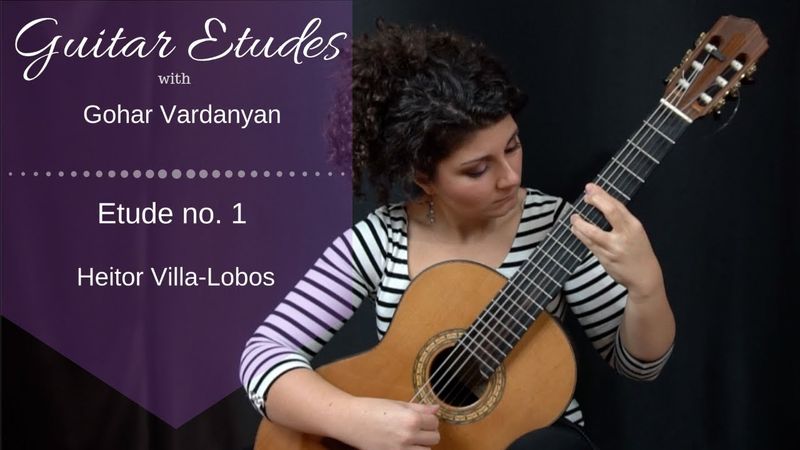
Download information and video details for Etude No. 1 by Heitor Villa-Lobos | Guitar Etudes with Gohar Vardanyan
Uploader:
Gohar VardanyanPublished at:
2/8/2019Views:
84.9KVideo Transcription
Hi everyone, I'm Gohar Vardanyan and welcome back to the Guitar Etude Series.
Today we have Etude No.
1 by Eitor Villalobos.
Thank you.
Thank you.
I'm sure you have already heard this piece, or at the very least you have heard about it.
This is one of those etus that's probably every single guitarist out there or guitar student out there has played it at some point or another in their guitar life.
And that's because it's a really cool, unique right-hand pattern that's pretty intricate.
You're supposed to travel across all six strings with a specific P-I-P-I-P-M-I-A-M-A.
pattern and it's really a lot of times when the teachers assign this to us it's for the combination that's the difficulty of it a lot of times we play this when you get to this part the sound either struggles or the evenness struggles there
because of the A and M combination.
So I would say if you want to have less trouble with this pattern, try to work on your A and M in other etudes that are concentrating only on that or have a pattern that you can just change to M and A and get used to having these two fingers independent from each other so when you put it into context of something a little bit more confusing, you are not struggling when you get to that part.
Now because this is quite an advanced etude and there are already so many videos out there, I'm going to try to keep this lesson brief.
Otherwise we could go an hour talking about everything that you could do to it musically, technically everything.
So I'm going to concentrate on some of the basics that will get you started.
and some of the ways that I like to practice the pattern.
So first let's do the right hand pattern.
I like to accent different notes out of the pattern.
So normally you just have this and you would do the dynamics whether it's a crescendo, decrescendo or if any note is accented according to your
musical interpretation.
But from the technical standpoint, I like to work on the A finger, for example.
So if I'm doing P-I, P-I, P-M, when I get to the A finger, I like to accent it.
So the A, the E note with the A finger comes out.
Then you would accent the M finger.
And the difficulty there is those notes that you are accenting, they're not on the beat.
Well, for the M, one of them is on the beat, the other two are not.
So you create this really cool offbeat accented sound when you're playing it.
And you can use that
as a rhythmic guide to know which notes you're going to accent or you can start feeling which finger is playing.
The reason I like to accent is to really be more in touch with what my right hand is doing because it's so, maybe not so easy, but so much easier to sort of commit the pattern into muscle memory and just leave your hand to do whatever it wants and it'll probably hit the right notes.
But if you really wanted to control what you're doing, you need to be aware
what finger is playing on what string and by specifically bringing out a certain note you're doing exactly that and later on when you are playing repertoire and you have some sort of musical idea where you want to crescendo something accent something articulate something a certain way if you've trained your hand to listen to your inner sort of
idea for accents and your hand just does it for you, that makes it so much easier than having to specifically practice accenting that note in that piece.
This way you are training your hand to be able to respond to your musical ideas by being aware of what note you are playing
in that particular pattern.
So you do that with the M, you can do the same thing with I.
And when I do I, because the I plays two different strings, I play it on the, let's say, only the third string.
And you can do the same thing to the fourth string and alternate between I and P that plays the fourth string.
So those are some ideas for the right hand.
I'm sure you've, in other videos that you have watched about this etude, you've probably learned about changing the right hand pattern.
A lot of times you can just do OPI.
Oh, sorry.
OPI or LP.
And you can really do whatever fingering you want.
Use the same string combination and just change the right hand to have a different practice routine.
It really depends on how much time you have.
Another thing to concentrate on is the left hand.
Oftentimes we forget how difficult the left hand in this etude is.
So because we're so concentrated on what we're doing in the right hand, the left hand is equally difficult.
um i usually shy away from assigning this etude to anyone who has trouble with bars because there are a lot of bars and let's just say not all bars are created equal um full bars with like a major chord shape like this that has the second finger and a fourth and third in this shape they're a lot easier to do because this kind of is more natural for us and besides here whether it's this one or that one the minor
the notes that are most difficult to get with the first finger, which are the ones in the middle, they're already masked with these three fingers.
So your first finger does not need to work that hard.
It just needs to get the bass and the top.
So major chord shapes or these minor ones, they're easier because the difficult part of the bar is not really under the bar.
The difficult notes under the bar are not being used.
In this etude, you have bar chords that are exposing
those difficult notes in the bar by not having anything covering them here.
So for example, a chord shape like this, which occurs, I think, three times.
This is more difficult because that fourth string and then the second string, you need to be able to do that with the first finger.
That's this part of the finger pressing down.
And a little segue, I did a video on bar chords and how not to
just use brute force to play bar chords for the strings by mail channel a while back i'll link it up in the description box and in the info thing up here so you can reference it so you're not just using like brute force you have to be smart about your bars um use the weight of your hand and train your finger to be able to play place pressure in different parts of the finger now these chords the ones that expose the fourth string or the third string they're more difficult to play another one here
you need to be able to get this fourth string because there is no pinky covering that note so that makes it more difficult for the left hand and some of them in a lower position in the second position part of the heart so the reason i don't assign this as also a bar exercise because you could say like well i'm going to learn this at you to to work on my bars and you could but you have to be aware that whenever something's very difficult for the left hand
you end up putting effort in it, maybe pressing harder.
And when there is tension in the left hand, that tension travels to the right hand and then your right hand becomes tense and it's difficult to play.
So by having already something difficult in the right hand, where having extra tension will not help you being able to get through the strings pretty fast, if your bars are adding onto it, it's not gonna be helpful.
So I would say approach this etude when you are,
more comfortable with bar chords and you're not struggling to get them clean before you play this.
Aside from the bar chords, the transitions can be pretty tricky.
However, there is a remedy for that.
The saving grace for guitarists is arpeggiated patterns.
It's so nice that we don't have to play blocked chords.
The most difficult thing is when you have to play all notes at the same time and change the left hand simultaneously.
When you have arpeggios, if you're smart about it, you will change the notes based on the order that you are playing.
So in this case, going from the first chord to the second, I don't need to put all of these at the same time.
You could train yourself to do that, and eventually you will have that muscle memory where you can.
But it's smarter to think about the first note that you need, first one is open, then I need the fourth finger, then I need the third, then second, and then only a
so i can start i can do this i can just allow my fingers to fall in the order that i'm plugging same thing with the next one i need the third first and then i can put the second one same thing here i'll need these first these two maybe like the first two i can put together because it happens pretty quickly but i don't need to worry about these guys
until I play all of these notes and then I bring it here.
And so on.
So think about the transitions.
Go for the first note you're actually going to pluck and then build the rest of it around it.
If it's easier to place two, go for it, but don't try to get all four or how many other fingers you need.
That will be helpful here as well.
This transition to this chord here
is harder because the action on the guitar is higher here so if you're not completely accurate it's very easy to miss a string and land in between them so if you think from here to aim for the third finger and then these two and only then think about the beginning you will save yourself a lot of trouble trying to land on this chord all at once
Now, speaking of that chord particularly, a lot of times we get here and we're like, oh, you know, I made it.
It's going to be smooth sailing after this.
I'm just going to move the same chord down.
And yes, you don't have any more difficult transitions.
However, this is where you will feel your left hand fatiguing and starting to hurt because you're not used to it.
As you play this,
It's sort of like holding a plank with all of the other chords, even though they might be more difficult.
When you are shifting, you are releasing your hand and you are using different combination of fingers.
So different muscles are working.
So they're not as fatiguing.
Here, you have this one exact chord shape and you have to maintain the pressure and keep switching.
And you can't really let go.
Not really.
You could relax it a little bit as you switch, but there's not really enough.
And as you get further back, your hand gets wider and wider, so it gets more and more difficult.
And you'll feel that somewhere in the middle when you're learning it, that your hand is getting really tired.
So if that happens, you just have to take a break, relax your hand, come back to it so you're not really fatiguing and hurting yourself.
Eventually you'll build the stamina where it's not a big deal, but you will notice that it happens in what's called the easy section.
It's not easy because you really are using the same muscles for a prolonged amount of time.
I would say in the beginning, if that gives you trouble, but you still want to play the whole piece, cut the repeat.
So instead of playing this twice, just play it once.
So you basically cut the time in half that you have to hold this chord and your thumb muscle here would be working.
That's for this chord.
But another thing that this chord does, it reflects on the right hand and you wouldn't really think so, but you'll notice that going from here, everything's going smoothly.
you get this chord and then you'll notice that somehow your right hand is messing up even though you got the chord and there could be two things it could be concentration you were so concentrated on this transition and you kind of the right hand sort of lost its balance but really what's happening is when you press the chord down here because it's so high up if you just looked down
at the string indentation on the right side, you'll notice that from this bar chord, everything's pretty even.
You have a pretty flat terrain.
And then as you go here and you look down, you have this really up and down terrain under your right hand.
So all of a sudden, you are used to having the strings in a certain place.
And then here, you have this E string pop up, right?
Because you released it.
Now it's a higher string.
And then you're pressing the middle strings in the middle in different places.
So if you just look at it, even the transition between the sixth string and the fifth string, it's not straight down anymore.
If I go down, there is no string there.
My string has been indented and pushed in.
So I actually have to dig deeper to reach that.
the same thing happens on the other end where your a finger and the m finger so when you play here your terrain is uneven and your right hand is going to be uneven unless you are practicing it slowly and making sure you are hitting the strings with the same beautiful tone the same volume and you are aware that it's not going to feel the same as it did in the opening because you really might think i'm doing the same thing what's the big deal
um and the tension of the strings is different so you have two open strings that are looser and middle strings that are pressed pretty high up where their tension is higher so that will happen as you go down that will even out and will be a lot easier so really i think those are the the basics that i i can cover in a short amount of time because these lessons aren't really supposed to be
an hour long.
The only thing that I can think of, the only other thing, is to mention the left hand fingerings that I use for that one middle section that is two measures long with the slur.
So what I do there is your E minor chord here, I end up landing on this G with my third finger and shape that like that instead of this so that I can slide with the second finger and then have my one and two do all the slurs and so on.
This ends up being maybe a little tricky at first, but I use my open strings and you have a bunch of them during which to travel.
So you actually don't need to rush here at all because you're just waiting around on open strings.
You can really shape your hand the way they need to be.
Place the three and the other ones.
And for the right hand,
I do that with P, I, B, I, B, M, I, A, just the way it goes up.
Then the next note in the pattern would have been M, but because I want to align my fingers properly, I end up doing P, I, B, I, B, M, I, A, I on that last B.
When I shift to the G, I use my M, and then the rest of it is just M, I's, and then I, M.
And I do those, actually I don't remember if I do them free stroke or rest stroke.
I think I'm doing them rest stroke, but it's really up to you what you do.
That fingering I think works better, at least for me.
There are a number of fingerings that I've seen people do, including playing something higher up.
feel free to experiment try out what i'm doing see if that works for you and if it doesn't work out then look at other guitarists and see how they have made it easier for for them to to work it out that section you will find that you will have to practice separately um you will have to do that way more than the rest of the piece so that when it comes to playing through and then going through it
you can execute it so it's not going to come easy because it breaks from the pattern it's something fast um all that time your left hand has been kind of static holding force down and all of a sudden now it needs to move fast so you will we will find that you have to practice that in isolation so i hope that was helpful i know we kind of went through um points quickly but this video is going to be long regardless and i will see you next uh next time hopefully in a couple of weeks with a new etude thank you so much for watching
Similar videos: Etude No

Why this is Red Hot Chili Peppers’ HARDEST GUITAR RIFF

Elektronomia - Limitless 10 HOURS LOOP

Playing Guitar In A Nuclear Power Plant (sounds BEAUTIFUL!)
The Best 5 Minutes You’ll Spend Learning Guitar

(I Can't Get No) SATISFACTION - The Rolling Stones Full Cover (Jagger/Richards)