Every Hideo Kojima Game, Ranked
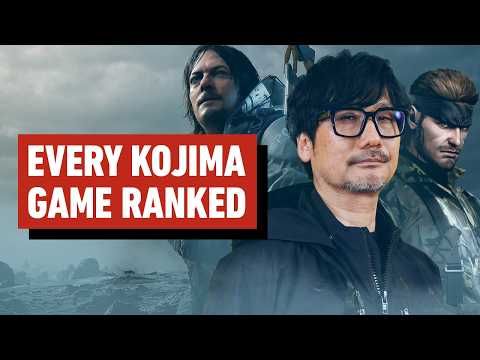
Download information and video details for Every Hideo Kojima Game, Ranked
Uploader:
IGNPublished at:
6/23/2025Views:
298Description:
Video Transcription
With the release of Death Stranding 2 on the beach, Hideo Kojima enters his fourth decade in game development as a director.
While the celebrated auteur has spent the majority of his career so far working on the Metal Gear series, Death Stranding 2 sees him expanding upon his newest universe, where he both introduces new concepts and revisits some of his most enduring ideas.
With a truly staggering list of credits and his impressive resume, there's no better time to revisit every genre-defying adventure Kojima has taken us on.
Here is every game designed or directed by Hideo Kojima, ranked worst to best by IGN staff.
Before the Metal Gear Solid series took over his life, Kojima dabbled in the graphic adventure genre.
One of his earliest games, Policenauts, is a point-and-click visual novel for the PC-9821, billed as a hard science fiction detective story.
Set in the not-too-distant future, players take on the role of Jonathan Ingram, an astronaut turned hard-boiled LA detective investigating a man's disappearance.
Get it?
He's a police astronaut.
As a visual novel, Policenauts doesn't have the level of gameplay innovations that Kojima would eventually become known for, but this early work highlights how movies, in this case buddy cop films like Lethal Weapon, would seep into his video game works for years to come.
Policenauts was never officially released outside of Japan, but Metal Gear Solid fans have been exposed to more of its DNA than they might realize.
For starters, you know that little synthesized choral jingle that plays over the Konami logo at the beginning of Metal Gear Solid 1?
Yeah, that one.
That was lifted directly from the Policenauts soundtrack.
More obviously, in that game Otacon has a Policenauts poster hanging in his office suggesting that Policenauts exists as a video game within the Metal Gear universe, but Policenauts almost took place in the Metal Gear universe instead.
Ultimately, the timeline didn't make sense, so they exist as separate works of fiction.
But they do both coincidentally feature a tough redhead named Meryl Silverberg.
Before there was Policenauts, Kojima had already dabbled with graphic adventure games.
Clearly influenced by cyberpunk stories like Blade Runner, Snatcher is set in a futuristic city where human-like robots known as Snatchers are murdering humans, with special members of the anti-Snatcher force tasked to stop them.
So yeah, it's basically bootleg Blade Runner.
Give us two regular Neo Kobe pizzas.
Originally released for PC, Snatcher received a Sega CD port that got a fully localized Western release, making it the second Kojima game to be released outside of Japan following the original Metal Gear.
Critics were able to overlook how much Snatcher had unabashedly snatched from Ridley Scott's iconic android film, and instead praised it for how well it took those ideas to even more extreme places with violence, humor, and an operatic scope that was ahead of most visual novels at the time.
Unbeknownst to Western audiences, they got a watered-down version.
For the localization, Konami had opted to censor some parts of the game, mostly for sexually explicit material, but also out of concern that a thinly-veiled Blade Runner knockoff featuring cameos from C-3PO, Dr. Zaius, and a xenomorph might be playing a little too fast and loose with copyright infringement
even by Konami standards.
Despite its positive reception, Snatcher's Sega CD release only sold a few thousand copies in the West, making it so hard to find now that collectors will regularly shell out more than a thousand dollars for a copy in good condition.
Following the success of the very first Metal Gear, Konami pushed out a sequel on the NES called Snake's Revenge, but without any involvement from Hideo Kojima.
Kojima was actually totally unaware a sequel was even being made until a coworker told him, and subsequently convinced him to create a true follow-up to the 1987 original, but for the MSX2 computer, which was significantly more powerful than Nintendo's 8-bit console.
The real Metal Gear 2's visuals are more sophisticated than its predecessor, and its story introduces some important characters to the Metal Gear canon, including Frank Jaeger, aka Gray Fox, who would play an integral part in Metal Gear Solid.
Metal Gear 2 also introduced several crucial mechanics that would become mainstays in not just the Metal Gear series, but stealth games in general, like crouching, knocking on walls to attract enemies.
Despite all this, Metal Gear 2 Solid Snake largely feels like a half-step.
But thankfully, it did well enough to pave the way for Metal Gear Solid, which would revolutionize the genre and gaming as a medium.
We'll come back to that one.
Metal Gear Solid 4 Guns of the Patriots was originally designed to be the grand finale of the series, capping off the Solid Snake storyline with a bang, and also offering closure to the ambiguous cliffhanger ending of Metal Gear Solid 2 Sons of Liberty that Kojima initially actually had no plans of resolving himself.
As for MGS4, this mega-budget PS3 exclusive was released in 2008 and set a technological benchmark thanks to its breathtaking graphics and cinematics.
Snake is back, but this time he's aged significantly.
The familiar faces of Otacon, Meryl, and Revolver Ocelot all return as well, and there are plenty of fanservice surprises.
But together, these characters work through a story that finally closes the book on an extremely complex tale that began with the very first Metal Gear game over 30 years prior.
Despite being the dramatic finale act in an iconic game series, MGS4 also represents Kojima indulging in some of his worst creative tendencies.
While the plot ties up a lot of loose storylines and gives Old Snake a hero's farewell, the majority of cutscenes border on self-parody, including one character's constant need to find a toilet.
and Kojima in general seems to focus on his own nostalgia for older games in the series, which has an impact on the overall execution of Solid Snake's send-off.
There are also a lot of big gameplay ideas here that aren't fully fleshed out.
Some of these mechanics, like active camo, would later be refined in Metal Gear Solid V.
One of the biggest gripes about the game, though, is how much the gameplay is sidelined in favor of cutscenes.
In fact, MGS4 holds multiple Guinness World Records in that department.
In addition to the longest single cutscene, which clocks in at 27 minutes, its 71-minute exposition dump ending holds the title for the longest cutscene sequence in a video game.
With all this in consideration, Metal Gear Solid 4, despite being an incredible spectacle in its own right, is our least favorite Metal Gear game.
The original Metal Gear on the MSX2 was the game that started it all.
Metal Gear combines compelling and revolutionary-for-the-time stealth action gameplay with a twisting story of Cold War-era paranoia, nuclear proliferation, and espionage.
You play as Solid Snake, a young member of the special forces group Foxhound, sent to stop the development of a new weapon known as Metal Gear.
Inspired by James Bond stories in the original Mission Impossible TV series, Metal Gear stood out in 1987 thanks to a heavily twisting plot that culminates in Snake facing off against Big Boss, Snake's commanding officer turned villain.
Metal Gear's unique stealth gameplay made waves at the time, and although its plot was relatively simple, it would end up starting one of the greatest decade-spanning stories in gaming history.
Without Kojima's involvement, a Famicom-slash-Nintendo port was developed, which was localized for release in the West.
Unfortunately, it omitted one major element from the MSX version, Metal Gear itself.
Due to the technical limitations of the NES, the final boss fight with the titular mech was replaced with a sequence where Snake blew up a supercomputer, which just isn't quite as cool.
Death Stranding was a complete departure for Kojima, and his first game developed outside the walls of Konami.
Starring Norman Reedus as the post-apocalyptic mailman Sam Porter Bridges, the game is less about sneaking past Soviet agents and more about sneaking past goopy monsters from beyond the astral plane.
Despite plenty of sneaking, this time around stealth takes a backseat to lots and lots and lots of walking.
While Death Stranding indulges in heavy use of sponsored products, bizarre character names like Die Hard Man, and an aggressive number of celebrity cameos, underneath all that questionable content might be one of Kojima's most prophetic stories yet.
Set in a world where humans are painfully disconnected from each other due to an apocalyptic event that forces everyone to seclude themselves in bunkers and have stuff delivered, Death Stranding was released a few months before the COVID-19 pandemic, and its vision of the future seemed a whole lot weirder back then.
The journey of Sam Porter Bridges as he goes on foot to reconnect the United States with a mystical form of the internet feels like something written in 2023 with all the experience of an isolating lockdown.
rather than a game that began development several years prior.
So it's gonna be really interesting to see how the sequel reflects on how much the world's changed since that first game came out.
Thank you, Sam.
Hey, take care out there.
Speaking of walking, when Kojima announced the PSP-exclusive Metal Gear Solid Peace Walker, he made clear that despite being a handheld title, this was a full-fledged, canonical entry into the Metal Gear series with ramifications for the overarching storyline.
And he was not bluffing.
The events of Peace Walker, which is set after Metal Gear Solid 3 Snake Eater, forms a substantial chapter in the legend of Big Boss and Outer Heaven and plays directly into the events of Metal Gear Solid V The Phantom Pain.
Kojima found a way to cut up his stealth action gameplay into bite-sized chunks that are perfect for on-the-go fun and also introduced a whole co-op element.
Despite the limited technical capabilities of the PSP, Peace Walker is one of the most mechanically inventive games in the Metal Gear series.
New systems like base building,
Weapons R&D and recruiting enemy soldiers by fultoning them into space means that Peace Walker not only delivers way beyond expectations for a handheld game, but also stands out as an excellent addition to the series in its own right.
These mechanics and plot connections go on to reappear in Metal Gear Solid V, proving how vital Peace Walker is to the entire Metal Gear canon.
And it's one of the rare instances where a handheld game gets a full-size console spin-off rather than the other way around.
Freeze.
Metal Gear Solid V The Phantom Pain would end up being Kojima's last Metal Gear game, but in our opinion, he left the franchise on a banger, with Metal Gear Solid V being the best playing Metal Gear game in the entire series.
Combining decades of stealth action experience and every mechanic Kojima ever fiddled with, Metal Gear Solid V's stealth combat feels better than ever.
That's largely thanks to the variety of tools and weapons that can be mixed and matched, ensuring you can infiltrate using your exact preferred play style.
Wanna go in guns blazing on an enemy camp?
No problem.
Prefer to be the sneaky stealth warrior utilizing camouflage, distractions, and even the time of day to your advantage?
You can do that too.
Wanna hide in the bushes and call in an airstrike from a pink helicopter that's blasting Laura Branigan?
That too is an option.
The helicopter even says old woman on it.
Metal Gear Solid V and its prologue Ground Zeroes take place after the events of Metal Gear Solid 3 and Peace Walker, focusing once more on Big Boss's quest to build a private army in the middle of the ocean.
Crush Cipher Boss, and you can build the army that can do it.
As much as Metal Gear Solid 4 sidelined gameplay for cutscenes, The Phantom Pain does the exact opposite.
And while it still has plenty, they're spread out between dozens of hours of open-world missions.
As a result of this, and the fact that Kojima and Konami were on the rocks towards the end of development, MGS5's narrative feels less cohesive than other entries in the series.
And its final mission was infamously cut due to time constraints.
Concept art and unfinished assets for episode 51, The Kingdom of the Flies, were included in some special features, which makes the Phantom Pain truly live up to its namesake, the sensation that something's missing that's still there.
Metal Gear Solid V feels like a tone piece where Kojima gets to explore the many horrors of war.
From child soldiers, torture and chemical weapons, and even an asynchronous online feature that challenged players to actually commit to nuclear disarmament, it's a meditation on humanity's never-ending thirst for conflict.
Yes, on the whole, the events of MGS5 don't affect the overall canon of Metal Gear too much, but by the end of the experience, you will definitely begin to feel ashamed of your words and deeds.
Wouldn't you agree?
We both are demons.
Our humanity won't return.
One of gaming's most famous almosts, PT, or Playable Teaser, was meant to be an interactive preview for Kojima's Silent Hills, the doomed-to-be-cancelled next installment in Konami's legendary horror series.
Norman Reedus was attached to Star, and it was developed in collaboration with director Guillermo del Toro and horror manga artist Junji Ito.
PT was something of a demonstration of Kojima's intent for that project.
At just a couple of hours long, P.T.
is set almost entirely within the confines of a single hallway in a nondescript American house and is genuinely one of the most terrifying games ever made.
Trapped in a loop, you're forced to endure terrifying events on every lap of the house, such as the radio recounting a gruesome murder, unimaginable horrors found in the bathroom, and a blood-chilling ghost stalking your every move.
This self-contained teaser is so full of terrifying ideas that it's truly a tragedy that Kojima never got a chance to complete Silent Hills.
PT is also some of the coolest marketing for anything ever, since it was released with minimal fanfare, and it wasn't until players solved its various puzzles that it became apparent that it was actually teasing a new Silent Hill.
So even if it is essentially a promotional demo rather than a full game, P.T.
is so satisfying that it feels like a complete experience.
Unfortunately, the most horrifying part of all of this was Konami delisting it from the PlayStation Store, basically turning a free download into a highly sought-after collectible.
Kojima famously said that there was a chance that Metal Gear Solid 2 Sons of Liberty might have never been released.
Scheduled to hit shelves in 2001, a few months after the events of September 11th, the game's ending originally centered on an enormous vehicle crashing into New York City, causing massive damage.
When Kojima explained the situation to Konami's board of directors, from his recollection, they all turned pale.
Fortunately, the ending was altered and the game was released and it still remains Kojima's most prescient work.
Set against a backdrop of government conspiracies, United States war profiteering, and presidents turned cyborg warriors, Metal Gear Solid 2 is proof that Kojima's thematic obsessions with nuclear proliferation, memes, and the military-industrial complex aren't just for show.
He even goes so far as to replace everyone's favorite Solid Snake with newcomer Raiden to hammer home his points about how the world operates under the shadow of duplicity and you can never trust anyone to be who they really are.
My name is... My name is Plissken.
Iroquois Plissken.
but also because Kojima thought that players might want a younger playable character.
Story aside, Metal Gear Solid 2 is such an astronomical leap above the first Metal Gear Solid in terms of gameplay that it's hard to believe the two games were released just three years apart.
Even the staunchest ride-and-hating, cut-scenes-skipping detractors have to acknowledge how much of a technical flex it is, taking full advantage of the PS2's then-cutting-edge hardware.
Sons of Liberty is Metal Gear Solid on steroids thanks to massively improved graphics that truly capture Kojima's cinematic intentions and controls that finally give Snake and Raiden the proper tools to be the ultimate stealth warriors.
The memories you have and the role you were assigned are burdens you had to carry.
It doesn't matter if they were real or not.
That's never the point.
Metal Gear Solid 3 is considered one of the greatest games of all time, and rightly so.
With the third entry in his ever-popular series, Kojima took on his biggest challenge yet.
Gone are the narrow corridors, tankers, and military bases, as Metal Gear Solid 3 welcomes the open jungles of the Southern USSR.
Naked Snake, the codename for the character who would eventually go on to be called Big Boss, and our hero this time around, is forced to brave harsh environments crawling with Soviet soldiers, perform emergency on-the-field first aid, and eat whatever creatures he can catch in the wild.
Hence that subtitle, and thus the vomiting.
It was the ultimate marriage of stealth combat and survivalist wish fulfillment, building on the systems introduced in MGS2 to create something wholly different.
With Metal Gear Solid 3, Kojima created one of history's best tributes to James Bond.
Snake's mission brings him face-to-face with disfigured villains, sees him fall for a mysterious femme fatale, and is even prefaced by a big, brassy theme song that's a clear homage to 007's best intros.
But while it features a checklist of Bond's key tropes, there's a deep and emotionally resonant story beneath them all.
Naked Snake is forced to confront his former mentor, who defects to the Soviet Union to ally herself with the certifiably insane Colonel Vulcan.
A treatise on the global divisions caused by the Cold War and a continuation of his long-running anti-war themes, Metal Gear Solid 3 stands at the pinnacle of playability, storytelling, and technical achievement, all while making the original Metal Gear's villain into a sympathetic hero.
Snake.
History will never know what she did.
Although not the director, Hideo Kojima is credited as the creator of a couple of noteworthy franchises.
For starters, Zone of the Enders.
Konami's third-person mech action game throws you into the quasi-literal cockpits of futuristic mechs known as Orbital Frames.
Set against the backdrop of an intergalactic war between space colonizers and their labor force, both of the Zone of the Enders games had players flying through the air in glorious mech suits that were pure joy to pilot.
Zone of the Enders 2 has been re-released several times and is very much worth playing for the hand-feel of blasting through enemies in your very own orbital frame alone.
And also, bonus points for Zone of the Enders 1, including a demo disc for Metal Gear Solid 2 that, much like PT, is better than a lot of full games out there.
Meanwhile, Kojima is also credited with creating Boktai, the Game Boy Advance action RPG about vampire hunting that actually forced gamers to brave daylight themselves.
Utilizing a solar sensor built into the game cartridge, players would use actual light from the real-world UV rays of the sun to charge the hero's sidearm, the Gun Del Sol, which could then be taken into dark areas in-game to zap sunlight-hating undead creatures.
Ironically at odds with the original Game Boy Advance's hard-to-view screen, it's still an incredibly novel game premise that would go on to spawn two sequels.
All right, now for the big one.
Metal Gear Solid is the game that put Kojima on the map.
While the older Metal Gear games were lauded for their creative gameplay, 1998's Metal Gear Solid on PlayStation 1 took that innovation and creativity to the next level.
At the time, its cinematic storytelling techniques were considered second to none, and even by today's standard, remained special.
Its interactive movie-like presentation demonstrated Kojima's love and understanding of cinema.
The plot of a special ops soldier sneaking into a remote military base to take down a stolen nuclear weapon may be simple compared to some of the later games' deep lore wells, but it became an instant and enduring classic.
Plus, it properly introduced us to a fully realized version of Snake, who would become one of the most enduring video game characters to date.
In a war, all of mankind's worst emotions, worst traits come out.
It's easy to forget what a sin is in the middle of a battlefield.
With Metal Gear Solid, Kojima's extraordinary skills as a game developer are clear to see.
Advanced stealth mechanics that made extensive use of enemy vision cones, a variety of unique and ingenious boss battles, and uncovering brilliant surprises such as having your game controller taken over by Psycho Mantis are long-standing reminders that Kojima's ideas about how players can interact with video games, and how video games can interact with their players, were way ahead of their time.
I see that you enjoy Konami again.
In an era where so many game developers were focused on pushing the boundaries of graphics and gameplay, Kojima managed to stand head and shoulders above the rest, pushing the medium forward in new ways others could only dream of.
With MGS, Kojima evolved how games look, play, tell stories, and ultimately mature.
Metal Gear Solid is a true masterpiece.
It's the game that created the blueprint for generations to come, and it truly is Hideo Kojima's magnum opus.
Until he tops it.
It's time we look for a new path in life.
A new path?
A new purpose.
Will we find it?
We'll find it.
And there you have it.
That is every Hideo Kojima game ranked.
What's your ranking?
Sound off in the comments below and for more on Metal Gear Solid, Death Stranding, plus future Kojima projects like OD and Fizzant, keep it right here on IGN.
Similar videos: Every Hideo Kojima Game
Death Stranding 2: 45 Amazing Details That Blew Us Away
Kojima Always Keeps it Real #deathstranding2 #deathstranding
Death Stranding 2 was "too good" so Hideo Kojima changed the game to make it less mainstream. #ign
Death Stranding – Gameplay Trailer
This is why Kojima's game is Peak #deathstranding2 #deathstranding