Fingerstyle Tutorial: Fly Me to the Moon - Guitar Lesson w/ TAB
Download information and video details for Fingerstyle Tutorial: Fly Me to the Moon - Guitar Lesson w/ TAB
Uploader:
LickNRiff - Free Guitar EducationPublished at:
11/14/2013Views:
654.2KVideo Transcription
Hey, this is Safa Evagri from lookingref.com and it's time for another viewer request.
And in this video we're going to learn how to play a fingerstyle arrangement of Fly Me to the Moon, the classic jazz song.
I've made this arrangement especially for you guys and girls, so first I'm going to play it for you so you can see and hear how it goes, and then we're going to break it down lick by lick with tabs on the screen and everything.
So before we begin the lesson, let's play this.
It goes like this.
We begin with D minor seven.
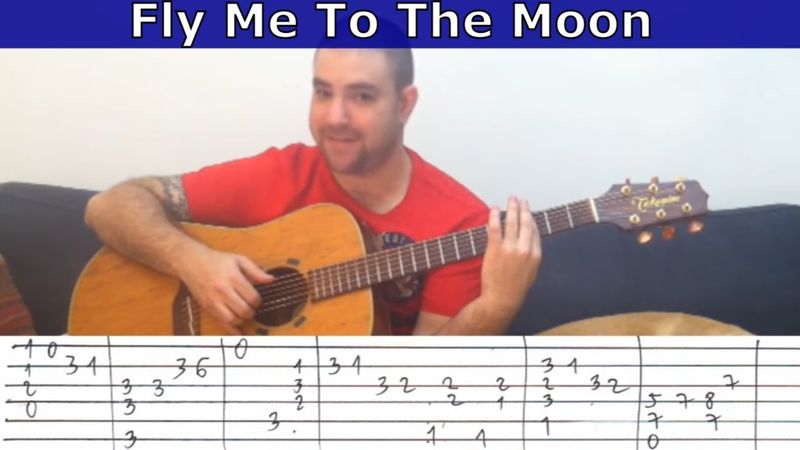
D minor seven tab wise is one, one, two on the E, B and G strings with an open D string.
It's almost an F chord, just instead of the F bass, we play a D bass.
That's just how chords go.
You change one note, you change the entire chord.
And sometimes one chord can be called three or four different names.
Never mind that now.
This is not a lesson in chord theory, so... Mercifully.
So, Dm7.
You just pick the entire chord.
And then you play this.
Okay?
Just open E string, 3 and 1 on the B string.
And then...
we play G minor seven.
Now, G minor seven, you can either put on the entire chord, barring the third fret and putting another finger on five on the A string, but you don't have to put anything on except for the bar because if you want a leaner sound, a leaner chord sound, then you just pick strings, the E bass, strings E, D, and G.
Okay, but if you want a heavier sound, a more condensed sound, you can pick this note, you can pick the D note, this is a D note, on the A string, and make it a really condensed kind of chord.
But I don't like that sound, so I play the leaner sound.
I play this.
Just strings six, three, and four.
And then this.
Okay, it's the G string on three still, and then the B string on three, and then I add the pinky on six on the B string.
Okay, so it's three, three, and three on the E, G, and D string, and then three and three on the G string and the B string, and then six on the
On the B string.
This is of course an F note Okay, but we could do it like this Okay, but we want to keep the chord ringing as as much as possible so
the chord is still ringing.
And then, open E string, and then we pick a C7 chord.
Okay, a C7 chord is just C, and you add the pinky on three on the G string.
Okay, so it sounds like this.
Okay, what I like to do is this little rhythm.
I pick the open E string, the melody note, and then I pick the C bass, and then I pick the rest of the chord.
Gives it a kind of jazzy, jumpy feel.
Let's hear it together.
But you don't have to.
You can make your own arrangement of this.
This is just my arrangement.
You don't have to play my arrangement.
You can make your own arrangement.
You can play it in whatever rhythm you want to hear, whatever rhythm you feel comfortable with.
You can play it like this.
if it sounds good to you.
Or to just practice this at first and then build your own rhythm.
So we were here.
And then this.
Okay, this is the melody.
It's three one on the B string.
And then three two on the G string.
But the two is already the beginning of the F major seven chord.
So you want to keep that in mind because you want to build the F major seven chord when you play the A note.
This is an A note, so.
Okay, I put the a the F major 7 like this because I So I don't see any reason I should put this on it's kind of a clam so I use my thumb for the F bass and
Two fingers for the second fret on the G and D strings.
You can do it like this too, but I find with the thumb comfortable, I'm a fingerstyle player, so that's just one trick to keep the fingers free to solo over chords.
So I use the thumb, you don't have to.
You can do this.
It works fine.
And then I do this.
This is just Fmaj7 turning into F7.
I just change from 2 to 1 on the D string.
From an E note to an Eb note.
That's usually what I do.
You can keep it an F major 7.
You don't have to turn it into an F7.
You can keep it an F major 7.
So let's stop talking for a minute and play it from the beginning.
Okay, just pick the F major 7 chord.
I turn it into F7 to lead it into B flat major 7.
Okay?
Instead of having two major 7 notes, ah, notes, chords.
Instead of having two consecutive major 7 chords,
and major 7 chords are very very pleasant for the ear so I like to spice it up a bit by turning one of them into a 7 and the 7 itself leads to the next major 7 chord so it makes sense both musically and both for the ear because instead of just being too pleasant for a while it's pleasant, spicy, pleasant again I hope you get what I'm trying to say it's really really
difficult talking about music.
Elvis Costello once said, talking about music is like dancing about architecture, and he's right.
You can't talk about music without sounding ridiculous.
So, pleasant, spicy, pleasant.
It's not food, it's music, but you try explaining it another way.
Anyway, stop talking.
B flat major seven.
You borrow the first fret and it's kind of like, it's D7 shape, but one string down.
It's an A shape with the middle note taken back one fret.
If it helps you memorize the shape.
So, it's this.
you pick strings 2, 3, 4 and 5 and on the B string you take the pinky off making it a C note from 3 to 1 this is the melody and then you put the pinky on 3 on the G string and take it off again and you still have the 2 on the G string so it's 3, 1 on the B string 3, 2 on the G string
I hope you recognize this because you've played the same melody a minute ago on the C7.
In a different context because it was on a different chord.
And then, remember this is Bbmaj7.
And then this.
It's E minor turning into an E minor 7 flat 5.
But we just play these notes.
We don't play the entire chord, we just play...
these notes inside the chords, so it's this.
You put first finger on the D string on five, third finger on seven on the A string and you play the D, A and E strings.
This is no mistake, this is an octave.
It's the same note, it's E. And then you add your pinky on seven on at the D string.
Okay, so you play this.
And then you do this.
You don't have to put on the entire minor seven flat five chord.
You just bar the seventh fret
And you put your second finger on the D string on 8.
Okay?
So... You play this.
You play 7 and 8 on the A and D strings.
And then 7 on the G string.
Got it?
It's just this.
And together they sound like this.
Okay, now for the final verse line.
The final verse line is this.
Okay, it's A7.
Now you can either play this or this.
are the same A bass.
For the purists you wanna practice the chord, you just put on a full A7 chord.
It's not a full A7 chord, but it's a full jazz A7 chord.
5 on the E string, 5 on the D string, 6 on the G string.
Or you can do the same thing without the E string, you just play the open A string.
Completely the same.
Well, maybe except for a bit of a fatter sound when you play the E string instead of the A string, and a fretted sound instead of an open string sound.
Let's not go into technical details.
Play whatever sounds good to you, okay?
Don't let anybody else tell you, you should play it like this.
Why don't you play it like this?
Because it's my version.
It's my arrangement.
That's what you tell them.
It's your arrangement.
You play whatever you want to play.
okay don't let anybody tell you you're playing something wrong because as long as it sounds good it's not wrong um so you play the a7 and then this um just three two zero on the g string three two open g string and then this
um out of context this sounds weird but i'll play it through in a second and you will hear that it's fine it's it's into d minor seven again so it's three on the d string with your first finger
And because you're blocking the open D string, the D bass, you need to have the D bass here.
Okay?
On 5 on the A string.
But this sounds too empty.
It's just an interval.
It's not a chord yet.
And this, this is too somber.
It's just, it's a classical chord.
it's not it doesn't fit so the only solution I could find was this just adding the seven with the pinky on five on the G string so it sounds like this okay so and that's the verse D minor seven
C7 Fmaj7 with an option to go into F7 Bbmaj7 Em into Em7b5 A7 Dm7 again Okay, now
I made a mistake playing this once, and I corrected it while playing and created a chromatic lick out of this.
And a friend heard me play it and started laughing and said it sounded Italian.
So I thought I'd show you, and if you like it you can play it.
It's pretty funny, it's this.
Okay?
And it is kind of Italian, it's chromatic.
I made a mistake and instead of going to 3, I went to 5.
Because there's a dot.
And sometimes when you play automatically, you make stupid mistakes.
So you can do that.
Don't know why, I just thought I'd show you.
By the way, you can use chromatics if you want.
Here, for example.
Okay, something like that.
It's the same idea, it's the same Italian lick, Italian motif idea, but if you want to, you can use it.
You can try and add little chromatics.
Now what I did was I just added the open B string into this line.
and the open B string of course is 4 on the G string so it's chromatic so together it sounds nice it's nice it's just small additions make your own arrangement that's what I'm trying to say anyway chorus now the chorus
has two endings.
And you play the chorus once with the first ending, and then you play the entire verse again, and then you play the chorus with the second ending.
I'll show you in a second.
So, you're here.
On the D minor seven.
Now, the chorus begins like this.
It's back to G minor and you need to prepare for the G minor, so I play this with my pinky.
Okay, it's just seven and five on the D string.
And then when I play the five, I bar the third fret.
And then I play both B and G strings, strings two and three, together.
Okay?
and then it's C7 just C7 I pick the bass and then the rest of the chord and then
1-0 on the E string and then 1 on the B string.
And when you play this C note, 1 on the B string, you put on the Fmaj7 again.
So it sounds like this.
and then Bbmaj7 again now you can use the F7 again but I don't because if I used it in the verse I won't use it in the chorus as well because then it loses its magic so here the pleasant sound works for me but if you want to use the spicier F7 sound by all means go ahead and do it and it will sound like this
It works as well.
I actually kind of like it.
And then this.
Okay, this note, the first melody note, 3 on the D string is inside the Bbmaj7 chord.
But then you need this.
This is Gm6.
It's 3 on the E string.
two on the D string, and three on the G string as well.
Okay, so it's three, two, three.
So, that's the chord.
So,
but because we need to transition between the Bbmaj7 and the Gm6 I put the first finger on 2 first and then I put these two fingers and I play this just the bass and the rest of the chord
That's how I do it.
You may find a better way.
C7 again.
And then this.
Okay?
And this goes into F major 7 again.
I'm warning you, you need to put the chord on the A note.
Again, just like in the verse.
So it's 3-1 on the B string, and 2 on the G string, with an F major 7 built.
Okay, so...
Up to here, we're all fine.
Again, I'm thinking about the second ending and how to explain where to change it into the second ending, but we're not there yet so I'll stop thinking about it.
So, the chorus.
Okay, now, just a 2-5-1 into, a 2-5-1 is a jazz trick, it's not only a jazz trick, but it's mainly a jazz trick, to bring you back into whatever chord they want to bring you back.
So it's just this.
And you're back into the D minor 7.
It's a...
Em7b5 This time played in full From 2nd string to 5th string it's 8-7-8-7 And then it's A7
You can play like this.
Giving it a jazzy feel.
There's the bass, then the rest of the chord, then the bass, then the rest of the chord.
Now, the interesting thing about these two is that you can play them in full or you can use the open bass notes.
Whatever sounds good to you.
And then you play the verse and the chorus again.
I'll show you up to where.
Okay, chorus.
That's it, this is where you change.
Okay, you play the C, the C7.
And then instead of this, you do this.
Okay, it's one zero on the E string.
And then this.
This is an F chord, C shaped, bar on five.
Okay, and you pick five on the E string.
And then the bass, and then the rest of the chord.
shaped like a C7, up two frets, the bass is on five, first finger on three.
Okay, that's it.
You don't pick the E string, you pick strings two, three, four, and five.
this little, this beautiful chord.
It's G minor seven nine, or G minor seven add nine.
The way to do this is to use this melody note to prepare the chord.
Third finger on five on the E string,
and then you bar the third fret, and use your pinky on six on the B string.
Okay?
You play the A note once, then the second time around along with the G bass, and then the rest of the chord.
Got it?
So we were here.
And then, guess what?
C7.
And then the final melody line.
It's 1-0-1 on the E string.
And an Fmaj7 again.
Now, you can play it again.
You can 2-5-1 into it.
We're going to end it on a 2-5-1, but you can just do...
the Em7b5 again to the A7 again to the beginning, the Bm7 again, and do a second run.
And on the second run, you can end on an Fmaj7.
Okay?
An open E string.
Or, an Fmaj7, add 9.
With 3 on the E string.
Now the thumb becomes uncomfortable, so I barred the first fret.
And it sounds good.
It all depends on what sound you want to get on your final note.
My ending is Em7b5 and then Ab13, which is A7 along with the pinky on 6 on the B string.
So we have 5566.
And then this.
Jazz endings, jazz ending chords.
our musician's way of showing how sophisticated his ear is.
His or hers.
It's kind of a joke as well because sometimes you'll bring out a really interesting chord which completely contrasts the rest of the song.
For example, the ending chord here should be this.
Because it's D minor.
And this is D minor 6 9.
Or D minor 6 add 9.
But I turned it into D major.
D major 6 add 9.
Or D major 6 9.
Or D 6 9 without major.
It's D 6 9 or D 6 add 9.
Because that's kind of a joke.
It's kind of joking musically.
And by the way, if you want to hear a band that...
They're unbelievable.
They're called the bad plus.
And they use these kind of...
These harmonies all the time.
And their music is hilarious.
And if you haven't heard hilarious music in your life, listen to the bad plus.
They're unbelievable.
You're gonna laugh...
your asses off when you hear their music they use these kinds of unexpected harmonies all the time in the funniest ways and also odd time signatures and such so this this is just my ending you don't have to do this you can end on D minor 7 but I like to end on
D6-9.
D6-9 is pinky on 5 on the B string.
Then on the G, D and A strings, it's just 3-4-5.
So it's 5-3-4-5.
Okay?
Now, a D minor 6 and 9 is just, instead of 4 on the D string, you take it back to 3, you just bar it.
Okay?
That's the normal jazz ending for a minor song.
That's why I turned it into major.
Just because I can, and you can too.
If you don't find this good sounding,
finish on D minor 7 or these are the sounds you can experiment with and you can experiment with a lot more sounds so
That's Fly Me To The Moon.
Congratulations for learning this.
Before you go, please subscribe to my channel if you haven't already.
I've got a ton of lessons over there already for you to learn for free.
Everything is free and will always be free.
My goal is to teach the world guitar.
All I ask in return is for you to tell other people about Lickenriff and about this channel and that there are lessons, free lessons, fingerstyle lessons, and hopefully...
more than just fingerstyle in the future.
Go to the website, download the tab.
It's also for free.
And while you're there, there's a donation button.
If you want to give something back for this lesson, for any lessons, for my work in general, just click the donation button and I'll be grateful for any donation whatsoever.
And go practice this.
Go get this under your fingers.
It's a beautiful song.
I hope you like the arrangement.
And I'll see you in the next lesson.
Thank you very much for watching.
Similar videos: Fingerstyle Tutorial
The ONE-FINGER Jazz Chords (Create Jazzy Chord Solos without Even Trying) - Guitar Lesson Tutorial

မင်းအတွက်ငါ - ရှိုင်း - အခြေခံ guitar tutorial အပိုင်း (၂)@lineasyguitar

Выучи ЛЕГЕНДАРНУЮ мелодию на гитаре !
The Coolest Strum Ever #guitar #classicalguitar #brandonacker

7 Things I Wish I Knew Sooner About Guitar (That Would’ve Saved Me Years)