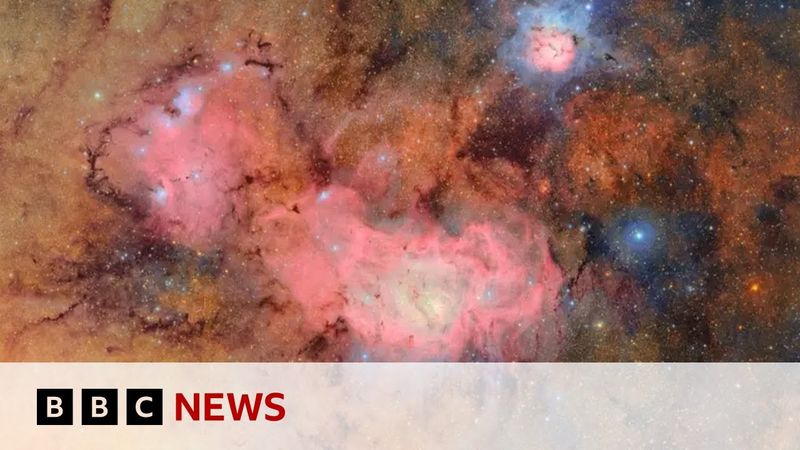
First images from powerful new telescope released | BBC News
Download information and video details for First images from powerful new telescope released | BBC News
Uploader:
BBC NewsPublished at:
6/23/2025Views:
1.2KDescription:
Video Transcription
But this half hour we're going to show you some extraordinary images of space and to do them justice really you need to see them across 400 ultra high definition television screens because each one contains 3,200 megapixels and they were taken by the world's newest and largest telescope which is in Chile and has just released its first set of pictures.
Our correspondent Ione Wells went to the desert there to find out more.
This is the night sky like it's never been seen before.
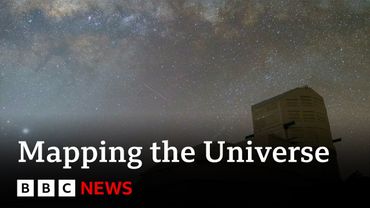
These are the first images released by the Vera C. Rubin Observatory, home to the most powerful new telescope in the world.
The BBC was granted early access to see it up close, before the images were made public.
It sits on a mountain in the Chilean desert.
Very high, very dry, very dark.
It's a perfect spot to watch the stars.
And that darkness is sacred.
Watch your step on this box.
There's a whole engineering unit dedicated to making sure this dome is dark.
It uses three mirrors to gather light from the universe and reflect it onto a camera.
Capturing a lot of light is key to detecting faint objects like galaxies from billions of years ago.
We want to go really deep and observe things that are from really far away, which essentially means in astronomy that they come there from earlier times.
When I first started working with this project, I met with someone who had been working on it since 1996, and I was born in 1997.
So it's really humbling on one side, but also it makes you realize that this is like an endeavor of a generation of astronomers.
The key to capturing these images is the telescope's digital camera, the biggest ever made.
At 3,200 megapixels, it is so high resolution it could capture a golf ball on the moon.
If you took your finger and held it at arm's reach and put it up to the sky, potentially, depending on where you're looking at, tens of thousands of galaxies will fit into that one little portion of the sky that is covered by your finger.
And now imagine that over the entire southern sky, we're getting an unprecedented data set, not just of galaxies, but of variable stars and near-Earth objects as well.
It will take an image about every 40 seconds for 8 to 12 hours a night.
So what we have here is a colorized pair of merging galaxies.
My laptop screen hardly does it justice, but I hope that gives you a sense of scale of what we're looking at, even nightly.
Documenting galaxies, stars and asteroids as they move and change, capturing the distant past and present.
to help scientists understand both what's in the universe and where it came from.
The design of Rubin Observatory has been driven by four science goals.
Probing the nature of dark energy and dark matter, exploring the transient optical sky, taking an inventory of the solar system and mapping the Milky Way.
And so what that really means is that we've built a telescope that is a discovery machine.
It will also be able to bring to light questions that we haven't even thought about yet.
It will open up the unknown.
And that's probably the thing that I'm most excited about with Ruben Observatory.
This 10-year survey of the night sky hasn't yet begun, but the telescope's first images have already excited scientists about the knowledge it will unlock.
Ione Wells, BBC News, at the Ruben Observatory in Chile.
Similar videos: First images from powerful new telescope released
Телескопы, легенды и звёзды: как устроены обсерватории Москвы

Телескоп Габбл, який бачить небачене
Телескоп за 1.500.000? #shortsclip #астрономия #четыреглаза #космос
Mapping the Universe at the Rubin Observatory in Chile | BBC News
Самый крупный метеорит с Марса выставят на торги в Нью-Йорке