Frank Farrelly 2005 - Talking about Provocative Therapy
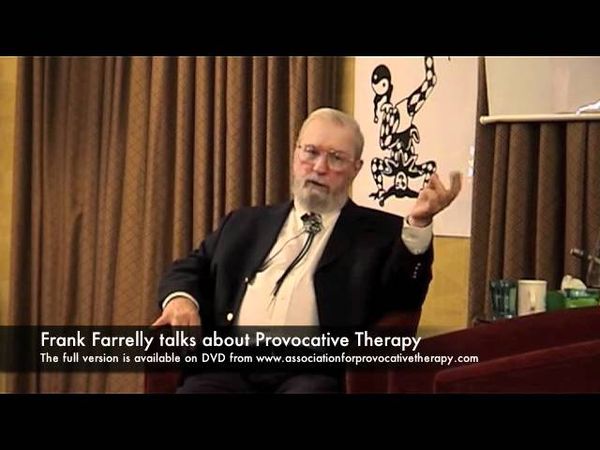
Download information and video details for Frank Farrelly 2005 - Talking about Provocative Therapy
Uploader:
Nick Kemp's Provocative Change WorksPublished at:
5/12/2012Views:
6KDescription:
Video Transcription
What is it again?
What did you say?
Yeah, yeah.
How do you say the things you say and still have the person feeling good about it at the end of the session?
And I think it was in Berlin, this one man during the discussion after an interview said to, what was her name?
I just call it Hildegard or Heinrich.
That's my two German every woman, every man.
Anyway, one gal came up in Aachen.
I said, OK, what's your name?
She said, Hildegard.
I said, cut the shit.
What's your name?
She said, Hildegard.
I said, look, let's get serious.
I'm about to start the.
And one of the psychiatrist friend in front row said, Frank, her name really is Hildegard.
I said, at last I found you.
And then I met Heinrich this way, too.
I said, cut the crap.
Come on, let's get in.
No, his name is Heinrich.
But it was a brilliant... And this one woman, well, Carla Hildegard wasn't it, but this guy said...
how did you tolerate Frank's insulting you just from beginning to end during this interview?
And I thought, let's see the response to that.
And she looked and just absolutely nonplussed and said, insulting?
She said, Frank is very empathic.
He understands exactly how I feel about me, myself.
And there was a sort of dead silence.
And I said, look, what I do is I say the unutterable, think the unthinkable, and feel the unfeelable.
And I say what the person has said to himself or to themselves.
what they've said to themselves, and the names they call.
People call themselves names.
Number one.
Number two are nicknames.
And I frequently will give a client a nickname.
Not always.
When I don't give them nicknames, some of them feel left out.
You didn't deserve one.
What can I tell you?
And my students and trainees are the same thing.
But at any rate, so number one, I say out loud what they say to themselves, you know, and a lot of it is so negative.
And they've been saying it for years, you know.
Number two, what other people have said to them, okay, teachers, brothers, sisters, fathers, mothers, aunts, uncles, grandma, grandpa, you know.
fellow employees, you know, buddies, whatever.
And then number three, what they anticipate somebody would say to them if they knew, you know, et cetera.
And so those three things, sources, and it's past, present, and future kind of stuff, and oriented, and I just slide or segue or whatever the hell you want to put it, or, you know, abruptly from past, present, and future just glom all together.
Yeah, and say these things.
So, you know, how can you say...
But Curtin's question still remains.
How can you say it?
Charm.
It's really, in some sense, true.
If guys can talk with...
Some people have said, telling Sue when we were driving in,
that when provocative therapy first came out, that it's a male therapy because it has this male type of humor, which is a more...
you know, bantering and, you know, a kind of mock aggression type of thing.
And guys talk this way to each other.
They do.
And you think, oh, my God, what's these two guys?
I was walking down a street in Madisonville, just see this.
And here's this big lummox.
Two guys in both suits.
And one of them comes up the back of this other guy and gets him in a choke hole and punches him in the kidney.
and says, you goddamn cocksucker.
And the other guy turns around and punches him in the ribs, saying, hi, you old motherfucker.
And I thought, oh god, there's going to be a fight.
I thought, oh, they're buddies.
That's deep affection.
It's guys.
And one of the last workshops on this tour, I was talking about women think men can't communicate.
Of course they can communicate.
They talk maleese, you know, like a guy sitting in a booth in a tavern waiting for somebody, and another guy comes in and just slumps, you know, kind of crashes into a bench opposite him, and the first guy says, how are they hanging?
And the second guy says, fuck, you know.
And the first guy says, that bad.
The second guy says, shit.
He says, I'm buying.
Two beers.
That heavy-duty male communication.
Deep, deep empathy.
I am with you, you know, the way your balls are hanging, which is not good today.
Compassion.
Whereas women would talk, you know, well, 30 minutes, 40 minutes to say, you know, guys, I don't need the references.
It's just, ah, fuck, you know.
Yes, OK, I'm buying the beers.
Yeah.
To me, it's always, and then guys think, I said, look at, if you saw, well, it's sort of like Mark Twain with,
Huckleberry's trying to teach Jim, the runaway slave, you know, about how the Frenchmen talk and stuff.
And he said, well, what would you, they're going, drifting down the raft on the Mississippi.
And he says, well, what would you, what would you think if some man came up to you and said, parlez-vous Francaise?
And he said, I'd bust him in the mouth, least ways if he weren't no white man, says Jim.
And he said, well, Jim, he's just asking you, do you speak French?
He said, well, then why the hell can't he ask like a man, stand up and ask like a man?
And he says, oh, shit.
And he finally decided, hell, some people, you just can't teach them anything.
And it's very allegorical, and it's very metaphorical, and it's very archetypal, too, type of thing.
If you don't talk about it the way I would talk about it, then you must be emotionally constipated.
There's another thing, yeah.
So the stereotypes that females have about males, you know, and that males have about females, you know, women are irrational.
That's all there is to that.
Their heads are filled with cotton stuff and hay.
Is that Professor Iggins?
It's a male-female tribal wisdom song.
And he's got every stereotype, you know, about male stereotype about women in it.
Et cetera.
Well, okay, who's next?
Similar videos: Frank Farrelly
Ф. Фарелли "Провокативная терапия" кассета 1 часть 1
Ф. Фарелли "Провокативная терапия" кассета 1 часть 2
Ф. Фарелли "Провокативная терапия" кассета 2 часть 2

Ф. Фарелли "Провокативная терапия" кассета 2 часть 1

Провокативная психотерапия Фрэнка Фарелли