Gary Cooper in Ernest Hemingway's "A Farewell to Arms" (1932) - feat. Adolphe Menjou
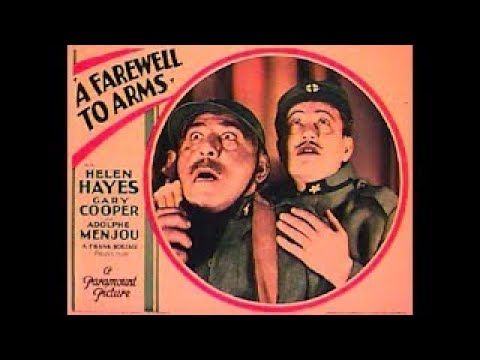
Download information and video details for Gary Cooper in Ernest Hemingway's "A Farewell to Arms" (1932) - feat. Adolphe Menjou
Uploader:
Donald P. BorchersPublished at:
11/7/2025Views:
2.7KDescription:
On the Italian front during World War I, Lieutenant Frederic Henry (Gary Cooper), serving as an ambulance officer with the Italian Army, crosses paths with English nurse Catherine Barkley (Helen Hayes) during an air raid. She has fled her dormitory in her nightclothes, and though Frederic is somewhat drunk and awkward, he is struck by her quiet grief and dignity. Rinaldi (Adolphe Menjou), Frederic’s friend and fellow officer, arranges a double date with Catherine and her friend Helen “Fergie” Ferguson (Mary Philips), hoping at first to pursue Catherine himself. Instead, Frederic and Catherine slowly form a bond. In the hospital garden, Catherine confides that she was engaged for years to a soldier killed in battle, and is still mourning him. When Frederic tries to kiss her, she resists, then allows herself to accept his affection. Their romance deepens, and he tells her earnestly that he loves her. Before Frederic can see her again, he is sent back to the front. Catherine gives him a St. Anthony medal, hoping to protect him. Frederic is severely wounded in battle and is transported to a hospital in Milan, where Catherine has coincidentally been assigned. Their reunion is overwhelming. Despite Fergie’s stern warnings, Frederic and Catherine behave as a married couple. The Padre (Jack La Rue), touched by their devotion, performs a quiet, unofficial wedding ceremony in Frederic’s hospital room. When Frederic is ordered to return to duty sooner than expected, he and Catherine cling to each other. She later confides to Fergie that she is pregnant, and moves to Switzerland to await the birth, writing to Frederic without revealing her condition. But Rinaldi, jealous and regretful, intercepts her letters, and Frederic’s letters to her are returned marked “person unknown.” Believing something is terribly wrong, Frederic deserts the army and searches for her, finally learning she is in Brissago, Switzerland. Reunited at last, they try to build a quiet life together. But Catherine goes into labor and suffers terrible complications. The baby dies before birth, and Catherine grows weak. Frederic remains beside her, holding her hand as she faces death with bravery. She tells him she is not afraid as long as he is with her. Catherine tells him she is not afraid and dies in Frederic's arms as the sun rises. Frederic, shattered and alone, picks up her body, slowly, sobbing, and whispers softly, "Peace, Peace." A 1932 American pre-Code romance drama film directed by Frank Borzage, produced by Frank Borzage, screenplay by Benjamin Glazer and Oliver H.P. Garrett, based on Ernest Hemingway's semi-autobiographical novel, "A Farewell to Arms" (1929), cinematography by Charles Lang, starring Helen Hayes, Gary Cooper, Adolphe Menjou, Mary Philips, Jack La Rue, Blanche Friderici, Mary Forbes, and Gilbert Emery. The film was released in multiple versions with different endings, one with Catherine's death, one in which she lives and another in which her fate is ambiguous. Although international audiences saw only the version with tragic ending, some American theaters were offered a choice. This was released before strict enforcement of the Production Code, its themes and content became problematic during the era of enforcement when the film was prepared for rereleases to film and television. Ernest Hemingway hated this interpretation of his novel, as he felt it was overly romantic. That didn't stop him, however, from becoming lifelong friends with Gary Cooper, whom he met several years later. In fact, it was Hemingway who would insist that Cooper be cast in the lead of the adaptation of his novel For Whom the Bell Tolls (1943) 11 years later. However, the two made a point of never discussing this film. The film's soundtrack includes selections from the Wagner operas Tristan und Isolde ("Liebestod"), Das Rheingold and Siegfried, as well as the storm passage from Tchaikovsky's symphonic poem Francesca da Rimini. The film received Academy Awards for Best Cinematography and Best Sound, Franklin Hansen, and was nominated for Best Picture and Best Art Direction. Laurence Stallings' original Broadway play starred Glenn Anders and Elissa Landi and was staged at the National Theatre September 22, 1930 to October 1930. This was the third most popular movie at the U.S. box office for 1932. The New York Daily News wrote, "The picture is heart-rending and throat-hurting. It moves you so deeply that it is often difficult to see the screen, for the haze which mists your tear-filled eyes. Frank Borzage's direction is nothing less than superb. ... He tugs at your heartstrings until you positively can't stand it any more. And yet he gives a human treatment, indeed, with abundant charm and none of the saccharine." The Chicago Tribune wrote, "'A Farewell to Arms' is rich with all the attributes that make for a completely satisfying screen play. Humor, pathos, suspense, romance, tragedy—all are there. And it has the human touch that endears.
Similar videos: Gary Cooper in Ernest Hemingway
Charles Boyer, Sigrid Gurie & Hedy Lamarr in "Algiers" (1938) - inspiration for "Casablanca" (1942)
Richard Basehart in Robert Wise's "The House on Telegraph Hill" (1951)
Warner Oland in "Charlie Chan in London" (1934) - feat. Ray Milland
Dick Miller in Roger Corman's "A Bucket of Blood" (1959) - feat. Bert Convy
Henry Kendall & Ida Lupino in "The Ghost Camera" (1933) - a British Mystery Thriller