
Inside the Largest Bitcoin Mine in The U.S. | WIRED
Download information and video details for Inside the Largest Bitcoin Mine in The U.S. | WIRED
Uploader:
WIREDPublished at:
8/16/2021Views:
1.2MDescription:
Video Transcription
Bitcoin hit $1 trillion market cap this year.
This has inspired some Bitcoin operations to expand, especially in the wake of the recent government crackdown of miners in China.
The ban on mining in China has caused a mass exodus to the United States, to Russia, and to any other areas where mining facilities are available.
Welcome to Rockdale, Texas, America's new crypto mining hub.
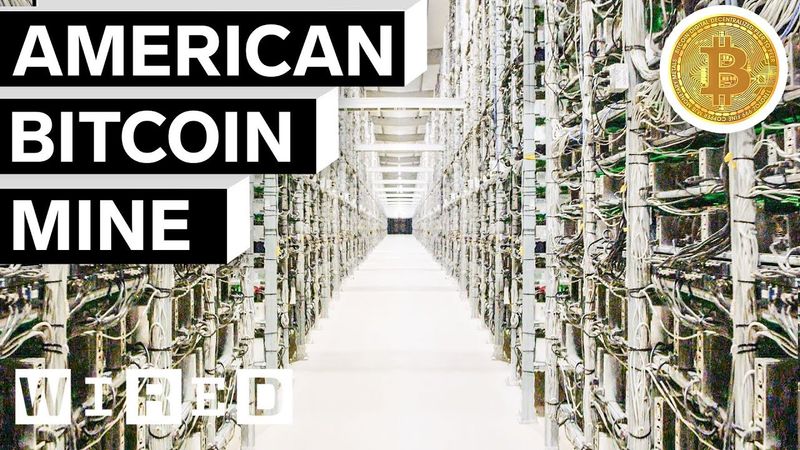
This building that's directly behind me, inside of the buildings, we have this shelving that's 1,000 feet long, 20 feet tall, and there are just miner after miner after miner after miner.
We went inside North America's largest Bitcoin mine to understand how it works and its energy footprint.
What is a miner?
It is a small computer.
They call it an ASIC miner.
It is made to solve problems.
And when they solve that problem, it feeds into the Bitcoin network.
When it feeds into the Bitcoin network, you receive a reward.
To help us understand crypto's reward system a little better, we spoke to blockchain expert Bettina Warburg.
That's what mining is.
It's a process by which people are contributing computing power and earning a reward for essentially participating in this process that secures a network.
Everybody's using the same software that allows them to connect together and participate in a governance structure that's shared.
It seemed like only yesterday that one person with a handful of computers crunching numbers in their apartment could make money from mining Bitcoin.
So how do we go from there to here?
Just like with many industries, you start small.
The guy in the garage started the process.
He mined Bitcoin.
I believe the reward was around 50 Bitcoin for every block reward.
Now it is at 6.25.
In some ways, cost equals energy expenditure.
This is just the nature of technology.
We see updates and innovation and people driving margin and driving their cost of operation down.
in order to reap the greatest reward.
So you get mining operations that happen in places where power is less expensive.
Typically, mining operations go where energy is cheap.
Right now, Texas has some of the lowest kilowatt-hour prices in America.
That's due in part to a deregulated energy market, which means several providers compete to snag big customers like Windstone.
There's environments like Iceland, Russia, China, Canada.
Areas like Iceland and Canada have a cooler environment.
There's probably less dust in those areas.
The miners run at a cooler temperature.
Cryptocurrency is about the low cost provider.
Texas is becoming a hotbed for other cryptocurrency facilities.
In fact, Shenzhen-based Bitmining is coming to Texas.
And Beijing-based Bitmain, a company that designs circuit chips for Bitcoin mining, is moving into the decaying aluminum plant down the road from Winstone.
According to the Oak Ridge Institute for Science and Education, $1 worth of Bitcoin takes 17 megajoules of energy to mine.
That's more than double the amount of energy it took back in the day to mine $1 worth of copper, gold, and platinum.
The machines require more power and more power requires larger capacity, bigger transformers, higher voltage.
Ultimately, the energy intensiveness comes from the fact that solving these mathematical puzzles is challenging and you have to expend a certain amount of compute power against it to be the fastest one to actually solve the puzzle.
And putting as much computational energy into that challenge as possible increases your ability to actually win.
It's intentionally inefficient.
Each building is 100 megawatts.
For each 100 megawatt building, you can fit 30,000 new ASIC miners in it.
In a Bitcoin mine, the consumption is basically taken by the miners.
Each miner has about 3,000 watts that it's pulling.
An older miner, an older generation, the S9, which was released in September 2017, was only pulling 1,350.
The miners now are at 3,000.
So at capacity, this facility will have 750 megawatts of electricity flowing through it, enough to power 150,000 Texas homes during peak demand.
That's a lot of juice.
How do they manage to keep all those miners cool?
Our ideal goal is to keep the ambient temperature around 81 degrees.
There's a lake about a mile from here and so underground we have a 8-inch line with a 1,000 GPM pump where we pump literally the water through this mile-long pipe into the facility and it actually goes into holding tanks that then recirculate the water and it pumps it back into these evaporative cooling walls that are 12 feet tall.
Water is actually dripping down the wall of that evaporative cooling cell, and then as the air comes through it, it actually cools from 16 to 20 degrees difference between the front of the wall and the inside of the wall.
The miners have fans, they have intake fans,
and there's thousands of those fans running, and they actually suck the ambient air through the miner, and then there's an exhaust fan that actually pushes the air through the chips and into the heat aisle.
As it goes through the miner, it then heats up because the chips, it's a processing, so it gets really hot, and then we capture the heat on the inside of the heat wall, and then it is evacuated out of the building through a quote-unquote chimney-like environment.
Inside the heat aisle, it literally feels like an oven.
One Windstone employee estimates that it can get as hot as 140 degrees Fahrenheit in here.
So the S9 has a hash rate of 13.5 terahash.
The new S19s are 110 terahash.
Hash rate measures how many computations a miner can do, usually in a second.
So how much money can each miner potentially make each day?
Currently, a S19 with 110 terahash, the profitability every day for one machine is 30 USD.
Okay, so 30 bucks times 30,000 miners times two big buildings
nearly $2 million a day for a facility this size.
We have a full staff of 120 employees.
We work 24 hours a day, three shifts.
There are definitely some increased efficiencies on the horizon, such as faster processing chips for the miners, cooling them in immersion technology.
But at approximately 73 terawatt hours annually, Bitcoin's energy consumption is more than the energy it takes to run every single television set in America.
I think ultimately the energy consumption question is a bit of a, what is it relative to?
When we look at our financial system as a whole, or even just Wall Street, to power Wall Street, which runs almost entirely off of computation today anyway, and high frequency trading algorithms, when you look at mining just to earn Bitcoin, well, that's not necessarily so awesome.
According to the Digiconomist's Bitcoin Energy Consumption Index, one Bitcoin transaction takes more than 1,500 kilowatt hours to complete.
That's more than 50 days of power for the average US household.
Bitcoin is what I like to think of as a calculator.
So it's this sort of old school, very clunky system that gets the job done.
When you look at what's happened with newer blockchains like Ethereum 2 and DFINITY is that they've actually implemented a totally different system
for essentially doing the same thing.
Ethereum is upgrading to a more energy efficient way of securing the network.
And the future will be about a lot of these different internet computers battling it out for adoption.
So you'll see DFINITY, NEAR, FLOW, Polkadot, all kinds of networks really
serving as the optimized internet computers.
Ultimately, the value will come from the amount of applications and tools and things that you can build and do on top of this computing architecture.
You know, I think all technology creates energy consumption in certain patterns, and ultimately what we have to do is make sure that what we're building is something that's worthwhile and that we actually want in our society.
Similar videos: Inside the Largest Bitcoin Mine in The U

capitalism breeds innovation. the innovation:

Максим Цыганков: путь от Яндекса до Силиконовой долины #57

This Is What a Digital Coup Looks Like | Carole Cadwalladr | TED
JR: Can Art Change the World? | TED

How the NSA Hacked Huawei: Operation Shotgiant