Israel and Iran exchange more airstrikes | BBC News
Download information and video details for Israel and Iran exchange more airstrikes | BBC News
Uploader:
BBC NewsPublished at:
6/23/2025Views:
4.9KDescription:
Video Transcription
Today was once again another sign that Saturday night strikes by the US in Iran has not changed the pace of this war between Iran and Israel.
In the last 12 hours we had two alerts of incoming Iranian ballistic missiles here that sent us down to our bunkers here in Tel Aviv.
As many millions of Israelis also went down to the bunkers, Israel says that there were seven direct hits in the country, including in the south.
That footage that you showed earlier in the program suggesting that some kind of power infrastructure there was hit.
There were power outages in the south of the country.
And also there were hits in Jerusalem as well with loud booms over the old city.
Meanwhile, Israel has continued to strike relentlessly in Iran.
It says it has hit headquarters of the Iranian Revolutionary Guard.
That is, of course, the branch of the Iranian armed forces.
And also, as you said earlier, the Evin prison in Tehran, the most notorious prison there for Iranian political dissidents, and also a prison where journalists and academics are held.
They also hit, the Israelis say,
a clock in central Tehran on what's called Palestine Square, which counts down to the supposed destruction of Israel by the year 2040.
So a very symbolic strike there by the Israelis inside Iran.
Well, a little earlier I spoke to Yaakov Katz, who is a former editor-in-chief of the Jerusalem Post, a longtime defense correspondent for that newspaper.
And I asked him what sort of level of cooperation there had been between Israel and the U.S. before those strikes in Iran on Saturday night.
You have Israeli Air Force jets that are operating over Iran.
You have lots of Israeli drones that are now continuously collecting intelligence and surveying and hunting down those rocket launchers and those surface-to-air missile systems.
And all of this needs to happen at the same time that those B-2 bombers were making their way.
So this had to be carefully orchestrated by General Carrillo of the CENTCOM, the Central Command, who's the U.S. general in charge of this region, and the IDF general staff.
So all of that was definitely happening, but you are to some extent right that what the Americans wanted from Israel was for those skies to be clear and for there not to be a threat against the B-2 bombers that were going to be making their way.
The B-2 bombers, yes, have stealth capabilities, but because of their massive payload that they were carrying, each of them had two...
of those GBU-57 bunker busters, they do fly slower than supersonic F-15s or F-16s.
They don't have that capability.
And therefore, if they were to come under surface-to-air fire, it could be a risky move for them.
So that was definitely something that was very important for the Americans and something that the Israelis put a big focus on in the run-up to that operation.
Yakov Katz there, former Edison chief of the Jerusalem Post.
Well, the Israelis have also hit Fordow, that nuclear site which was very much the focus of the American bombing on Saturday night.
And really, Katrina, now a lot of the focus is on an amount of
enriched uranium, some 400 kilograms of uranium, which is thought to be enriched to 60 percent.
And it is there are reports that potentially Iran moved that uranium out of Fordow before the strikes on Saturday night as a precaution, perhaps
knowing that the Americans would at some stage get into striking that site.
And so the fear is what has happened to that uranium, where it is, what the Iranians could do with it, potentially spurred into action, even greater action, because of the strikes from Israel and the Americans into trying to make some kind of dirty bomb.
And really, I suppose the success of the entire military operation in Iran might now hinge
on that 400 kilograms of enriched uranium we will continue to bring you at all the latest from here in the Middle East Katrina but for now back to you
The Iranian capital has been hit by an intense new wave of Israeli strikes.
The targets included a paramilitary headquarters, a prison and a university in Tehran.
Video footage shows plumes of smoke rising above the Iranian capital, which is largely without power because of Israeli strikes on energy infrastructure.
Well, with me now is Berang Tajin from BBC Persia, part of the BBC World Service.
Thank you for being with us here.
What do we know about what's happening inside Iran today?
Obviously, it's very difficult for us to get information from there.
The restrictions mean we can't be on the ground ourselves.
Exactly.
Iran doesn't let anyone from BBC Persian to report from Iran or the wider BBC, apart from some occasions.
There are a few things that everyone needs to consider.
Firstly, some of these targets, including, for example, the Evin prison, are in the middle of residential areas in Tehran.
So, some of these attacks are also having civilian casualties and injuries.
We have seen, my colleagues have seen pictures, videos, or photos from
friends or family members who live nearby that kind of confirms that actually there are civilian casualties and there are civilian injuries as a result of these attacks.
It goes the same for universities, even some of the military or military bases.
So we should remember that.
On top of that, you need to remember that unlike Israel, when the attacks come, there are no alarms.
So there is no way for ordinary people to find shelter, even if there were any shelters.
So as a result of that,
We are seeing a lot of injuries and some casualties within Iran who are people who are not connected to the military establishment.
Even we have had reports of some children being killed in these attacks since they started.
Okay.
And the internet blackout as well makes it even more difficult to get information about what you've described there.
Exactly.
The internet has been shut down and then some people have had patchy connections, sometimes even for minutes.
We have seen messages getting to the recipient in Iran after a couple of days on some occasions.
And again, without having journalists from international media on the ground, videos or pictures posted on the internet, on social media, is one of the very few ways for us to get a glimpse inside the country and to see what is happening.
And then we have to hand it over to our colleagues in BBC Verify or BBC Persia's digital team who have become experts
experts in terms of geolocating these videos and authenticating them, making sure that they are where they are claimed to be and they were shot at the time they were claimed to be.
and you know it's a journalistic effort in order to just confirm some very patchy details because as you can see the Iranian state is trying to control information there are edicts going to newspapers and other media almost every day telling them what they can and can't cover and because of that
having accurate up-to-date information about what is happening in Iran, what is happening in different cities and different parts of the country is quite a difficult task.
I know there are some restrictions imposed in Israel as well in terms of, for example, the media are not allowed to confirm the exact location of any missile hits, but it's nothing compared to what we see in Iran.
Now, we do get some information from Israel about what it's doing in Iran.
And again, we can't verify that.
But it has said that it has hit the Avin prison.
Talk to us a little bit about the significance of that or why that might be a target.
So Evin is the most notorious prison in Iran.
It is the place that usually they hold political prisoners from journalists to academics to intellectuals to all sorts of political activists who are imprisoned by the judiciary.
But it also holds, you know, normal criminals, you know, murderers and rapists and other sorts of anyone who has done crime.
What we know is it seems like two wings of the prison were damaged, not the wing where the political prisoners are held.
We've been told by prisoners who have called people outside to say that it seems like the wall of the women's wing was also damaged, but the judiciary claims that the situation is under control.
Similar videos: Israel and Iran exchange more airstrikes
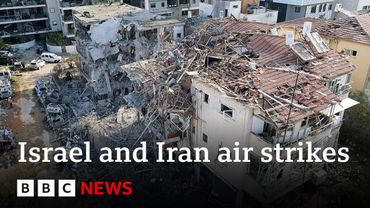
Israel and Iran exchange fire through night with blasts heard in Jerusalem and Tel Aviv | BBC News
Iran launches ballistic missiles at Israel | BBC News
ВВС Израиля наносят удары в районе Тегерана, - ЦАХАЛ
Israel continues strikes on Iran, including key nuclear site | BBC News
Israeli military says it has 'full aerial control over Tehran' | BBC News