Most UNDERRATED City in Japan? | 3 Days in Nagasaki
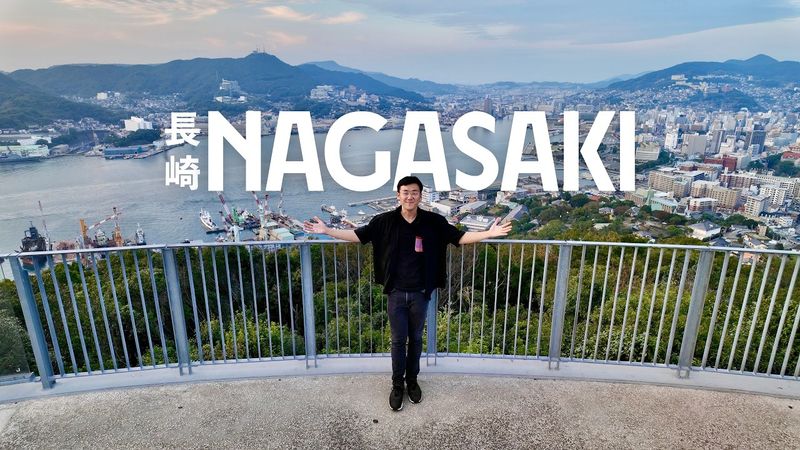
Download information and video details for Most UNDERRATED City in Japan? | 3 Days in Nagasaki
Uploader:
JHMediumPublished at:
3/27/2025Views:
30.8KDescription:
Video Transcription
Today, I'm heading over to Nagasaki from Kumamoto the scenic way.
As you can see, I'm here with a sailor Kumamon.
I'm gonna take the ferry from the Kumamoto port over to Nagasaki prefecture.
There is a fast ferry and a slow ferry, but only a 320 yen price difference.
However, the fast ferry is twice as fast, so I think I'm gonna go take the fast one.
I got my ticket for 1,500 yen.
This ferry doesn't actually take me to Nagasaki City.
It takes me to a small port called Shimabara, and then I have to take another train to Nagasaki.
Even though this seems quite inconvenient, the views are supposed to be absolutely spectacular.
And overall, the ticket price, the ferry, plus the train, it's still less than a highway bus over to Nagasaki, which takes around the same time.
So hopefully this slightly more inconvenient trip will be worth it.
I don't think I've ever taken a ferry before in Japan, so this will be a first.
It's actually quite a luxurious looking ferry.
There's this lounge here with sofas.
It's not the boring old boat chairs.
It seems like this is also a car fair.
I saw many cars driving into the lower deck.
So most of the passengers here are probably on a car or even a tour bus.
That's why it seems like there were not many people lining up to go the passenger route.
I've decided to come sit outside since the weather is so beautiful.
It seems like feeding seagulls is a very popular activity on these ferries.
The people behind me, they bought a lot of shrimp chips and the seagulls are just gliding next to the boat trying to catch the shrimp chip.
It's actually pretty cool to watch.
If you're going from Kumamoto to Nagasaki and you're not in a hurry, I highly suggest taking the ferry.
And it's not even that much more inconvenient than taking the Shinkansen.
There's no direct Shinkansen from Kumamoto to Nagasaki either way.
You have to do a transfer.
So this is a cheaper route and more scenic route.
Seriously, why would you take a boring highway bus or the Shinkansen when you have such a great ocean view like this?
If you're traveling between these two prefectures, this is the way to go.
Welcome to Nagasaki Prefecture.
From the ferry station, you have to walk around 5 minutes to get to the train station.
And then we're going to hop on the first of two trains that will take me over to Nagasaki City.
because it's a very small one carriage train.
I've now boarded a little train that will take me to my first transfer point at Ishihaya.
Apparently this train doesn't take IC card, it only takes cash.
It's quite old fashioned.
So just be aware of that.
And it's good that I have a little bit of cash on me.
This route is awesome because so much of it is next to the sea.
Seriously, just look at that.
And as we leave the seaside and head more inland, there are these beautiful green fields.
After the one-hour train run on the very scenic route, we're here at our final transfer point, Ishihaya Station.
From here, I'll take the Nagasaki Line JR train over to Nagasaki City.
My train to Nagasaki is here.
And finally, welcome to Nagasaki.
I arrived at my hostel at 2.10, and I started my journey this morning at 10.10, so it took me exactly four hours to get here.
Obviously, as you can see, this was not the most convenient way to get to Nagasaki.
I'm gonna put the other major options on screen right now, including how long it would take and how much it costs.
So for my first meal here in Nagasaki, I'm gonna have this dish called champon, which is arguably the most famous regional dish.
I'm here inside this chain store that many locals like to come eat at.
So what exactly is champon?
Well, it's basically a noodle soup dish with different vegetable and meat toppings.
The dish actually originated from Chinatown here in Nagasaki.
They wanted to create a dish that's filling, nutritious, and cheap.
You can consider this dish a cousin of Fujian cuisine in China.
Okay, let's try it.
The broth is still that delicious pork bone ramen broth, and it has ramen noodles too.
They cook this in one pot instead of assembling it like ramen.
And the ingredients on top, it's mainly vegetable-based.
It's not like char siu pork.
For this bowl of champon, there's some woodier mushrooms, fish cakes, shrimp, pork, and cabbage as well.
It's like something I would make at home, throwing ramen noodles, vegetables, and meat into one pot and cooking it.
So why is this dish called champon and not something ramen?
There are actually many theories behind it, but the one I like the most is that the name champon actually comes from this Fujian term that literally means to eat.
So it makes sense that champon is a hearty dish that's just supposed to fill you up.
When you're here in Nagasaki, you gotta try out champon.
You can try it at any Chinese restaurant here in the city.
There are many chain stores as well.
Meal over and now it's time to go see more of Nagasaki.
Every time I come to a new city, I like to go to somewhere high and see the city from above, like going to Fukuoka Tower and Kumamoto Castle.
So today in Nagasaki, I'm going to go up to Mount Inasa, which apparently has one of the best night views in all of Japan.
To get to the Mount Inasa Observatory, you can either take a cable car directly up, or you can take a bus and then walk like 10 minutes.
Since I still have a little bit of time before sunset, I'm going to go take the bus.
Now I've arrived at the top of Mount Inasa.
The bus ride over here was already so spectacular.
Unfortunately, I couldn't film any of it since I was sitting on the wrong side of the bus.
Now I have to walk around 600 meters up to the observatory.
If you don't like walking, there's actually another cable car that will take you from the parking lot and bus station up to the observatory.
This over here is the cable car, but it doesn't seem to be operating.
I'll be honest, there's way more steps than I expected, but I think I can make it.
I wonder why there's no one else here.
Maybe all the tourists decided to take the cable car.
I believe this observatory is actually free to enter as well.
Ooh, the sunlight.
I'm not exaggerating when I say I think this might be the best view I've ever seen in Japan.
This view really has everything.
It has mountains, it has the ocean, it has the islands, and it has the city.
In a way, it kind of reminds me of Hong Kong, but without all the skyscrapers.
Even though it's quite a large city, it feels small.
The houses on the hills make the whole place feel like a little town, a small village.
Good morning from Nagasaki.
It's another beautiful clear blue day and I'm gonna go explore the city.
But while I'm here, I feel like this trip cannot really go on without first paying respect to the most important part of the city.
I guess many people visit Nagasaki and Hiroshima specifically to visit these places and learn about its history.
You know, if I'll be honest, history was never my strong suit.
It was probably my least favorite subject back in high school.
Personally, I came to Nagasaki on this trip to see what the city is today.
I'm interested in the beautiful scenery, the mountain views, the very aesthetic streetcars, its delicious food.
But when I walked into this park, walked in front of these monuments,
I can't really describe this feeling.
It's a bright sunny day, everything is really beautiful, really saturated, really colorful.
But yet the feeling inside is just tense and somber.
Even though today it is a symbol of peace, I can't help but feel absolutely terrified for what it must have been like.
This has got to be the most powerful statue I've ever seen.
Not in the sense of strength, but in the sense of devastation and the message it conveys.
70% of the casualties were just civilians who had nothing to do with the war.
Just within the 30 minutes I've spent here, there were probably hundreds of school kids visiting this monument.
After seeing all the memorials, it's time to go check out the museum and learn a bit more about the atomic bomb and the history of Nagasaki.
I feel like it's not necessary for me to speak too much about the history of World War II inside this vlog.
It's something we're all very familiar with from history class.
But this museum is still definitely a must visit.
Looking at the artifacts, looking at the things that survived, looking at the things from 1945, and some absolutely horrifying images.
That's history.
Just north of the Hypo Center is the Nagasaki Peace Park, and the fountain behind me, it sprays up water like a pair of wings.
It's designed to invoke the dove of peace, and it's also shaped similarly to the Nagasaki Harbor.
In this park, there are also many statues and sculptures donated by other countries to Nagasaki in a hope for a better future for mankind and for the hope that Nagasaki will forever be the last city to ever experience an atomic bombing.
Thank you.
In the center of the park is the Peace Statue, built during the 10th anniversary of the bombings in 1955.
His right hand is pointed to the sky to symbolize the threat the world will always have to atomic weapons, while his left hand is put flat on one side to symbolize tranquility.
He's also sitting in a half-meditative pose, but the other foot firmly on the ground.
So this statue is supposed to be sturdy in the sense of power, but also gentle at the same time.
On both sides of the statue, there's also these towers made for paper cranes.
Cranes are a mystical creature in Japanese mythology, but at the same time, they also represent peace.
There's a belief in Japan that if you fold 1,000 paper cranes within a year, your wish can be granted.
So when many of the school groups visit this monument, they would also place 1,000 paper cranes that they fold inside that tower.
All we can do right now is to hope and pray the world never sees the use of another atomic weapon.
Okay, after all that, I think it's about time to lighten the mood a bit.
While this is an important part of Nagasaki's history, there is so much more this city is known for.
I have arrived here at the Urakami Cathedral, but before I go see the cathedral, I'm gonna go get something to eat.
For lunch day, I'm gonna have some katsu.
I found this nice little shop near the museum, near the memorial, owned by an elderly couple.
They specialize in katsudon and katsu udon.
It looks really good.
On top of the katsudon, there's also an egg, and I think it's cooked from that steam.
Every piece of katsu is freshly cooked here.
So when you order it, they immediately deep fry it for you.
The part covered with the egg is not crispy anymore, but it's okay, it's still really delicious.
The Urukami Cathedral is also a very important landmark in Nagasaki, but this one we see right here was actually the one rebuilt after the war.
The original cathedral was so close to the hypocenter that it got completely destroyed during the bombings.
When they built this new cathedral, they actually moved the ruins of the old cathedral.
Part of it is inside the atomic bomb museum, and part of it is displayed at the hypocenter memorial.
If you're taking the tram a lot like I'm doing today, you can actually buy a one-day pass, which costs 600 yen.
So if you take the tram more than four times, you get your money's worth.
And you don't need to get a physical ticket.
You can download the app and buy the ticket from the app, and then you just show the tram driver every time you get off.
It's really convenient.
After a short tram ride, I'm heading up to my next destination of the day, the Shua Shrine.
shrine is famous for its 200 something step staircase that will bring you up to the top it's quite a hike but you will not regret it when you reach the top because look at that view
This shrine was actually built in an attempt to revert people back to Shintoism and Buddhism, the more traditional Japanese religions, after Christianity was getting huge popularity in the region.
So the government back then built this shrine as a center point for people to worship and pray.
But the most interesting about this shrine was that it was not destroyed during the bombings, unlike some Christian churches like the Urukani Cathedral.
So after that, of course, there are many theories saying that this shrine survived because of the power of Shintoism.
In reality, this shrine was actually built in a very strategic location, so the mountains and the hills were able to block off the impact from the bomb.
Now I've made it over to the Nakashima River which is a small little waterway near the city hall area of Nagasaki.
Something you gotta try when you're here at the riverside is this ice cream called chilling ice cream.
It's really cool because they shaped it into like a rose shape.
It's so beautiful I don't even want to bite into it and destroy it.
But I mean today is quite a hot day.
I'm even wearing short sleeves so ice cream would be perfect.
Mmm, that's really nice.
Texture-wise, it tastes more like a sorbet than an ice cream, but it's definitely like milk-flavored.
There are also so many students here lining up to buy the ice cream, so it must mean it's a local favorite, right?
There's so many little bridges here across the river and over there, there are these stepping stones where you can actually hop across.
I'm going to go see if I can go down there.
It's nearly sunset now.
You get this magic hour light already.
And to watch the sunset today, I'm going to head over to the Nagasaki Seaside Park.
Yesterday, I saw this harbor up from Mount Inasa and I already thought this will be a great place to watch the sunset.
So now I'm here.
This is awesome.
I am really loving it here in Nagasaki, even though it's only been a day and a half.
It's just the layout of the city, Nagasaki Harbor, with the mountains surrounding the city on all sides.
I think even though I haven't experienced all of Nagasaki yet, I like it so much, not because of what I did, I think the most important thing is how this city makes me feel.
And it makes me feel calm, relaxed, and happy.
It just puts me in a good mood sitting next to the ocean, looking at the sunset, looking at a city that's a metropolis but yet doesn't feel big at all.
Honestly, I'm a pretty simple traveler and it's really easy to make me satisfied.
When I'm traveling, I'm not the type of person who will just hit up every single tourist spot, hit up every single famous restaurant that people recommend.
I just like to take it easy and I think Nagasaki is one of those cities that is perfect for me, perfect for my type of travel.
It has the cultural and historical elements I'm interested in, but if I'm too tired of looking at all the sites, I can always come down here by the harbour, just sit here by myself.
As you can probably see, my itinerary on this trip is very simple, and I spend the most time at these scenic spots rather than like a tourist site.
This might not be how most people like to travel, but for me, it's perfect.
I don't need anything luxurious, anything too fancy, or itinerary that's even particularly interesting.
Like I said before, the most important thing about traveling for me is how it makes me feel.
And really, all I feel is peace.
Not in the sense like the peace memorial I visited earlier today, but in the sense that there's nothing to worry about.
In the sense that this is my life, sitting here looking at this spectacular scenery.
And it makes me really really happy.
Good morning again from Nagasaki.
Unfortunately, this is my last day here and my last day on this Kyushu trip.
A little bit sad to be leaving because Nagasaki has just been such a wonderful city.
My mission this morning is to get some postcards.
I always like to collect postcards wherever I go.
So right now I'm in this neighborhood called Hamamachi, which is sort of like an indoor shopping area.
And apparently there's this bookstore here that sells many postcards.
Surprisingly, it's been way more difficult to find postcards here in Japan than I expected.
I want a postcard that's more like Nagasaki themed.
So in the end, I chose this nice postcard of the Megami Bridge.
It captures sort of everything I love about Nagasaki.
The small town vibe, the hill, the sea, and it's in this nice watercolor style.
I hate those photograph postcards.
And in a big shopping area, of course, you will always find some good food.
So right now I'm gonna go try one of the most popular ramen shops here in Nagasaki.
Hopefully the line won't be too long.
So the specialty of this ramen shop is actually this tomato-based ramen.
I've never seen that before.
Visually speaking, it looks more like a pasta, but in ramen form.
It looks like there's some eggplants and some vegetables on top.
I mean, the smell-wise, it certainly does smell like the pasta.
So hopefully this will be very unique, but delicious.
Let's try it.
Gotta give that tomato broth a go first.
Now that's a very rich tomato broth, but it doesn't taste like the Italian pasta sauce actually.
It still tastes like a ramen broth.
Let's give it a mix and try the noodles too.
The black pepper and garlic taste is really strong.
You get that hint of spiciness to it because of the strong black pepper.
By default, it doesn't come with the meat on top.
It comes with the sauteed eggplant.
That's the main topping.
Mm, the eggplants are so good.
They completely disintegrate in your mouth, and they're also like a sponge soaking up that delicious tomato broth.
I'm not sure if this ramen is vegetarian or not.
Probably not, because I do taste some pork bone flavor to it, but I would never expect a ramen without any meat toppings on top to be so good.
So after you're done with the noodles, of course you can just drink the remaining tomato broth.
But what they suggest you to do is actually to order a small bowl of clam rice and then pour the tomato broth on the rice and enjoy it that way.
So it's like you're having a second rice dish with your tomato ramen.
So I guess this is now a bowl of tomato mixed rice.
Let's try it.
The clams give this whole spoonful some extra umami-ness on top of the already super umami tomato flavor.
So yeah, highly recommend getting one of these clam rice to go with your tomato ramen.
Well, that was certainly a very great bowl of ramen, super unique taste.
Never had anything like it, so highly recommend when you're here in Nagasaki.
Of course, you don't have to order the tomato ramen.
They also have tonkotsu ramen if you just want a traditional bowl of ramen.
But I mean, why come here if you don't order their speciality?
After lunch, it's time for my final day of exploring the city.
And there's one more super popular destination that I have not been to yet, and that's Glover Garden.
So I'm hiking up to go there right now.
On your way to the Glover Garden, you can also choose to visit the Ora Cathedral, but I heard from many people it's not worth paying the 1,000 yen just to enter.
So I think I'm going to skip it and head directly to the gardens.
It is 620 yen to enter.
I think there's also this included photo ticket.
There are actually escalators going up this entire place.
It's good to make it accessible.
So looking at the map, it seems like the route is to take the escalators up and then walk your way around the garden and make your way back down again.
So the Glover Garden is named after a merchant named Thomas Blake Glover.
He is known to have contributed a lot to Japan's coal mining and more importantly, the shipbuilding industry.
So this garden also houses his old residence, which is one of the oldest Western buildings here in Japan.
He chose such a brilliant place to live.
Just look at that view.
You have the mountains, you have the harbor, you have this beautiful garden around you.
Now we're here in front of the old Glover residence.
This is actually one of the oldest surviving wooden Western style buildings here in Nagasaki.
But I mean, visually speaking on the outside, it doesn't look all that Western, definitely has some Japanese influence on it.
For example, on the roof tiles,
While the exterior and the overall design of this house is certainly very Japanese, once you step inside, you can feel the Western influences.
The curtains, the windows, the doorways.
So this house really is this perfect combination of Western and Japanese architecture.
Over here in front of the Glover residence, there's actually a place where they give you free photo shoots.
One, two, three.
Nagasaki.
Thank you.
And they print it out in this mini newspaper-like thing.
And on this newspaper, well, it's not actually a newspaper, it's the description of the house, an introduction of the house.
They also sell larger colored photos for 1,500 yen, but I think that's less special than this one.
So yeah, come here and get your free little photograph.
There really are so many angles here in Nagasaki that just give you a perfect view.
About Mt.
Inasa, here in the Glover Gardens, down there in the park.
I love this city so much.
I think just within the past three days, Nagasaki has become a city I'd even consider living in.
That's how much I love it here.
But obviously living here will be completely different than visiting as a tourist.
Or maybe not necessarily living in, but a place I would want to stay at for a month or two.
And surprisingly, as it turns out, the gift shop here is one of the best places to buy postcards.
So if you're a postcard collector or like sending them, this really is a great place to come.
There's so many to choose from, more than the stationery store even.
Another thing you gotta try at Nagasaki or buy as a souvenir is the Castella cake.
It was actually introduced to Nagasaki by the Portuguese, but it's super popular throughout this city.
And today it is considered a Nagasaki speciality.
On this street leading up to the Glover Garden, literally every single store sells this cake.
I ended up choosing this store here because then you try the cake before you buy, which is always great.
It's basically like a sponge cake, soft, fluffy, and not too sweet, which is very important.
I ended up getting the chocolate flavor because I think that one is the best, and I think this is going to be a gift for my friend.
I made it down from the hill and now I'm here in Nagasaki, Chinatown.
Originally, I wasn't going to come here because I heard from many locals that this place is too touristy and overpriced.
Even though many famous dishes from Nagasaki such as champon and sour udon were invented in this area, the locals also say that it's better to eat those dishes outside of Chinatown instead.
So I guess I'm not going to be eating anything here, but I'm still going to walk down the street and have a stroll.
I was going to stay on that hill until sunset but there's still like two hours left and Chinatown is not that far away.
The sun is nearly setting and it's time to go head back up.
The observatory I'm going to today is called the Nabe Kamri Observatory which is I guess a less popular observatory compared to Mount Inasa but it should have a very good view.
I feel like every time I see a new viewpoint, I just can't help but stop, take pictures, film, and just look at this scenery.
Seriously, just look at that view.
Looking at this view really shows you why I think Nagasaki has this small town vibe.
It doesn't have any skyscrapers.
It's just very low buildings stacked on top of each other going up the hill.
It must be so nice to live in these houses.
Well, I guess hiking the mountain every day might be kind of tiring and annoying, but that view though.
Okay, I guess I understand why few people come here compared to Mount Inasa.
The hike to this one is much tougher.
I made it.
When most people hear of Nagasaki, they immediately think of that one history-defining day.
However, this city is so much more.
Nagasaki is an absolute gem in Kyushu that may not be on most people's Japan itineraries, but from its rich history of international trade, which has left the city with strong western influences, to its charming shrines and breathtaking scenery, I can confidently say that Nagasaki is now my favorite city in Japan.
While life in Nagasaki has largely moved on from that day in 1945, the memory of those who were lost is still deeply ingrained in every resident of this stunning city.
And I guess up here on this viewpoint, looking out at Nagasaki really is the perfect place to end my 10-day trip here in Kyushu, Japan.
So I think to end this video, I'll leave you guys with these beautiful scenes of Nagasaki.
Hope you guys enjoyed this Kyushu series as much as I enjoyed traveling this amazing part of Japan.
If you're new here, do consider subscribing to JH Medium for more travel videos coming soon.
And as always, travel safe and thanks for watching.
See you guys next time.
Similar videos: Most UNDERRATED City in Japan
![Tokyo’s First Snowfall of 2026 | Peaceful New Year Walk in Shibuya [4K/HDR/Binaural]](https://videodownloadbot.com/images/video/4e0/zszzls5wit0wq3swuupekselxy92zo81_medium.jpeg)
Tokyo’s First Snowfall of 2026 | Peaceful New Year Walk in Shibuya [4K/HDR/Binaural]

Korean Air's NEW A350 has a BIG flaw. (Full review)
Novosibirsk Russia in 4K - Hidden Gems & Incredible Scenes

Kaliningrad Russia in 4K - Hidden Gems & Incredible Scenes
Asia 4k - Scenic Relaxation Film With Calming Music