Protests in Tehran after US strikes on Iranian nuclear sites | BBC News
Download information and video details for Protests in Tehran after US strikes on Iranian nuclear sites | BBC News
Uploader:
BBC NewsPublished at:
6/23/2025Views:
3.1KDescription:
Video Transcription
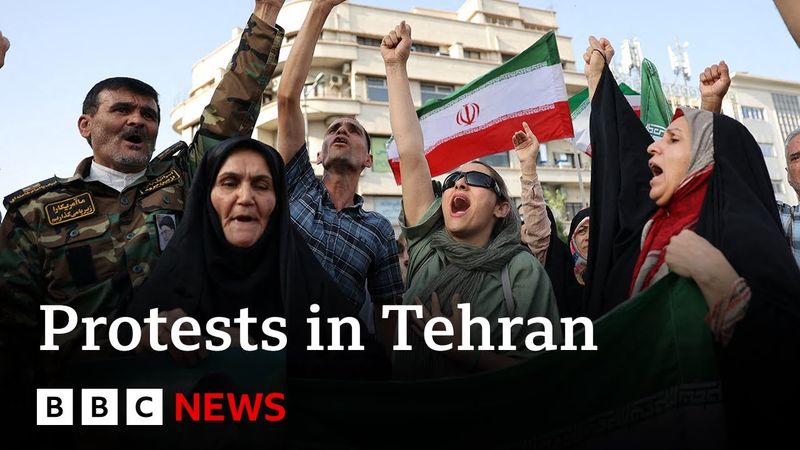
Protests have taken place in Tehran.
Despite mass evacuations there, the BBC isn't allowed to broadcast from inside Iran.
But we have this report from Siavash Ardalan of the BBC Persian service in London.
In the center of the crowd, Iran's president, surrounded by hundreds of party faithful, venting their fury at the United States.
What America did is truly unforgivable, says this woman.
Iran is stronger than they perceive.
But after last night's U.S. attacks, the regime here is seriously weakened.
So what comes next?
The Iranian supreme leader, Ali Khamenei, could swallow his pride and possibly save his regime and the country from further damage.
Or he could fight on and risk everything.
Domestic public opinion is now divided and confused.
The response must be firm and decisive.
What's at stake here is the very identity of being Iranian.
In my opinion, Iran needs to engage in some reflection and contemplation.
As for the country's Revolutionary Guard, it responded by saying U.S. military bases in the region are vulnerable.
But they know retaliation would invite further U.S. attacks.
This is a state TV reporter who went to Fordow.
I can't see much damage, he says.
For now, it's America's word against Iran's.
Weakened and humiliated, the Iranian regime will struggle to maintain its credibility and grip on power in the face of widespread discontent.
Sia Bashar Dallon, BBC News.
We can speak now to Bahman Kalabasi, correspondent for BBC Persian, who's joining us.
Bahman, very good to see you.
We don't have a great picture of the general mood right now inside Iran, but what can you tell us?
We mentioned there were some protests in Tehran, but also, as we saw in that report, support for the government in the face of what they see as U.S. aggression.
There's definite mass discontent with this regime and the immediate needs that talking to people is very obvious is for this strike and counter strike cycles to end.
The Israelis stop attacking Iran and Iran stop retaliating.
That is the first thing that much of the public is hoping would happen as soon as possible.
There has been many civilian casualties.
Infrastructure is being hit and the lives of millions of people have been disrupted.
It's one thing to hear, you know, bombers and drones on TV, but it's another thing to live under them day in and day out and hear those voices and be worried that your area, your neighborhood could be next.
So that is the reality in the short term, but in the medium term and long term,
I think a lot of Iranians would want this to end permanently, which means they do not want the government to retaliate at all.
Of course, there are hardliners who support the regime, and there is some rallying around the flag effect of this as well.
But the majority remains hopeful that the regime calculates that this will be too costly if they attack American interests in the region.
So that is where the population stands on a large scale, and that is hoping that the war would end and that there is no further escalation by the regime.
But that still takes us where it was before these attacks started, which was
A country heavily sanctioned, economy in the worst shape it's been since maybe the beginning of this regime.
And there's no light at the end of the tunnel without some sort of a negotiated settlement that opens up Iran's economy, that lifts the sanctions.
And that feels far away right now.
So what options do you think does that leave for the Iranian regime?
And can we learn anything from how it responded to the assassination of Qasem Soleimani during Donald Trump's first term?
Not many good options.
If they are one to finally make a U-turn and accept that their policies have brought Iran to this point, even though they find it unfair and even though they actually are worried about the consequences,
The reality is they don't actually have very good options.
If they decide to come out and say that we want to negotiate, then they have given up all that they have invested in, billions of dollars.
with nothing to show for it.
And if they want to retaliate, we know the cost might be even higher.
So it's a very difficult place that the regime is in right now.
Of course, they blame the United States and Israel, and some of it does find audience in Iran because it was the United States that ripped up
the Iran nuclear deal.
It was the United States that brought back sanctions despite Iran being following and adhering to that deal.
But nevertheless, today is a different day and they have to make a decision in which way they want to go.
Similar videos: Protests in Tehran after US strikes on Iranian nuclear sites
US must rule out more strikes before new talks, Iranian minister says | BBC News
US bombs Iran nuclear sites and Tehran warns of 'everlasting consequences' | BBC News
Iran's supreme leader says country delivered "hard slap" to US | BBC News
How the US strikes on Iranian nuclear sites unfolded | BBC News
Iran would react without 'reluctance’ to a US attack, country’s ambassador to UN says | BBC News