
Re-Release: Nick Fuentes on Israel, Censorship, and the Groyper Movement - Fight Back Ep. 9
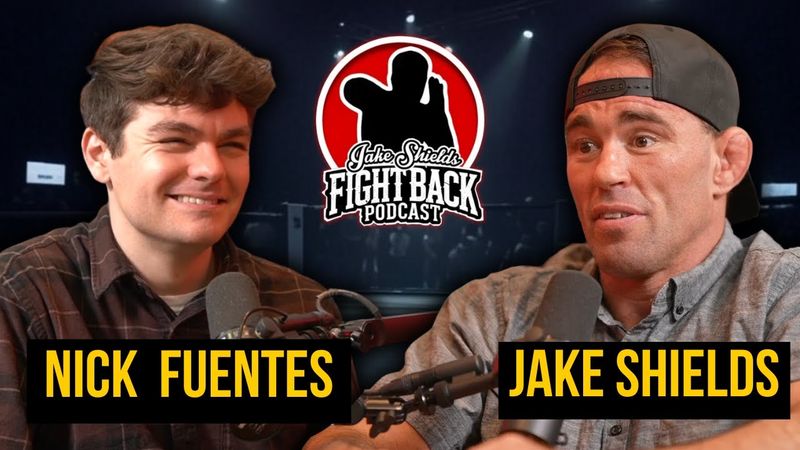
Download information and video details for Re-Release: Nick Fuentes on Israel, Censorship, and the Groyper Movement - Fight Back Ep. 9
Uploader:
Jake Shields' Fight Back PodcastPublished at:
7/24/2025Views:
357.6KDescription:
Video Transcription
What's up, guys?
I'm here with the notorious Nick Fuentes.
It's a very interesting guest because you are so vilified.
I kind of believed it and fully believe it.
I remember hearing like you're Nazi, white supremacist.
The only thing I saw was negativity about you.
It was just negativity, negativity, and you had no voice.
You were banned from literally everything.
And then, you know, so I didn't really like, I mean, I didn't think you were the worst person ever, but I think, but I figured you're someone I didn't want to associate with because I'm, you know, I'm not a racist.
Like half my friends are black, Mexican.
I'm like, oh, I don't really want to associate with this guy.
But then, you know, I was in New York, our mutual friend, fuck I'm terrible with names, Tenrio.
Tenrio, yeah.
He kept going like, oh, bro, you got to talk to my friend, Nick.
You got to talk to my friend, Nick.
And I'm like, bro, he's racist.
He's like, I'm black.
How are you sitting there saying he's racist?
Okay, good point.
Give me his number.
So then I think I started texting you.
We had a couple of phone calls and you were so not the guy that I thought you were.
And then we have, I don't know, a year ago or something, we met up, you know, had dinner in Chicago and it was just, you seem like such a genuine, normal guy.
And that's when I'm like, all right, I was completely lied to.
I was wrong about this guy.
I want to, uh,
I want to do something, you know, try to help you get mainstream again a little bit, which you are starting to slowly move that direction.
I just think it was, it's just crazy how bad they're able to vilify you, make you to, and even it's embarrassing to admit this, but even when I met you in the back of my head, I'm like, should I meet him?
Is this going to get me ostracized?
How much money is this going to cost me?
Because they were so after you.
They didn't just go after you.
They went after anyone that associated with you.
Guys lost their YouTubes for putting you on.
Guys got ostracized.
So they went after anyone that would even associate with you.
And I'm like a brave, self-employed guy.
And it was even in my mind, should I meet this kid?
I'm sorry I say kid because I'm a lot older.
No offense.
But I'm glad I did meet you because I realized I was completely lied to.
So I guess the question is...
What did that feel like, being that ostracized?
I believe you were 18?
Yeah, that's right, when I was 18.
Well, you know, it's a very strange thing because I think a lot of us are on this journey now.
You know, we're realizing that things aren't exactly as they seem, and we're all transgressing these political correctness boundaries, you know, and people are kind of stumbling around in the dark, feeling around for the truth.
And I think in that process, they find out that there's these severe repercussions.
And it's kind of a tricky thing because you can't really know until you do it.
It's not until you put your hand on the stove do you realize it burns.
And so for someone like myself, I was very young.
I was 18.
And I literally, it was as simple as just asking the wrong question.
You know, noticing...
pardon the expression, certain things, certain inconvenient things, asking the wrong question.
And I was swiftly and severely punished for it at a very young age.
And so for the past six, seven years, it's been a very lonely, difficult journey.
But ultimately, I don't regret it.
In a lot of ways, it sucks because I've been completely ostracized, and I don't think people realize what that looks like on a day-to-day.
That's tough.
Yeah.
It is.
I wouldn't want it now.
And at 18, I couldn't imagine how tough that would be.
You know, I'm a 45, but 18, being ostracized from society, that's just brutal.
Yeah, it's a tough age.
But I was brave of you to, instead of apologizing and backtracking, you march forwards.
Right.
Well, and, you know, I realized from a very early age and when I started that I was and I really, you know, not to be self-righteous, but I joined politics for the right reasons.
You know, a lot of people get into this stuff, become career politicians or career in commentary because they want to be famous.
They want to get rich.
I was always just passionate about politics.
I love the country.
And I went where the truth led me and I never look back.
And, you know, there was always something in me.
where I said if people don't want to associate with me because of politics, then they're not good people.
I think you're either a super boring person or you're a very shallow person, or you're just not that interesting.
I'm interested in the people that break the rules and have something different to say.
So it was never a huge loss.
I mean, it's more difficult this way, but I feel like in the long run, I think you'd probably agree it's more rewarding because you meet a lot of good people.
Way more rewarding.
But I was also in a situation where I was already extremely popular, so no one really wanted to disassociate with me.
So I can still walk through all those scenes.
Guys know they can't really ostracize me that easy.
So I can still cruise through these things.
People still want me.
Maybe people don't like me.
They still think they can get something from me.
So I haven't felt anywhere near the repercussions you have.
So did you lose a lot of personal friends like in high school and –
All of them, yeah.
I had a friend group that I was with in high school.
It was like seven or eight guys, and I was friends with them throughout the whole four years.
And we were pretty close.
And I was friends with them even through college, my first and only year of college.
But after I really started getting hit by the media, they completely disassociated.
And to this day, I only speak to one of them.
Do you think they believed it or think they were cowards?
Oh, they totally believed it.
I'm sure some of them bought in.
Some of them were cowards.
It's kind of interesting.
Half of them...
They bought in because they bought into the propaganda.
It was a different time.
It was strong propaganda against you.
It was really strong.
Well, and it was a different time, too.
I feel like now political correctness has receded.
Cancel culture has receded a little bit.
But back then it was just getting started.
So half of them bought in and they started making trouble.
And the other half said it's not worth the trouble.
And so even though they kind of had my back or they didn't buy into it, they said, well, we don't want this guy around.
He's causing all these problems.
And that's the cowardice.
Yeah.
I mean, it's, it's been, you know, backlash.
You're the most backlash person I've ever met.
And in the fight scene, I, I've, you know, I've rolled with mobsters, Yakuza, Hell's Angels, just out of prison, like head guys in the gang, people that are not the best people that I shouldn't have been hanging out with.
No backlash from that guy.
Guy got out of prison for murder.
One of the head guys, Hell's Angels, no backlash.
But you, I think you've never been arrested.
Do you even drink?
No.
Don't drink alcohol.
Don't drink drugs.
Never had a sip of alcohol.
Don't womanize.
Should be someone that people look up to.
And that's the ones like, Jake, you can't associate with him.
But I'm kind of like, fuck you.
You can't tell me who I can associate with.
Right.
Well, you know, and the thing is about that is people, I feel like, have this presumption that
all these political trends we're seeing are organic.
It is the way it is.
People think that these are just the times we live in.
When they see the craziness, they see that the government's totally corrupt, the country sucks.
People just kind of have this complacency where they say, well, that's just how it is.
This is just a sign of the times.
But you realize that
The reason you will never get pushback for associating with a mobster is because who would do the pushing back?
The people that push back against me are paid to do it.
It's groups like the ADL, SPLC, Media Matters.
And what are these groups?
They're political nonprofits.
for-profit companies and it's not you know it's not a real business they don't make stuff they get paid by donors to look out for people that say the kinds of things that i say and they're paid to stalk people like me harass people like me and ultimately spread lies and you could see that with the adl splc media matters they do it about people like me or kanye or candace owens now you lately anybody that says and it's of course it's interested it's politically motivated
It's political actors putting up the money for political nonprofits and they operate as the pain mechanisms like a protection racket against the people that speak out.
And once you realize that's what's going on, you realize it has a solution.
You realize like there are flesh and blood people getting paid money by flesh and blood billionaires to attack other flesh and blood people for saying very specific things because it threatens their political interest.
And that's the part that they don't want to get out.
It's really that process, because, you know, the way that it's able to go on is people just think, you know, someone like myself.
Well, I got canceled because I'm a bad guy.
I sort of had it coming.
That's what they said.
Right.
I had it coming.
You know, I said something and they say, well, freedom of speech is a freedom from consequences.
You shouldn't have been controversial.
But it's like you say, somebody like O.J.
Simpson could kill a person.
And he still goes out and people are taking pictures with him.
Exactly.
Oh, it's O.J.
I could do an interview with O.J.
and no one would say anything.
Right, and no one will say, well, you shouldn't have killed somebody or something.
But that's because killing people or being a mobster doesn't threaten the political interest.
And therefore, the media, which is totally controlled and these nonprofits—
Right.
The whole thing, you know, they're not coming after murderers, drug dealers, because that doesn't threaten the interest.
And so, you know, we really do live.
People call it the matrix.
They talk about red pills.
And what that's getting at fundamentally is that the world is a little bit more designed than we think it is.
You know, that's really to get to the fundamental premise, the simplest form of the idea.
Of the Matrix analogy.
In the movie, The Matrix, they realize we're living in a simulation.
We're realizing that it's a designed, created illusion.
But everyone thinks it's just how things are.
Everyone thinks, you know, we just kind of were born into this and it's what it is.
And the analogy is that our world is very much like that.
Now, we look at the world through a lens of media, movies, smartphones, and all of that is put on the screen by people, by very wealthy people, by connected people.
And they're not going to have the most integrity and do it with no filter because that's a very big power.
Mm-hmm.
to control the lens through which people, most people view the world.
And it's only, it's a very certain type of person that I think is even psychologically equipped to look through that.
You have to be a little bit disagreeable.
You have to be observant.
You have to be intelligent.
You have to, you cannot be a nihilist.
You know, you have to be somebody that thinks that the truth matters enough to make sacrifice.
And so, you know, that, I know that's a lot to throw at you, but that is really why we're in this predicament.
Yeah, I also had these organized, they're clearly organized groups going after all kinds of work I did.
They would go to seminars.
There would be like 50 people calling, everyone I work with.
Thankfully in the fight industry, and I mostly do business with my friends, I only had one thing canceled.
It was a seminar.
But it was with Nate Diaz, who publicly avoids politics.
So I was pretty pissed, you know, because I didn't want to cost him money.
But thankfully I was at a book seminar an hour later in a Muslim-owned gym, like five minutes away.
So it was a big kind of fuck you to the Israeli guys that canceled it.
So it's, uh, so I've seen the mobs myself.
It's just, I've been pretty fortunate with the people.
And I think because I was in a position of power already when it happened, I've been harder to cancel being self-employed.
Hey guys, I'm a self-funded podcast.
So if you want to support me and the work I'm doing, go to fightbackpodcast.com and you can buy cool merch like the shirt I'm wearing about the Rhodesia resistance.
What, um...
What were the first things you said that started getting you canceled?
Well, the very first thing I said is that it's actually super ironic because everyone knows me as like a reactionary, super right-wing guy.
But maybe literally the first thing I remember, I wrote a blog post because I had a very small blog.
And it was in December 2016.
It was actually defending Obama, believe it or not.
And I don't like Obama.
I don't think he was a good president.
But one of the last things he did in office is there was a resolution in the Security Council in the United Nations, and it was condemning the Israeli settlements in the West Bank.
Clearly a good thing.
Right.
Well, and not only is it something that I agreed with at the time, but also it's undeniable that that is official American policy since 1967.
Republicans and Democrats, the official, formal, diplomatic posture of the United States is that we do not approve of the settlements.
We consider them illegal.
And so the resolution went to the floor on the Security Council.
It's condemning the settlements.
And the Obama administration instructed our ambassador not to veto it, because typically we veto those resolutions.
United States, with the other P5s, permanent members, have veto power.
And so typically we will sink and veto and banish any resolution, even if it would pass.
But Obama declined to veto it, and he instructed the ambassador to abstain.
And so it passed.
And I remember, because I was a conservative and I still am, I saw Shapiro and Daily Wire and Fox News, the whole right-wing media machine.
They said Obama is the biggest Israel hater.
He's an anti-Semite.
He hates Jews.
And I said, well, hang on a second.
I'm like, whether you support what he did or he didn't, it's the official U.S. policy under Republicans, under Democrats.
So what he's doing is what's in the interest of the United States of America.
Maybe it's not in the interest of Israel.
And the germ of the idea was that America's interests and Israel's interests matter.
aren't identical.
And that's like a big revelation because they kind of believe that, you know, and they may be similar.
They may be very similar, but they're not identical because we're two separate countries.
And, you know, that actually means something.
Like America should have sovereignty and be able to conduct a foreign policy for the benefit of Americans first.
not for other countries, whoever they are.
And so that was really the germ of the idea.
And in very short order, I started to ask the related questions, which are, why do we have to veto every resolution, even if it's against our interest?
Why do we send them foreign aid?
Why did we fight in Iraq?
And it really snowballed very quickly.
And at that time, I was friends with all the Daily Wire writers.
A lot of them were in Boston, where I went to school.
And I knew them all.
And I would ask them, you know, because you're in college and that's the spirit of that's actually the spirit of the right wing in politics is open debate, the marketplace of ideas.
So I would say to Cassie Dillon and Elliot Hamilton and Aaron Bandler.
Why do we give all this aid?
Why did we go to Iraq and so on?
And they ran out of patience very quickly.
You know, at first they kind of dismissed it.
They were kind of glib.
Oh, you can't talk about that.
Oh, you're so you're so controversial.
But I kept pushing.
I said, no, I want an answer.
I'm America first, like Trump, because I was a big Trump guy.
I said, I'm America first.
I'm not even less.
I'm even more than I'm a conservative.
I'm America first.
And I said, I want an answer.
And they said, well, you can't ask that ever again.
And I said, well, that's a problem because there's not an apparent answer that kind of remedies this contradiction.
And then they said, we can't do business with you anymore.
We can't talk to you.
And I have the screenshots.
Cassie Dillon, I was very good friends with her.
She literally texted me on Twitter one night.
She said verbatim, we can't be friends anymore.
We're not in the same movement.
You're in the alt-right.
You're America first.
Right?
And then, but it got worse.
So she blacklisted me.
They all blocked me.
People that I hung out with, was friends with, they all blocked me, would never talk to me.
And then I got a call from my boss because I was doing the show at that time for Right Side Broadcasting Network.
I wasn't doing it independently.
It's a guy named Joe Seals.
And I got a call from him about a week later, and he goes, what's going on with you and Cassie?
And I said, I don't know what you're talking about.
We haven't talked in a week.
He goes, she's been calling me every day for the past two weeks demanding that I cancel your show.
Wow.
And she was watching the show every night, and every little thing I said that was controversial, she would pick up the phone and say, you'll never guess what Nick just said.
He said this, you got to take down the show.
And he goes, I'm not going to take your show, but this is really weird.
And then he confided in me she was considering converting to Judaism.
And he goes, don't tell her, and he'd probably be mad that I'm saying this, because he's an evangelical Christian.
He said, I've been trying to convince her, and she was living in Israel at the time, and she had been over there, and she was a fellow at Daily Wire.
And I said, wow.
And then the last thing that happened is she clipped my show, and to answer your question, the first big hit piece about me, she clipped my show and sent it to Media Matters.
Media Matters is literally funded by like Soros.
Yeah.
And all the usual suspects.
So here you have ostensibly a right wing Republican conservative pundit.
She's clipping a fellow conservative who's a Trump guy and sending it to the Soros.
The left wing.
Yeah.
So the left wing white Jews works hand in hand.
Right.
And it was some clip, ironically, where I was criticizing ISIS and I was supporting the Muslim ban, you know, that Trump passed.
But that was the first big hit piece.
And from then on, it was April 2017, I was tarred as a bigot, a racist.
And basically, that was three months in of doing my show.
It's like it was over before it even began for me.
Wow, you were just starting your political career and got pushed out.
18 years old, freshman in college.
Wow, that must have been devastating.
But, you know, you managed to go through it all and start your own channel.
And another thing I noticed, too, once I started watching some of your clips, because, you know, I never watched you.
I was told you're a bad person, that you use a lot of humor.
They would take the humor clips when you're joking out of context and look at makes like I use humor, too.
So they'd make it look like you're saying something you can't.
Also, when I started watching you, I realized you're very, very good at breaking down exactly what the problems are with our greatest ally.
Right.
So I think they looked at you as a threat.
Plus, you had the young audience, the Zoomers.
You were probably starting to build a big audience when they cut you off.
Yeah, that's exactly right.
I mean, because so I did something on the campus.
I debated the class president or whatever.
It's a long story how it got going.
But I literally did an in real life event with the campus president like my first week in college.
300 people came.
We debated Trump versus Hillary.
And that's how I actually met Cassie Dillon.
She live streamed it on Periscope.
And she told me after the fact, she said Ben Shapiro watched it.
And I told him he needs to take you under his wing.
Oh, wow.
So they were literally grooming you.
Yeah.
To be like the next big star.
You know, and who knows?
Maybe I'd just be a low level influencer.
But, you know, this is what they do.
They would have been big with the way you speak.
You could have been a big star if you'd have sold out.
You could be making millions being a star.
But you feel a lot better as you are, I bet.
Yeah.
Well, and I think that was the play.
And I think they clocked me as a threat because you're right.
I'm reasonable, and I bring humor to the table, and I'm a very... At that time, I was a very young guy.
And so they basically said, we need to throttle this guy in the crib before he really gets any momentum.
And, you know, in retrospect...
what you know i think i was treated very unfairly and i know that i didn't do myself a lot of favors over the years because i said some super controversial i think when they ban you it kind of pisses you off and it makes you go really far the other way which i did that a little bit when they first started going after me because i wasn't saying anything at all i was just pushing against the genocide in palestine and they went after trying to get me fired for everything so i did say some pretty controversial things after that because i was pissed off i wanted to be like fuck you to these people when they're trying to cancel me anyways i might as well up it so i mean yeah you said a few controversial things but i've never seen anything that bad you know
Well, yeah, and I don't think I've ever said anything bad, but that's always where they go is, well, you got treated unfairly, but then later you said things.
But I was a teenager who got utterly canceled, harassed.
My name dragged through the mud.
I doubled down, and I got mad about it.
I got pretty aggressive.
And again, I'm not walking that back or regretting, but people really need to put themselves in the shoes of –
This is a real problem, that if you speak out against a particular issue, you do get absolutely harassed.
And people that don't, I think, even have as much composure as me would go a lot crazier even.
Yeah, I definitely stepped it up and went after me because I had clearly organized groups of groups going after me.
It was highly organized.
They get people's phone numbers, 50 emails.
So it seems like a lot of people think that, but they don't.
Like I said, I actually do a lot of business with a Jewish guy.
Thankfully, he doesn't give a crap.
He thinks it's funny.
He'll send me the messages sometimes in his reply because he knows I'm not an anti-Semite.
He's just like, how do you deal with this anti-Semite?
He hates Jews.
He's like, dude, the guys are my best friends.
We do great business together.
We've never had any business problems.
I always do what I say.
We're very beneficial business-wise.
I'm not going to cut him out because you're telling me he doesn't like Israel.
I don't give a shit.
Right, right.
So I'm thankful.
I'm very thankful, though, because a lot of people don't have, you know, Jewish people in their corners.
A lot of guys would be like, oh, he's against Israel.
I'm going to fire him.
Right.
Well, and that happens, you know.
Well, and even with me, I had a Jewish assistant for years, you know.
And people within my clique or my movement, they said, well, you know, well, this guy can't be a part of it.
He's Jewish.
I actually went out on a limb and defended him.
You know, this is back in 2019, kind of at my first big break.
I brought a guy on our team who was Jewish, and, you know, he's a pretty smart guy.
And people said, well, you know, he can't be a part of it.
And I said, well, he's a really hard worker.
He's a smart guy.
I said, so I think he's okay.
Now, ironically, he later ended up betraying me.
I mean, I live to regret it.
I don't know.
Maybe that says something.
But, you know, but the point is they always try to turn you into a caricature.
But we're talking about the country.
We're talking about big picture.
We're talking about generalities.
And that's where people always get hung up is they say, do you think it's every single person?
Is every single person in on it?
And I feel like as a society, we kind of have to move past, they used to call it NAGZALT, not all X are like this.
And so, for example, you talk about a crime like, or excuse me, a problem like crime.
And you'd say, well, when you look at violent crime, it's a lot of black people.
Now, if you say that, people say you're racist.
And then you say, well, not all black people are like that.
But there's a generality.
It's a big country with a lot of people.
Their statistics and patterns emerge.
And they elucidate the nature of the issue or they characterize the issue.
And the same is true with Israel or Jewish people.
And that's always kind of the hang-up is you say, well, when you look at who's –
disproportionately represented and whatever you want to call it.
There's clearly something going on there and people say, well, you don't mean every single one is like that or something.
And I think that it's very important that people need to kind of grow up and have an adult perspective on things that, yeah,
The world is a big place full of distinct races, tribes, religions, and these identities people have and their ideas, they matter and they have significant implications.
And it may not be down to a man, but there can be groups that act in the world.
Yeah, I know different groups act different ways.
And honestly, if I didn't have several...
me they're just like so ruthless and then you see what they're doing in israel or in palestine just brutalizing people you see how they're controlling our government so if you don't have
I think they're turning them that way by attacking them.
They need to realize this.
They're trying to get people fired for wearing a Palestinian pin I saw today, like it is a work thing.
Just awful behavior.
There's definitely some group behavior that's not the best.
Right.
Well, and that's why for me, and this is maybe where I differ from a lot of people, kind of getting back to the fact that we're in this matrix.
When you start to notice and talk about these things, what's the first thing they call you?
Anti-Semite.
You know, if you say there's anything going on with Israel, there's anything going on with the media, anti-Semite, and no one wants to be called that because it's brutal.
It's devastating as a label.
Yeah, the first time I was called that, I was like, what?
But now we're used to it, you know?
Right, well, and for me, that never meant anything to me.
You know, when people call me racist or anti-Semitic, and I think a lot of people have gotten wise that that's really a scam.
I think people are waking up.
But when they call you that...
For me, I didn't care whether it was anti.
What even is that?
You don't even know.
If it's true is all that matters to me.
Exactly.
I care about truth.
It's about what's true and it's about what's right.
And if there's impropriety, if there's something wrong in the country, it needs to be fixed.
People could say racist, racist.
It's like the crime problem.
I'm from Chicago.
Yeah.
You know, people cry about racism, but there's 10,000 car thefts every year.
So do you want to live in the so-called racist society where there's no car thefts?
Or do you want to live in the society where everyone feels good about themselves?
We're so not racist.
Look at our black mayor.
But they're stealing your catalytic converter at 12.
Exactly.
Like I'm from San Francisco and like.
I think they're like, I don't know, five, six percent of the population, but most of the violent crime.
And I don't consider myself racist.
I have lots of black friends, but I also can admit this reality.
If you're not admitting that, you're an idiot.
And people, they're so scared to admit the truth they see.
It's like, okay, maybe you gotta look at, okay, what's causing this?
By blaming it on racism, it's never gonna get fixed.
Well, and what kind of society do we want to live in?
That's a question.
And what you're seeing in that issue as an example is at a certain point BLM and these groups got together and said, well, there's too many black people in jail.
They called it mass incarceration.
So they said – and they made the cops very wary of –
interdicting criminals because they don't want to wind up as an ex Derek Chauvin.
They don't want to wind up with a, you know, a attorney general.
It's not going to have their back.
So, you know, they call that the Mike Brown effect, you know, that the police kind of took a step back and they let the crime commence.
And, you know, and the question is, do you want to live in a society where we have a proportionate diversity in the prison population, or do we want to live in a society where all criminals get caught and go to jail?
I want to live in the ladder society.
You want to hear something crazy?
In San Francisco, this guy ran for DA and won.
He was a district attorney.
I'm not going to say what kind of district attorney.
He was a Jewish district attorney.
I had to do the Kanye.
But this guy, his parents were literally in a gang where they were this, the Weather Underground, I think it was called.
Oh, yeah, yeah.
They were Jewish, but they were a black liberation army, and they killed three cops, his parents.
The guy hated cops, and he said he wanted to make jails equitable, which obviously the only way to do that is to charge white people and Asian people more for the same crime.
It's insane this guy won.
I heard his speech.
I was like, wow, and then he won.
He was so bad after a year, even San Francisco recalled him.
He just wouldn't prosecute black people.
They would do whatever and he just let them right out.
Like 30 car thefts, beating up an old Asian lady.
It was absolute insanity.
And he believed it.
It's like, how do these people, I don't know if he believed it or if he's trying to destroy America.
I mean, he's probably trying to destroy America.
His parents were communists, literally trying to overthrow our government.
And then George Soros, not gonna say who George Soros, another one of these guys funds them.
And so you see the sanity of this.
And it's like, are these people, to me, it feels like they're trying to destroy our country deliberately, like the Soroses and stuff.
Well, I think that, you know, for example, in a city like Chicago, when when they take over the Magnificent Mile, they take over the Daily Plaza or the.
Those were nice areas in Chicago until recently.
People that don't know Chicago.
Oh, yeah.
Those are like beautiful areas.
Yeah.
It's clean.
It's one of the most beautiful cities in the country.
But when they go and commit the crime, the black mayor gets up and he says, well, they're not a mob.
They're kids.
They're teenagers and so on.
But you know what it is?
I think I cracked the code on why they don't see it the same way that we do.
black people do have a chip on their shoulder in the country.
They think that, and it's true, their average income, wealth, education is lower than white people, persistently for generations.
60 years after the Civil Rights Act, 60 years after the Voting Rights Act,
And they say, how is it that these disparities continue to exist?
They blame it on racism.
Exactly.
They say the only reason is because the white man's keeping us down, or they say the persistent effects of the white man keeping them down in the past.
It's because they didn't have generational wealth, whatever.
And so when they see...
the property crimes, the violent crimes, there's almost like a sick form of, they think it's like white people getting their just desserts.
They see white people in their beautiful society and in these rich neighborhoods, and they kind of see the pillaging and the marauding, and they say, well, good.
Because the black people, they've been oppressed for so long, it's time for the white people to suffer a little bit.
But that's actually not conducive to having an orderly society.
On the contrary,
Rather, I think they should look at white people as an example or Asians or any other group that is, you know, doesn't have the same dysfunction rather than have that resentment based politics, which is this kind of malicious envy, malicious resentment where they say, you know, we don't have a good.
So we're going to smile when we make it bad for everybody else.
We're going to smile when things fall apart.
That's a very destructive and nonproductive mentality.
So.
I think that's why they do that.
I couldn't agree more.
And I saw a lot of that living in San Francisco.
It's not, that's like a mainstream, probably same in Chicago.
And it's not going to fix the problem.
Like playing a victim and hauling racism is not going to fix it.
The problem is it's a long fix and no one wants to address it because it's such a complicated issue.
You know, they need to get fathers in homes.
They need to do like, I think the most charity thing I did that actually felt really good for like a year, I'd go into the inner cities and I would do sports with the kids, which happened to mostly be black kids.
We would bring cops in sometimes and I'd be teaching these, you know, wrestling with these kids, playing like playing soccer or stuff like that.
And it was it was some of these kids had never been around white people.
Some of these kids tell me like, oh, you're the first white person I've been comfortable to be around because the guy that was doing it was like a dark skinned Afghani guy.
And that was like crazy hearing that.
Like, wow, I'm like hanging out with a white person.
I was scared to like be around white people.
But now I feel comfortable around you.
And you're like, wow, you see that different mindset.
Yeah.
So they need programs like this.
They need to do education.
They need to encourage them to have fathers in the home.
But these are not easy fixes.
No.
Well, and you need law and order first.
That's the uncomfortable reality.
You need law and order.
You know, because you think about it.
I think about this all the time.
If you put the military in Chicago and you made it so that the crime rate
went to zero and the south side of the west side it would be an economic boom the investment would pour in because there's so much property and a lot of it's dilapidated there'd be so much investment but the problem is nobody wants to go into these communities you know this was like in chicago recently walmart is pulling out of chicago because there's so much shoplifting probably yeah so much theft and then they complain it's there's a food ghetto we can't get fresh groceries speak
Because they're stealing.
Because they're stealing.
Oh, yeah.
You would have prosperity, and then it would follow, but it starts with the discipline.
It starts with the order, and then you can have schools.
You could have charter schools or whatever.
Then you could have jobs.
Then you could have investment.
But the problem now, they're pissing it all away because we all –
We all know what's going on.
It's babies having babies.
It's welfare.
It's violence, fatherlessness.
They're trapped in this toxic cycle.
And this is really the role of the state.
If there is a role of the state, it's this, to break up that cycle and get in the middle.
And by the way, number one beneficiary would be the black people.
You know, the white people move away.
White people pay the property.
Yeah, they're the ones that are getting killed and hurt the most from their crime.
I mean, it comes over and gets us too, but it gets them way more.
Totally.
The white people pay the property tax to live in a white neighborhood.
They're the ones dying and being poor and, you know, having hypertension.
Something I always found funny, they say white people are racist and they move away from black people, but anytime a black guy gets money, they move away from black people.
That's right.
Look at the Obamas.
They're always talking about racism and white flight.
Oh, look where you are, the whitest neighborhood in America.
Martha's Vineyard, yeah.
Mm-hmm.
So switching it up real quick, you had a feud with Ben Shapiro and Charlie Kirk, correct?
I did, yeah.
Do you want to walk me through those?
Just briefly.
Sure, yeah.
Well, with Shapiro, we kind of told the first part of that story, and around that same time when I posted that blog thing about Obama, I put out on Twitter, and again, this is when I'm 18 years old, I was in college, I think it was on Christmas Eve, I tweeted something like,
you know, Daily Wire never criticizes Israel.
Well, just an observation.
It's so funny how observations, you know, and people could say, well, you're implying something, you know, well, it's an observation.
Maybe you should be implying that because it's very true.
Yeah, well, and, you know, if it's true, well, there's kind of an obvious inference that can be drawn.
And I said, you know, I noticed they never say anything critical about Israel.
And Shapiro quote tweeted that.
At that time, I had a thousand followers.
He had a million or something.
And I'm 18.
He quote tweets me on Christmas Eve.
And he says, the surest sign that you're an anti-Semite is accusing a Jewish person of having dual loyalty.
And I said, well, hang on a second.
Obviously, Jewish people support Israel.
Is that anti-Semitic to say that?
When you look at the biggest proponents of foreign aid to Israel or America supporting Israel, they're Jewish because it's the Jewish state of Israel.
And that's very near and dear to their heart.
Now, agree with it, don't agree with it.
It's a fact.
And he said that to say that they have any affinity with this country or allegiance to this country, well, that's the surest sign you hate Jewish people.
So I said, that's ridiculous.
And that was the beginning of my feud with him.
And he gave a really nasty speech about me at Stanford University in 2019.
And even recently, they fired Candace Owens because they said she's starting to sound like me.
That woke a lot of people up because she was such a big star.
Firing her was like a whoa.
These people are hurting...
It shows they don't care about money.
They're hurting their money.
People are seeing through them.
Guys like them.
I think Tim Pool hurt himself after he agreed to have me and Yuan backed out.
That hurt him.
Patrick Bette Davis just got destroyed by Dan Blazerian.
It just shows these people are losing.
So we are winning the information war.
More and more people are waking up.
Well, yeah, and you realize the media – how does media make money?
Advertisements.
And who's paying the advertisements?
Big companies.
So what's the purpose of media?
Is the purpose of media specifically political commentary?
Is it to make money?
There's a lot of good businesses to get in that make a better return on investment.
Or is political commentary supported at a loss by the big money interests –
to influence public opinion, which is in itself a very powerful thing.
And what's more valuable about something like the Washington Post, which Jeff Bezos bought?
Yeah, that was clearly for propaganda.
Is it because Jeff Bezos needs more money?
No.
Or because the Washington Post is one of the papers of record of the United States and has enormous influence over the elections?
Yeah, a moment that was really crazy for me.
I went through, and one day I randomly started digging through all the right-wing media, and I realized they weren't just owned by Jews.
It was like Zionist Jews, and a lot of them tracked directly to Israel.
I haven't done the left-wing media yet, but I was just like, whoa.
Everyone was Jewish, and then a connection to Netanyahu, like over and over, like the Daily Wire, Breitbart, Drudge Report.
It was like all of them.
It was a few more.
I think...
Yeah, it's so obvious, especially on the right.
You got PragerU.
Yeah, PragerU, that was another one.
You got Daily Wire with Shapiro.
You got Fox News with Murdoch.
And he's not Jewish, but he's tight with Netanyahu.
He got Breitbart with Joel Pollack is the editor now.
And, you know, there's an article on Breitbart.
It says, born in America, conceived in Israel.
It's a picture of the founders with Netanyahu.
So it's like...
So they admit it sometimes that, yeah.
Totally, yeah.
So you take a quick survey.
They're all Zionists.
And, you know, people say, well...
First of all, it's a good point you make that they're not just Jewish.
They're also Zionist or pro-Israel.
And people say, well, they're Jewish because Jewish people are smart.
It's like, okay, well, you know who else is smart?
Chinese people are pretty smart.
Indians are pretty smart.
The Persians that come here are pretty smart.
Germans are pretty smart.
Do Chinese have a cartel over the media?
No.
No.
No.
Indians?
No, I don't think so.
Do the Germans have?
No, I don't think so.
So it's like, you know, you could say that if you test really well, you could be a better lawyer or a better doctor.
But owning the media companies is not something you test into.
And if it was, we'd have a Chinese cartel running the media.
The other point is not just the overrepresentation of the group.
It's also that they're in favor of another country.
Exactly.
It's not just that they have power.
It's that they're putting all their power towards Israel.
I saw an interesting clip of you a couple of years ago.
You said something about you don't know if dual citizens should be in government or the people.
When I first saw that, I thought that was extremely racist and ridiculous.
But after September 11th, I've talked to all my friends and almost all of them are equally, or I would say most of them are more loyal to Israel than America.
And that was really shocking to me.
One of them wants to go join the IDF.
It goes into regional war.
They'll defend anything they do.
They don't care about the USS Liberty getting bombed.
It's just kind of shocking.
If you have a few friends, I recommend you go talk to them about this stuff.
You'll be shocked.
Not all of them.
There's a few of them that aren't, so I'm not going to say all, but the majority of them, I would say, are more loyal to Israel.
So how can you have people running your government if they're more loyal to Israel?
And what's the cabinet in the White House?
I think it's like...
35% Jews and all the top positions.
So it's not just the bottom ones.
And Kamala Harris, her husband's Jewish.
So you look at this, people that are dual loyalty or more loyal to Israel running American government.
And that was a moment to me that was like, wow.
Well, and that's the conflict of interest.
Iran exports rugs, they export carpets.
Does anyone have a problem that the Iranians control the carpets?
No, because it's carpets.
But when you're talking about a monopoly on conservative media and you're animating like the opposition of the country, which is Republicans and conservatives.
Well, it actually does kind of matter that you're only pro-America in that industry in the same way that, you know, we wouldn't.
And this is a big problem actually now.
We wouldn't want the Chinese making our fighter jets.
Want to know why?
Because they're another country.
It's a national security concern.
We wouldn't want Russians being responsible for our oil, or Saudi Arabia even, for that matter, who's an ally.
Similarly, do you want the opinion-making for American politics to be controlled by people that have allegiance to a foreign state?
No.
What might be the conflict of interest?
It's pretty obvious when you spell it out that way.
But the problem is, one, they call it anti-Semitic when you count how many of them run the media.
They say it's anti-Semitic when you say that's disproportionate.
They say it's anti-Semitic when you say that's a problem or even insinuate to have another allegiance.
And it's really not even allowed to get that far.
But when you acknowledge it's factual.
We just went through the facts.
Breitbart, Daily Wire, PragerU, Fox News.
These are some of the biggest ones.
They all have something in common.
We can acknowledge it's a conflict of interest.
So just on a factual, logical basis, we could say that's a problem.
But every step, they would try to put that kind of mental block of anti-Semitism in your path.
You don't even get that far.
Yeah, they hurl the thing.
It worked so good to say no one would be called an anti-Semite.
But then you're like, okay, what is an anti-Semite?
What does it mean?
Now the definition is always changing, they say, and only a joke can decide.
Yes.
So I think more and more people are realizing it's a complete joke.
Also, they're the only race that has their own word for racism.
Why not just call it racism?
They have their own word they make up for it.
It's kind of crazy.
And it's always changing.
It can mean whatever.
Did you see Thomas Massey?
He's one of the few guys actually that was trying to ban dual citizens.
And his wife mysteriously died.
Yeah, I saw that.
Really sad because Thomas seems like a great guy.
I've chatted with him a little.
He seems like an amazing politician.
So that's just terrible.
Yeah, well, who knows?
I mean, it's possible.
No, I'm certainly not saying they killed her, but I think he said something like she was healthy.
And he mentioned she wasn't vaccinated.
Yeah, and she wasn't old either.
I think the fact that he mentioned that she wasn't vaccinated means he has little suspicion.
She was a young woman.
So I believe she was in her 50s.
Yeah.
Unvaccinated 50-year-old women with no issue.
Typically don't drive well.
And they just drop dead, yeah.
No, when you see stuff like that, yeah, certainly I'm not making any accusations, but it puts it in the back of your head that it could be.
These people are known for assassinations.
They are.
They're very well known for that.
It's their specialty.
Yeah, backtrack real quick.
We're talking about Charlie Kirk.
It was interesting.
I was in Chicago at Turning Point, and I got you.
I was in there, and I grabbed you a pass.
I'm like, oh, Nick, come by.
You're like, oh, no, I don't think I can come.
I'm like, oh, no, I got you a pass.
Come through.
You showed up.
We go walking through.
Security rushed out, like 15 security escorted you out.
I was so confused.
I'm like, well, I guess I was wrong about that one.
Sorry.
It was insane the reaction they had for just walking in with a pass that I had.
I got one of my passes for the booth I was at.
And they just, they threw you out.
They said they're gonna arrest you for trespassing.
It's just, again, it just shows you the threat you are.
So what was your, is it, do you have a long feud with Charlie Kirk or what was that?
That really surprised me, that reaction.
Well, yeah, Kirk and Shapiro are slightly different, but back in 2019, he was doing this big campus tour.
He was going to all the college campuses, doing a speaking engagement.
And he would go to these different events, and he's supposed to be one of the more right-wing guys.
Shapiro is more of your traditional conservatives.
Charlie Kirk was really more MAGA-aligned, a little more nationalist-aligned.
So this is coming from maybe the most right-wing element in the mainstream.
And he would go to these events and he would say things like, we need to bring in 50 million illegal or 50 million legal immigrants.
I'm like, yeah, it's not really super conservative.
And he would say, this was the one which is totally outrageous.
He went to some kind of fundraiser with Zionists because I forget the organization, but the step and repeat banner behind him, it was in Hebrew, it was some pro-Israel group.
And he's speaking in front of them.
And he said that when it comes to the United States, he said, we're unique because.
Although he loves the country, loves the Grand Canyon, and he loves the topographical features and so on, he said you could wipe out the United States tomorrow.
And if you went to a desert island and you had the Constitution, he said that would be America.
Wow.
Get rid of the people and the land.
When did he say this?
He said this years ago, probably 2018, 2019.
Wow.
And but, and here's the but, he said, so with the United States, we're unique because we are all about the Constitution.
People don't matter.
The land that we love doesn't matter.
The people don't matter.
It's all about the paper, which is not true, by the way.
I think our land matters.
I strongly disagree.
I think our land matters, and I think the people matter.
Totally.
A lot.
I guess they don't because they're just flooding them across the border.
Well, and Liberia has our constitution.
They're not doing us a lot.
No, exactly.
I think the people matter quite a bit.
Right.
And our land is pretty amazing here.
I think it's the most beautiful country in the world.
Right.
Well, we're a nation, you know?
Well, and here's the important part.
He goes, but, he goes, Israel is not like that.
He goes, because the Israelis have a connection to the land.
He goes, you take away the land from Israel, it's no longer Israel.
And it's like, hang on a second.
So the American people can be replaced by immigration.
We could lose our land.
That is not essential to America's identity, but Israel must have the land and must have the people and the Arabs got to go and they get to do deportations and they get to have a border.
And they get to, you know, because there's such a striking difference.
Like in America, you can't talk about limiting immigration.
You can't talk about how the country's becoming minority white.
In Israel, they literally say we have to get Palestinians out.
There's too many of them.
In other words, they want to make sure it's a majority Jewish state to protect the identity and culture of the country.
And so he was in this position where he has to justify the double standard.
But he put it on display right there, which is nationalism for them, but not for us.
Yeah, I find it really interesting.
A lot of the people that push the open borders here happen to be Jewish, like the Mayorkas, like tons of them can't get through it.
And then they never, ever push it for Israel.
Same thing with gay marriage.
It's banned in Israel, but not here.
Interracial marriage, banned in Israel, not here.
I mean, I don't think it should be, but gay marriage, yes.
Interracial, no.
But interracial marriage, you can't do in Israel.
No.
Well, and it's a very conservative country.
And this stems from the idea that, look, the Jewish people for 2,000 years were in exile.
They did live in—and this is their claim to the land, historically, is that they did live there.
You know, they had kingdoms of Israel.
And then Jesus Christ arrived, and Jesus Christ said, time's up.
You rejected me, and now you've got to go.
To paraphrase from the Bronx tale, now you've got to go.
So they tore the veil, the temple was destroyed when Christ was crucified, and then shortly afterward.
And then after that, they were banished from the land, and they went into exile.
And they went into Europe, they went into Africa and India, they went all over.
And for 2,000 years, they could not resettle the land.
And so it's only in the past 100 years that the Jews have resettled the land which we call Palestine in significant numbers.
And so what you have is this dynamic where you have the Jews that remain in exile, the Jews that reside in the United States and Europe and elsewhere, and the Jews that now live in Israel.
And what you find is that they have different rules for the Jews in exile and the Jews in Israel.
So for example...
There was a debate between Bret Stephens and a rabbi.
Bret Stephens, he was a columnist at Wall Street Journal.
Now he's at the New York Times.
Started out at Jerusalem Post.
Big time Jewish neocon.
And Bret Stephens had a debate with a rabbi, and the debate was, is Trump good for the Jews?
That was the title of debate.
And they're debating, is he good for our collective interest?
Yeah.
And in the debate, Brett Stevens said the reason why Trump is bad for the Jewish people is because he is hostile to the liberal international principles that are good for Jewish people.
Wow.
And there's a premise here.
There was an article in The Atlantic a few weeks ago.
It said this is the end of the golden age of American Jewry.
It was written by a Jewish person.
And it said that 100 years ago, you know who invented the melting pot narrative about America?
A Jewish person.
With the explicit intention, because when they got here...
the native people realize they're different.
You know, they speak Yiddish, they practice Judaism, they're ethnically different.
And so like the Irish and Italians, Jews were not welcomed.
So Jews thought it would be beneficial for them to be tolerated in the country and for them to ascend the ladder that the country now be multicultural.
You know, now America's not a white Christian country.
America's for everybody.
We're a big melting pot.
Anybody could be American.
And they say they say it that opened the door for them to rise up and for them to become influential in Hollywood and government.
And, you know, the quotas and the elite universities were eliminated.
Now they're comprised significant proportion of the attendees of the Ivy League schools.
And so so, you know, to put it plainly.
In America, they say we have to have open borders, and we have to be multicultural and tolerant and liberal, because that's good for Jewish people.
Because only in that paradigm are Jewish people whose culture is different tolerated, and are they allowed to take control of the government or the media or whatever.
In Israel, however, it's beneficial for them to have a closed society.
Mm-hmm.
Because when they have a state, they have to protect its identity.
When they're under siege by foreign powers and invaders, they have to build giant walls in the West Bank and the Gaza Strip.
They have to do preemptive strikes against their enemies.
They have to do, by any means necessary, secure their state.
So in Israel, they have something like a fascist, identitarian, ethno-state.
So for the Jews in exile, they're going to push total liberal internationalism.
For the Jews in Israel, they're going to push closed borders, ethno-nationalism.
Netanyahu is trying to build like a fascist dictatorship there.
And it's like – so it's different rules, but it all comes down to what's good for them as a people.
Yeah, something really interesting for me, I remember seeing when I first saw that gay marriage is illegal in Israel, but it was a lot of the Jewish people pushing it here.
And originally, when a gay marriage got pushed, I was actually, I didn't have a strong opinion.
I was like slightly like, oh, I guess, whatever.
But looking back, that showed that, what do they call the slippery slope?
It showed me that really was true.
That's when things started spiraling out of control.
And then I also thought, why do two men need to get married?
The point of marriage is to have a family and kids.
And something, you've probably seen these videos, something that really shook me is when I saw videos of taking a small infant and handing it to two gay men, just ripping it from a mother.
Like, you know, someone with children, like, you know, they need a mother and a father, but, you know, especially that first year, the mother understands the needs of a kid.
A man, we can't read a baby like the women just always seems to know what the baby needs.
And as much as we try,
We just can't just to hand this little baby, rip it from his mother and hand it to these gay men.
I saw these videos as absolutely disgusted.
And I think that, I think that turned a lot of people on the gay adoption issue.
And I just, I think that needs to be pulled.
It seems, it seems demonic.
A lot of these guys are using these kids as pets.
I mean, I'm for sure you probably agree.
What was your pitch opinion on that?
Yeah, it's totally sick.
And you know,
I think a lot of people were okay with gay marriage because they said, well, whatever.
How does that affect me?
That was the angle.
That's kind of what I said.
Just whatever.
People said – and there was a meme going around.
They said conservatives say that when gay marriage passes, the sky is going to fall and the moral decay will increase.
They said, well, what's really going to happen is gay people are going to get married.
So what?
Big deal.
They're going to go and do their thing.
And then when gay adoption happened, people said, oh –
But they said, well, there's a lot of kids that need to be adopted.
There's not enough parents that want to adopt the kids.
They said, do we want to have the kids be in the foster system and be parentless or in a household?
People said, okay.
But then they started to do the surrogacy thing.
The surrogacy is the really nasty one.
And then it's like, okay.
So imagine, I mean, every human being has to have a mother and a father.
Every human being has sperm and an egg, which can only come from a male and a female.
And every human being has to be carried in a womb, which only female has.
So every man, woman has a biological mother and a father.
But the gay people say, we're going to create a child through this Frankenstein method, basically with the intention of taking the kid from their mother.
And the kid doesn't get a vote in that.
I don't know about you.
I love my mother.
I love my birth mother.
It's just, you're so connected with her.
She raises you like in her body.
Like you're connected to him before you're born.
People don't realize it's like for nine months, you're a part of your mother.
So I think that's why they're so in tune with the baby when they come out where the father just can't get that.
We can't read their needs the way the mother can.
Exactly.
And, and, you know, so the idea that you would be deprived of a mother.
It's just, I couldn't imagine.
You need a mother for, I need a father for discipline and teaching you life, but you need the mother for the nurturing and the love that the fathers, you know, can't give.
I couldn't imagine having two, two gay dads and the teasing they'll get, the bullying.
It's just, to me, it's just disgusting.
And again, I didn't have a strong opinion on it first, but when I saw those videos, it was just like, it was wow.
It was an instant, just like, wow, this is just demonic.
Yeah.
It's, it's unspeakably evil.
Um,
You know, and that's where you really realize that is why this stuff is so evil, because it thwarts God's plan.
And people don't like to hear that because not everybody's religious, but it's like we were designed a certain way.
Two men can't have kids.
Two women can't have kids.
A man and a woman can have kids.
And it turns out it's pretty important that the child, especially in the first three months, is raised by their mother.
And you see what happens.
Like a lot of people are pretty messed up because their parents get divorced or they go to daycare.
It's a very important relationship.
And so we see when you try to thwart that plan, you get all these externalities and people think they know better.
They say, well, we were designed this way.
It's obvious.
Adam and Eve, Adam and Steve, like, you know, the male end and the female end.
We all know biologically men and women are compatible.
But people in this day and age, they say, well, we know better because the heart wants what the heart wants.
You know, and a gay person says, well, you know, this is what I want for my life.
So biology be damned.
And look at where it ends up.
Nothing ever good comes from it, and that's because it's the fruit of the poisonous tree.
And these are just basic principles.
So the further and further you get away – and even, by the way, for the straight people, the same thing is true.
Even for the people that are having promiscuous sex, that's where abortion comes from.
What's an unplanned pregnancy?
It's when people do a sexual act that produces a child –
with no intention of having a child or raising that child together.
All abortions stem from non-marital sex.
And, you know, so same thing with divorce.
You know, these are people that get together and, you know, maybe it's noncommittal.
Maybe they do it because they just love each other.
And then they mess up the lives of the kids forever.
The generation's lost.
They get together.
They split because they're not feeling it or whatever.
They don't recognize the permanence or the sanctity of the sacrament.
And then they split, and the kid is like a ripple in a pond.
They perpetuate that trauma even further.
Then they're messed up, and their kids are messed up.
So it's really like things have gotten way too crazy.
We've got to get back to basics.
We've got to get back to a foundation, and the foundation is religion.
It's common sense.
All this other stuff, the further we get from it, the more horrors we can see, and that's how people rationalize it.
And I think in some sense, like the Pete Buttigieg is the worst of all possibilities.
A lot of conservatives, they look at leftists and they look at the –
You know, like some of these homosexuals that get taken down in the Biden admin, they're cross-dressers or they're pedophiles.
And people think that's gross.
And it's true.
You know, the outright degeneracy is disgusting.
But at least the degenerates know that it's a transgression.
They kind of relish it and they know it's evil and they're doing evil.
And so it's a little bit more honest.
And in that sense, there's something qualitatively different.
When Pete Buttigieg or Guy Benson or Dave Rubin
These are gay men.
They marry a guy.
They create a child through surrogacy.
They put on the college football sweatshirt.
They go to the game.
They go home.
They get a dog.
They raise their kids.
And it's almost worse because it's like this inversion of what is holy and sacred.
And they say, this is normal.
They're normalizing it.
And it's almost worse to say there is no good and evil.
Whether you're two guys married with a dog and a surrogate kid, or you're a man and a woman in a traditional marriage with a real kid, hey, we're all just families.
When you blur that line, because that's what the devil does.
The devil doesn't come and say, hey, do evil.
the devil comes in and says, well, there's no such thing as good and evil.
Let's do what we want to do, and let's do what's best for us.
That's always how the devil comes.
You know, when the devil tempted Jesus, he didn't say, hey, let's be evil.
He said, I'll give you all the power in the world.
They offer you everything.
Right.
You know, and even in Star Wars, you know, people say, how do you get Darth Vader?
How does someone go and blow up a planet?
I know this is, you know, maybe a little Reddit or whatever, but
But in that trilogy, they show how a person falls.
They say, well, good and evil is a point of view.
Who's to say what's good and evil?
Good and evil is how we rationalize power, how we rationalize interest.
And it's blurring the line.
That's how they get you to surrogate children.
That's how they get you to pedophilia.
That's how they get you to these abortions, these post-work abortions.
So for people that think they're too good for religion, it's like people need to really kind of rethink their assumptions.
Yeah, I know.
I was like an atheist growing up and then switched to agnostic.
And I definitely believe in God.
I haven't switched to organized religion yet.
It's possible I will.
I mean, I'm looking at the religions.
But yeah, personally, I badly partook in the hookup culture.
And it's like one of those things, sleeping around.
But it's not rewarding.
You just start feeling empty after a while.
And I did have a kid young.
And we didn't get along with the mother.
But luckily, I was never pro-abortion.
I thought it should be legal.
But for myself, I just couldn't...
I couldn't get myself to kill my own child, thank God.
Obviously we talked about it, but thank God I just couldn't go through with doing it.
And extremely close to my daughter, but it was terrible that I didn't raise her in a family together.
I still feel so, that's one of the few things I feel totally guilty about in my life that she didn't have
a full-time father there.
We're still close, but just not having the father a hundred percent time, the whole child needs that.
And it's just like, you are right about the family union.
They need both parents in the house, both parents taking.
So when you split these relationships, the kids going back and forth, it's so damaging for the child.
I said, my daughter turned out great.
We're close, but it's still, you know, for sure it hurt her.
Well, and I can hear that you mean that sincerely because you have a conscience.
Even though you're not religious, you have a conscience and you can see the way it's supposed to be.
And the sickest thing of all is when people go and encourage young people who don't know better that this is the way, and they have no idea the damage it causes.
And that's the thing about the devil, is in the Bible, angel comes to the Virgin Mary or anybody,
And they say, don't be afraid.
Because when an angel comes, people are terrified because they don't look like the angels we think of.
They look like, you know, crazy things.
And people are in awe of God's power.
And the angel says, hey, it's cool.
Because in the immediacy, we're terrified.
But as we get to know God, we get to love God.
And we realize that, you know, and I don't want to sound like I'm giving like a big sermon or whatever, but this is true about the nature of good and evil.
As we get to know God, we realize it's unconditional love.
We realize we love God and we fear God.
With the devil, it's the opposite.
The devil comes to you and says, hey, man, try a cigarette.
Hey, man, let's smoke pot.
Hey, let's have sex.
Free love, man, feels good.
What's wrong with love?
What's wrong with jerking off?
Whatever.
And then the devil says 20 years later, I got you.
I got your soul.
You know, when people are tempted, they fall further and further into it.
They don't realize it's a false promise and you're selling your soul.
And so, you know, that's what's really sick about our society is that, you know, people make their choices, whatever, but the media is inculcating the youth problem.
with this doctrine of sin they're totally stealing their innocence and it's not it's basically not until it's too late you know the kid that gets hooked on heroin the kid that loses his virginity the kid that finds pornography at 12 12 years old they have no idea what they're getting the pornography thing is crazy because when i was older when i when i grew up much older it was almost impossible to get pornography so it wasn't an issue maybe i found a magazine once you know so it didn't like really damage my brain kids now
have unlimited access to hardcore pornography.
And I think it was Nico told me he started watching at 11, and then I looked it up.
The average age kids start watching pornography now is 11 years old.
That just has to be damaging to the brain.
I couldn't, I mean, I'm glad that I learned sex naturally, not like watching all the porn.
It just can't, it cannot be healthy.
No, it's so evil.
And also the hookup culture, it's so easy to get sucked into that, you know, especially if you're like successful doing well, you know, you have all these beautiful women around and then people are offering you drugs.
You can just get sucked into this.
It seems like, oh, everything's great.
We're at the house with models.
You don't really realize you have a problem because everything seems good.
Like, you know, if you're like some fucking tweaker in a trailer with some ugly chick, you're going to know you have a problem, but you're at a mansion, you know, models everywhere, you know, ratio five to one people, you know, pulling out clothes like, oh, life's great.
But you don't realize you keep doing that.
You're going to hit rock bottom.
You're not going to have people that truly love you.
You're not, you know, it's so much better to be with your children and family and loved ones.
And it's I think a lot of people kind of fall into that trap.
Yeah, it's absolutely true.
And that, you know, and that kind of gets back to the big subject, which is like, you know, what is really best for our people?
You know, that's kind of like the big question, which is at the heart of it all.
Because, you know, people have conversations about this topic.
And, you know, they talk about the tax dollars.
They talk about the wars.
And, you know, really, it's really scratching the surface.
The fundamental question is, if Bret Stephens and a rabbi can ask the question, is Trump good for the Jews?
And is he good for Israel?
Why can't the Americans say, what's good for Americans?
Is he good for us?
Exactly.
We almost need our own PACs, which I actually really respect that you challenged Trump.
I mean, I'm probably going to vote for Trump because he's so much better than Kamala.
But I love the fact you had the balls to stand up to him and call him back.
That was not popular.
I mean, you got a lot of hate for that and still are.
But these guys need to be called out.
And I've called him out, too, and I've lost thousands of followers.
When I first criticized Trump, I lost thousands of followers.
but I'm always going to speak truth.
And that's what I can tell you the same way.
We might not agree on every issue, but we're going to speak truthfully to each other.
And more people need to do that.
Absolutely.
Well, and it's not worth doing anything else.
I mean, lying on behalf of who or what.
You know, with Trump, at the bottom of it, like with everything, it's just about politics.
And I explain it this way because a lot of people say I'm with Kamala.
I'm not with Kamala.
I'm not a Democrat.
I would never vote for her.
But I'm not going to vote for Trump just yet because I don't agree with a lot of the things he's saying.
And people say, well...
If you don't vote for him, you're going to get the Democrat.
But it's like, let's talk about how politics actually works.
Miriam Adelson gives Trump $100 million, and Trump is going to do what Israel wants.
And why?
Because Miriam Adelson, representing the political interest of the state of Israel, has given Trump what he needs.
They made a deal.
He needs money.
She gave him money.
Now he's going to use political power to benefit her.
That's what politics is really about.
Yeah.
For all of us, politics is about arguing with your neighbor about whether the Democrats or the Republicans have better presidents.
And we vote for them one way or the other.
So when I go out there, because I said, you know, Trump was just getting worse and worse.
I said, look, I'm going to go and tell people to withhold the vote.
And we're going to articulate a clear agenda.
No war, no more immigration.
You know, for at least 10 years, we've had a billion immigrants.
It's clearly too much.
Right.
Right.
So I said, no war, no immigration, and let's get Republicans to say we won't vote unless he has a conservative America first position on this.
People said, well, you're going to make them lose.
It's like, well, how is this any different than what Mary Madelson is doing?
Because all we're doing is going to Trump and saying, we could give you 20,000 votes in Michigan, which is what you need, but we need something in return.
I agree.
I think we need to hold him accountable.
Jake Shields built his name in the cage.
Now he's taking the fight to the narrative.
The Fightback Podcast doesn't hold back.
No filters.
No corporate strings.
If you're tired of the same recycled lies, support real independence.
Visit fightbackpodcast.com.
Pick up something from the shop.
Because truth needs muscle.
You're part of the resistance.
Methylene blue has been used for over 100 years for medical purposes and recently surged back into popularity.
It has been shown to help repair brain tissue and improve memory, cognitive function, energy, and mood.
Research suggests that methylene blue could have neuroprotective effects, possibly aiding in conditions like Alzheimer's, Parkinson's, and depression.
Go to MerakiMedicinal.com and use the promo code FIGHTBACK for a discount.
And Adelson, like I said, the person, her husband is a traitor.
I saw him giving a speech saying he served in the US military, but he was shameful because he wanted to be in the IDF.
That means he represents Israel, not America.
There's a traitor, Jonathan Polard, I'm sure you know him.
He's one of the worst spies in American history.
He was stealing our secrets for Israel.
I think they're selling them to like China or Russia.
He basically had everything, one of the worst spies ever.
Soon as this guy got out of prison, he picked him up, flew him to a private jet for a hero's welcome in Israel.
This guy is representing Israel.
He loves a guy who's a spy and undermines America.
This guy is not our friend.
This money is not to help us.
No, and Trump pardoned him because of Sheldon Adelson's money, who's now dead.
And Adelson flew Pollard back to Israel on his private jet.
And he was greeted on the tarmac by Bibi Netanyahu.
And the guy's a traitor.
Yeah, he should have been hung, in my opinion.
Well, he committed treason.
Yeah, literally committed treason.
That's what happens when you commit treason.
So it honestly makes me sick to my stomach when I think about it, because that's why Trump was so powerful, because Trump didn't come up and say, we're going to have a free market, man, and I'm going to cut your taxes.
He didn't say, I'm going to be conservative, whatever that means.
He said, we're going to make the country great again.
He said, the American dream is dead.
Country's in decline.
We all know it, he said.
And what was critical, too—
because I kind of deconstructed this on my show.
He said, make America great again.
And that contains three powerful ideas, which is one.
America is no longer great.
If it has to be made great again, it's no longer great, which few politicians will ever say that.
Every politician says no.
Joe Biden says, we're America, man.
This is who we are.
It's not great.
Our cities are embarrassing.
There's fucking trash everywhere.
Pardon my language.
It's terrible.
But Trump goes out there and says, well, make America great again.
It says, one, America was great.
which we know, is no longer, which no one will say.
But he said, if you elect me, we can actually tangibly make the country better.
And that's actually different than what other people say.
Because every other campaign slogan is like, stronger together.
When we fight, we win.
I'm with her.
Kamala Harris for the people, whatever that means.
But Trump said, no, we're going to make the country great again.
We're going to achieve greatness.
It's tangible.
It's real.
And within that, you know, during his announcement speech in 16 or June 15, he came out and he said something which was like at the time I didn't think anything of it.
But going back, he said he said we need a leader.
He said you need a leader to literally take this country and make it great.
And, you know, in that sense, he said what we need is a president that actually counts.
We all know the president doesn't make the decisions.
We know it's an opaque, incomprehensibly complex system.
Nobody knows exactly how it works or who's really making the decisions.
So Trump said, no, we need a leader to bypass that who's accountable, who is proceeding from the unity of one individual, going to take responsibility for the greatness.
And by taking the country, seizing power, making it better, you know, a lot of people said, well, that's like Hitler.
That's like a dictator.
That's fascism.
I call that accountability.
I prefer if the president's in charge.
Good.
We know who to blame.
We know who's responsible.
And let's empower that person to make the country better.
Instead of unaccountable bureaucrats, hedge fund managers, unelected people.
You know, we don't even know who's making or passing the laws.
They don't write them.
It's not Biden, yes.
They don't read them.
They don't know what's in them.
You know, the think tanks.
Who are doing these things?
It's crazy, right?
They just hand them these, like, giant things.
They don't even read them, just sign them.
It's absolutely insane.
It's an 8,000-page omnibus bill.
It funds the whole government.
None of them could possibly read it.
So Trump said – it was really a message about efficacy.
He said, I'm going to go in, and it's one of my favorite speeches.
I've been quoting it all the time lately on October 13th, 2016 in West Palm Beach because he gave a few speeches that day.
People should look it up.
I'll go have a look this up.
It's the best one ever.
I love Trump 2016.
It was magic.
You will literally like – it's like the best thing you'll ever watch.
Yeah.
And they all called it anti-Semitic because he goes out there and he's like – he said this election will determine whether or not we the people retain control over our government or whether we have only the illusion of democracy but are actually controlled by a small handful of global special interests rigging the system.
Wow.
And it's like, if that's not like a shot of espresso, like that's like a shot of adrenaline because you watch like Kamala and she's like, hey man, like Trump's a bully and like we need to bring people together and not like drive them apart.
And Trump's like, you know, we have an illusion of democracy.
We're controlled by global special interests because that's real.
It's real and it's true.
And it cuts the heart of the matter, which is that we don't have sovereignty.
We don't have a government of, by, and for the people.
How can we expect them to do anything for us?
And so, you know, that's what it represented in 16 was like a leader getting up, taking the reins, literally taking the country and making it better in tangible ways.
Not we're going to have a pro business environment.
It was like, no, we're going to build highways.
The cities are going to be clean.
There's going to be no crime.
We're not going to have all these illegal immigrants coming in like we're going to be a serious country.
And that is what was so exciting about it.
And now it's just like a regular.
Yeah, that trumps.
gone and people get mad at me and you for saying that but he's that guy clearly is not the same guy he's not talking about you know getting rid of nafta and nato and like all these things all these things that were groundbreaking at the time i think that's why they hated him so bad the globalists which you know who they probably are i don't even think he realized who he was going against but he accidentally upset the globalists which is why they were impeaching him in his way for everything he did and i feel like now he's kind of like caved and bowed to him a little bit totally but he is still a wild card i could see him possibly getting there and shaking things up but it seems like he's kind of neutered
It's possible.
Here's the reality.
He's very old, and he's been fighting for a long time.
He's been fighting for 10 years.
And, you know, they say that about the president, that it ages you like you wouldn't believe.
And that's for a normal president, not a president that's fighting tooth and nail.
They're trying to put him in jail, take all his money.
He got shot in the face.
It's insane when they're doing a shot.
Like...
So this man's been through hell.
He's 80-some years old.
And he's tired.
And I think he's tired of fighting.
I think he has no interest in governing.
And he doesn't have super strong ideological conviction.
You know, he's got a good core.
On his instincts, he's with us.
He's like a 1990s populist.
He's anti-free trade.
He's against the wars.
He's against the immigration.
But you know what it is?
This is what happens typically.
They go in.
I'm talking about a president gets elected.
They get in the Oval Office and the people get around him and they control his diet of information.
He actually becomes more isolated than ever, because when you're like a guy and you're out in the public, you're a little bit in tune with what people are saying.
And so when you're the president, you're so busy and you're the Secret Service around you all the time.
Trump has people deliver clippings to his desk every day.
They control his eyes and ears.
And when that happens, they start to control his perception.
And they'll tell him, you know, and after years of this, it's just attrition.
They say, you got to bomb Syria.
You got to do this.
We need the people.
Like Trump has been saying lately, we need the immigration because Jacob Halberg is telling them we need the Indians to power artificial intelligence to be in China.
We want to give our best jobs to Indians.
That's almost worse than bringing in the low wage jobs, in my opinion.
But that's what they tell him.
And I know because I know how they operate.
This is how they manipulate you.
On some level, it's deeply personal.
The political is the personal.
People will get in your face, and I know this because it's happened to me, and this is how they control you.
They find your anxiety.
They find your insecurity.
For some people, it's their pride.
For some people, they like money.
For some people, women are their weakness.
But everybody's got something they're anxious about.
And for example, I had people that tried to handle me, people tried to groom me, and they would come to me.
And what they do is they induce a state of anxiety or fear.
And so in my case, a guy would come up to me and say, if you don't do this, your career is going to be over in three months.
You're losing support.
You're going to be irrelevant.
No one's going to care.
If you don't do this in three months, that's what's urgency.
It's your anxiety.
And they induce the state of panic where you sort of become irrational.
And they say, I got all the answers, but don't worry.
Don't fear.
I have a plan.
Just trust me.
I know what I'm doing.
And people go, oh, okay.
Well, you know, this person knows what they're doing.
They're going to help me along.
This is how people always get got.
It's an intelligence tactic.
It's intelligence 101.
If you read books...
Like Spy Fail is a good one.
There's a few others.
You read these books about how the Mossad and the intelligence operate.
This is how they cultivate their human intelligence.
And I have no doubt in my mind, on some level, they're doing that with Trump.
It's hard.
It's not hard to imagine a scenario where they get around Trump and they say, hey, man, you're going to jail.
You're losing the election.
They're going to kill you.
But fortunately, we're the GOP.
We can save it.
We're going to get you elected.
Yeah.
And like the people he surrounds himself with, like the Pompeo is the frickin Bolton.
J.D.
Vance, he just picked like J.D.
Vance was a never Trumper.
This guy hated him.
He probably still hates him.
How you put that guy in there?
I know that was such a disappointment.
I know.
I'm pretty sure you agreed strongly with that one, too.
Right.
That was one of those like really J.D.
Vance.
Yeah.
Well, and I clocked that guy even when he was running for the Senate, when he's running for the Senate primary.
J.D.
Vance is a whole rabbit hole because, you know, he represents Silicon Valley and this Peter Till.
Right.
This big thing, you know, but but to put it simply, he was a never Trumper.
And like, you know, look at the guy's record.
He was at American Enterprise Institute, American Enterprise Institute.
Look at their alumni.
It's like all the neocons in the Bush administration.
They published a paper in 1999 with David Wormser.
He was the guy that wrote the Clean Break Report in 96, which was like – What was that?
That was a blueprint to go to war with Iraq and Syria and Iran.
So it's like AEI published that, and all the neocons went through there, and J.D.
Vance worked for them.
And people go, oh, so what?
It's like, no, you need to pay attention to these networks.
He didn't stumble into the American Enterprise Institute Fellowship or whatever.
He was there.
He was a never-Trumper in 16.
And not only was he a never-Trumper, he voted for Evan McMullin, who was a CIA agent.
Not only was he a CIA agent, he was handpicked by Bill Kristol.
Bill Kristol is a neocon, son of Irving Kristol.
who has invented neoconservatism in the 70s, Bill Kristol was one of the main proponents of the war in Iraq at the Weekly Standard.
He's a Jewish neocon.
Yeah, almost all the people that pushed the war were neoconservatives.
Exactly.
Yeah.
Well, and it's like so Bill Kristol, one of the big ones, and he's got the genealogy.
Irving Kristol was they call him the godfather of neoconservatives.
That's his kid.
Bill Kristol handpicked this CIA even CIA agent Evan McMullin to be a spoiler because Evan McMullin was from Utah.
So they thought they were going to take enough votes from Trump in Utah.
Trump wouldn't win Utah and would be deprived to 70 electoral votes.
So it's not like Trump wasn't ever Trump or he's like some shit lib or whatever.
No, he was from AEI, Neocon headquarters, voted for the handpicked Neocon spoiler against Trump.
and you know and there's even more to the story than that he's even more than i knew i knew he was bad but this is this is awful like how would you pick that guy for your vice president it makes no sense look at pence pence already betrayed him and he does the same thing how do you not learn yeah i think the thing is we want trump to do better people criticize us for like i got like so much hate like it's gonna be your fault when he loses it's like no it's gonna be his fault for not doing a better job exactly and i'll probably end up still voting for him but i'm not 100 decided still
I don't know.
I mean, look, this is the art of the deal.
In Trump's book, Art of the Deal, he says the most important thing in any negotiation, everyone knows this is true, have to be willing to walk away.
No, I agree.
I'm glad that you did that.
A lot of people are mad at you, but I think we have to do this.
And I might walk away still, too.
It's just, yeah, such a tough decision.
And you have to hold out.
Kamala is so bad is the problem.
That's the issue.
But can't we just keep giving these people our votes?
I don't think we can.
I think it might be better to crash and make them lose one of the elections.
You can't affirm it.
We might actually make some change if we do that.
It's moral hazard because the Republicans know they could put up garbage every year and everyone knows that.
There's no one that hates the Republican Party more than Republican voters because the Republican Party screws Republican voters every time.
And we've known that for generations.
But every cycle we fall into this trap where they say, well, we got to vote this one more time because it's the most important election of our lifetimes.
And the country is going to be done if you don't always say it's not.
Yeah, we're going the wrong direction, but it's not going to be done for you.
We got to hold your nose and vote.
And, you know, we can't let the Democrats get in.
But it's like, hang on a second.
Obama won in 08, had a majority in the House and the Senate, and had some favorable stuff in the Supreme Court.
And you got gay marriage, you got Obamacare.
Did the sky fall when Obama had all of it?
And by the way, it's indistinguishable from when Republicans are in.
My life doesn't change very much depending on who's in charge.
I might pay a little taxes, there might be more of a border crisis, but overall, we're responsible for our own lives.
I mean, it does make a difference for sure to the politicians, but one term's not going to destroy our lives.
Well, that's the point.
It's like we have to start setting some long-term plays, and we have to start thinking beyond the next two-year election, which is the problem.
I agree.
Every two years, they go in, they go out.
It's like, here's a perfect example.
In 2022, Republicans, after betraying Trump, because they didn't back him up.
When he denied the election, they didn't back him up.
In 2022, they said, we got to get in there.
We got to get Kevin McCarthy.
You know, Republicans by hair, won a majority in the House.
Right.
They didn't want McCarthy because McCarthy sucks.
He wasn't speaker because of a sex scandal.
But he got it in 22 because there was no one else who could get the votes.
But McCarthy had a contract with Matt Gaetz in the MAGA caucus.
And they said, look, we'll make you the speaker reluctantly.
But here's what you got to do.
You've got to cut the deficit.
You've got to make a deal on border security.
You've got to subpoena the Biden admin.
You've got to impeach Biden because they impeached Trump.
You've got to release the 44,000 hours of Capitol footage from January 6th.
It's still not released, right?
They're still holding that.
None of those things have been done.
Didn't they say they were going to do it too?
They did.
That was in the commitment.
So here we are.
It's practically September 2024.
None of those things have been accomplished.
So it's like, hang, let's rewind the tape.
In 2022, they said we had to get in to do these things.
Not one of them has been done.
It didn't make a difference.
You know what's a really, really big deal to me?
Remember they were arguing over the Ukraine and Israel money, and then they're putting the border money in on top of it.
It wasn't enough.
You know what they did?
They pulled it all out.
We never got anything for the border because, oh, it's not enough.
Instead, we're going to give you nothing.
That was like, I couldn't believe they did that.
I could believe it.
I know what you mean.
It's outrageous.
I could believe it, but I was just like, wow.
Because remember, I think it was like, oh, $20 billion for the border.
Everyone's like, that's not near enough.
And instead, they did it both separately and got nothing for the border.
And then no one talked about it.
The Republicans could have shut the government down if they cared about the border.
These Republicans aren't fighting for us.
They're saying, oh, they say they'll do better than the border, but if they really wanted a border, they would shut the country down.
Well, no money for Israel, no money for Ukraine.
And Trump did that.
You know, Trump had a majority in the House from 16 to 18.
Republicans wouldn't give him the funding.
He shut down the government twice after the omnibus bill in April 18.
And then after the midterms in November, December 18, it was the longest shutdown in history.
And here's the point.
There's no efficacy.
You've got a super majority of conservatives on the court.
And, you know, we had to get Amy Coney Barrett before the election.
in order to adjudicate the election.
Like, for example, in North Carolina and Pennsylvania, you had state election boards and state supreme courts changing the election laws, which is unconstitutional.
Only the state legislature can do that.
So Trump, right before the election, made sure they jammed through Amy Coney Barrett so that they would have a big majority so that they could correct things like that.
What did Amy Coney Barrett do when she got in?
She recused herself
from those cases.
So a split four, four.
So it's like, and then on Trump's immunity, you know, whether Trump has immunity, which was the big SCOTUS case recently, Amy Coney Barrett voted against.
Katanji Brown Jackson voted for.
Yes, everyone keeps betraying him.
He doesn't pick the best people.
The liberal black woman voted for Trump.
The Catholic young women from Notre Dame or whatever that Trump picked from the Fed sock, she went against.
And here's the point.
Congress, President, Supreme Court,
Doesn't seem to make that much of a difference.
Supreme Court lets us down.
The president lets us down.
Congress lets us down.
It was Roberts that gave us Obamacare and gay marriage.
It was Republicans that voted to enshrine gay marriage in federal law after the Dobbs decision last year.
But they tell us every cycle, you just got to vote Republican.
And that's where I'm like- It's the most important election of your lifetime, every time.
The country's going to be gone in four years if you don't.
And then they give us nothing.
Exactly.
So it's like timeout.
And that's where you put the cart before the horse.
You say, you know what?
You let us down.
You're not even promising to do anything good.
I'm not going to vote.
And if you don't win, that's your problem.
You want to win two years from now?
Give us what we want.
87% of the country thinks the border's in a crisis.
For the first time in 20 years, a majority of the country thinks there's too many legal immigrants coming in.
20 years.
There's never been a consensus against immigration like this in this century.
What does Trump come out and say?
We need to give green cards to every foreign student, whether they're taking a two-year degree or a doctorate, and we need a lot of people
But you know who told them that?
The Silicon Valley donors.
Yeah, because they want to pay less for the top jobs.
Exactly.
So let them vote for Trump.
So yeah, we're bringing in people for the low jobs and the highest jobs.
It makes no sense.
Exactly.
Let them vote for, I'm not voting for more immigration.
I'm not voting for war with Iran.
Let Bill Ackman and Miriam Adelson vote for them.
And that's, I love the Michael Moore.
I don't know if you saw this, but in 2016, Michael Moore, he did this like tour and he did this awesome, he's like a total shit lid, but.
Yeah, yeah, I know him.
He gave this awesome speech about Trump and it went viral by like pro-Trump people.
And he said, you know, he was explaining the appeal of Trump because people didn't really get it.
He's like, you know, whether you've been pissed on and disrespected, he goes, but the one thing that they can't take away from you is your vote.
He goes, and you may not have a pot to piss in, but you still have your vote.
So all the people of the country got together, and they used their vote to give the middle finger, F you, to the system.
That's what Trump was.
That's kind of what I'm doing right now.
It's like, you can have all Mary Madelson's money.
You're not going to get votes from patriots unless you have America first.
Yeah, like I said, I'm undecided.
You might be pulling me back towards giving a fuck you.
We're bringing you back on our side here.
I was leaning towards not voting, and I was starting to be like, oh, man, Kamala's so bad.
I might have to, but...
I hope he wins me back over.
I hope Trump does something to win me back over because I've liked Trump for a long time.
You've liked him like a large part of your adult life, your entire adult life.
I love him.
I think it was probably hard for you to admit it was a problem.
That had to be a tough like we had to talk a long time ago, you know, and it's one of those things that takes a little bit to like to realize, damn, this guy's not really serving us.
It's heartbreaking, yeah.
Yeah, because you, like I said, the guy you look up to when you're 18, it's like, you know, it's hard when you're that age.
People you look up to is like different than when you're older.
You know, you look at these guys, it's like, oh, heroes.
Then you start being like, oh man, he's not this hero.
It hurts, you know?
But let's switch subjects a little bit because we're too much longer.
Recently, you got in a feud with one of my friends, Dave Smith.
I don't know exactly what you're feuding over.
So I want to talk to that real quick.
I said, I'm not like super close to him, but I've always liked the guy.
We get along good.
Yeah, well, you know, I like the guy.
I like him, too.
I've done streams with him in the past.
And, you know, it's so funny.
These days, people are pretty soft.
You can't say anything.
People take offense.
You know, in fairness, I criticized him, but it wasn't personal.
I didn't even really criticize him.
But here's something I've noticed.
There's this discussion going on lately.
This is a war in Gaza about Israel and their influence over the government.
And it's something I've been talking about for a long time.
Other people too.
You get brutally canceled for talking about it.
And I've been banned from everything.
YouTube, Facebook, you name it.
Why don't you go to the list real quick of what you've been banned from so people can hear.
It'd be easier to list what I'm not banned from.
But it's like Facebook, Instagram, YouTube, Twitter.
Twitch, DLive, I'm banned from.
Trovo, things you never heard of, banned from.
Bank of America, Chase Bank, US Bank, I'm banned from.
Every payment processor, PayPal, Stripe.
I might get banned for putting this episode on there.
Yeah, yeah.
I'm debating, do I put this on YouTube?
I'm probably going to say fucking put it on if they blast my page, whatever, but.
I'm banned from TikTok.
If you look up my name on TikTok, it will say, it will not give you search results.
Wow.
If you search Nick Fuentes, it will say that is a banned term.
You can't even find videos of my name on it.
A band from CPAC, I got disavowed by both parties in the RNC DNC.
Turning point, I saw that.
Turning point, yeah, I got thrown out of there.
I thought, yeah, come walk in, I got your pass.
Yep.
A band from Email Octopus, MailChimp, Authorize.net, everything you can think of, even the stuff you haven't heard of.
Um, every podcast, I remember I talked to you, I'm like, Oh, I'm gonna get you on a few podcasts.
I call it around the only hot twins.
Thankfully they're the only people have the balls to do it.
Everyone else.
I'm not gonna name names.
Some of you guys are my friends.
You're just like, Oh no, we can't have him on.
Yup.
Yup.
So yeah, I'm blacklisted blackballed.
So, you know, so that, that's what happens.
And here's the reason why.
It's because we're coming at it from the perspective of, you know, let's be very clear.
We're not criticizing Israel.
We're criticizing their relationship with our government, which also involves private people.
Exactly.
Like donors.
You know, what we're saying is we need American sovereignty.
So we're not saying no foreign aid.
We're not even saying, although we are.
I'm saying, yeah, no foreign aid.
In addition to this.
That's one of the things I want.
We're not just saying that.
We're not just saying no wars.
We're saying we need a breakup.
We need American sovereignty.
We need FARA to be applied, Foreign Agent Registration Act, to these pro-Israel groups.
We need to root this stuff out.
And we need to have a breakup.
We need American sovereignty and American nationalism.
and that is a message that people don't like because you'll notice that left-wing people get a little more leeway criticizing Israel because they're complaining about human rights abuses.
They'll blame it on white supremacy sometimes, or they'll say they're a colony of America and just embarrassing stuff like that.
Guys like Michael Hudson and others.
Joe Biden said they're an aircraft carrier in the Middle East.
So their criticism, their critique's a little different.
The critique coming from us, coming from the Americans, is the potent one.
That's one they're afraid of.
And there's a Jew who spoke at American Renaissance 20-some years ago.
He said, and pay close attention, they'll tell you that, their number one fear is not the Muslims.
It's not the left.
It's the white right.
They're terrified of white nativism, right-wing nationalism.
And even Michael Moore said that.
Michael Moore, the same guy we mentioned, he said recently, he said, he said, you know, Jewish people, don't focus about these pro-Palestine left-wing guys.
He said, worry about the neo-Nazi, white supremacist, the right-wing guys that criticize Israel.
And I'm not a neo-Nazi.
That's what they call them.
As they call you, yeah.
You should worry about the white people criticizing Israel.
Worry about the patriots.
If the MAGA people criticize Israel, you got a problem.
And so anyway, so the criticism is becoming more mainstream lately.
And the other day, you know, Candace Owens does this Twitter space.
And listen, I like Candace.
I like Candace a lot.
I like her.
I was very brave what she did with Daily Wire.
And I supported her during that.
She's been great overall.
But I think I know what you're about to go into of her big mistake.
Well, let's be diplomatic about it.
She does Twitter space.
And she does Dan Bilzerian, the Tay Brothers.
Super brave of her going on there and doing that.
Yeah.
But everybody's in the reply saying, well, you've got to invite Nick Fuentes.
You've got to invite Nick Fuentes.
Ignored.
Somebody says, you've got to invite Dave Smith.
She goes, well, he's invited to everything I do forever.
He's so smart.
And the glazing of Dave Smith is incredible.
She's ignored you, yeah.
The glazing.
Well, it's not even just about me.
I like you both think you're both smart, but to ignore you is a little, yeah.
But here's the point.
It's not even about ignoring me.
let's be clear about what's happening.
She says to Dave, we got to do a 10-part history series.
You're so smart.
We got to do interviews.
You're invited to everything I've ever done.
Me?
Oh, no interview.
No radio silence.
No Twitter space.
No acknowledgement.
But here's the reason why.
He's Jewish.
Dave Smith is Jewish.
And what Dave Smith is going to do is go up on the show.
And by the way, he's a libertarian.
So he's basically liberal.
Libertarians basically write liberal in political ideology.
Yeah.
He's a right liberal who's going to go on the show and say, hey, man, I'm anti-war, like all libertarians are.
But because he's Jewish, he can say that the neocons are Jewish.
No one's going to call him a Nazi because he's Jewish.
And so all I said the other day – and people say, why are you attacking him?
I'm not attacking him.
I'm not attacking him.
I'm not even really – I didn't start out attacking Canis.
I attacked her a little bit later.
But all I said was this.
I said, you know –
I said, let's call it what it is.
The guy's the token Jew.
Let's be clear.
You're bringing him on to shield you from allegations of anti-Semitism because if you have him...
If every time you talk about Israel, you're talking about it with the Jew, they can't say you're anti-Semitic.
They bring over the Jewish guys.
And, you know...
And, you know, it kind of makes a little bit of sense.
But here's why I have a problem with it.
It reinforces an attitude.
And maybe this is above people's head.
Maybe people say you're getting too crazy.
Maybe.
Fair enough.
But this is me doing this for a long time.
It gets to the point where, you know, there was a big debate that Zero Hedge posted recently.
between Dave Smith and Laura Loomer on Israel.
So you got a Jewish Zionist and a Jewish Zionist debating on Israel.
And it's like, okay, so I think actually the last thing we need is another conversation between two pro-Israel Jews about what America should do.
Can't we have non-Jewish people talk about this subject?
Can't we have...
You know, and here's the thing.
People said, well, well, that's not true.
That's not true at all.
Dave Smith is being brought along because he's really smart.
I said, really?
I go back through his tweets.
And, you know, he responds to Charlotte Clymer, this transgender talking about, you know, whatever.
And Dave Smith says, well, I happen to be an authority on the Holocaust because my ancestors died there.
So, yeah, I could.
And then there's another tweet.
And he says, well, if you don't want to get slapped, don't call a Jewish person a Nazi.
So it's like clearly that indicates he has an attitude, which everyone else has, that if you're Jewish, it's against the rules to call that person a Nazi for obvious reasons.
Yeah.
So that's kind of like not fair that a Jewish person can say that the neocons are Jewish and that there's an Israel lobby.
And if someone calls him a Nazi, he can say he could play the Holocaust card.
Red.
I'm playing a red card Holocaust.
I'm Jewish.
Parents, Holocaust survivors.
Yeah, that's just so played out.
But if a white person who's like a patriot, not a libertarian, but a nationalist who wants to use the government to help America comes out and says, you know, the neocons are Jews.
Well, I get crushed by Jewish power.
I get crushed by the ADL.
I get crushed by the SPLC.
I don't get a card to play, a victim card where I say, oh, racism, anti-Semitism, Holocaust.
And all I said is, is it really helpful to reinforce and perpetuate that dynamic?
So this may be a subtle thing, but it's so important.
When you realize these truths, everybody wants to say, hey, man, I'm not anti-Semitic.
Hey, man.
And how do they reinforce that?
They say, well, I'm not anti-Semitic.
I have a Jewish person approving of this.
And, you know, it's kind of like with the race issue.
It's not that we need to prove to these bad faith liars, because that's what they are.
I don't need to prove to a bad faith actor that I'm not an anti-Semite, because that's a fake word.
And the definition is always changing.
It's always changing.
And only a Jew can decide that.
That's what they say.
They're like, well, anti-Semitism means if you think the gospel's true, that the Jews killed Jesus.
Yeah, they literally said that's crazy.
Or if you don't support the state of Israel, it's insane stuff like that.
You don't support Israel.
So it's like, I don't want to prove I'm not an anti-Semite because if I'm doing that, I'm in their paradigm.
And if I'm doing that, I'm having an approved criticism of Israel.
So what we need to do is just bypass that and say, I don't care.
Because this is what happens is, like on Twitter, for example, they say we're going to ban anti-Semites.
And everybody endeavors to say, well, here's all the reasons I'm not anti-Semitic.
Here's my argument.
We should let speech that people call anti-Semitic, that should be allowed to be said on Twitter because we have a First Amendment.
It's not illegal to be anti-Semitic.
Exactly.
Especially when it really does criticism of Israel, not saying Jesus, the Talmud, which is true, all this stuff.
So you need to bypass that entirely.
And by the way, it already happened to Candace.
And this is my, so, and I want to clarify.
I think Candace is very intelligent.
I think she's courageous.
Look, I'm Italian.
I get a little fired up.
And it is personal.
It's deeply personal to me.
Not walking it back at all, but good with the bad.
I think she's very intelligent, very courageous.
And Dave Smith, he's a very smart guy.
You don't dislike Dave.
You guys have just a little minor spat.
No, but it's like this on social media.
I've known Dave for years.
He's been a good guy.
You critique people and people take it personally.
Yeah, I get into it sometimes with people too.
I'm hot-headed too.
And sometimes I genuinely don't like these people.
Other times I do.
But sometimes I see when someone like Jordan Peterson's daughter calling to get me banned from Twitter.
Like, really?
Exactly, yeah.
You're talking about free speech and you want me banned?
She probably called you to get banned too, but she used one of my names.
Like, oh, come on.
Or what was it?
Is it not Oliver Stone?
What's the Stone guy?
Yeah.
Roger Stone?
Roger Stone.
Someone goes, what do you think?
Does Candace Owens, Nick Fuentes, and Jake Shields, are they going to be part of the Republic Party?
He goes, no.
So then I went after him, and he's like, I'm going to sue you.
I'm like, oh, okay, buddy.
That sounds a little bit— Yeah, yeah, right.
Very litigious.
Who is that?
Who does that?
And then he acts like I'm attacking him when he says, I have no business in the Republican Party.
He's like, I don't want in your shitty party anyways.
Right, right, right.
Well, yeah.
So I like those guys.
I like Candace.
I like Dave.
You know, have you ever spoke to Jimmy Dore?
I think that would be an interesting conversation.
No.
Because he's talking about bringing the left populist and right populist together.
I should reach out to him and see if he has an interest.
If you have interest, be good to him.
I would do it.
I would totally collaborate with him.
I don't know if he would or not, but I think he's a pretty genuine guy, and that could be interesting.
I think the left-right thing, it's been talked about forever.
I think ultimately it's very hard to bridge that gap.
I doubt that that will happen.
He's talking about they need to scrap the transgender.
I'm pretty sure he's against all that garbage.
He says most people just want the better for the country, and they keep us fighting over stupid stuff.
I don't 100% agree with him, but I think he has some valid points there, too.
Yeah, I don't know.
I think that's been talked up a lot.
They call it the red-brown alliance, the red shirts and brown shirts, the communists and the fascists.
Oh, we're not aligned with communists.
I think the problem is part of the left can kind of go back and forth, like some of the left is going to Trump.
So I think he's looking at kind of the people that are in the middle.
That's just what they call it, yeah.
But that's basically the right, like you said, the right populists, the Bernie bros, the Trump people.
You know, there's some semblance of that years ago.
Yeah.
So yeah, I mean, I would talk to him, but the thing with Candace, what I was going to say about Dave Smith is, and the proof of it is this, why it's a problem to reinforce anti-Semitism and all that.
She started to say it's Frankists.
I was just about to ask you that.
That's funny.
The Frankists are a real thing.
They're a real group, but I just think that's kind of a cop-out.
What's your opinions on that?
So let's just say...
You know, the problem is—you don't want to say, like, the problem is Jews, because that's taken a certain way.
Yeah, it's more like a Jew mafia or supremacy.
Right.
Let's be measured in how we describe it.
The problem is we don't have American sovereignty.
There's a fifth column that influences the government in the direction of Israel and for the organized Jewish community in the world.
That's how I would put it.
And insofar as that's the case, it's religious Jews that are involved with that.
It's also secular Jewish people.
It's people that are very pro-Israel, people that are less pro-Israel.
It's a lot of them.
It's J Street.
I doubt AIPAC's all Frankists.
Yeah, exactly.
And so what the Frankists were...
There's some history involved.
They're the followers of a guy named Jacob Frank, who was a disciple of or influenced by the Sabbateans, by this guy named Sabbate Zevi, who in 1666, which is an interesting number, 1-666, he declared that he was the Messiah.
And he was one of the most—there's really like two famous Jewish people that claim—well, now there's really four—
But at that time, there were two Jewish people that claimed to be the Messiah that were universally recognized.
It was Jesus Christ, and then it was Sabbatee Zevi in 1666.
Then later was Jacob Frank, and then after that, now it's this Rebbe of the Chabad Lubavitchers.
And that's the whole other thing.
Those guys are a little strange.
Yeah, they're pretty freaky.
But they have a lot of power, too, is what's weird.
They do.
Yeah, they do.
So anyway, so in 1666, Sabbatee Zevi says that he's the Messiah.
And he preaches a breaking of Jewish law, because in the Jewish prophecy it says that when the Messiah comes, they'll break the law.
Kind of like Jesus, in the sense that Jesus Christ came, and the Pharisees said, well, if you know the law, you have to stone this woman.
And Jesus wrote their sins in the dust and said, well, he without sin casts a first stone, because he was the law.
He fulfilled the law and abrogated the old law.
He made it relevant—abrogating means to get rid of the old things—
He kind of rode over the old law, he got rid of the temple, and so all the things like the sacrifices at the temple and the things about the garments being mixed and so on became irrelevant when the temple was destroyed, because the temple was really essential to Jewish religion.
And so in the same way, Sabbatee Zevi came and said, well, we have to break some of the ceremonial laws.
That's what the Messiah would do, because he claimed to be the Messiah.
And Hasidic Judaism, these guys are fanatical believers in the Jewish law, halacha, which is the Talmud.
There's legalistic Judaism and there's mystical Judaism.
What does the Talmud think about Jesus?
Well, the Talmud says he's in hell.
And what the Talmud is, because people don't even know what it is, you have the Hebrew Bible, which is the Old Testament, the first five books.
And contained in the Hebrew Bible are 613 commandments.
You know, the Jews are people of the law.
They observe the law.
They were given a law, the Ten Commandments.
But in addition, the Ten Commandments are given 613 commandments in whole.
In the first century, they compile all the commandments into what they call the Mishnah, and they just codify the 613 commandments they're supposed to follow.
But like Muslims, it's legalistic tradition, it's not enough.
A book is not long enough to govern all the particularities of everyday life, because life is pretty complicated.
So the rabbis, who are really like lawyers, they debate the law, and they debate how to apply it, and they come up with different explanations and whatever.
And it's wild, the stuff in there.
It's totally wild.
There's passages where the rabbis win a debate with God.
Like they argue with God and the rabbis win.
That's like the epitome of being Jewish.
Raping three-year-old girls, killing non-Jews.
It's like, yeah, it's not a great book.
No, it's terrible.
I sidetracked you.
I cut you off in the middle of the Frankenstein.
So they call that disputations.
is the debate.
And anyway, that's the Talmud.
So the Talmud, the most—and there have been different versions of the Talmud over the years, but the most sophisticated one, they call it—there's a Babylonian and a Jerusalem Talmud.
Babylonian was more advanced.
It came 200 years later, in the 4th or 5th century.
And later, Maimonides really codified it in the 12th century.
He was, I think, in Spain or Portugal.
And I have to brush up on all this stuff when I debate Candace about this.
But so that's legalistic Judaism.
And the Hasidic Jews were really like a response to the Sabbateans and the Frankists is they believed in the law.
The Sabbateans and then the Frankists were a radical offshoot of the Sabbateans later.
The Frankists came up with this idea.
They said sanctification through transgression.
And so, you know, there's a mistranslation of a book by the scholar of the Sabbateans where people say it meant transgression.
It's a mistranslation of a report by a scholar.
But Jacob Frank, who's a radical...
said, no, we have to do evil and bizarre things.
We have to do everything to sanctify ourselves because, you know, there's some Gnostic concepts within legalistic and mystical Judaism where they say that
you know, in order to become like God, we have to do everything.
As above, so below.
We have to do the good and the evil.
They think that, you know, Jews believe that God is not single but dual, and there's good and bad, and evil is contained within God.
Like Satan and God are connected?
Yes.
Oh, wow.
And so many Jews actually pray to the devil like they would pray to God.
Interesting.
Is that like some of the Baphomet stuff?
Yes, that's 100% related to that.
I've seen all that in the music industry and stuff.
Several rappers mentioned about Baphomet.
You know these guys in the hood don't know Baphomet.
That was really weird.
It all comes from Kabbalah.
Kabbalah is Jewish.
You know, that's where Kabbalah—when you say Jewish Kabbalah, it comes from Kabbalah, and that's Jewish mysticism.
And so the Frankists said, we have to sin in order to become pure.
And they were very evil, and they broke the laws.
And this is where the Hasidic movement came in, because they were all—they came about in the same time period in the same place, like Belarus and Russia.
And so Chabad Lubavitch and the Hasidic Jews were a radical reaction.
They said, no, we have to follow the law to the letter.
That's why they wear the big hats and they kill the chickens, because they're intense followers of the law.
And so when Candace Owens says, it's the Frankists, look, like the scholarship on the Frankists was basically destroyed, didn't get rediscovered until about 100 years ago.
We don't even know if they still exist.
They don't really exist.
Yeah, so it's kind of a...
And anyone telling Candace that it's the Frankists is probably a Chabad Lubavitcher because the Chabad Lubavitchers don't like the Frankists.
That makes sense.
And that's always what they'll do.
Like the Zionists will say, no, no, it's the left-wing Jewish people like Jonathan Greenblatt and Soros that are the issue.
But it's like, okay, you want us to go to war with Iran.
So you're in on a two.
And same with Chabad Lubavitchers.
The Chabad Lubavitchers say, oh, it's the Frankists.
It's like, no, it's you too, because you have an audience with Putin, Millay, Netanyahu, and you guys are playing all sides of the fence.
Jared Kushner's a supporter of the Lubavitchers.
They're in the Trump administration.
Oh, yeah.
Yeah.
It's interesting how much power they have.
They're always meeting with everyone.
I'm like, wow, these guys are super powerful.
Yeah, Millay visited them.
Aren't those the same guys connected with the tunnel ones?
Yes, yeah, that was at their headquarters, 770 in Brooklyn.
That's a little bit weird.
And the mattresses in there with stains on them.
Yes, very bizarre.
So, you know, the point is, is like, there's many factions, whether they're Kabbalists, Frankists, Sabbateans, Hasidic, whatever they are, Zionists, revisionist laborers,
What they have in common is they're on the same team.
It's a family feud.
Yeah, because people, their rebuttal is always, well, Jews aren't a monolith.
True.
But it's a family affair.
It's a family feud.
And when October 7th happened, Ben Shapiro and Jonathan Greenblatt were on the same side.
And Bill Ackman and Donald Trump were on the same side.
You know, suddenly they're all on the same side.
Switching together over the one issue.
That was a wave call for me.
I considered myself a kind of a right wing, free speech, anti-war, you know, and
And that's what I thought was my party I was in.
I realized, oh, these people are all fake.
They're all for sale.
I realized they don't actually support free speech when it comes to Jews.
They're pro-war with Israel.
And I realized they're all bought.
And for me, I would never sell myself.
I doubt you would.
If someone offered you $500 million, would you shut up right now?
Absolutely not.
Yeah, absolutely not.
And I actually believe that with you.
Most people would.
It's just like they think money.
And I understand, I guess, $500 million.
But then you have no dignity, no self-respect.
And I'm just like, how can a guy like Charlie Kirk respect himself?
Well, and you sold out your country.
You betrayed your country if you do that.
And like, yeah, it's for a lot of people.
They're like, oh, people.
Here's what happens.
People find out that this is the truth, but they know that if they go down this path, they're going to get fired and their life's going to suck.
It is hard.
It's a hard decision.
You know, I was pretty comfortable and I still had to be like, do I want to talk about this?
Do I want to meet up with you?
So I understand.
But people got to stop being cowards to our country is not going to be saved.
Well, and that's the thing is like people don't become convinced it isn't true.
They become convinced that it's not worth it.
No, most people don't tell me that's true.
They're more like, oh, you might get killed.
You might get that.
Yeah, they say, well... And then that's how they convince themselves.
They see, because they kind of stare into the abyss, and they say, if I take the plunge, it's over for me.
And then it's very easy for them to convince themselves, oh, well, I'm not going to ruin my career talking about this.
I have a life.
And it's like, okay, but you're going to lie.
Like, you're lying for money.
Like, you know it's false,
You're kind of coping yourself and deluding yourself because it would be inconvenient.
So now you're a paid liar.
And, you know, I really sincerely believe you should just go and do something else.
If you don't have the integrity to tell the truth, you know, go sell hot dogs.
100% agree.
But these guys are starting to get shamed now.
We're making some difference, especially places like Twitter.
Yeah.
So we should wrap the next couple minutes.
A couple more questions real quick.
Well, I'm going to go somewhere I disagree with you on.
I saw you tweeting about J.D.
Vance's wife.
I mean, I'm fine with people wanting to marry their own race, but I feel like in America at this point, probably attacking interracial marriage seems like kind of a losing tactic, in my opinion.
I just want to know what your thoughts on that are.
Well, specifically with J.D.
Vance, you have to understand that he was elected out of this milieu of this national conservatism scene.
It's like a very specific sect of the right wing.
And the reason he was chosen and his whole persona was built up that he would be an olive branch to like white people.
That's why he was chosen, because he's from Ohio.
He wrote Hillbilly Allergy.
Because he was the white, white middle America.
Right.
And so so think about it this way.
They're trying the Republicans are trying to get white because white people are 80 to 90 percent of the electorate in Wisconsin, Michigan and Pennsylvania.
And those are must win states for Trump.
So Republicans and Republicans did worse with white people in 2020 than they did in 16.
And white people are determinative.
So they said, how do we get the white people?
They said, well, we got to get somebody from the Rust Belt, somebody from the Midwest, somebody that's pretty right wing.
And, you know, someone that can speak their language.
We're going to get the hillbilly elegy guy.
He's going to talk to him and he's going to bring him into the fold.
And so what I tweeted specifically about, because I didn't attack the wife.
The wife seems intelligent.
She seems charming.
I said, what kind of values does he have if he married outside of his race and culture?
And lo and behold.
In his book, Hillbilly Elegy, he's very spiteful about this.
Hillbilly Elegy, he basically says the reason these people are poor is because they suck.
That's what the book is about.
He says it's their fault.
And, you know, obviously everyone makes choices.
Yeah, I mean, we make choices, but when you're born into it, it's tough.
You know, I come from a white area that's very poor, and most of them don't get out of it.
They relapse from their parents.
Their parents are drug addicts, alcoholics, and it's sad to see.
I mean, you can get out of it for sure.
It is your fault, too.
But it's hard getting out of those environments.
Well, and these towns have been destroyed by free trade and immigration.
All the jobs went to China and Mexico.
And, you know, it's like look at Gary, Indiana.
Gary, Indiana was an industry town.
They had a big factory.
Factory closed, left.
And the economy died.
They went into a permanent recession, which is what happens when you lose all the employment.
And now there's more dilapidated buildings in Gary, Indiana than anywhere else.
I'm at lots of the carpentry, which are fairly high paying jobs are getting taken over by Mexican immigrants now.
Because they'll do it for half the price.
And now the white workers are getting either having to work for less or work somewhere else.
And so, well, and what that book is about is like telling people, it's telling the white people and Vance claiming to be a representative of them.
saying, hey, I speak for the white people, and the reason whites are hurting is not because of free trade and the elites and immigration and political policies.
No, it's because they're just not good enough.
Like, they're bad people.
And he writes in the book something specific.
He says, you know, my people, they're self-sabotaging and they're such losers.
He said, it's no wonder everyone in my family married outside of our culture.
Okay, this makes a little more sense.
So he's saying, like, F my own people.
I'm spitefully marrying a kid of an immigrant.
Yeah, okay, this makes a lot more sense explaining it.
Right?
I just saw it, like, I took it a little different.
Yeah, because I have friends.
Look, I mean, I have someone that works for me that is in, you know, it's a white woman with a Mexican husband.
And look, it's not my values.
I'm going to marry someone that's white.
Are you part Mexican?
I am, yeah.
My grandma didn't like that my mom married a guy who's half Mexican.
But generally, as a principal, I do think...
And we disagree on this, but I think people should marry within their race, but it's a free country.
I don't think it's bad to, by any means.
I just don't think it should be pushing other people.
I think if you want to marry within the race, there's nothing wrong.
I think the funny thing is a lot of the minority friends, their parents push it really heavy on them, but we're called racists.
Like the Asians I know, they'd be so mad.
The Jewish people I know, the black people, their moms will freak out on them.
But if a white person would never be like, what are you doing bringing a non-white home?
So that's why I can totally relate your position.
I just personally don't agree with it.
Right.
Yeah, well, yeah, and that's fine.
It's just a lot of people, they think it's like you hate other races if you are proud of your own.
Yeah, I'm extremely pro-white.
I don't dislike any other.
I think everyone should be proud of the race.
I think black people should be pro-black.
Mexicans should be pro-Mexicans.
I have friends that are black nationalists, white nationalists.
Cain Velasco has a giant brown pride tattooed on his chest we were talking about earlier.
He's a good friend of mine.
It's just like, you should be proud of your race.
Yeah.
Yeah.
I would love to get into like the tech stuff, but that'll probably take too long.
The whole, that's the whole, maybe we'll have to do another podcast.
Cause that's like another half an hour to properly touch into that.
But Hey, thanks so much, man.
Thanks for having me.
Great conversation.
Similar videos: Release

Valhalla VFT on Epstein, Israel, and Charlie Kirk - Fight Back Ep. 146
Why We Hate Work: David Graeber and a Better Future For All
Loose Lips Sink Ships: ANOTHER Zoom Call Leaks… | Candace Ep 297

John Mearsheimer says Israel ‘deeply committed’ to ethnic cleansing of Palestine

Ceasefire By USA | Iran Israel Conflict | Donald Trump| DEF-TALKS By Aadi |The Abhishek Tiwary Show