Semantics
Download information and video details for Semantics
Uploader:
prof. khader khaderPublished at:
6/4/2025Views:
160Video Transcription
Hello, .
OK. Shall we start?
OK. Fine.
Here.
We have introduced you in linguistics to several branches of the main subject that is called linguistics.
And we have seen that how phonology deals with the organization of speech sounds.
And morphology also deals with the grammar of the word.
And syntax also deals with the
grammar of the sentence or the phrase, as such.
So, today, we are going to look at the meaning of such words, phrases, and sentences.
Sometimes, when you are making, for example, a conversation, or studying something,
You keep on asking, what's the meaning of this word?
What do you mean by this?
Can you please give me the meaning of this?
And so on.
Such questions and such inquiries related to the meaning of the word
and the meaning of the sentence and the meaning of the phrase, we can include it under a branch of linguistics that is called semantics.
Now, what's the meaning of semantics in general?
What's the meaning of semantics?
Now, semantics deals with...
Meaning.
Meaning, exactly, or الدلالة or علم المعاني.
So, that's why we are concerned about the meaning of the words, the meaning of phrases, the meaning of sentences.
So, we consider it to be the study of the meaning
of words and the study of the meaning of sentences all right so we say it is the study of meaning communicated through language now we are looking at the meaning communicated through language
so where from did we derive the term semantics or the word semantics as such semantics as a word is derived from greek it is derived from a greek usually
Whenever we talk about new terms like this, semantics, for example, or pragmatics, or syntax, or something like that, that the students are not aware of, we have to go back to the etymological meaning of the word.
Or what does it mean?
What does it refer to?
So we derived it from the Greek language.
That means, you know, sima.
which is a noun that is the sign and ethics you know that is you know the second part or we consider it to be the suffix sometimes that is you know the science now the verb of semantics is the main that is you know mean or signifying
So we are going to deal with the science of meaning, the science of signifying, the science of sign.
But there is a difference between semantics and semiotics.
Semantics deals with the sign, all right?
That is something else.
So we refer to it by semiotics.
Semantics could be
Semantics could be in linguistics, semantics could be in fine art, semantics could be in art in general, and semantics could be rather in sculpture, semantics could be in embroidery, and so on.
So we are dealing with that is what that is called, you know, semiotics rather than semantics of, you know, today's class that is, you know, concerned or related to the subject of meaning or to the meaning in general.
Previously, in the previous lectures, or the previous chapters rather, we are familiar with the term Semantic.
In the sense, when we talked about Semantic structure,
Whenever we talked about, you know, syntactic structure, we have to add something, you know, as a matter or as a complementarity rather to some sentences.
We say that this is a semantic structure and it's perfectly fine and perfectly understood.
So in semantic analysis, there is always an attempt to focus on what the words
conventionally mean.
So we are concerned about or we are looking for the meaning of the words, all right, on what a speaker might want the words to mean on a particular occasion.
Linguistic semantics deals with, you know, the conventional meaning
conveyed by the use of words and sentences of a language.
Fine?
Following me?
Okay.
Now, what is semantics?
as a subject.
Semantics, as I mentioned earlier, and I'm going also to continue saying, is the study of meaning that is used to understand a human expression through language.
Semantics is perhaps the most difficult part of the grammar.
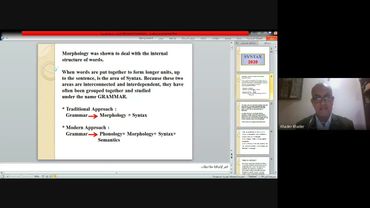
You know, we have two approaches in grammar.
Now the modern approach and the traditional approach.
We said that we are going to include semantics in the modern approach of grammar.
Why?
Because you know, there are so many
sentences which have you know semantic meaning but they don't have you know as they have similar syntactic rather structure but they don't convey a meaning as such fine so semantics is perhaps the most difficult part of a grammar of a language to learn the reason is because basically meaning in a language are
indefinite or undetermined.
The meaning of the language is indefinite or undetermined.
That's why it is sometimes difficult to say.
Now remember that language is arbitrary and we know what's the meaning of arbitrary
when we talked about the characteristic features of language earlier at the beginning of the course, when we said language is arbitrary because the relationship between forms and their meanings are sometimes cannot logically proved.
And sometimes no one can answer me.
Now, what is the relationship between the object door
and you know its meaning or what's the meaning of why table is called table why for example is window is called window and so on no one knows that all right
But that's why we say that language is arbitrary.
We are just repeating it and knowing that this is the meaning of that word.
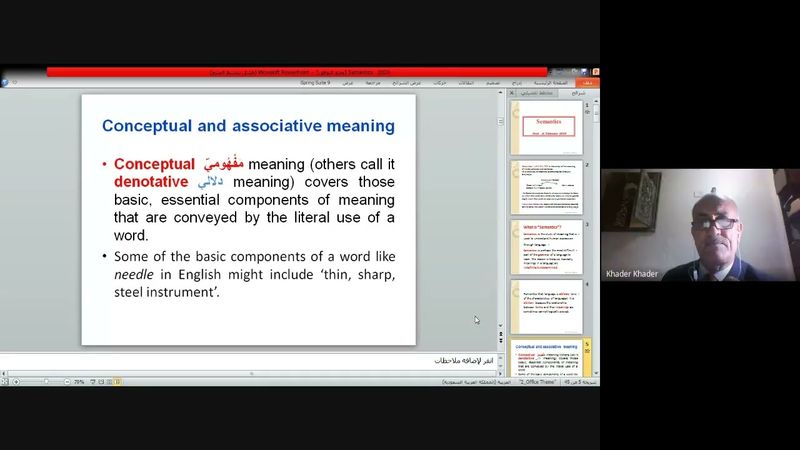
or the use of that word as such conceptual and associative meaning you know what's the meaning of conceptual conceptually all right we understand it you know
comprehend it you know we are looking at the conceptual meaning you know others you know other linguists as such they call it denotative
denotative meaning all right so we have two types of meaning as such that is conceptual meaning and associative or associative meaning so we mean by the conceptual or others they call it you know
DEMOTATIVE, which is the meaning of DELALI in the language.
Doctor?
Yes?
There are girls who want you to accept them.
I don't have any, my daughter, and every now and then I want to do the recording, because when I work, I see no one.
When I work, there is only one work that I have, that's it, we accept it.
After that, don't worry about something like that.
Whoever wants to accept it, he will come early.
Let's accept it correctly, okay?
Thank you.
Okay.
Again, let me just repeat what I have mentioned.
Conceptual and associative meaning, or associative rather, meaning.
Conceptual in Arabic means, you know, and others, they call, you know, conceptual,
They call it denotative.
You know, in translation, or rather in semantics, we have two types of meanings.
Something which is called denotative, and the other thing is called what?
Connotative.
So...
The notative covers those basic, essential components of meaning that are conveyed by the literal use of a word.
Some of the basic components of the word, like, for example, let us have an example that is called the needle.
Now, what's the meaning of the needle?
Who can tell me?
Now, in English, we say it includes thin, yana haji,
Yes.
Yes.
Are you with me, or am I just talking?
I'm with you, doctor.
It's the part that was put on the slinger.
It's not necessary.
The needle is used for sewing.
It has more meaning.
But we are talking about the needle.
But the needle is used for injection.
We use it to stitch our clothes.
We use the needle, for example,
make some particular you know sharp or technical things as such so these components would be part of the conceptual meaning of needle
for the word needle as such.
So everyone can give his own use of the meaning or connotative or conceptual meaning of the word needle as such.
Now associative, as I mentioned earlier,
Tarafuki or Tasharuki in the meaning of associative connotation.
We took the first one, denotation.
Now we will explain what it is.
Connotation, meaning, the meaning that includes everything.
Different people might have different associations or connotations attached to a word like needle, for example.
They might associate it with pain.
For example, we are going to use it for, for example, examining the blood.
So we can say that pain or, for example, illness or a blood, as I mentioned,
Or drugs, people who give themselves to drugs, by the grace of God, they use what is, of course, a needle.
Or, the general meaning that we want to take in our way, which is the thread, which is the thread.
Or knitting, the thread.
Or the hard to find.
I mean, sometimes I say, by God, what?
Difficult to find, so I'll give it, which is, like the story, which is, who looks for a needle in a table, right?
Yeah.
That's fine.
It's hard to find it over there because this is something which is, you know, let's say, sharp or accurate, you know, to find.
It's hard to find it over there because this is something which is, you know, let's say, sharp or accurate, you know, to find.
It's hard to find it over there because this is something which is, you know, let's say, sharp or accurate, you know, to find.
It's hard to find it over there because this is something which is, you know, let's say, sharp or accurate, you know, to find.
It's hard to find it over there because this is something which is, you know, let's say, sharp or accurate, you know, to find.
It's hard to find it over there because this is something which is, you know, let's say, sharp or accurate, you know, to find.
It's hard to find it over there because this is something which is, you know, let's say, sharp or accurate, you know, to find.
Maybe we put it in the street, or in traffic, or it comes with pain, or illness, or blood, or drugs, or thread, or knitting, or hard to find.
All these words are issues associated with the word, you know, needle, hard to find.
Fine, like previously,
The previous words also we use, all right, like pain.
We use it for illness, all right, as an injection, okay?
We use it for blood, checking the blood or examining the blood, all right?
Fine.
Or a drags, or a person who gives drugs, he gives them through blood, all right?
Or someone who does a kind of knitting or stitching, or embroidery, embroidery.
So he used it for that particular purpose.
Fine?
Okay.
Move further.
Although a form can have more than one meaning.
There is always a primary or original meaning that is expressed.
The original meaning of a form in a language is normally called denotation.
Previously, we have taken something, or earlier, we have taken connotation and denotation.
With respect, for example, to words, which is the meaning of what?
The lexical terms.
The primary original meaning is the meaning that we can find in a dictionary.
The general meaning that we find in the fifth is denotation.
All right?
It is denotation.
For example,
For example, the word rose.
What's the meaning of rose, if I ask you?
You are going to say, it's a garden plant with thorns on its stem and pleasant smelling of flowers.
Fine, that's very good.
You know, it's a complete meaning.
Or, you can say, it's a type of a flower, you know, from this plant.
Okay?
Here, nabta fi hadiqa.
All right?
We can find it originally in a dictionary like that.
But let's see the connotation of the word rose, for example.
Besides, there are additional...
Excuse me?
We can call any beautiful girl like a rose, or something we love, we love it, we can call it a rose, to express the beauty of it.
No, I mean to express the beauty of the thing.
Yes, that's right.
That's right.
But in fact, okay, that's very good.
Let me continue rather.
So besides, there are additional meaning, which is known as connotation.
Earlier, we have mentioned something like the notation.
You can find it straightforward.
Like in today, or we continue.
talking about or explaining regarding connotation the second time you know where everyone should be able to differentiate between denotation and connotation and i'm uh i think that you are going to study it in translation one in the future or
Not sure that much, but with respect to words, connotation, or additional meanings, all the words are not listed in the dictionary.
All right?
Fine.
For example, in Britain, for example, not usually it is there.
It is not exactly only in England, but even in our culture.
All right?
we can find someone refers to the policeman in england exactly they say that look at that pig all right he doesn't mean
know an animal but he means to refer to a person misbehaved in a particular behavior all right so since they are hating the policeman in england
They call him a pig.
They call him a pig.
They call him a pig.
They call him a pig.
They call him a pig.
They call him a pig.
They call him a pig.
Or to call him a dog.
No, something beyond that.
All right?
You got it?
With respect to words, connotation or additional meanings of a word are not listed in a dictionary.
You won't find these words or these meanings in a particular dictionary, like, for example, Collins Concise Dictionary, or Coble Dictionary, rather, or Longman Dictionary, or Oxford.
We don't find...
these are called connotation meaning normally a person expresses a connotative meaning through a word or phrase clause or sentence based on certain characteristics of the entity or event that he she is referring to for example
One may call a beautiful girl a rose, as it was mentioned, or a lily, all right?
It depends upon his own reference to that particular meaning or particular word as it is stated.
Fine?
You got it?
Fahimna?
Then, al-denotation huwa ma'na al-qamoos.
Al-connotation huwa al-ma'na al-ish?
What we give, we are not going to find it in a dictionary.
It depends upon what?
Upon our own expression.
Where it is related to that particular word as such.
Go ahead.
Go ahead, do you want to speak?
Are you guys with me or not?
Do you have a connection?
Yes, I have a connection.
Does anyone have a question from what you mentioned before?
Yes?
The connection is like the Kinaia in Arabic.
No, it's not like the Kinaia in Arabic.
That has a different meaning.
This is a language and it has its own terms, of course.
so that we don't get into details.
I'm not talking about the Kaniyya, the Tashbih, and the Balagha.
The Kaniyya is part of the Balagha.
Okay?
Therefore, no.
I'm talking about the meaning, which is direct, and the meaning that we refer to, as we said, the conceptual meaning, or the meaning that we are looking for, the internal meaning.
We include it in
What do we call this in linguistics?
Sociopragmatic
Alright?
What is social pragmatic, which has meanings in this context?
It means something that leads to another meaning, which is a sign, let's say, in a social dialect.
A lot, for example, there is someone who says, hit and punch.
The second says, hit and punch.
The third says, hit and punch.
The fourth says, and the fifth says, and to the end, alright, we have words, I mean, I can get the meaning of beating, and I get in this context, twenty meanings, even we call it social, the pragmatic, which has a sign in this aspect, from the pragmatics, and you know the meanings of the pragmatics in this
how to use a language in a particular use.
All right?
A particular use.
Go ahead, does anyone have a question?
I mean, how do we communicate?
The meaning of communication.
This is what I mean when I say sociopragmatic.
The social communication of a particular word.
Everyone has the use of some of the existing words.
Every specific culture, every society, every dialect has
Comment?
Fine.
Anyone want to share my opinion?
Hello?
Doctor, I wanted to tell you that I felt it was like irony, but after I explained that it was a joke, I found it to be a different meaning.
It's the language between people.
It's like we're in a mountain or something else.
That's how I felt it.
What are you talking about?
I felt it was from the accent, from the accent of the speech, for example.
There are people who speak Zaza, there are people who speak Zaza.
The noble name, the noble name only, I'm sorry.
I'm sorry, but the noble name.
Zaino's names.
I swear I didn't hear you, it looks like there's a weakness in the internet.
Your name, if you'll excuse me, call me again.
Zaino's names.
Do you hear me, doctor?
Asmaa Zaino Asmaa Zaino Asmaa Zaino
Zaino?
Ah, yes.
Ah.
Ah, the names of Zaino.
I swear I didn't hear anything.
No names or anything.
These are the names of Zaino.
These are the names of times that are out of cover.
In the sense that we download the things on the model.
After a week, when we download the lecture on the model, you go and send me a message.
So you tell me, oh doctor, I swear I didn't download it on the model.
Of course, you can go back to the model.
It's there.
I download it personally.
No, doctor.
It's the same thing.
It's the same thing.
It's the same thing.
I prefer that before you know asking any question
We will concentrate on the meaning of words, concentrate on the meanings of words.
Like, for example, lexical items, as they are usually called by semantics.
Okay?
Without ignoring the more complicated study of the meaning of sentences,
to complete the meaning in general in the context.
We will limit ourselves to the descriptive or literal meanings of words, usually called denotation.
Now, connotation, let's see it later.
But it doesn't mean that we should completely ignore it when we talk about general communication linguistically.
know pragmatically rather you know about the connotation of the word fine okay and ignore the emotive meaning usually called connotation for example the literal meaning of the word pig it means animal no one can deny its meaning
you know, as an animal in a dictionary.
All of us, we know that the meaning of pig is an animal.
And moreover, from being a Muslim, for example, according to my heritage and my culture, I don't accept the animal pig in my culture.
It is not accepted in our heritage and in our tradition and in our habits and our traditions as Muslims, which is the animal pig.
But sometimes in some countries, the education of children's sports in drawing, as soon as I teach them, I tell them to draw a pig.
So I go and draw in front of him in an easy way, and I draw him.
When we were children, in the beginning, they taught us how to draw a horse, or a cat, or a camel, for example.
Why?
Because it's part of the culture.
Where is it from?
in some societies for example no they begin by pig i know another society for example like the indian society they teach them or train them how to draw
an elephant, all right?
And ignore the fact that any angry man may use it with reference to a policeman.
Not in our culture, of course, or not in our society.
But in England, they do it.
Okay?
They do it in England.
Briefly, what we will discuss in the introductory course is to highlight some of the approaches to the study of meaning.
We are concerned about studying the approaches of
meaning, which will be of some use to the students in the further linguistic area.
And it's going to help you whenever we are going to talk about, for example, pragmatics, or we are going to talk about speech act theory in the future, as part of pragmatics and discourse analysis, we are concerned about the approaches of the study of meaning, you know, that's all.
One point that should be emphasized, and again also to those people who are doing translation, it's going to help them a lot to know what is the meaning of denotation and the meaning of connotation.
And again also, I said, we are going to focus or to concentrate on denotation rather than connotation of the meaning, but there is no harm, all right?
And it is...
Also necessary to keep in mind that connotation is very important to deal with.
One point should be emphasized here is that word meaning, as we mentioned earlier, is arbitrary.
The language, as one of its characteristic features, is arbitrary.
Lexical and grammatical meaning.
When we talk about meanings, we are talking about the ability of human beings to understand each other when they speak.
Now, how do we understand each other?
We understand each other by knowing the meaning.
Now, how is it possible for a Chinese person to understand you
If that Chinese doesn't know Arabic, and you don't know Chinese, so the medium of communication between you is English, for example, so you can communicate with each other in English language.
Sometimes, lack of grammatical or lexical meaning with the speaker,
will intrude him into trouble in the meaning.
It depends from culture to culture, society to another.
Fine.
No one, for example, among us will understand the following.
Look at it, hat one, the, the, but, red, green, on, those, side, hazard.
Did you understand it?
No.
No.
There's no sound, doctor.
I'm on mute.
Doctor, your voice is broken.
There's no sound, doctor.
Can you hear anything?
Also no, I don't think so.
This is a section on the internet, wait.
Thank you so much, doctor.
Hello?
Hello?
Can you hear me?
Yes, doctor.
Okay, doctor.
Okay.
Okay.
Coming back, huh?
We are back again.
All right.
Yes.
Fine.
So, I'm sorry for the interruption, rather, it was internet fault.
So, we have to cope with each other, rather, due to the fault of the technology, as we say it.
Okay.
No one could understand, has, won,
the the ba red green on both tried hazard it's supposed to be only group of words no meaning of the sentence but if we can pick up the words we can notice some of the words can be classified under
something called lexical, and the other one, they have grammatical function.
Now, the word hat conveys a meaning.
One conveys a meaning.
Alone, I am saying.
That does not convey a meaning, but it has a grammatical function as such.
Again, the second the is the same, but is the same.
Red has a meaning.
Green has a meaning.
on now grammatical function both meaning is there tried meaning is there and has him you know it's proper noun all right that is you know name of a person like joan or mary or something like that but look at the second organized
systemized sentence, in a structure, like, hasn't tried on the red hat, but bought the green one.
No difficulty is there.
Everyone among us, is going to understand this sentence, or understands the sentence, you know, completely.
Do you have a difficulty in understanding that, hasn't tried on the red hat, but bought
The green one.
Grammatically correct.
Grammatically correct.
And lexical meaning is there.
It conveys a meaning.
If you tell someone Hazem tried on the red hat but bought the green one.
Hazem guess
There are numerous sentences which are perfectly grammatical but meaningless.
In the beginning of the course in linguistics, I gave you a famous sentence
When I said, colorless green ideas, sleep furiously, here it is.
The most famous example is Chomsky's Sanders, colorless green ideas, sleep furiously.
Now for me as a linguist and you who is learning or studying linguistics, you are going to accept it.
Because you know, the function or the structure of the sentences, we can accept it like that.
Like in for a lay person, will not accept this sentence.
You say, come on, how are you talking?
What are you talking about?
Colorless green ideas.
How is it possible for the ideas to be green and then colorless, alright?
And then colorless and green, they don't come together.
Why?
They're not opposite each other.
You say colorless, then you say green.
Green is a color, and colorless, without color, how is it possible to be so?
So you can say that, do ideas have colors?
Oh, I can't believe it.
All right.
Then someone else will say that, do ideas sleep?
How come?
Is it possible for you to believe that?
And do ideas sleep furiously, rather?
We don't know.
All right?
No one of us can sleep furiously.
Is there anyone of you who can sleep furiously?
Answer me.
No.
No.
No one of you can sleep furiously.
No.
He has to calm down and then sleep.
Then we go back to the saying, standing like trees.
What do you mean by dying?
Standing like trees.
A linguist has to take into...
Similar other examples are, the tree ate the elephant.
Is it possible for the tree to eat the elephant?
No, no.
But what I'm talking about is the tree is that huge one.
Whenever the elephant passes through, the tree ate it.
That means the tree covered it.
How big was the tree?
How big was the elephant?
It was huge, but the tree covered it.
In the morning, I would listen to news.
There is an elephant that feels, let's say, psychologically tired.
Depressed.
They moved him from one place to another.
To protect nature and animal friends.
To protect the mood.
of the elephant.
All right?
But imagine what's happening nowadays in our area.
So many people, you know, are dying from, you know, depression.
No one cares for them.
Fine.
The tree ate the elephant.
Okay?
Means the tree is that huge.
All right?
Where it covered the elephant as such.
The table sneezed.
Is it possible for the table to sneeze?
Maybe it has...
For example, COVID-19, right?
I started sneezing.
But I think it's mean when we move the table and have a sound.
It's mean when we move the table and it give a sound.
Means, whenever we moved it, it gave a sound like sneezing.
The table sneezed.
It's just like that.
The last sentence, well, of course, notice that all the sentences I have mentioned or written are there.
They are grammatical ones.
But we have a problem with the meaning, all right?
So grammatical sentences are there.
My cat learns linguistics.
Can you believe it?
No, of course.
Maybe, to some extent.
No.
But to some extent, we can believe it.
Because sometimes the cat has started, you know, producing different sounds.
All right?
Apart from the common sound that is meal, for example.
All right?
Far from the type of cat.
My cat learns linguistics.
Probably she's listening to me while I'm teaching phonetics or something like that.
Fine.
A linguist has to take into account at least two different types of meaning.
One which is called lexical meaning.
The second one, grammatical meaning.
Grammatical meaning I told you about.
You know, just it has a function, you know, in the sentence.
What has a function in the sentence?
Full words, you know, they are not empty.
Full, you know, that means they have a meaning.
Have some kind of intrinsic meaning.
They refer to objects.
actions, qualities that can be identified in the external word, such as table, banana, sleep, eat, read.
All these words, we consider them to be meaningful words.
All right.
They convey a meaning.
They have quality.
Whenever I utter them or speak them or write them, everyone among us will understand the meaning of such words.
Agreed?
Fine.
Such words are said to have lexical meaning.
Lexical what?
Lexical meaning, yes.
Lexical meaning means connotation meaning or connotation?
It contains.
Do you know why?
Because it has a meaning.
But the lexical meaning, I differentiate between it and between the grammatical.
The grammatical has a function.
Alright?
It only has a function.
Or there is a function inside the sentence.
But if I removed, for example, the tables.
And I raised the the and I left the tables.
Does the meaning continue or not?
Of course.
Of course it continues.
But if we left this and raised the table, no, it won't continue.
So it remains, what does it mean, Han, or its existence in the meaning of adak?
Which is in the meaning of adak, grammatical.
But Han, when I say lexical, I'm talking about the two.
So lexical is the meaning, which is what?
The whole, which gives me to whom?
To the word.
Empty words have little or no intrinsic meaning.
They exist and try to focus on this.
They exist because of their grammatical function only in the sentence.
For example, and is used to join items.
Or indicates alternatives.
تعمل بدائل.
Alternatives.
مش حدا يقول لي alternative.
لا يا ستي.
هي alternatives.
تمام؟ كمان مرة خلينا عيدها.
هادي مش alternatives.
هي alternatives.
تمام؟ Sometimes we have of.
Sometimes indicates position.
يعني هي of كذا.
Of كذا.
All right?
These words have grammatical meaning only.
And they have grammatical function as such.
You got it?
Any question?
Yes.
Almost every word has denotation and connotation.
And sometimes denotation and connotation are one word.
It's the same, right?
No, it's not the same.
How?
Sometimes, for example, the literal meaning is the meaning.
It is according to the context, according to the context, the context of communication, the meaning of communication that is present in it.
I mean, you are not interested in this expression.
For example, there are some teachers who used to say,
For a long time, of course, the standards and standards of education have become clear in all aspects of life.
I mean, he used to say to the boy who does not know what to answer and say, look, I do not know what to answer in this word, I mean, a normal word.
Look, the donkey does not know how to answer.
Does he mean a donkey with four legs?
No.
He became the last meaning for whom he wants to call this person, because he does not know how to answer this question.
But this meaning is not found in the dictionary.
We do not know the general meaning of the donkey.
Where does it come from?
It is the same animal that has four legs, long ears, and horns, and so on.
All the definitions, you will find them in the dictionary.
But, no harm sometimes if we are calling some people like that.
Why?
It refers to their stupidity.
Alright?
It refers to the stupidity of people.
And I know about the donkey that, for example, this and that.
Okay?
Excuse me.
In the past, I read an article called, What does it mean?
Does it mean that dogs don't die?
No.
The writer in that newspaper mentioned that many people, when he wants to describe a person with a bad behavior, or a bad behavior, that he is a dog.
He said no.
Notice that now the police dogs are very smart, and the dogs used to fight drugs are very smart, and the dogs used to lead people are the blind people.
In Europe, it is used that, for example, a blind person or a blind woman has a dog with her to guide her.
in certain directions.
And of course, these are trained dogs.
And the world, especially the British world in particular, is very fond of dogs.
They like dogs.
You won't find any house, for example, without a dog in England.
Most of them, they have.
The majority of them, you know, they have.
But the meaning is connotation with denotation.
The dog is the dog.
Okay.
But what are the characteristics of the dog?
We give it other characteristics.
We can blame some people for this, but we say no.
Sometimes, or many dogs, especially the trained dogs, we say about them, intelligent and loyal to their owners, as such.
And stray dogs, which we see in the streets,
Of course, they don't rely on it, nor do they focus on it in this direction.
Okay.
Dr. Mogeswar.
Go ahead.
You said that we want to differentiate between lexical meaning and grammatical meaning when you said the table.
The two have lexical meaning, but the table has grammatical meaning, right or not?
It's not grammatical meaning.
It has a correct grammatical function.
What does table mean?
It's not a noun.
Okay, but...
But stay with me, please.
When we say table, only one word.
What do you understand?
Table, does it mean with the or without the?
With the.
When I say table and I shut up, what do you understand from me?
You captured the table in my head.
Which table?
In any way possible.
Yes, any table without a table.
The table of Makhtar.
The table of Sufra.
The table of Kanab.
The table of Zahar.
The one who plays on it is Zahar.
Isn't it?
Okay, but I have a question.
At the end of this slide...
Which is the Nard.
Okay?
The one that exists.
The one who plays on it is the Nard.
Do you know the Nard?
Yes.
What is it?
At the end of the slide, why...
Why did you say these words have a grammatical meaning, not a grammatical function?
Without them, the meaning doesn't continue.
Without them, it doesn't continue.
Or not?
I mean, I can put, for example, I can say, take a sentence from what we have.
A linguist has to take.
I can say, for example, a linguist has to take account of two different types of meaning.
I can't.
To them.
Grammatical meaning.
But not lexical meaning.
Did you notice?
Yes.
And they have a grammatical function as such.
For example, you can put a preposition from a sentence that says that the girl went to the university.
Do you say the girl went to the university?
No.
It doesn't become grammatical meaning, does it?
Even the letters have a grammatical meaning.
It has a grammatical meaning, of course, because without it, the structure of the sentence doesn't continue.
But I can say, for example, let's stay with me.
I'll say preposition to.
By itself.
What do you think you understand from the word to?
Do you understand anything?
No.
Of course not.
Or I'll say, for example, or.
Do you know English or Spanish?
Do you know English or Spanish?
Do you know English or Spanish?
Do you know English or Spanish?
Do you know English or Spanish?
Do you know English or Spanish?
Grammatical meaning refers mainly to the meaning of grammatical items.
Grammatical meaning refers mainly to the meaning of grammatical items Because of its complicity, grammatical meaning is extremely difficult to study
As yet, no theory of semantics has been able to cope with it adequately.
But the study of lexical items is more manageable.
In the study of lexical items, we need to do things more orderly and deeper in the study.
Semantic features.
Who can read with me?
I want to hear from people.
Can I read?
Yes, do can I?
Yes, do can I?
The one who told me at the beginning, can I read, what's his name?
Arij Abu-Nur.
Hi, Arij Abu-Nur.
Semantic features.
Semantic features represent the basic conceptual components of meaning for any lexical item.
An individual semantic feature consists of a word's intention.
Which is the inherent sense or concept evoked?
Mumta, just listen to me.
And also your friends should compare between your reading and mine.
Semantic features represent the basic conceptual components of meaning for any lexical item.
An individual semantic feature constitutes one component of a word's intention, which is the inherent sense or concept evoked.
What is the difference between our readings?
Now, you see, whenever you read, you have to read the sentence as a whole.
Alright?
Because you are going to convey a meaning to others.
If you break down the sentence at any juncture, without, you know, giving a pause, then you fail in conveying that message,
to the hearers or to the listeners.
You got it?
So let me repeat.
Semantic features represent the basic conceptual components of meaning for any lexical item.
An individual semantic feature constitutes one component of the word's intention, which is the inherent sense of concept evoked.
We can then use this idea to describe part of the meaning of words as having either a plus or minus that particular feature.
How do I start talking?
Let's talk about the semantic feature.
Let's see this semantic feature, for example, plus animal or minus animal.
which is the meaning.
For example, a dog.
Is it a plus animal or a minus animal?
No, it's a plus animal.
Is it a plus human?
No, it's a minus human.
Is it a male or a female?
No, we refer to the dog by male.
And a bitch by what?
By female.
Okay, let's see together what comes next.
In another union, with Areej,
Semantic features and approach to the study of word meaning is similar to the...
Distinctive features distinguish one sound from another.
Distinctive features of sounds.
No.
Park or park.
How do you make a distinction between the and the?
You mean the sounds.
Of course, I'm telling you the sounds.
The term distinctive features related to sounds only, right?
Distinguishes one sound from another.
If I told you, for example, the word pray and the word pray.
Pray.
Yes, yes.
Even one sound, a difference in the sound can change the meaning of the word.
You got it?
Fine.
Yes Doctor, yes.
According to this approach, we assume that the meaning of each lexical item is made up of certain basic semantic features, which might overlap with those of other items, but can distinguish each item in the set, or even in the whole language, from the other.
The analysis of these features
Okay, wait.
Combinance is called combinational analysis.
Let us take the features plus animate, animate.
Human, human.
Adult, adult.
Male, male.
Can I answer?
Yes, can I?
Doctor, can I?
Can I?
Can I?
Can I?
Can I?
Can I?
Can I?
Can I?
Can I?
Can I?
Can I?
Can I?
Can I?
Can I?
Can I?
Can I?
Can I?
Can I?
Can I?
Can I?
Can I?
Okay, can you show me how to say it?
I'm not going to show you.
You're alone.
This is the first time.
This is a well-known word, approach.
Approach, yes.
Is this the first time I'm showing you?
No, no, but I don't know what you're talking about.
Okay, I'm sorry.
I'm sorry for the mistake.
Okay.
An approach to the study of word meaning is similar to the distinctive features.
Distinguish one sound from another.
According to this approach, we assume that the meaning of each lexical item is made up of certain basic semantic features, which might overlap with those of other items, but can distinguish each... Is there something wrong or what?
Nothing.
Nothing, I'm sorry.
Okay, what's that?
Nothing.
Those.
Okay.
Those.
Those.
With those of other items but can't distinguish each item in the set or even in the whole language from the other.
The analysis of these features or components is called componential analysis.
And let us
No, wait, wait, wait, wait, wait, wait, wait, wait, wait, wait, wait, wait, wait, wait, wait, wait, wait, wait, wait, wait.
better English pronunciation.
Semantic features and approach to the study of word meaning is similar to the distinctive features
We mean by distinctive features to distinguish one sound from another.
So semantic features to distinguish one word from another.
According to this approach, we assume that the meaning of each lexical item is made up of certain basic semantic features.
Which one is called basic?
This one.
which might overlap with those of other items, but can distinguish each item in the set, from the other.
The analysis of these features, or components, is called, Componential Analysis, not analysis, yeah, hala, alright?
Let us take the features, plus animate, minus animate, plus human, minus human, plus adult, minus adult, plus male, minus male.
So we are going to bring words that can be related to this and either could be plus or minus.
Fine.
And find out.
Doctor.
Yes.
What do you mean when we say minus male or plus male?
What does it mean?
We don't want to make a distinction between the words.
We didn't make a distinction between the sounds.
We said they have distinctive features.
We don't want to call them semantic features.
Right.
Right.
The first one we talked about, we called it distinctive features.
And I gave you an example.
I mean, for the sake of the example.
You have two words, cat and mat.
Okay or no?
I mean, we have distinctive features of sounds.
Cat and mat.
We also have pat and bat.
We're looking for sounds that are close to each other.
That's why we're looking for sounds that are close to each other.
And we see the difference between them.
For example, and this depends on the semantic features of the culture.
I mean, at any age, the girl stopped to be a girl in our society.
I mean, for example, in the American society, and the British, and the European societies, the girl at the age of 13 will leave the house.
She can live alone.
Before that, no.
Until she marries.
Until she marries.
At a particular period of time.
I mean, when I have a daughter who is young, for example,
21 or 22 years old, but she is married.
I say to her, look at that girl behind me.
I saw her with a child and I was completely convinced that this is a married woman.
I say to her, look at that woman.
With respect and dignity to that human being.
When I say, for example, I will give you another example.
By the way, I studied in Iraq.
Baccalaureate of English Literature from the University of Baghdad.
And I was there for a long time.
So even a person who is 70 years old, they say to him, oh boy.
Why?
Yes.
Why do they say to him, oh boy?
Working in a way that everyone is born a boy.
Did you understand?
Yes.
That's why sometimes, personally, I have some...
Yes, yes.
For the connotation and the denotation.
Did you notice?
Yes, yes.
Okay, but I say that everyone is born a boy.
I mean, maybe someone in the public street in Baghdad called him, for example, something fell from him, let's say he didn't keep it, the purse, or a pen fell from him, for example, and I was walking on the street and I was smiling the way I am right now, and someone behind me said, oh boy, oh boy, your pen fell.
But why?
So imagine...
It depends on their culture.
Of course, and it is common among all of us.
Here, the socio-pragmatic plays a role.
Did you notice?
Here, the socio-pragmatic plays a role in this direction.
If someone said to me, for example, here in the street, he said, my son, my son, and he sat with you.
He considered it a form of respect for us.
Exactly, of course.
It belongs to whom?
It belongs to the culture.
That's why we take the semantic feature.
What do we want?
What we mean by its classification.
And find out how they can distinguish lexical items such as table, cow.
Animates, minus animate, human minus human, adult minus adult, male minus male.
We want to take the following examples, which are lexical items, such as table, cow, girl, woman, boy, and man from each other.
Look at the following diagram.
Let's see the following diagram.
These words that we have, we want to see their semantic feature.
Table, cow,
Girl, woman, boy, man.
Look at the world table.
Look at the world table.
Look at the world table.
Look at the world table.
Look at the world table.
Look at the world table.
Look at the world table.
No, no, no.
No, no, no.
No, no, no.
No, no, no.
Can anyone come to the table?
No.
Can anyone say, come to the table, we can't carry you from one place to another, we want to do some new decoration in the house, and we would like to replace you somewhere else.
Can you move from that place and come here?
It becomes a matter of choice.
We have reached a wrong stage.
Okay, is the table human?
Of course not.
Is the table male?
Of course not.
Is the table adult?
Of course not.
Look at the cow.
Animated?
Yes.
Is it a living being?
Of course.
Is the cow a living being?
Is the cow a human?
No.
Is it a male?
No.
Is it an adult?
Of course, because it is illogical, we can't say that it is an adult or not an adult.
It is not a claim.
Can we distinguish a cow as an adult or not an adult?
Of course not.
But there are some cases
Biologically, it's possible.
I'm not talking about the general meaning.
But I'm not talking about the details.
Is a girl a plus or a minus animator?
Of course, a plus.
Is she a human?
Yes.
Is she a plus human?
Is she a male?
No.
Is she a female?
Is she an adult?
No.
That's why we say that a girl is not an adult.
After a certain age, a girl becomes an adult.
Is it an exaggeration of her mind?
The exaggeration she is happy with?
No.
She found it in the name of the English culture.
So the woman, that's why I gave you an example.
When we say a girl, she is 22 years old or 21 years old, and she has a child who was walking with her.
We say, no, this is an adult.
No, what am I?
A housekeeper, a housekeeper, and she could be a teacher.
Or maybe it's something else, but I don't think she'll be a physician.
I mean, a doctor.
Or will she be at the age of 21?
No, no.
Of course not, she won't be.
She wants to, I mean, maybe.
No, no, no, no.
How does she want to?
Tell me.
That she's in process, not that she's a doctor, a doctor.
Well, God willing, I mean, no.
We're not in Gaza, right?
As you can see, we have, for example, high school students.
The students are in their first year.
I'm studying for a doctorate, and they say, I'll come back to work, I'm in charge of my presence in the higher studies, and my position in the higher studies.
They come and say, they call me on the phone and say, the doctor is with you.
Okay, go ahead, go ahead, doctor.
I say, I swear I want to sign this paper, I'm studying for a doctorate.
They say, but you're not a doctor yet.
So, you mean you're in charge of studying?
Or is this an Egyptian system?
So, the Egyptians say, yes, I'm a doctor.
Yes.
In the future.
God willing, we don't know what the future holds.
Maybe it will be a failure.
It's possible.
Everything is possible.
Our societies differ from other societies.
We have to be realistic people, but we are not realistic.
We have to be emotional and romantic.
It's clear from this diagram.
Yes, doctor.
Hello.
Yes, doctor.
Yes, doctor.
Yes, doctor.
Yes, doctor.
It's clear from this diagram that what distinguishes girl from woman, for instance, is the feature adulthood in that woman is plus adult whereas girl is minus adult.
The same applies to man and boy also.
Semantic features can be treated as the basic features which are involved in differentiating the meanings of each word in the language from each other word.
Excellent.
It's clear from this diagram that what distinguishes girl from woman, for instance, is the feature adulthood.
In that woman is plus adult, whereas girl is minus adult.
The same applies to man and boy also.
I gave you that.
Semantic feature can be treated as the basic features which are involved in differentiating the meanings of each word in the language from every other word.
I want to hear from people the word from.
Is there anything, young man, that is called from in English?
It is from, right?
From.
I ask for your attention.
So take care of such a pronunciation.
Now look, for example, at the word boy.
So the feature that the noun boy has is plus animate.
Denotes an animate being.
and the future that the noun hamburger has
is minus animate does not denote an animate being for example coming back to the lexical meaning and the grammatical meaning we have a sentence for example the burger ate the boy the burger
ate the boy.
I didn't say the burger.
I didn't say ham.
I didn't say cheese.
I didn't say veg.
I didn't say chicken.
I didn't say beef.
I didn't say mutton.
I said the burger ate
The boy.
This is a sentence.
Can you explain it to me?
Acceptable or not?
Acceptable.
Yes, go ahead.
Acceptable.
Acceptable?
It's not acceptable if we come to the meaning.
Acceptable.
But if you'll excuse me, I have headphones in my ears.
So, I don't want everyone to speak one by one.
I don't know.
May God be pleased with you.
Go ahead.
We need someone to answer me like this.
if we come as the meaning it's not the meaning is not right but grammatically is right but as if we want to explain it we're gonna say that from how much the boy eat the burger it it gives him a lot of problem it could be like fat or something like that and that baby kiss him to the death
That's very good.
That's very good.
Thank you.
Whenever we talk about the burger, hey, the boy, you know, the burger is full of calories.
Fast food in the Western society and even nowadays in the Arab society, you know, everywhere.
When I say the burger ate the boy, it means that burger is very harmful to be eaten while full.
calories so but we can say as far as the structure is concerned is particularly all right like in the meaning you know it's not meaningful why because the burger comes should come rather here as an object not as a subject so that's why we say
The boy ate the burger.
Acceptable on both sides, lexical and grammatical.
Did you see what kind of burger it is?
The ham is what we recognize in Arabic.
And of course, what is the meaning of the hamburger?
The ham is pork.
Exactly.
Why do you use it?
Maybe you at home say, I swear, tomorrow we will make a hamburger.
Or do you say hamburger?
Burger.
We mentioned burger.
Yes.
So, you have to take every meaning in its way.
Okay, lexical relations.
The relationship between words in terms of their meanings.
Okay?
Look at the lexical relations.
I want someone to read with me.
Yes, doctor.
I don't want anyone to read.
Where is Iman al-Aslan?
Is he with me?
Is Iman al-Aslan with me on the line or not?
Where are you, Tasneem?
Here I am.
Thank you, doctor.
Who's with me, Tasneem?
Hello?
Thank you, doctor.
Who's with me?
Iman, Iman Ashtar.
Oh, please, Iman.
Were you watching the lecture or what?
No, no, I heard you.
Just now, when I told him to read, he opened it.
Another quite common and useful way of analyzing vocabulary is the study of such lexical relations as
Homonymy.
Homonymy.
Homonymy.
Synonymy.
Synonymy.
Synonymy.
Anatomy.
Anatomy.
No, no.
Anatomy goes on the description.
Antonymy.
Antonymy.
Antonymy.
No, my daughter.
Antonymy.
Ah, okay.
Antonymy.
Antonymy.
Or oppositeness.
Oppositeness.
Oppositeness.
And hyponymy.
Hyponymy.
Hyponymy.
Okay, Iman, listen to me so you can see where the mistake was in your pronunciation.
Lexical relations.
Another quite common.
Not common.
Then common becomes what?
Think of it as common.
No.
Another quite common and useful way of analyzing vocabulary is the study of such lexical relations as philosophy.
Doctor, lexical or lexical?
No, lexical, lexical.
What is it?
No, it remains as it is.
Yes.
Okay.
Lexical, lexical.
Relations as philosophy.
Focus on the P.
Polysemy comes from two things.
Poly means poly.
Polytechnic.
Polysemy.
Semi means semantics.
Hyponymy or homonymy.
Then synonymy.
So, antonymy, which is oppositeness, and hyponymy.
Hyponymy is used in the science of libraries, and they call it classification.
It means classification.
It means the evolution, and not the evolution.
The evolution is a disease, or not a disease, it is a psychological phenomenon.
We say so and so is bent, or so and so
To be isolated, no.
When we say we have hyponymy, it means that we are human beings.
Do you mean like Tauria, doctor, in Arabic language?
No, lady, don't go too far, this is a classification, and not Tauria, okay?
We don't care about Tauria, Tauria is something else.
Apparently, I told you, it comes in the message, or something like that.
I am an inspiration, it comes in the meanings.
For example, take another example.
Bukuli, what comes under it?
The beans come under it,
and lentils and beans and lentils and beans and chickpeas and chickpeas and chickpeas and chickpeas and chickpeas and chickpeas and chickpeas and chickpeas and chickpeas and chickpeas and chickpeas and chickpeas and chickpeas and chickpeas and chickpeas and chickpeas and chickpeas and chickpeas and chickpeas and chickpeas and chickpeas and chickpeas and chickpeas and chickpeas and chickpeas and chickpeas and chickpeas and chickpeas and chickpeas and chickpeas and chickpeas and chickpeas and chickpeas and chickpeas and chickpeas and chickpeas and chickpeas and chickpeas and chickpeas and chickpeas and chickpeas and chickpeas and chickpeas and chickpeas and chickpeas and chickpeas and chickpeas and chickpeas and chickpeas and chickpeas and chickpeas and chickpeas and chickpeas and chick
Or the tools of paper, which are always vegetables.
Like what?
Cucumber.
Cucumber.
And spinach.
And apricot.
And apricot.
And apricot.
And all these plants.
Okay.
Okay, let's go to the first lecture.
Let's see.
Philosophy.
I want someone to tell me what the meaning of philosophy is.
Which is the diversity of meanings.
I mean, I want a word.
It has more than one meaning.
Polysemy or...
Wait a minute.
Polysemy or polysemantic.
Go ahead and read what you told me to read.
Yes, Sarah Zakout.
What's your name?
Sarah Zakout.
Yes, Sarah, go ahead.
Polysemy or polysemantic is generally defined as having several meanings, all derived from the basic idea or concept
Dictionary of Linguistics, 1954.
Relatedness of meaning.
What's?
Relatedness or meaning accompanying identical form is technically known as Plasmid.
Doctor, can I read?
Can I read?
What's your name?
Yes, Doctor.
What's your name?
What's your name?
What's your name?
What's your name?
What's your name?
What's your name?
What's your name?
Okay.
Relatedness of meaning accompanying identical from is technically known as polysemy, which can be defined as one form, written or spoken, having multiple meanings which are all related by extension.
Examples are the words head, used to donate, to donate the objects on top of your body, on top of a glass of Pepsi, on top of a company or department.
Or foot, donates the human foot, foot or a pet of a mountain, or a run donate person, does, water, water does, color does, colors do.
Tamam, tamam, tamam, tamam.
Okay, thank you.
Listen to me carefully and let me explain it rather.
Philosophy, as I mentioned earlier, consists of poly, ta'dud, semi, ta'dud, al-ma'ani, all right, that we refer to it in semantics.
Or polysemantic is generally defined as
having several meanings.
All derived from the basic idea.
All concepts.
1954.
Let me repeat it again.
having several meanings, all derived from the basic idea or concept that is Dictionary of Linguistics, 1954.
Relatedness of meaning accompanying identical form is technically known as polysemy, known as polysemy, which can be defined as one form
written or spoken have multiple meanings which are all related by extension examples are the word head
You can say that this is my head.
Head on the top of your body.
This is your head.
We call it the head of the haram.
We call it the head of the afaa.
We call it the head of the pepsi.
Why?
Because whenever you pour, when you pour the Pepsi, there's soda.
And this soda, what does it produce?
Released water.
Foam, which is the foam that we call it.
We call it, what?
Head.
How much did we say first?
Head of your body.
It's an object.
Head of, for example, a snake, we use the connotation and the connotation, okay or no?
When someone tells me the head of a snake, what does the head of a snake mean?
Does that mean that I want the head of the elephant?
No, it is the head of the elephant, it is not the head of the elephant, it is the head of the elephant, okay or not?
Where is the elephant still present?
It is in its head.
So if we passed on the head or the elephant received a blow to the head, it was immediately killed.
But if we hit it in any part of the body, it does not move a resident with it, it can hang on you and make a story for you.
Go ahead.
On the head of the list as well.
The head of the list is correct, and when we come to the foot of the football, we say that someone is playing a warhead.
What does that mean?
He is an aggressor in the line of attack, he is playing a warhead in the first way.
Some say that he has a defense heart.
What do you mean by defense heart?
Does he have a defense heart?
No, he is a defender.
Okay, so they say that he is the head of the team and he took the title of the team.
Or do you say it in the Palestinian accent from the top of your head?
Give it the feeling from the top of your head.
Okay.
On top of a glass of Pepsi, on top of a company, we say head of the department, head of institution, president of the Arabic language, president of the English language, and so on.
All right?
President of the company.
Okay?
Okay, this is done.
So I have multiple meanings.
So the word president or head took more meaning.
The general head is my head and your head and the head of any other person or an animal head or something like that.
Or we say the head of the needle.
Right or not?
The head of the needle.
Okay, so we gave it multiple meanings.
Let's take the word foot.
Denotes human foots.
Yours, mine, his, hers, and so on.
Okay?
Or her.
Foot of a bed.
We don't say leg of the bed.
We say foot of a mountain.
What does it mean?
The base of the mountain.
Not top.
of the mountain.
We have another word that is called run.
Run denotes what?
Me and you can run.
Water does run.
Colors do run.
How is it water?
Explain this to me.
What happened?
A person does run.
Water does.
Colors do run.
Can you explain this to me?
Where did the water go?
Yes, doctor.
Go ahead.
Explain this to me.
Are you listening to the question?
It's not in front of you.
You're not on air.
No, the internet is gone.
Okay, I'll call you back.
We'll say run the notes.
No, the internet is gone.
And now?
Okay, we don't want anyone to have internet.
Who?
Nermin.
Nermin, why Nermin?
Nermin, Abu Hussain.
Thank you, Nermin Abu Hussain.
It's the first time I hear your name.
The microphone wasn't on before.
And now it's on?
Thank God.
Congratulations.
Go ahead, Nermin.
A person does run.
How does a person run?
I want you to translate for me.
I want to know who runs with whom.
It comes with everything.
What do you mean with everything?
Give me the features that I have.
How?
How?
How?
You have a fountain.
You and I run.
Yes.
Does it work with us or not?
Yes, it works.
Really?
Water, in the sense of water.
How does water work?
When the water is liquid.
We say that water is a spring.
Yes.
It doesn't mean that the spring is the spring that served in the era of the Arabs.
No.
It is the running of water.
Did you understand?
Yes.
So here the beauty of the translation is manifested.
And its expression is embodied in this sentence.
Okay.
Continue, please.
Colors do.
Where do I have a pen?
The colors.
How do the colors work?
They get messed up.
Oh.
Don't ask.
May God bless you.
May God bless you.
May God bless you.
May God bless you.
May God bless you.
May God bless you.
May God bless you.
This is a new term.
The colors.
The colors.
The colors.
The colors.
The colors.
The colors.
The colors.
The colors.
The colors.
Stay with me.
Colors run means that it disappears.
God bless you.
You did a great job.
How did you know?
I did some research.
Your research is wrong.
It's wrong.
Maybe when the color comes out.
No, stay with me.
Stay with me.
Stay with me.
Stay with me.
Stay with me.
Excuse me.
Sometimes we say this color goes with this color.
I mean, I have matching.
It's the harmony of colors.
These are the meanings of colors.
Duran with colors.
The black with the white, BG, BG.
Sometimes we find someone who wears Technicolors, right or not?
So we say about him, oh God, a world of colors.
I mean, what is the meaning of a world of colors?
I mean, Technicolors, okay?
And a variety of colors.
So how does this color go with this color?
In Arabic poetry, they say, against him, his beauty appears against him.
So the contrast with the color shows the other color.
Did you notice?
So we say, this color runs with that color.
So matching with that color.
There is a color harmony.
What do you say to each other in the public language?
This color, we will match with this color.
Or not?
Yes, that's right.
Didn't we say that this color matches with this color or not?
That's what we say.
It matches with it or not.
So, we continue.
Okay?
So, these are meanings.
The word run, run denotes, alright?
I mean, colors do run with each other.
Not all of them, for sure.
I mean, I don't get a color with a contrasting color or a changing color or a strange color.
I mean, I don't get like a man who wears, for example, the color pink.
And I will be a part of the brightness.
No, I don't fit.
Because it doesn't suit me.
It doesn't suit me.
Okay?
And you, when you wear a color, for example, it is in harmony with the general nature of the person.
Or something like that.
So, in the translation, when people understand the translation, when we say the colors, it means it goes with it or it is in harmony with it.
In harmony.
In harmony.
Exactly.
Let's take, guys, homonyms.
What is homonyms?
Go ahead.
Who?
Me?
Who?
Iman.
Malek.
Malek.
Iman.
Who was before Iman?
Malek.
What is Malek?
Abu Riala.
Go ahead, Malek.
Yes, that's right.
Your name is right in front of me.
Malek Abu Riala.
Go ahead, Malek.
Go ahead, my daughter.
Hominence?
Hominence.
No, you heard me well, but go ahead.
You heard me well.
Hominence.
Yes.
Identical in form, spelling, and pronunciation, but different in meaning.
Very good.
Very good.
What are the meanings of the words?
We have the forms, the spelling, and the pronunciation,
Are the same.
But the meaning is different.
What do we say about them?
Mutajanisat in the word.
Mukhtalifat in the meaning.
It means an example.
But you say, for example, bank.
Maybe a Palestinian bank.
The Palestinian Islamic Bank.
The Arab Bank.
West Bank.
The West Bank.
Of the Jordan River.
For whom?
For the Jordan River, which is surrounded by this bridge.
You didn't reach the embassies through it.
Alright?
So this is what we call Bankrava.
It is a suburb of the Jordan River.
And the names that I called at the beginning were commercial.
I said to you, not commercial, but commercial bank.
It is the commercial banks.
The commercial banks.
Also, in the old days, in the schools, they used to bring us, when we were in elementary school, seats.
And these seats, we used to say about the bank.
We used to say about the bank.
We used to sit in the first bank, and this one in the second bank, and drink like that.
And we also say another word, guys, which is bank of blood.
Bank of blood.
Bank of blood.
No, no.
One sense with several names is synonymy.
That is, two items are synonymous.
They have the same sense.
Of course, synonymous to each other.
For example, the word broad means wide.
The word hide means concealed.
Almost, nearly.
Something called nearly means almost.
Well, we can find the words like taxi.
Of course, synonymous words
We find them in a variety of vocab whenever we talk about American English and British English.
Sometimes, in American English, we find the word, for example, they say about something called pavement.
Of course, what is pavement?
What do they call it in the British?
Roadside.
It's the sidewalk.
Sometimes we find the word warden.
The person in charge of the internal housing.
So what do we call it?
Provost.
Like Dr. Fall and Autumn?
Exactly.
Not full, fall.
Fall.
Fall and Autumn.
Good.
So we say these are names in American English and British English.
The word hide means to conceal, almost, nearly.
In Britain, it's rare to use the word taxi, but nowadays, you know that many immigrants, people are there, alright?
People from the immigrants, all of them use it, all of them are taxi drivers.
For example, a taxi driver in Britain can be from Afghanistan, or from where?
From Pakistan or in India, alright?
Take another word,
I'm going to answer the following questions.
Rather I say, I'm going to reply the following questions.
The variety of English as such.
Fine.
It should be noted that the idea of sameness used in discussing synonymy is not necessarily total sameness.
There are many occasions when one word is appropriate in a sentence but its synonym would be odd.
Mutasawiyat, Mutakaribat in the meaning, but their Radeef is old sometimes, and this is not always, but in many occasions.
Okay, let's move to something called Antinomy, right?
It means Antinomy.
What do we mean by Antinomy?
Can I do it?
Can I do it?
Can I do it?
I'm telling me, is the relation of oppositeness in pairs of lexical items, where, where the...
Assertion.
Assertion.
Assertion of a...
Assert.
Yes.
Of one implies a... Of one implies...
Implies the denial of the other.
The denial.
There you are.
For example, big and small, little and much, few and many.
Come on, thank you.
Now, Antony, here for Bob.
Let's look at the relation of oppositeness in thirds of lexical items.
The assertion of one implies
I'm in autonomy, the denial of the other.
What do we have?
The big.
Or just the big.
Or what's more.
Okay, I want to give you a word.
Sometimes we say, by God, the coffee I drank, the coffee that is heavy, in the Arabic language.
This is one centimeter.
So we say in Arabic,
And someone else says, no, I want light coffee.
Light.
What do we say in English, heavy coffee?
Strong coffee.
Yes.
Strong, yes.
So it's not heavy coffee?
No.
No, strong coffee.
So you saw how the lexical item worked.
It didn't work at all.
I didn't come with its accuracy.
that strong coffee means heavy coffee.
No.
Strong, but for example, when I want to say, you have types, here I will help with the translation so that they understand me well.
Types, for example, of drinks.
What are the types of drinks?
I have light drinks, like the ones you and I drink.
And you have heavy drinks, right or not?
No, I don't have heavy drinks.
What do you mean by light drinks?
It may contain one element.
We didn't ask you what light drinks mean.
Maybe juices.
Okay, so what do we call it in English?
Light drinks?
Yes.
No, not yes.
No, cold drinks.
Ah, exactly.
Cold drinks come, they get cold.
But I want to call it, for the future, soft drinks.
Soft drinks.
This is meant by light, not light.
When I say light, I mean thickness.
I mean, coffee can be heavy in the sense that we want to increase the amount of honey that we put on it.
Or we want to increase the percentage of fat in it.
What will happen?
Strong coffee.
But when we do it in a smaller amount, we will talk about light.
Coffee.
It became a light coffee.
Pay attention to its thickness.
But it is present in drinks in general.
To give you another term, we say soft drinks.
It includes cold drinks.
It includes coffee, tea, flowers, or flavored tea.
This is what foreigners call flowers.
They have all the drinks you think of.
They call it flavored tea.
Dr. Flavored?
Flavor Flavor Flavor Flavor Flavor Flavor Flavor Flavor Flavor Flavor Flavor Flavor Flavor Flavor Flavor Flavor Flavor
Not the spiritual, we say alcohol drinks, leave the spiritual, the spiritual takes something else, the spiritual is a non-spiritual girl.
Did you notice?
So the spiritual is what?
The spiritual, did you notice?
But these are not drinks, they are called spiritual and not spiritual.
Okay?
Okay.
Are you okay, Ms. Hala?
I'm here.
Yes, you don't tell me spiritualism, spiritualism is the spiritualism of faith.
As for spirituality, what do I want to call it?
I took it from you.
No, no, no, please translate it.
Hard drinks.
Hard.
Hard.
Do you know the word hard?
I didn't find the hard drinks.
One of the hard drinks, which is liquor, which includes even beer.
Today, there is beer.
As our friends say, you have the Islamic beer.
What is it made of?
It is alcohol.
It is the water of alcohol.
It is made of alcohol.
But other people find normal beer with a certain percentage of alcohol.
And we have, of course, in Islam, a typhoon.
Why a typhoon?
It is forbidden because if its content is a drink, then most of it is forbidden.
Okay?
So if it has a small percentage of alcohol, people can add to it instead of drinking a glass of three or four or something similar.
It will increase the amount of alcohol, and other things will be arranged for it.
So this is what we call hard drinks.
Hard drinks.
Hard drinks.
Hard drinks.
Vodka.
Vodka.
Wine.
Wine.
that we are talking about, and most of them are made locally.
For example, in areas like Bethlehem and Beit Sahour, where there are a lot of grapes, they make a lot of wine, and in the countryside, they also make a lot of wine, because there are a lot of grapes in this area.
We don't have to talk about it.
Doctor?
Yes, one minute.
I brought it because of the translation, because I know completely
that we are students of translation.
So, we need to put the appropriate word in the appropriate place.
That's why I bring these things.
And maybe I will have a question topic to answer in the exam.
Who is the doctor?
Dr. Halkid, Café and Tea.
What's your name?
Hala.
Hala.
What's Hala?
Hala Wada.
Oh, you told me a little while ago.
Come on, tell me.
Did you find the coffee and tea from the soft drinks?
Yes, from what?
Spiritual drinks?
No, no, but I wanted to know.
It's just that I don't know what coffee is.
It's up to you and your theory.
Doctor?
Yes, my daughter, what's your name?
Fatima Mustafa.
Oh, you're right.
I sent him a message about this.
Okay, tell me, Fatah.
Doctor, you told me about the light coffee, but you mixed it up.
What did you mix it up with?
When you said light coffee and you said strong coffee.
Yes.
At what point are we going to use the light?
We use the light when we say the coffee is normal.
What did you put it with?
With Nescafé, with milk, for example.
What happened?
It became light coffee.
You don't sometimes have people with you to make fun of.
Right or not?
Right.
I mean, for example, I don't like the coffee that you say has a face.
As an individual, I mean, as a certain mood.
Of course, I don't drink coffee that doesn't boil.
The coffee must be boiled.
I mean, the theory of the sixth coffee was launched.
That's why.
They call it the Arabian coffee for translation, and they call it Turkish coffee.
Did you notice?
What is Arabian coffee?
The Arabian coffee that we use in the funeral, and we make it in the bakery on the fire, and we boil it a lot, Fatima.
Okay?
Okay.
We call it the black coffee, to be more precise.
The Arabian coffee.
And we call it the yellow coffee, because you call it the coffee of the Saudis.
The egg.
I don't know what that is.
Let's go to another thing, which is Turkish, which is the most popular in restaurants and in the world, they call it Turkish coffee.
The same Yahoo that we drink at home, this is called Turkish coffee.
But if you want to go to the other side of the translation and say I have espresso coffee, you need a machine, right or not?
You go to a coffee filter, you also need a machine.
And that's it.
So, in terms of translation, in order for us to translate the precise meaning of the appropriate word, we have to be precise in pronouncing the word or the vocabulary.
Agreed?
Fine.
I want to finish, I don't have time.
It's 11.15, I have to finish my lunch.
Tell me, come on.
I mean, there is no risk to divide this research into two because it is still long.
There are about 20 slides left.
It is better to divide it into two.
It is better to divide it into two.
It is better to divide it into two.
It is better to divide it into two.
It is better to divide it into two.
It is better to divide it into two.
It is better to divide it into two.
It is better to divide it into two.
It is better to divide it into two.
It is better to divide it into two.
It is better to divide it into two.
It is better to divide it into two.
It is better to divide it into two.
It is better to divide it into two.
It is better to divide it into two.
We can use heavy, for example.
Do you drink tea now or not?
Yes.
Sometimes they tell you to drink tea.
Yes.
They tell you to drink tea.
What tea do you drink?
Strong coffee.
Heavy tea?
Do you drink heavy tea or what?
Strong tea.
When we say tanglish, it means to make it strong.
It's not about the weight, it's not about the quantity, it's about the thickness.
For example, someone makes you a soup, or one without anyone, as you want, if you want it.
Yes, doctor.
Yes, doctor.
Can I read?
Yes.
I don't focus on the speed of reading.
I don't focus on the speed of reading.
because I focus on understanding the reading.
Complementarity is the relation of opposite-ness in pairs of lexical items, where the denial of the one implies the assertion of the other, and the assertion of the one implies the denial of the other.
Go ahead.
Thus, James is not married implies James is single.
James is married implies James is not single.
Very good.
In the case of those terms for which John Lyons reserves...
In the case of those terms, Ayo.
In the case of those terms for which John Lyons reserves the term anatomy,
Example, good, bad, high, low.
Only the second of those implications holds James is good, implies the denial James is bad.
But James is not good doesn't imply the assertion of James is bad.
Very good.
Thank you.
Thank you.
If I'm not mistaken, I wish I'm mistaken in that.
Okay, we have complementarity.
What does complementarity mean?
It means to complement or complement.
For example, you took a physics theory and you say this thing has complementarity.
It means it has complementarity.
But in general, when I want to praise someone and say a word, how nice person you are.
If he was a cheater,
Is it a compliment or a comment?
Is it a compliment or a comment?
is the relation of oppositeness in terms of lexical items where the denial of the one implies the assertion of the other, and the assertion of one implies the denial of the other.
For example, thus,
Thus, this is what we hear.
Thus, James is not married implies James is single.
When someone says to him, he is not married.
What does that mean?
He is single.
He is single.
But when I say to him, James is married.
Implies James is not single.
He is not what?
Not single.
But it doesn't mean that he is single.
When I say what?
Why?
Because I said it right away.
I have an assertion.
We said he is.
What?
Merit.
It means, for sure, he is not single.
In the case of those terms for which John Lyons, and John Lyons is a linguist who passed away last year, and in particular he is specialized in semantics, reserves.
He returned the term anatomy, for example, and said the word good is the opposite of hashu, bad.
But
High, low.
Only the second of those implications holds.
James is good implies the denial James is bad.
But James is not good.
When someone asks me a question, I say, how are you?
He says, I'm not good.
It doesn't mean I'm bad.
No.
Someone else says, how are you, sir?
I say, well, I'm not bad.
When I ask someone, how are you?
He says, I'm fine.
What does that mean?
I mean, he's fine.
He's fine.
When I ask him, how are you?
He says, I'm not very well.
When I ask him, how are you?
He says, I'm not very well.
I mean, he didn't say he's bad.
He didn't make an assertion that he is bad.
He said, well, I'm not that good.
All right.
How are you, sir?
I said, OK, not bad.
Thank you.
He said, well, I'm not that bad.
He said, well, I'm not that bad.
He said, well, I'm not that bad.
He said, well, I'm not that bad.
He said, well, I'm not that bad.
He said, well, I'm not that bad.
He said, well, I'm not that bad.
He said, well, I'm not that bad.
He said, well, I'm not that bad.
He said, well, I'm not that bad.
He said, well, I'm not that bad.
He said, well, I'm not that bad.
He said, well, I'm not that bad.
He said, well, I'm not that bad.
He said, well, I'm not that bad.
He said, well, I'm not that bad.
He said, well, I'm not that bad.
He said, well, I
The third sense relation which is frequently described in terms of oppositeness is that which holds between buy and sell or husband and wife.
He buys.
On the contrary, he buys.
When you compare with her, he buys.
On the contrary to the wife, of course, it should be the husband.
On the contrary to the husband, of course, the comparison of her canvasness should be what?
Wife.
Wife.
Like a boy or a girl.
Exactly.
What do you think, Agafhan?
Yes.
To tell you the story, because I am now in the air for two hours and twenty-four minutes.
You should ask me any question you feel like.
But me, I don't prefer.
A lot of things, people ask things that are out of the general context.
So, it doesn't matter.
Let it be within the scope of our interest.
Whether it's in linguistics or any other subject, but it should be related to the same topic or subject.
Even in translation, phonetics, phonology, linguistics, syntax, I'm ready to answer any question.
In general culture, I'm ready for anything.
to answer any questions.
In conclusion, I thank you for your good listening, as I said, and I wish you all the best in the future.
And peace be upon you.
Doctor?
Doctor, if you'll excuse me.
Doctor, if you'll excuse me, I want to ask you.
The compliment.
The compliment, I don't understand.
The compliment, I don't understand it very well.
What is its name?
What's your name, my daughter?
I'm Batool Abu Ali.
The one who asked us, oh, I swear to God, you're Batool.
I mean, Batool Abu Ali?
Okay, Batool.
Yes, doctor.
What do you want from me?
The compliment, I didn't understand it very well.
I don't know if it's a compliment or a compliment.
Compliment.
No, no.
I'm not satisfied.
It doesn't mean that you're not satisfied, but no, I'm not completely satisfied.
But you are, to some extent, you know, you agree with me.
But you are not satisfied completely.
Okay or no?
Like you said to me a little while ago, you say to me, I don't understand this complementarity.
It doesn't mean that you don't care about all the topics.
Not 100%.
Exactly.
When I say to someone, for example, you are happy, implied you are not
Sad.
Okay or no?
But when I say to him, by God, you are good.
What does it mean?
The complementarity will be a little different.
Which is, you are not, for example, bad.
Okay?
For example, James is not married.
Implies James is single.
But there are other societies.
He is not married, but he is not single.
Right or wrong?
But in our society, we believe that if he is not married, he is single.
It could be that he is divorced.
It could be that he is divorced.
It could be that he is divorced.
It could be that he is divorced.
It could be that he is divorced.
It could be that he is divorced.
It could be that he is divorced.
It could be that he is divorced.
It could be that he is divorced.
It could be that he is divorced.
It could be that he is divorced.
It could be that he is divorced.
It could be that he is divorced.
It could be that he is divorced.
This theory has the theory of integration, right?
So there is integration for something specific in this field.
Okay, Batool?
Doctor?
Doctor?
Doctor, but... Tell me, my daughter.
Okay, in the previous lecture, we talked about the exercises to solve them with the word program, right?
That's right.
But, Doctor, it's very difficult for me to draw on it.
Yesterday, I tried my luck.
I didn't know how to draw on it.
Okay, what's your name?
Hala.
Hala what?
Hala Aweeda.
Oh, that's right.
I thought you were going to say Hala what.
Can we open the model that you submitted?
If we take a picture for you, it would be better.
No, it's okay.
It's okay.
But it's good to take a picture for everyone.
Take a picture for me.
No, it's okay.
Take a picture, but everyone should write their name.
Where should we send them?
To the website.
To the website.
Doctor, I called them yesterday.
I called them and sent them to the website.
Should I write their names?
They don't get it?
Doctor, I sent them yesterday.
I sent them to the website.
I sent them to the website.
Doctor.
How are you?
How are you?
Please download this slide so we can have it next time.
Where are you from?
No, no, Samah Khalifa.
Did I tell you that I didn't publish the Turkish version because you asked me to?
No, because you didn't complete this slide.
Does it have a complementarity or not?
We will publish the semantics part one and the semantics part two.
Is it good?
Yes, it's good.
You didn't send me a message saying that you didn't publish the Turkish version.
No, I didn't publish it.
Until we meet again, peace be upon you.
May God bless you.