Silent Hill f: What We Think After Playing 5 Hours
Download information and video details for Silent Hill f: What We Think After Playing 5 Hours
Uploader:
IGNPublished at:
8/1/2025Views:
507.8KDescription:
Video Transcription
As someone who loved Bloober Team's 2024 remake of Silent Hill 2, I'm happy to report that while being developed by an entirely different developer, Silent Hill F boasts that same level of quality and polish.
From story to world building, from graphics to combat and exploration, Taiwan-based developer Neobards has created an experience that meets the high bar set by the Polish developer, albeit in a drastically different setting.
As I started walking the dense yet deserted streets of Ebiskałka, it was immediately apparent just how detailed and well-realised this fictional remote town in the mountains of rural Japan in the 60s is.
With an immersive over-the-shoulder view and no UI on screen during exploration, Silent Hill F is a game that tells a convincing story through its visuals.
Ebisugaoka is undoubtedly one of the most impressive contemporary Japanese townscapes I've ever seen in a video game, and that comes from someone who has lived in Japan for the majority of his life and loves games like Shenmue, Persona and Ghostwire Tokyo.
One of the few minor issues I had with the Silent Hill 2 remake was that the majority of its playtime is spent inside buildings and facilities.
While these functioned as well-designed dungeons packed with horrifying enemies to fight and intricate puzzles to solve, the increase in volume compared to the 2001 original made it feel like exploration of the actual town of Silent Hill was limited.
And so I was pleasantly surprised that the vast majority of my playtime with Silent Hill F was spent exploring Ebisukaoka, which oozes with atmosphere.
Files and other documents scattered throughout the town add context to Ebisukaoka, which flourished as a mine town during its heyday.
Now it has become a largely forgotten village and its people are stuck in old ways, such as favouring traditional healthcare methods over modern medical science,
and being overly devout to the Shinto deity Inari.
The context of Ebisugaoka and its people immediately feel like they are an integral part of Silent Hill F's cohesive story, which made me eager to go off the beaten path and obtain every hidden file.
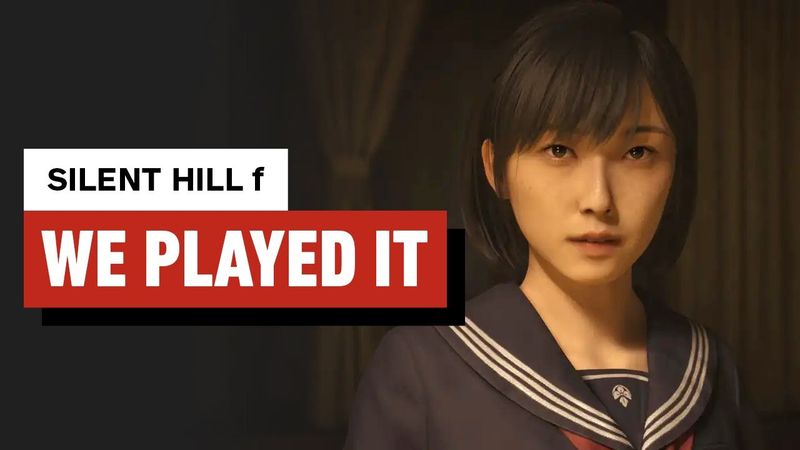
The game starts after protagonist Hinako, a female high school student,
runs away from home after being scolded by her drunk father.
Walking the empty streets of Ebisukaoka, heading to the local candy store to meet up with Hinako's fellow high school friends, feels like an authored walking simulator reminiscent of games like Everybody's Gone to the Rapture and The Vanishing of Ethan Carter.
Of course, it doesn't take long until Hinako and her friends discover something is wrong in town.
And before you know it, Hinako is holding an iron pipe in her hands, an iconic weapon of the series.
Eviscauca then gradually proves to be not just suited for a captivated walking simulator experience, but also the perfect setting for a horror game, as its narrow alleys and staircases are ideal to hide enemies behind corners, while also functioning as a maze for the player to get lost in.
In some instances, doors left ajar and open windows invite Hinako inside traditional tatami-floored houses, where she will have to solve simple puzzles in order to make her way through to the next area.
These puzzles play out in an unconventional way.
One puzzle, for example, had me obtain keys to a locked door, but there was nothing noteworthy inside.
Then, as I went back to the corridor, another door suddenly swung open, which gave me the chills.
Silent Hill F's scenario writer, Yukishi07, sees Japanese horror as a subgenre that doesn't so much rely on threats to the protagonist's life, but rather makes you feel uncomfortable by creating situations that feel off.
When you think about it, Silent Hill is a series known for just that.
While there isn't a lack of life-threatening encounters, some of this series' most uncomfortable moments are in conversations with its outright weird characters.
In Silent Hill F, Hinako and her friends are trying to find a way to escape the haunted town of Ebisukaoka.
Interactions with these friends seem normal at first, but then suddenly they say something or do something that catches you off guard.
Also, in typical Silent Hill fashion, puzzles often reveal something about Hinako herself or the world she inhabits.
A puzzle on a misty rice field has you examine scarecrows in order to learn the direction you should be heading, which is connected to a childhood trauma of Hinako getting lost and being afraid of the scarecrows.
During my playthrough, puzzles never felt too difficult.
Hints provided by files you obtain never make the solution too obvious while still giving the player an idea of what they have to do.
Silent Hill F has difficulty settings for both its combat and puzzles, and while Konami advised me to play on story mode for both, I stubbornly chose normal mode as I wanted to take on a challenge.
While the difficulty of the puzzles never overwhelmed me, combat proved to be a bit more demanding.
Silent Hill F's combat relies entirely on melee attacks.
Hinako can obtain all sorts of weapons ranging from iron pipes to kitchen knives and baseball bats, but no guns come into play.
With some exceptions, these weapons are not obtained through story beats, but are scattered throughout Silent Hill F's world like other resources, and Hinako can carry up to three weapons at a time.
As you wield iron pipes and stab at enemies with knives, you will notice that the game has weapon durability.
It is a nice touch that weapons that are about to break actually change in appearance, so expect to be holding a bent pipe or a broken bat.
This also functions as a hint to the player, which Hinako will acknowledge by mentioning that she should fix it.
Weapons can be fixed by using a repair kit, but these are so scarce that on many occasions you will have to say goodbye to your new favourite weapon.
While weapon durability is often regarded as a burden in games, it works here, as finding a new weapon and repair kits quickly becomes an integral part of the resource management that the survival horror genre is known for, especially since you won't be having to look for ammo this time around.
A clever system allows you to turn in your resources for an in-game currency at save points,
which can be used to increase your stats, or obtain new amulets that can be equipped to give you certain buffs.
That means that if you are careful and don't waste your resources, leftovers can be turned into something useful, which feels like a great reward to a well-planned expedition.
Combat itself has a similar feel to Silent Hill 2's close-range combat.
You can dodge enemy attacks with the Dual Senses Circle button, while you can activate light and heavy attacks with R1 and R2 respectively.
Your limited reach and lengthy attack motions give a realistic, weighty feel to combat.
Heavy attacks especially are slow and need to be timed well, contributing to the feeling that Hinako is just a teenager with limited strength.
What sets Silent Hill F's combat apart from Silent Hill 2's more limited melee combat is the implementation of timed dodges and counter attacks.
The latter in particular deals a lot of damage, and is key in battle.
Enemies briefly show a sign when a counterattack can be utilized, but unless you have trained your reflex skills by playing games of the likes of Sekiro, you will likely have a hard time reacting.
That's where the focus mode comes in, which can be triggered by holding L2.
Sadly, we don't have any footage of it, but when in focus mode, enemy signs for counterattacks appear for longer,
while also charging up a power attack that staggers an enemy.
That means you might head into focus mode with the intention of going for a counterattack, but find yourself switching to a power attack when it charges before the enemy shows an opening.
Focus mode is tied to Hinako's mental energy gauge, which exists separately from her stamina and health bar.
Interestingly, the upper limit of her mental energy decreases when enemies do something that scares her, or when she is frightened by a certain event, connecting the gameplay to the story and Hinako's mental state.
Luckily, there are items that can recover the upper limit of your mental energy gauge, but Hinako's stamina is limited too.
When she runs out of stamina and mental energy, she can become so frightened and tired that she won't even be able to move for a while.
Managing her energy resources, therefore, is key to survival.
Fighting one regular enemy is fairly manageable, but when confronted by multiple enemies, running away often felt like the best option, especially since enemies don't give experience points or drop resources.
Combat was fun enough that I found myself actively engaging in combat even if there wasn't a real benefit to it, beyond being able to explore the environment more freely.
While keeping combat engaging and complex, Silent Hill F does a great job in making the player feel weak.
The game cleverly incorporates this by having what seems to be a boss battle at first actually play out as a sequence in which the player has to find an escape route.
Another iconic element to the series is the existence of an alternate world, which is present in Silent Hill F as well.
Hinako is occasionally transported to a different dimension that shows a more traditional Japan, where a mysterious masked figure guides her through the grounds of various shrines.
Here, Hinako obtains traditional Japanese weapons such as the naginata, a pole weapon with a curved blade on the end, similar to a glaive or halberd that is known to be mostly used by women.
Weapons that Hinako finds in this alternate world don't break, but Hinako won't be able to carry them over to Ebisugaoka.
It was in this realm that I encountered the main boss of my playtime, which proved much more difficult than I had anticipated.
Even with my full understanding of the combat mechanics and systems, its long reach, hard to predict attack patterns and multiple stages required significant trial and error.
The boss took me nearly an hour to beat, but gradually learning how to take on the boss was a welcome challenge that never felt unfair.
For reference, my colleague was playing on story mode and defeated the boss on his second try, but an acquaintance from another media outlet who was also playing on story mode didn't manage to defeat the boss at all and ran out of time.
While he didn't specifically mention the Souls-like genre, series producer Motoi Okamoto says that Silent Hill F's combat was inspired by the current popularity of more difficult action games.
With multiple difficulty settings, Silent Hill F is by no means a Souls-like, but its boss design shares a similar learning curve that ultimately results in a great feeling of satisfaction when you beat it.
The last part of my demo took place inside a school, which was essentially a dungeon similar to Silent Hill 2's aforementioned apartment buildings, hospitals, museums and hotels.
Upon entering the school, Hinako obtains a map of the building, which the player will have to use to navigate their way through.
Luckily, Hinako is just as diligent a note-taking enthusiast as Silent Hill 2's James, so whenever you learn that a door is locked or that there is a passage somewhere, it will be noted for you on the map.
Inside the school, I had to solve a multitude of puzzles in order to find keys to reach different classrooms and floors,
while fighting and running away from enemies along the way.
According to Okamoto, the average playtime for Silent Hill F will be about 12 or 13 hours, which should indicate that I've played through roughly one third of the game.
While I don't know how things will go from here, so far the game's balance between town exploration and interior facilities feels like an improvement over the Silent Hill 2 remake.
While the first five hours of the game felt like they were structured linearly, Silent Hill F has multiple endings, like many other games in the series, including the famous UFO ending.
My time with Silent Hill F was promising, to say the least.
Its worldbuilding and story had me so intrigued that I still think back on my brief visit to Ebisugaoka almost a week later.
Ebisugaoka just feels like the perfect fit for a psychological horror narrative, and all of Silent Hill F's systems and mechanics complement the setting.
Series composer Akira Yamaoka's soundtrack also does a stellar job in making the player feel uncomfortable throughout.
Silent Hill F seems to be a horror game that gets everything right.
If, like me, the Silent Hill 2 remake was one of your favorite games of 2024, Silent Hill F has the potential to become a serious game of the year contender when it releases for PlayStation 5, Xbox Series X and S, and PC on September 25th.
For more scary stuff, keep it locked on IGN.
But don't you like things like that too, Shu?
I'm not interested.
Then...
Similar videos: Silent Hill f

Silent Hill f - Developer Interview | Xbox @ gamescom 2025
Here's Why You Shouldn't Be Scared Of Silent Hill f's Combat | gamescom 2025
New Silent Hill f gameplay revealed #ignsummerofgaming #stateofplay
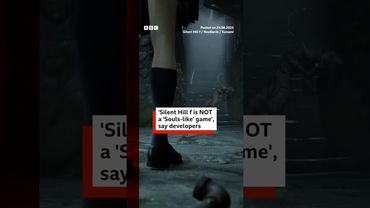
Silent Hill f is not a 'Souls-like' game, say devs. #SilentHill #Gamescom #BBCNews
На рубеже PlayStation. Лето 2016. Стрим четвёртый