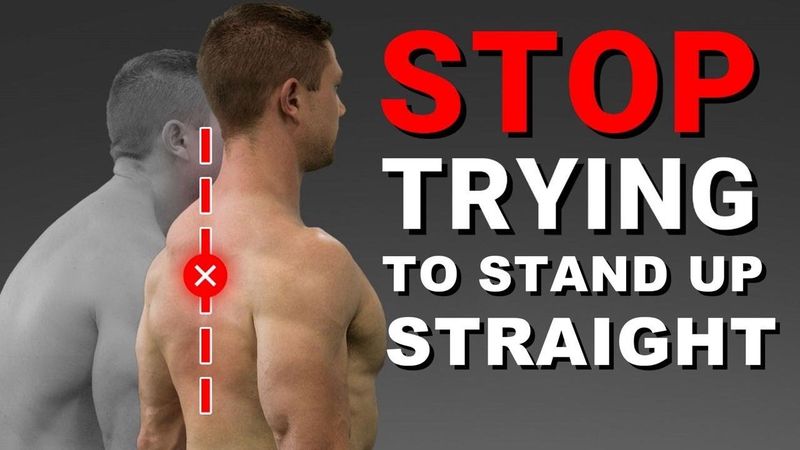
“Standing Up Straight” WON’T Fix Your Posture! (but this will)
Download information and video details for “Standing Up Straight” WON’T Fix Your Posture! (but this will)
Uploader:
Conor HarrisPublished at:
9/11/2024Views:
1.1MVideo Transcription
if you have crappy posture you were probably told at some point or growing up by your parents to stand up straight and maybe even pull your shoulders back as you do it but here's why that's not ideal for your posture the idea of trying to stand taller with our shoulders back makes sense on the surface but once we take a closer look we start to realize that it's actually promoting a lot of the things we don't constantly want happening within our posture
You see a normal human spine curve had some degree of arching at the low back, some rounding at the mid and upper back, and then another arch here at the neck.
And this is what is ideal for the spine.
If we try to alter this too much, it can be problematic.
And here's why.
Overwhelming majority of the time when I see people try to stand tall, what they do is they stand up and they pull their shoulders back like this.
This is actually increasing the low back arch and flattening out what should be more of that upper back curvature.
This is not ideal because the shoulder blade is actually sort of this rounded structure like this.
It's a concave structure as we say.
And the upper back is this convex structure like this.
So there should be a relationship there for it to glide and move.
If we're squeezing our shoulders down and back, we're actually compromising this relationship, flattening out the spine and preventing the shoulder from being able to rotate and glide on it effectively.
And not only that, but trying to stand tall even with or without the shoulders back typically leads to that movement being initiated from the low back itself.
And what that does is it creates more of this forward pelvis orientation.
You can see that my pelvis will be moving more forward as I did this.
That is exaggerating how much anterior pelvic tilt is present.
An anterior pelvic tilt is a posture that a lot of people already have a lot of.
upwards of 75 80 of the population according to research already has some degree of anterior pelvic tilt this is not something we want to promote more and more of a lot of the times the final really important key here is when we are tall right here pulling our shoulders back and we're compressing or closing off the space back here this is compromising our breathing strategy to a significant extent
We have a huge chamber in the back of our rib cage called our posterior mediastinum.
This area is essential for us to expand under normal respiration and breathing.
So if this posterior mediastinum is closed off and this massive chamber can't expand as we need to when we inhale, we're going to need to find a place to make up for that or to compensate for a lack of expansion there.
So what tends to happen is because this is flared like this, and you can feel this on yourself, if you go here and you inhale,
You feel these lower ribs expand and your belly expand primarily, and this is not ideal breathing mechanics.
And over time, this can lead to some other compensations, which I'll talk about in a second, but this is going to limit our diaphragm's ability to work under normal breathing, but it's also going to further promote
more extension rather than keeping the rib cage more down and being able to expand the rib cage in all areas from front and back to side to side as it normally should.
And not only that, but when you have a rib cage that's flared and a diaphragm that doesn't work very well, we tend to see other muscles try to kick on and work in overdrive to make up for a lack of that diaphragmatic function.
So what you tend to see a lot of the times is the neck tends to kick on to try to elevate the rib cage and try to help get air and expansion into the rib cage because that's not happening as well anymore.
And this can lead to all sorts of issues like neck pain, headaches, tension, etc.
Now let me be very clear, there is no one best posture.
The best posture is the one that you can shift out and then get into a different one.
So I don't want to give you an idea of like there is some perfect posture that you can be in because there's not.
But if you want to feel taller while you stand, then here's something that might work better.
Try to think about how you need to get the spine in a more neutral position while keeping the head stacked over the rib cage, over the pelvis, over the midfoot.
That's what we're ultimately trying to do.
That is going to give us a nice weight distribution through our foot.
and it's not going to be compromising our spine curves.
And so ultimately what people tend to feel is when they are not as tall as they would like to be, is they tend to feel like their sternum is depressed and their shoulders are rounding forward.
The second part is actually having to do with that anterior pelvic tilt situation.
Because if this pelvis goes too far forward, this puts the hips in a position of somewhat hip bend.
like this so what we actually want to do is promote more hip extension to get the pelvis underneath us more and that's going to help us get a little bit taller there and that's really helpful so we ultimately want to be able to open up the chest and a little bit of the back we want to be able to get the legs actually underneath us here are two exercises that can address those things
If this is helping to open up your eyes to a little bit of a different perspective you haven't considered before, and you want more exercises and easy exercises that can address common movement and postural deviations and dysfunctions, check out my beginner body restoration program.
It's designed for anyone to be able to do, requires minimal time and not much equipment at all,
and it's really going to be helpful for addressing a lot of the things we're talking about within this video and it should also over time help you feel a little bit taller as well so if you're interested in learning more check out the link down below in the description for this first exercise you want a hand towel rolled up thick enough to where when it's underneath the midpoint of your neck your chin is passively pointing towards the ceiling and you can keep it there at all times
Then you wanna grab a broomstick or a dowel, something like this, and a little tiny bit wider than shoulder width apart here is where you're gonna go.
You don't wanna go too wide, just a little bit wider than your shoulders here.
Now start with your fists straight up at the ceiling.
Here's what's gonna be interesting.
The breath is actually going to guide your shoulders into the right position here.
So first things, just push the mid foot down into the ground a little bit to get your low back flat and nice and relaxed on the floor.
Now, I want you to just get a little reach.
Try to get your shoulder blades moving slightly away from your spine, not too much, just 10, 20%.
Now exhale fully through your mouth and it's key you get a full exhale here because at the end of the exhale you're gonna feel your side abs engage right here not your six-pack as much but your side abs and then you're going to inhale through your nose and what you'll find if you can stay relaxed is that your arms are naturally going to start going behind your body because you're inhaling and as you do more and more breaths your arms will get further behind your body so it should look like this.
Notice how it's just a couple of inches and you'll feel your chest expand and you're not going to inhale forcefully.
If you do, you're gonna feel your neck engage.
You don't want to ever, ever feel your neck engage.
So just have a nice, gentle, silent inhale for the most part, but get a full exhale.
So one more time.
And over time, you're gonna do more and more breaths, maybe about five or six or so.
And eventually you're gonna reach a point where if you went any further overhead, you would actually just start to flare your rib cage like this.
At that point, you've gone too far.
And then you gotta go back to the beginning and restart.
You can play around with different grips, but ultimately a little bit wider than shoulder width is gonna be helpful for most people.
and finally if holding this is just not comfortable or not something you think is helping you could just put it down and then have your palms face in and do the same thing like this and finally if that exercise was too challenging or you feel like it didn't quite click with you something else you could do that's easy is simply hanging from a bar with your feet up on a bench allowing your knees to be bent at around a 90 degree angle what's great about this is that you can adjust and come back a little bit
or you can allow your arms to be more overhead.
The key is though, same thing as the last exercise, don't let your rib cage flare like this.
This is not what we want.
Having the feet up on the bench allows our pelvis to stay tucked underneath us a little bit.
So everything is ideal here as I am just right here.
So we're going to exhale.
Find those side abs, pause.
Nice and soft and full inhale.
We should not feel our neck engaged, but we should feel our chest, our lats, and some of our lower back open up here.
For this next one, you want to be on a table or something firm.
A bed will not work for the most part, but something like this is going to be great.
A coffee table, a dinner table, that could work.
You want to start with the mid portion of your thigh at least that much as hanging off and your knees are bent.
You're gonna take a foam roller, you're gonna slide it underneath the upper part of the hamstring right there.
And then you're gonna make sure that in this position, your low back is 100% flat and relaxed on the table.
If it's not, you need to give yourself a little bit more elevation with something else.
And then you're gonna go one leg at a time.
So make sure that you have a straight line from this knee to this hip.
You don't wanna be dumped out like this.
And you're going to very gently push down with that leg and that hamstring as you pull the other leg back to just about 90 degrees, knees pointing up at the ceiling.
You don't want to go too far back.
Just 90 degrees is fine.
Now, what you could do is simply just hold this position.
If you want, you can take this same side arm and just hold it in place right here to take some stress off of this hip flexor right here.
But just press down gently and breathe in through your nose, out through your mouth.
just like you did on the last exercise.
Feel little side abs engage, feel that low back stay flat as you inhale through your nose,
I like to keep this hand on my rib cage to make sure it's not flaring, my back isn't coming off of the table, but you should feel just a little bit of hamstring working on this leg right here, and your low back is 100% flat and relaxed.
The progression here to open up your chest a little bit more, if you can handle it, is same thing, everything else is in place.
You're gonna take this same side arm and reach it as far as you can overhead, stopping at the point where if you went any further, your ribs would flare.
Do not want to get there.
So stop short of that.
Low back should still stay easily 100% flat and relaxed.
Now get that full exhale and feel those side abs engage.
Inhale, you'll feel more expansion right here.
It should feel really nice.
I would recommend doing each of these for about two sets of about five to eight breath cycles per set.
And then see how you feel afterwards when you stand up and walk around.
Thank you guys for watching.
And if you enjoyed this, please leave a like and subscribe.