Starting the CHARACTER RIG | Toon Boom Harmony Rigging Tutorial | Part 4
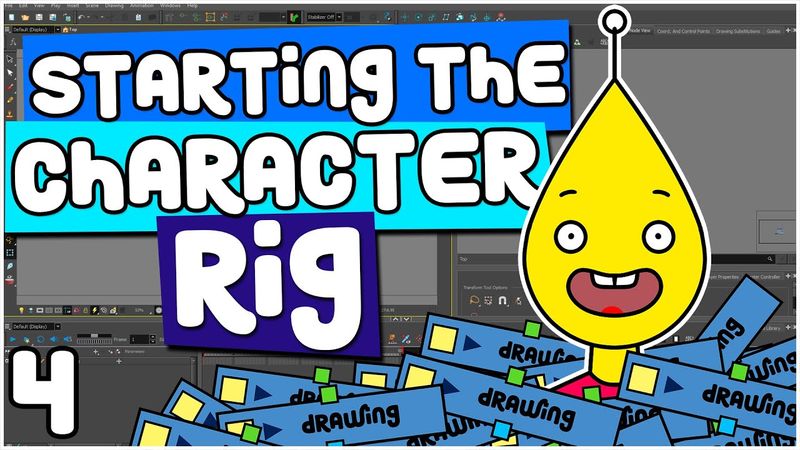
Download information and video details for Starting the CHARACTER RIG | Toon Boom Harmony Rigging Tutorial | Part 4
Uploader:
DrawnSeanPublished at:
3/23/2022Views:
34.8KDescription:
Video Transcription
Hello and welcome!
This is part four in my video tutorial series showing you how to create your own cartoon from start to finish in Toon Boom Harmony Premium.
In previous videos I talked about Toon Boom Harmony and if it's for you, I then talked about planning out your animation, and then I showed how I designed a character turnaround that we're going to be using to build our character rig in this tutorial, which also marks the start of the rigging process.
Let's get started shall we?
Yeah.
Alright, hi guys.
We're finally ready to start jumping into Toon Boom and making our character rig.
So, let's open up Toon Boom.
So this is the first thing you're going to see when you open up Toon Boom.
Some basic settings here.
So we are going to name our scene
Sunny Rig.
You then want to choose where you want to save it.
So I'm just going to save it into where I keep all my animation projects.
So now you can see the location path changes here and we've just got some basic settings for the scene.
So the camera size, the resolution and the frame rate and the field of view.
You can keep these all as default because these are very common settings but then you can change them inside Toon Boom Harmony as well.
Click create.
scene and here we are so I've actually deleted all of my preference settings so that I can see exactly what you would see once you start a fresh brand new scene now there are a few settings that we do want to change before we start building our rig and you can find the preference settings by going into edit
and preferences or you can press ctrl and u.
So the first setting we're going to change is we're going to tick this box here which is focus on mouse enter and I can show you quickly what that does.
So you can see here as I'm hovering over each window
it highlights red and that just means if I'm gonna ever use any shortcuts the shortcut will only take effect in the window that is highlighted.
Normally what you have to do you have to actually click the window for it to become highlighted but because we've changed the settings we can just have it highlighted as our mouse enters it.
I like to change the border color from a red to a more brighter color so something like a yellow and that's just so it's a little bit brighter.
We are going to change some other settings, but I'll talk about those a little bit later in this video.
And then you can press OK.
So you can change the size of these windows by clicking and dragging these sections here.
And you've got four main windows, so you've got your main camera view here, you've got the tool properties, you've got the node view, and you've got the timeline view.
And I'm just going to explain the interface as we go along.
In our last video we created a character turnaround.
So we want to import that into the scene so then we can use it as a guide to draw over the top as we're creating our rig.
So to do that you go to file and then import and click images.
It will then bring up this window.
Or alternatively, you can click this button up here, import images.
And then you want to go to browse, find where you have saved your image.
So mine is here.
And then you can leave all of these settings as they are.
We don't need to change anything here.
And then we're going to press OK. And then that brings in our drawing that we made earlier.
And this is the node view, this is where a majority of the work is going to be taking place.
So you can see here that a node has been created for this character turnaround.
These nodes here, these are automatically in the node view when you open up a new scene.
So this right node is for rendering, when you want to render out your animation towards the end.
And then this is the display node, and this is everything that gets displayed inside the camera view.
And this is the composite and this is essentially an organizational tool so you can see that multiple elements feed into this and then it outputs as one.
And that really helps with organization and we can actually be creating multiple composites as we go.
Now there is a very important setting that we want to do for this composite.
So if I go into this composite by pressing that yellow square there you can see that it is set to as bitmap.
Now that's something we want to change to pass through because if it stays as a bitmap it just will flatten all those images and that's not something we want.
So we're going to set it to pass through here and then if we go back into the settings by pressing ctrl and u you can see that there's an option here default pass through composite so you just want to tick that
just so you don't have to do it every single time you create a new composite.
And you can see here that as I do change it to pass through, the shape changes, so that's how you will know that it's passed through.
And then this is a drawing node, so this is just for the visual information, the art.
So now when we're starting to create our character rig, we want to think about what elements of the character we want to separate out.
So we're going to start with the front view.
So you would want to make that head separate, the mouth, the eyes, the pupil in the eyes, the eyebrow, and you would make each element of the arm separate as well.
So that hand would be separate, the lower arm, the upper arm, and we're even going to put a shoulder in there as well so we can have some...
shruggy shruggy action going on we're going to separate out this sun symbol and the hip and then again upper leg lower leg foot so let's start building this is our character turnaround and we're just going to place it so somewhere about there which is good
And I've used the transform tool or shift T to select that and then move it over.
Now we want to lock that into place so that we don't accidentally select it and move it.
So to do that you can click it, go to the timeline view down here and you can see that there is a little padlock symbol there.
So just click that.
then it will be unselectable so you can't move it.
Another thing that we want to do is make it semi-transparent so that it's easier to see our art over the top as we're creating it.
So to do that you can go down to the node library here and you can type in transparency or another thing you can do which is a little bit quicker is you can press enter on the node view and then this little menu will come up.
You can start typing in
transparency when you found it you can press enter and then it will appear on the node view.
Now we need to connect that underneath the character turnaround to tell Toon Boom that that's the object which is going to be semi-transparent but a quicker way of connecting it into a connection here is to click and hold and then if we press alt you can see that our cursor changes
to this symbol here and then if we just drag it over to this connection it will automatically pop itself into the middle.
So you can see here that it passes through the transparency and you can now see in the camera view that that has taken effect.
If you want to change the amount of transparency you can click on that yellow button here
And then you can move that up and down as necessary.
I'm pretty happy with 50% so I'll close that.
And you can scroll in and out of the node view as well if you hold spacebar you can move it like that.
So we're just gonna select these two and we're just gonna put them over here out of the way for now.
And then we're gonna start creating all of our drawing nodes for each part of the body.
So you can see by default, as you make a new scene, you've already got a drawing node in here.
But I'm gonna delete that because we're gonna be creating them from scratch.
So to do that, you can come down to the timeline view here by pressing this plus button and you can click drawing.
And that will bring up this window here where you can name your drawing.
So we're just gonna start, let's start with the head first.
so we're going to type in head and we want to keep it as vector and i recommend ticking this box here extend exposure for scene duration and that's what the exposure is here so you can see the exposure just goes up to 60. so if we drag past 60 you can see that our car turnaround
actually disappears because there's not enough cells in the entire scene.
So if we unlock our character turnaround and then we click the last frame that we want to extend it to and press F5 you can see that then it will automatically add those cells in to the end of the scene.
A quicker way of creating a drawing is to press CTRL R and then that will add a new drawing node into the node view.
and it will then be connected to this composite here.
So everything you see here is a visual representation of everything that will be in the timeline view here.
So you can see here we've got this red icon and that just determines the length of our scene.
Now we're just going to be using this particular scene just for the character rig so we're not going to be putting any backgrounds in it or anything like that.
So we won't need a huge amount of frames but if you did want to lengthen your scene length you can just click and drag this red marker here and then that will expand the amount of frames in the scene.
Another way you can change the scene length as well is to come up to here, scene, scene length, and then you can increase the amount of frames there.
and then we will just start making all the elements that we need for our rig.
So we've already got the head and then I'm gonna do the torso and if you just press enter it will allow you to start a new drawing layer without closing and opening each time.
So I'm gonna start from the top and you've got this ball here I'm just gonna call it antenna ball.
Enter.
And then the line below it.
So we'll call that just antenna.
And then we've already got the head.
So let's do the eyebrow.
And we're going to call that eyebrow underscore 01.
Pupil 01.
Arm.
Upper 01.
We'll have to create a lot more drawing nodes later on but for now that will be fine.
You'll notice that I've only created nodes for one side of the body and that's because we're going to be duplicating these elements over to the other side later on just so we don't have to do twice as much work.
So I can add and close that now and you can see that all of these elements
have been made.
So let's do a little bit of organization before we continue.
They're not connected.
So let's just start connecting all of these.
We're just going to plug them all in there.
And you can see that it's getting a little bit chaotic at the moment.
So we're going to click that composite.
We're then going to come up to here and click this button here, order node view up.
And then we're going to press OK. And then you can see that it has organized all of our elements nicely for us.
Isn't that nice?
You can see that this composite is getting pretty long.
We're going to sort that out later.
So next we need to do the color and line art for each of these drawing nodes, and that is going to be in the next video.
Thank you so much for watching.
If you do have any questions, feel free to drop them in the comments section below and I'll do my best to answer them.
Or you can find me streaming this stuff live five days a week over on Twitch.
If you found this video useful and you want to see more of them in the future, please consider liking and subscribing.
Your support really does go a long way.
And if you want to keep up to date with any future videos, you can click that notification bell.
Thanks again.
See you in the next video!
Similar videos: Starting the CHARACTER RIG
FINISHING the RIG | Toon Boom Harmony Rigging Tutorial | Part 13
Character TURNAROUND | Toon Boom Harmony Rigging Tutorial | Part 14
RIGGING Sonnie's ARM | Toon Boom Harmony Rigging Tutorial | Part 9
Building the RIG HIERARCHY | Toon Boom Harmony Rigging Tutorial | Part 6
MASTER CONTROLLERS | Toon Boom Harmony Rigging Tutorial | Part 16