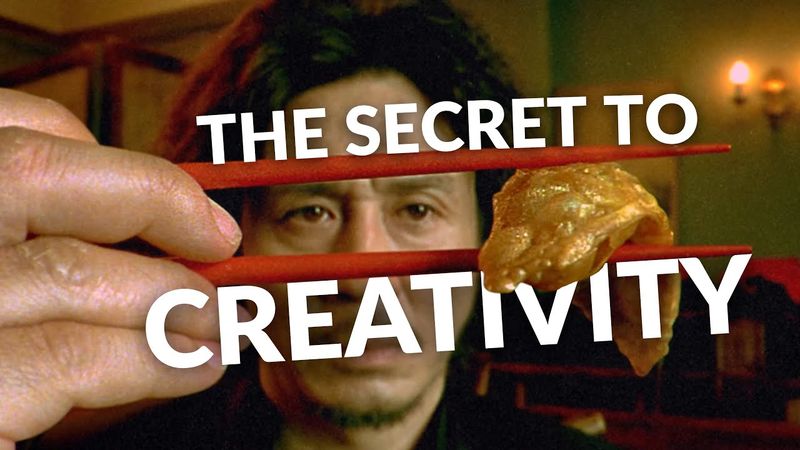
Stop chasing original ideas—here’s what actually makes you creative
Download information and video details for Stop chasing original ideas—here’s what actually makes you creative
Uploader:
Lofi CinemaPublished at:
4/24/2025Views:
981.1KDescription:
Video Transcription
What's the movie that we have never seen because you haven't made it?
And make that movie.
Years ago when I first heard this, I took it as a challenge.
Like Tarantino was saying, go make something the world's never seen before.
Something bold, something completely original.
And for a long time, that's what I chased.
I believed that true artistry was about being a visionary, about originality.
But over time, that interpretation started to fall apart.
You soon realize that every story has already been told.
There are only a handful of basic plots and so on.
But if originality wasn't the key, then what was my role as an artist?
What made anything I created worth it?
This question stuck with me, and it sent me searching.
That's when something came to mind.
This is for Elise by Beethoven.
You've definitely heard it before, maybe in a music class, maybe in an elevator.
But there's this interesting thing about it.
This melody feels kind of inevitable, like it always existed.
And Ludwig von just happened to be the one to catch it.
And I had this thought.
If he hadn't written it, maybe someone else eventually would have.
Could another composer have come up with the same tune?
Probably.
But it would have sounded different.
It would have carried a different emotional weight.
Because the person behind it, whoever they were, would have brought their own interpretation.
And that's when something clicked.
Maybe ideas, themes, stories, they already exist.
But what turns them into art is how you interpret them.
How you frame them, feel them, structure them.
Let me show you what I mean.
Take the film Gravity.
On the surface, it's a space movie, but it didn't really start that way.
Alfonso Cuarón had been working on a personal intimate art house project.
It fell apart, no financing, no backup plan, and suddenly he was broke.
I told Jonás, I need to write something right now, but no artist shit.
I need to write something that can be appealable for a studio just to pay a check now for me to keep on going.
And he said, yes, but if you're going to do it, he has to do something that is relevant to you.
And he says, OK, what do you feel right now?
He says, I just feel I have to go through all this.
I just want to put my feet back on the earth.
I says, there you go.
He says, but I mean, well, how do you feel?
He says, I feel like I'm falling in the damn void.
He says, there you go.
That feeling became Gravity, a survival thriller.
Sandra Bullock lost in space, spinning out of control, trying to come back down to Earth.
He didn't write about being broke.
He didn't write about depression.
He wrote what it felt like.
Paul Schrader, who wrote Taxi Driver, Raging Bull, and First Reformed, has this way of talking about writing that feels more like therapy.
You begin with yourself.
You are the raw material.
He gives his students this exercise.
Write down your biggest personal problem.
Not a plot idea, not a character.
Just the thing you're carrying.
Then ask yourself, what's the metaphor for that?
Because that's the thing about powerful storytelling.
It's not the literal story that hits you.
It's the feeling underneath it, translated into something new.
For example, someone who's hiding their sexuality, who spends their life hiding who they are, that doesn't have to turn into a coming out story.
It could become a spy thriller, because being closeted can feel like being undercover.
Always scanning the room, always keeping track of what version of yourself is safe to show.
Even the people who love you don't fully know you.
It's not the literal story, it's your experience, disguised as a story.
because you're actually talking about the problem without talking about the problem.
That's what Paul Schrader did with Taxi Driver 2.
He was broke, alone, disconnected from the world, and then it clicked.
He was already living the metaphor.
A man in a taxi, surrounded by people, yet completely alone, watching life through a windshield.
That became Travis Bickle.
I mean, I wrote the script essentially for myself as therapy.
And so it was something of a surprise, the degree to which a large number of people plugged into my own neurosis.
So the story might be familiar, but how you see it, that's the part no one else can do.
Because here's the thing.
There are only so many plots.
But if your problem is real and your metaphor is honest, those old stories come alive again.
poured through you like new wine in old bottles.
So maybe it isn't about finding this genius one in a lifetime idea, but rather tuning into what already exists around you, or inside you, and expressing it in a way only you could.
But interpretation doesn't always start with personal pain or metaphor.
Sometimes it starts with someone else's story, and what you do with it.
Take Oldboy, for example.
It was based on a Japanese manga, which was itself loosely inspired by Dumas' The Count of Monte Cristo.
But Park Chan-wook didn't just adapt it.
He completely reinterpreted it through his own lens.
He kept the premise, a man mysteriously imprisoned for years, then released and told to figure out why.
But then he flipped the question.
Not why was he locked up, but why was he let go?
The story became a modern Greek tragedy, filled with taboo, guilt, and emotional punishment.
None of that was in the manga.
It came from Park.
His vision, his obsessions, his culture, his own unique filmmaking style.
That's interpretation.
And speaking of applying your own style of filmmaking, let's look at a filmmaker who didn't just reinterpret a story.
He changed what a genre could be.
Sergio Leone took Kurosawa's Yojimbo and reimagined it as a fistful of dollars.
He didn't copy it.
He transformed it, creating the Spaghetti Western.
This wasn't a regular Western.
He slowed the pacing, cut scenes to music, used silence like tension,
framed shots like Sergio Leone.
Leone made Western heroes dangerous and sexy in a way they had never been before.
Before him, Westerns were about noble cowboys and clear morality.
His West was gritty, lawless, ambiguous.
Survival mattered more than virtue.
And in doing so, he created an entirely new genre.
It wasn't a new story.
It was a new language.
But sometimes the genre stays the same, and it's the personal story inside that makes it powerful.
Like a movie about aliens, something we've seen a hundred times, can feel completely original when it's filtered through someone's life.
The whole movie for me grew out of growing up in South Africa.
And so my experiences growing up as a kid are reflected very accurately in the film.
Neil Blomkamp grew up in apartheid era Johannesburg.
And when he made his first feature, he didn't write a historical drama or a documentary.
He made a science fiction film about aliens forced into slums.
But it wasn't really about aliens.
It was about what it felt like to live inside segregation, to grow up in a system built on categories, fences, and forced removals.
And by telling it that way, he turned his experience into something that we could universally understand.
He took something massive, sci-fi, and used it to say something deeply personal and political.
He didn't show the problem directly, he interpreted it.
That's why District 9 landed so hard.
Now compare that to his later movies.
They had bigger budgets, more visual effects, but they didn't land the same way.
Maybe because they started from concept, not from something lived.
They didn't carry the same personal weight.
They didn't feel interpreted.
They felt designed.
One was born from personal experience, the others from concept.
So whether it starts with a metaphor, a feeling, or a genre you grew up loving, what matters is that it's honest and that it's yours.
Maybe that's what Tarantino meant all along.
Make the version of the story that only you can.
Good, bad, or indifferent, Reservoir Dogs didn't really exist before I did it.
Heist films had been made.
Hong Kong movie, City on Fire, if you've ever seen City on Fire, it's very, very different from my movie.
The section that they say I took, I did take from it, all right?
Absolutely, I took from it.
But it's a very different movie.
They actually talked to the director, Ringo Lam.
He goes, wow.
Tarantino took the last 10 minutes of my movie and made an entire movie about it.
There was Barry Levinson in Tin Man, and there was Goodfellas, and there was all kinds, there was the David Mamet stuff, all that stuff existed that was sort of like Reservoir Dogs,
But it wasn't Reservoir Dogs.
It didn't have this aesthetic that I'd been having.
It was never just there.
I mean, if it was just there, if two or three other people were doing it, I might have been the filmmaker because I didn't need to get it out of my head.
So maybe it's not about chasing the next great idea or inventing something no one's ever thought of.
Maybe it's about making something no one else could have made because it came through you.
Similar videos: Stop chasing original ideas

『JOOHOUR』DIY Dollhouse |<Glory of Titanic>The Grand Staircase with add-on figures and furniture

Adventure Action 🎬 Eclipse: The Rise of Ink 🎬 Full MOVIE 🎬 4K
when the director is basically John Wick
Unlocking the Secrets: The Terror (1963) Film Review by Dr. Steve Haberman
![🔥The Game of Ice and Fire | Full AI Fantasy War Movie [TRAILER]](https://videodownloadbot.com/images/video/636/z7i9a2lstwnw4dnq18734ri69x4z4xr7_medium.jpeg)
🔥The Game of Ice and Fire | Full AI Fantasy War Movie [TRAILER]