Syntax 1
Download information and video details for Syntax 1
Uploader:
prof. khader khaderPublished at:
6/4/2025Views:
26Video Transcription
Good morning everyone and we are today going to approach a new subject and begin with a new topic and this is Syntax.
Now earlier, at the beginning of the course, when I introduced you to the branches of linguistics, and then I talked about the language levels earlier with relation to linguistics, I have
talked about phonology, and then morphology, and then syntax, and then semantics, and pragmatics, and other branches of linguistics which are related to other disciplines in the field.
Last topic, we talked about morphology as a branch of linguistics and a major branch of linguistics.
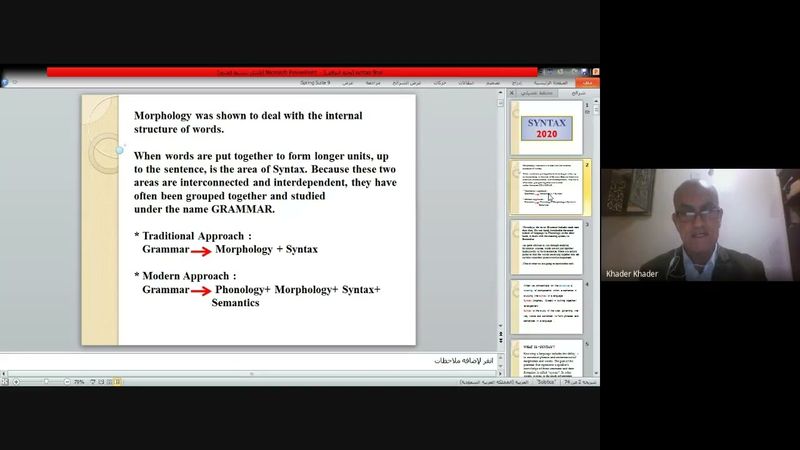
And we said that morphology was shown to deal with the internal structure of the words.
When words are put together to form longer units up to the sentence is the area of syntax.
Earlier in morphology, we used to talk about
the area of morphology with relation to word structure or the internal structure of words as such.
Today, we will continue talking about further
a structure with relation to the words.
When words are put together to form longer units up to the sentence, this is the area of syntax.
Because these two areas are interconnected and interdependent,
they have often been grouped together and studied under the names of grammar.
So, since morphology is the grammar of the word, syntax is the grammar of
structure of sentences.
So, morphology and the grammar can be studied under the name of grammar.
Earlier, as far as the approach is concerned, we have two approaches.
One which we call traditional approach, where grammar means morphology and syntax only.
But in the modern approach, grammar can be phonology.
Why is it phonology?
if someone will ask me and says, you are talking about sounds, I tell him yes or huh, that I'm talking about sounds, how those sounds
are organized in a proper systematic order.
So, we get a word, and this word is meaningful.
Unless and until this word is well structured phonologically, we cannot
get an organized word properly.
So those sounds should be organized in a proper form to convey a meaning and to give you a well-structured word.
Plus, after phonology, we have morphology.
morphology as i mentioned earlier it is the internal structure of words how such words are organized internally in a proper way plus syntax and syntax means
how do we organize the words in a systematic proper order so that's why we can say that well structured sentences well structured phrases plus also semantics so sometimes we can say
or we have well-structured sentences but the meaning is not complete like for example the cat learns linguistics the cat learns linguistics now we have a subject
the cat learns verb linguistics an object point this is grammatically well structured syntactically well structured then no one will understand or some people like us will understand that the cat learns linguistics in the sense whenever the cat for example
uh released some we can say old sounds apart from its meal all right yeah
We say, by God, the cat learns linguistics.
Because we work to see or hear new sounds that the cat produces.
which is known that this is the cat's you know sound all right fine uh so it has to be meaningful
Now, for example, in modern approach, we have a new sentence, which is very famous by Noam Chomsky, where it says, the sentence, colorless green ideas sleep furiously.
How is it possible?
I told you about it before.
How is it possible for colorless green ideas to sleep?
Sleep how?
Furiously.
No one among us can sleep when he is furious.
Only very few who sometimes, you know, they don't feel or they don't realize any, you know, kind of feeling like that.
Nowadays, the term grammar includes much more than that.
On one hand, it embodies the sound system of language.
That is, as I told you, phonology.
On the other hand,
It deals with the meaning system that is semantics.
We begin by phonology, the sound system of the language, and also it deals with the meaning system that is semantics.
As a quite obvious deal, through studying grammar courses before, words are not
put together haphazardly.
They have such words to be well organized, well systemized in a systematic order.
We call it word
For example, no one of us can say that the English language usually starts with a verb.
No.
But the Arabic language has to begin by a verb.
In other words, if we consider a mistake, sorry, if we consider a news,
Through the media or in the newspapers, we say that the American candidate, Joe Biden, won the American presidency in 2020.
Another one tells me through the newspapers, Joe Biden won the American presidency in the United States of America in the 2020 elections.
That's right.
But which one is stronger?
To begin with, let's say, Joe Biden wins the 2020 White House elections.
Okay.
Therefore, the Arabic language
It has two types, an information sentence and a noun and an action sentence.
It starts with a noun and it starts with an action, but which one is stronger in dealing with the news or dealing with the subject is the sentence that starts with an action.
Notice, for example, in all news,
In English, we can say Joe Biden, for example, Joe Biden, the new president who will make the oath in January, will enter the White House in January.
subject object we say english is subject verb object there are certain patterns that words are strung together into certain rules
that govern world arrangement.
This is what we are going to learn in this unit.
This is what we are going to learn in this unit.
We are.
concern about systemizing, arranging words, sentences in a proper systematic order.
You know, that's why we call it, this is syntax.
Fine.
Dr. Blyth?
Yes.
I would like to ask for your permission.
Yes, please.
One minute.
Okay.
Okay.
Fine.
Okay.
When we concentrate on the structure and ordering of components with a sentence, that means what?
That means studying the syntax of the language.
Fine.
Again.
When we concentrate on the structure of ordering of components within a sentence, it means that we are studying the syntax of a language.
Now, etymologically speaking, the word syntax originally, it's a Greek word, which means putting together.
We are organizing the words together.
We arrange the words together.
in order to get a proper, systematic, well-structured sentence.
Syntax as a definition means the study of the rules governing the way words are combined
to form phrases and sentences in a language.
Again, let me repeat it.
This is an important definition for you.
Syntax as a subject or a branch of linguistics is the study of the rules governing the way words
are combined to form phrases and sentences in a language.
All right?
Fine.
And then also, knowing a language includes the ability to construct the phrases and sentences out of them of themes and words.
Knowing a language includes the ability to construct phrases and sentences
out of morphemes and words.
Out of morphemes and words, we are going to construct phrases and sentences in a particular language.
The part of grammar,
Part of a grammar that represents a speaker's knowledge of these structures and their formation is called what?
Syntax.
Then syntax
is that part of a grammar that represents a speaker's knowledge of these structures and their formation.
In other words, syntax is the study of sentence patterns of language.
How do we build sentences?
In well-structured way, in a proper order,
we build up sentences so this is under the study of syntax the aim of this study that is the aim of syntax is to show you what syntactic structure is
and what the rules that determine syntactic structure are like.
Again, the aim of Syntax is, why this is important, I mean, sometimes I ask a question, what is the aim of Syntax?
So, this is the answer of it.
The aim of this study, or the aim of Syntax is,
to show you what syntactic structure is and what the rules that determine syntactic structure are like.
Okay?
Is this clear?
Is this clear, everyone?
Yes, Doctor.
Yes, Doctor.
Any question or observation, we can change.
Doctor, can you ask?
Ask about what?
About what you explained.
Can I ask?
Yeah, yeah.
Can I ask?
Go ahead, your name.
Layla Al-Farrah.
Go ahead, Mr. Laila.
May God bless you, doctor.
Doctor, now, syntax, it studies the grammar of sentence correctly, yeah?
Of course, that's right.
I always say that syntax, it follows the subject plus verb plus direct object.
You see, this is one rule, like it not always is like that.
So we have to look at the structure of such sentences in a proper order.
That's why we can decide.
And this is called syntactic categories.
I'm going to explain it afterwards.
Yeah.
The last question, syntax is studied sentence, but grammar studies the word?
No.
No, it is not like that.
First of all, we explained morphology, isn't it?
Yeah.
And we said morphology is concerned.
about the internal structure of the word.
How such word is organized grammatically, I'm talking about the word, mind that, in a proper order.
Alright?
Then, we went beyond than that.
beyond than the word.
That is what?
We come to the phrase, we come to the clause, we come to the sentence, which is larger than a word.
All right?
So, we study them syntactically.
How such phrases, clauses, sentences are organized.
in a well-structured way, in order to convey a well-structured sentence and also meaningful sentence.
Like, and whenever we talk about
excuse me, whenever we talk about the meaning, then we are going to explain something related to semantics.
Alright?
Alright?
Fine.
Any other question?
No, thanks, Dr.
Welcome.
Anybody else wanted to ask a question also?
Okay.
Now, everybody is keeping silent.
It means that I should go ahead and everything is understood.
I hope so.
Fine.
Excuse me.
Just let me summarize what is syntax, as I mentioned earlier.
Knowing a language includes the ability to construct the phrases and sentences out of themes and words.
Now, we are supposed to look at
ability to construct phrases and sentences out of what?
Out of morphemes and words.
The morpheme is a grammatical unit that is, you know, can be a word or part of a word.
And then we go beyond than the morpheme slightly.
Further, that is called word.
And then, putting the morphemes and the words in a proper order, in a constructed, well-structured order to get phrase and sentence.
The part of the grammar that represents a speaker's
knowledge of these structures and their formation is called syntax in other words syntax is the study of sentence patterns of language the aim of this study is to show you what syntactic structure is
and what the rules that determine syntactic structure are like.
Okay.
As a matter of continuation to the question that Layla asked me about syntax and morphology and word order of any language as such, we look at syntactic category.
Syntactic category is a set of words and all phrases in a language which share
significant number of common characteristics.
Syntactic categories commonly include parts of the speech, like what?
Determiner.
A determiner, of course, is what you call an article.
But I will go beyond that, the article, and get something
you know, which is called determiner.
A determiner is supposed to be either quantifier or articles, definite articles, indefinite articles, like the F, N, and so on.
Or we have some students, they just stood, you know, in the course of linguistics.
So we begin right from the beginning.
If I have a sentence, that determiner is there, noun is there, pronoun is there.
verb, auxiliary, adjective, preposition, adverb, etc.
Doctor.
If someone opened the speaker, close it for me.
Go ahead.
Excuse me, I don't understand the word Determiner.
Can you explain it to me?
What's your name?
Areej Aboulnour.
Areej, Determiner means to replace what?
To replace the article?
And instead of things like some, we start with a sentence, with issues, like we say about it, for example, some, or few, or many, or something like that.
Or we say, the girls, fine, went to the university.
So that is a determinant.
It's the tools of knowledge.
Okay, thank you, doctor.
Okay, fine.
Then we have nouns and pronouns.
All right?
Fine.
And now, when I say, for example, Biden won the election of presidency to American election presidency to 2020.
We took Biden.
Biden became a noun.
When we say, for example, Kamala Harris,
What did the president become?
She.
But Biden, what do we say about him?
He won.
He won the elections.
He became a pronoun.
The verb won.
From when?
All right.
He won.
It means the verb.
Auxiliary.
I always go early to the university.
I became an auxiliary.
All right.
Or modifier.
then adjective good man all right good adjective preposition in the university at the university adverb you will call your adverb as a replacement of the adverb which is there etc we are going to explain them in details inshallah very soon we meant by structure here
is word order how the words are organized in a proper order the meaning of a sentence depends on the order in which words occur in a sentence
It has, of course, an effect or it has, let's say, a meaning.
Why does this word that exists in the structure refer to a meaning?
So, is its existence appropriate or not appropriate?
We will see, God willing, in the future.
Compare the following sentences.
See how the comparison between the two sentences, the following ones.
I sing because I am happy.
Again, I want to repeat it and understand me well.
I sing because I'm happy.
I am happy because I sing.
There is a difference between the first two.
I sing because I am happy.
And the second one, I'm happy because I sing.
After that, I say, it depends upon the reading, the way I read it.
We call it
In phonology, something like intonation.
I sing because I'm happy.
I sing because I am happy.
I'm happy because I sing.
I'm happy because I sing.
أنا ليش سعيد؟ لأني أغني.
عشان هيك أنا بغني لأني سعيد.
تمام؟ The two sentences above have the same categories.
التصنيف واحد.
فئة الجملة واحدة.
لكن the number of words they are the same.
Let's count.
subject saying the because I am then one two three four five six six words are available there in the first sentence six words are available there the second one one two three four five six same number of words like in different attitudes all right
If we have the same number of words, but they are different in structure, or in the word order, thus they have different meanings.
Okay?
Does anyone have a question before I finish?
You opened the network and left me.
You didn't register your presence.
No, doctor.
I'm with you.
We're here.
I'm with you.
You do it.
You register your presence and go out.
No, I'm with you.
Okay.
Do you understand me well?
Yes, I understand.
I'm with you, doctor.
Okay, so if someone doesn't understand, tell me, please, I'll stop right away.
Okay?
Okay.
Phrase Structured Grammars, which we call PSG, it is Noun Phrase, Word Phrase, Noun Phrase, Noun Phrase, Noun Phrase,
Adverb Phrase Preposition Phrase and Sentence as the core of the structure Every sentence in English and Arabic has a classification Either we call it starting with the noun like for example the feature
went to school.
Now, the teacher, this is all, all the teacher, noun phrase.
Then this noun phrase, I can play with it as I want.
I say, for example, Khadr went to school.
I can say, he went to school.
I don't want it.
I want to put instead, let's say, Noor.
Alright?
Noor went to school.
She went to school.
The girl or the student went to school.
So, this noun phrase, I changed it as I want, but the structure of the sentence is the same.
Alright, imagine that I'm going to bring
the cat went to school.
Structure is correct, but the cat doesn't have the ability to go to school as a pupil.
It's like a difficult from, you know, that.
Okay.
Syntactic categories are illustrated in a tree diagram.
which we call it Phrase Structure Tree.
Phrase Structure Tree by supplying the name of the syntactic category of each word grouping.
These names are often referred to as syntactic labels.
The root of the tree is the sentence.
Why should the sentence be divided?
It should be divided into phrases.
We have a noun and a phrase, and we have a verb and a phrase.
The noun and phrase should be divided into, if we have, of course, the determinate, which is the definite article, and we have a noun.
If I don't have a determinate, I should have a noun.
If I don't have a noun, I should have a pronoun.
But I don't have a proper pronoun.
But all of them under something that is called what?
Noun or phrase.
And the verb or phrase is the same.
Take the sentence.
Okay.
For example, we say the president or the president won the election.
What do we give it?
I mean, I want to be happy.
I'm not supposed to accept you because the time is 9.47.
But let's go.
No problem.
We want to be a little...
I mean, we want to get along with people.
Okay, okay.
It's okay, Leila.
It's okay.
Fine.
Syntactic categories.
Let's go to the sentence.
What sentence did we take at the end?
The president won the election.
Okay.
Answer it, by the way.
Who is with you?
Areej Aboulnour.
Let's go, Areej.
You found it, Doctor?
You're asking us to say the syntactic categories of the sentence, right?
Yes, exactly.
Let's see.
Let's say, the president won in the election.
President won in the elections.
Not in the election.
The election.
The election.
The election.
Okay, let's divide it into categories.
Okay.
No, no, if you'll excuse me.
How do we divide it?
We'll say the whole thing.
Okay.
What happened here?
It became a noun phrase.
Ah, I understand.
The president noun phrase.
A noun phrase.
The last part of the sentence remains.
Won the election.
The whole thing.
Won the election.
Verb phrase.
Verb phrase, yes.
A noun phrase.
Okay, now we want to do it like a tree diagram.
A tree model or a tree drawing, a tree structure.
How do we say it?
We want to say the sentence.
We want to make a separate course.
Let me just draw it for you.
One minute, the small board is gone.
Because people...
These topics, like this one, don't need electronic education.
Topics like this one, all the linguistics and sounds, don't need electronic education.
It needs direct education, because we write, and we ask, and we explain.
I'll read you the sentence.
The president, here on the board, so you can see it.
Won the election.
Do you see me or not?
Doctor, can you move back a little bit?
Yes, of course.
You see, you see.
Okay, okay.
Can you share the sentence with me?
Yes, yes, I want to share.
What's your name?
Don't bother us, bother your daughter a little bit.
My name is Farah Abu Jazar.
Okay.
The president won the election.
The first thing we're going to do is the three diagrams.
The first thing is the sentence.
That's right.
No, before the three diagrams.
Stay with me, Farah.
Stay with me.
Okay.
Before the three diagrams, we're going to divide what?
The president.
The president.
In case you don't have a role in the conversation, you will speak.
This is a noun phrase.
The second division is one, the election.
It became a verb phrase.
All right?
Who is this Hayya Al-Na'san?
She will tell me what the sentence is and what the division is.
Of course, we are sitting here and we will talk for more than a quarter of an hour.
Follow us, Hayya Al-Na'san, follow us.
Okay, guys?
Okay, but let me...
Okay.
Where did Farah go, Abu Jazza?
Here I am.
Did you see Shafsina?
Yes, yes.
We're going to divide it into noun phrase and verb phrase.
Yes.
The noun phrase is an article and a noun.
It's an article and a noun in president.
Excuse me.
We don't use an article since today, Farah.
You and everyone.
We use an article instead.
Determiner.
Okay?
That's it.
I gave it a shortcut.
By the way, in syntax, we have a lot of shortcuts.
Do you see or not?
Did you see Determiner?
Yes, we saw it.
Okay, so Determiner, what is its abbreviation?
I found it.
Determiner has many abbreviations or many types.
Maybe let's focus now only on the article.
And the articles are either definite articles or indefinite articles.
Indefinite articles.
These are available to you.
Okay?
Did you see it, Faraha Mujaza?
Yes, yes.
Part of determinants.
Determinant, definite article and indefinite article.
Now, the noun phrase can be replaced by any other expression suitable to the meaning of the sentence or the structure of the sentence.
In other words, I don't want to say, who is he?
The president.
I want to say, we put Biden for you.
I mean, Joe Biden, the new elected president.
God forbid, he gives the presidency or not.
Trump is making his story.
Who do we have?
We have Biden.
Did you see how?
We changed Biden.
What happened?
This is a proper noun.
Is it okay or not?
The name is a flag.
I don't want Biden.
I might be the president too.
It's very easy and natural.
This is allowed for the elections, of course.
There are no elections in our country.
The president, from the day he dies, is the president.
We don't say he.
He won the election.
Assume it wasn't her.
Assume it was last time's elections.
With whom?
With Donald Trump.
Who came up against Donald Trump in the old days?
Why don't you remember, Zainab Bashir?
Hillary Clinton.
She was a woman.
Tell me who she was.
Hillary Clinton.
Hillary Clinton.
Clinton won the election.
She.
Under the category of one.
Under the category of one.
Noun phrase.
Noun phrase.
Under the category of noun phrases.
Okay, let's go back to me.
I also have the sentence divided into two parts.
One which is called noun phrase earlier.
The second part is verb phrase.
Why does the verb phrase need to be formed?
Who can answer?
Me.
Verb and noun phrase.
Verb and noun phrase.
No, verb and noun phrase.
Stay with me, Farah.
Stay with me.
This is the three diagram that I'm drawing.
This is the three diagram.
What's its name in English?
Three diagram.
Okay?
Three diagram.
It consists of the noun phrase and the verb phrase that I have here.
Okay.
And we stopped at this point.
No.
I also have a further analysis of the noun phrase and the verb phrase.
What is the further analysis in detail for that labeling the sentence, all right?
That is, noun phrase becomes determiner plus noun.
Noun.
Determiner plus noun.
Okay, now I don't have a determiner plus a noun.
I only have a pronoun.
We say it's correct.
The noun phrase goes straight to the pronoun.
And it became like this.
It became a pronoun by itself.
In order to get Hillary Clinton, I need to get something.
All right?
One.
One.
We have the election.
What do we want to go back to?
We want to go back to the noun phrase.
The noun phrase.
So we have two noun phrases.
So now we have a replacement.
Anything can replace the noun phrase, this one.
I can put, I don't want to use, for example, one.
We want to say, look at another thing.
She went to, huh?
The university.
I hope you go to the university soon so we can relax from all these stories.
Went became the main verb.
Okay?
To the university became a preposition.
Right or not?
Why?
Because the head of the phrase came out.
What do I have here?
Preposition.
Prepositional phrase.
Okay.
What could be the prepositional phrase?
I don't want to say, to the university, to the market.
I don't want to say, to the market.
Let's say, to the cinema, for example.
All right?
Fine.
So, anything, instead of doing a replacement, the important thing is the category.
The syntactic category is present.
But we put the word order that we want, in accordance with who?
With the syntactic category.
We want to take a break here a little bit.
Five minutes, okay?
Because an hour has passed.
So that you can breathe a little.
And then we'll be back, God willing.
Okay?
Okay.
What do you mean by replacement?
Yes, ma'am.
What do you mean by replacement?
I mean, replacement, for example, you said something.
Okay?
What's your name?
Fatima, Mustafa.
Okay, Fatima.
We put Fatima instead of anything.
Is it a replacement for the pronoun or not?
Yes.
Okay.
You don't want to go to the university.
You want to go to the market.
It became to the market instead of what?
Instead of to the university.
The first two categories are prepositional phrases.
One or not one?
One.
But what are the words that came instead of it?
The meaning is different.
But the syntactic category is one.
In the same words that we have here.
Okay, Fatima?
Thank you, doctor.
Okay, no problem.
I want to stop here.
I don't know what to do.
Just five minutes to refresh your energy.
I am active, but how about you?
Who is asking?
Hi, doctor.
What's your name?
Rana.
Rana Shor.
Call me Rana.
Semantics.
What do we have here?
Syntax, right?
I don't know.
Ask yourself.
Okay.
Syntax.
I want to ask you a question.
How did you get into the lecture without knowing the...
Doctor, I'm confused by the name.
I don't know what it is.
OK, we're in syntax, Rana.
OK, now, syntax.
This means that the meaning is correct, and at the same time, the composition is correct, right?
No, we're focusing on the composition more than the meaning.
So, for example, the characters you talked about, this is a correct syntax.
But, for example, your meaning is wrong.
Of course, have you ever seen a cat learning linguistics?
No, of course not.
OK.
Doctor?
Yes.
Can you give us an example of the categories?
Who's with me?
Sarah Zakot.
Sarah, we're on a break.
Take a break.
I'm fine.
After the break.
I'm not questioning your father, your father, your husband, or anyone.
Take a break, Sarah.
I'm fine.
Don't worry.
Just a minute.
Sabaya, what's wrong with this lecture?
We're on break.
Yeah, if there wasn't a break, we'd be open.
Thank God, it's good.
OK.
Welcome back to the lecture, as a matter of continuation.
All right.
There was a question by about giving her some examples about syntactic categories.
We said, as a definition, syntactic category is a set of words or phrases in a language
would share significant number of common characteristics.
When we say, for example, the lady, the girl has one phrase that is called noun phrase, we can share
a number of common characteristics, like the teacher is the same, teacher is a noun, girl is a noun, boy, lady, and so on.
Fine.
Syntactic categories commonly include parts of speech.
In parts of speech,
As I mentioned earlier, if I have a sentence, Joe Biden won the American election.
Joe Biden is a proper noun.
The president won the election.
President now.
He won the election.
One verb.
The election noun phrase.
Okay.
What is the election?
I want to say the teacher won the match.
He won the game.
He won the game.
Fine.
You lost here instead of the election.
We put something here.
It's in the game, but in the game, the match and so on.
Even same category, our common category with different words, category, verb, phrase, category, noun, phrase, category, determiner, noun and pronoun.
Then we go to verb.
under something that is called what verb phrase.
OK, fine.
Even syntactic categories commonly include parts of the speech, determiner, noun, pronoun, verb, auxiliary, adjective, preposition, adverb, et cetera.
All right?
Move further.
Now, what's meant by structure here?
What is meant by structure?
We will say what is meant by structure.
Structure is a word, order.
كيف هيكلت ترتيب تركيب الجمل inside a sentence or a phrase.
The meaning of a sentence depends on the order, جدولة, ترتيب, and مذجة.
In which words occur in a sentence.
كيف
compare the following sentences I sing because I am happy compare the following sentences I sing because I am happy I am happy because I sing now number of words I
Again, the second sentence.
The two sentences above have the same categories and number of words, but different in structure, like word order.
Thus, they have different meanings.
Phrase structure grammars like noun phrase, verb phrase, adjective phrase, adverb phrase, preposition phrase, and sentence as the core of structure.
Syntactic categories.
are illustrated in a three diagram, as I discussed before the break, called Phrase Structure 3 by supplying the name of the syntactic category of each word grouping.
I made a supplement for every word in the Phrase Structure 3, and we gave it of
We gave the syntactic category a name.
For example, these names are often referred to as syntactic labels, usually.
written by the initials of the categories, such as the following.
We give it abbreviations, like the first one, for example, sentence, it is as, determiner, that, by the way, these abbreviations are dependent, not with us, but in the whole subject that is called syntax.
whenever and wherever you go studying syntax you have the same abbreviations as it refers to centers that refers to the terminal noun phrase it is np and refers to noun prone reverse to pronoun vp refers to verb phrase verb it is
P, that is adjective phrase.
Adjective, adjective.
Adverb phrase, ad-p. Adverb, that is adverb.
Preposition phrase, p-p. P-p, sometimes we find it in past participle, that we have to distinguish between whenever we read the entire or the detailed expression available there.
so pp refers to past or present participle like in the word content indicates the full name of the abbreviation preposition phrase pp preposition p auxiliary verb that is ox all right fine can i doctor
Sentence, S, Determinant, Det, Noun Phrase, NP, Noun, N, Pronoun, Pro, Verb Phrase, VP, Verb, V, Adjective Phrase,
adjective, adjective, adjective, adjective, adjective, adjective, adjective, adjective, adverb, adverb, adverb, adverb, adverb, adverb, adverb, adverb, adverb, adverb, adverb, adverb, adverb, adverb, adverb, adverb, adverb, adverb, adverb, adverb, adverb, adverb, adverb, adverb, adverb, adverb, adverb, adverb, adverb, adverb, adverb, adverb, adverb, adverb, adverb, adverb, adverb, adverb, adverb, adverb, adverb, adverb, adverb, adverb, adverb, adverb, adverb, adverb, adverb, adverb, adverb, adverb, adverb, adverb, adverb, adverb, adverb, adverb, adverb, adverb, adverb, adverb, adverb, adverb, adverb, adverb, adverb, adverb, adverb, ad
Now, we will discuss each and every phrase, separately.
The phrase, group of words, that is part of, rather than the whole of, a sentence.
Again, the phrase is supposed to be a group of words that is part of a sentence or rather than the whole of a sentence.
There are different kinds of phrases depending on the head word.
Now the head word, which is available
in the phrase can identify the type of that phrase, can identify the type of that phrase.
For example, this, another phrase,
which refers to as NP consists of a noun as the head word.
Even the head in the noun phrase is the noun.
For example, consider the following examples.
The word man, it's a noun.
When I add a determiner, I say,
the man but what is that head it's man the young man it is the young man the entire three words
supposed to be noun and phrase.
So we can say, the young man.
But where is the head of the expression or the phrase, the young man?
That is, man.
We can delete the
We can delete young and only have the main word that is men.
Because I can say the young woman, the young boy, etc.
The clever young man, I added another word that is called adjective.
Like what is the head?
Man.
The clever young man in the garden
killed the thief come on mother the clever young man young man in the garden killed the thief i can delete clever i can delete young i can delete in the garden and say the man killed the thief
Is it possible for me, huh?
It's much to add.
Is it possible for me to delete man and leave the clever young in the garden, killed the thief?
No.
No.
No.
No.
No.
It does not convey a meaning.
Lacks something.
I can delete the clever and young and say the man.
killed the thief then the head word which indicates the type of the phrase the one which is going to last for long as part of the structure in the sentence
Doctor, I found that the word man is the head word in these sentences, we considered them a noun phrase, even though there are adjectives.
Okay, but can we remove the adjectives or not?
The important thing is that when the head words, we depend on the head words that are in the specific category.
Right, exactly.
Now, for example, you have this sentence or phrase, the clever young man.
If I went and did deletion, the man, would the phrase settle?
No.
Would the phrase fit with me or not?
Like, let us count together.
In the last one, number five, the clever young man in the garden.
How many words are there in this phrase?
Seven hearts.
Seven words.
Seven words.
Seven words, alright?
Yes.
So, these seven words are not necessary, except one.
Out of that which is the main or the head word in the brain.
Okay?
Fine, move further.
In the other phrase,
As I mentioned before, NP, a group of words, or a word, the head, which is an L, or any structure functions as an L. Again.
It's a group of words, or a word, in the head, which is a noun, or in its structure, functions as a noun.
For example... Shall I read, Doctor?
For example, girl, the girl, the young girl, the clever young girl,
The clever young girl in the park.
Good.
That noun phrase didn't have a finite verb, but it can have a non-finite verb, waiting.
Very good, thank you.
For example, we have the word girl.
We have the expression or the phrase, the girl.
We have another phrase, longer, consists of young, that is what, that is the young girl.
Then, in addition to that, we have the clever young girl, or the clever young girl in the park.
Notice that noun phrases do not have a finite verb,
But it can have a non-finite verb like waiting.
The clever young girl waiting in the park went to the airport.
The clever young girl waiting in the park went to the airport.
Move further.
Clear?
Yes.
We have a reminder.
Can someone read the reminder with me?
Shall I read?
Your name?
Suma Dosh.
Okay, Suma.
Reminder.
All verbs are finite.
Expect the following.
No, but after your permission.
You're going to say all verbs.
You don't have S or R. So it's going to be all verbs.
Verbs.
Verbs, yes.
Okay.
Okay.
All verbs are finite, expect the following.
The infinitive, like to come, to go.
The present participate, like coming, going.
The past participle, like come, gone.
The young man throw the old dog upon.
Throw, means throw the old dog upon.
Through.
Through.
Through.
Through.
Through.
Through.
Through.
Through past.
But we have something else.
T-H-R-O-U-G.
H, that is خلال أو عبر.
لكن هنا أصلاً لازم تكون الفعل الأصلي أو التنس الأصلي.
The young man throws the old dog a bone.
لكن هنا through رمى في الماضي.
In the past.
أيوة.
The young man threw the old dog a bone.
A bone, a bone.
A bone.
A bone.
A bone.
John built his eldest daughter a fine house.
A simple sentence may have more than one noun phrase.
Thank you.
Welcome.
John built the house.
A simple sentence.
So, John here became under the category of noun and phrase.
And the house became under the category of noun and phrase.
So, in such a simple sentence, we have two noun phrases.
We have two noun phrases.
Okay?
So, as a result, it comes from us.
Now, let's see this as a beginning and then we will change it.
Government and binding vary.
Minimalist approach.
Governmental binding theory.
Minimalist approach.
X-bar syntax.
Syntax.
And semantics.
In a subject.
Verb phrase.
Verb phrase.
Rima.
Rima.
Verb phrase.
VB.
A verb phrase consists of a verb and all the word, and word group that belong with the verb and the cluster around it.
Examples, when, soon, when, was going home, was walking along the road, may have arrived when the plane was landing,
In the close, the head word is a verb, the other that go with it, may be exo... exoterous.
Modiverse, indirect, object, subjective, compliments, objective, compliments.
Thank you.
But it seems me, it seems to me, Rima, that ...
You forgot my own pronunciation whenever I pronounce the words and you did not learn out of my pronunciation.
Just let me read and compare your readings with mine.
and your pronunciation with mine too.
A verb phrase consists of a verb and all the words.
All the words and word groups that belong with the verb and the cluster around it.
Examples went
soon went, was going home, was walking along the road, may have arrived when the plane was landing.
In this clause, the head word is the verb.
The others that go with it may be auxiliaries, modifiers, indirect objects, subjective complements, objective complements.
.
Inshallah, I will modify it next time.
Okay?
Inshallah.
Okay.
Let's move on.
In the above examples, we have two modifiers.
Like, who wrote it?
Yes, doctor.
Yes, doctor.
Can I?
The one who wrote the first thing, yes, please go ahead.
In the above examples, we have modifiers.
Soon, out, along, along the road, when the plan was landing, auxiliaries was may have.
Here are examples on the others.
Direct object, ate an orange.
Indirect object, gave Mary a dress.
Subjective complement, is a doctor.
Objective complement, elected him captain.
Come on.
Let me repeat.
In the above examples, we have modifiers.
What do we mean by modifiers?
For example, the word soon, the word out, along the road, when the plane was landing.
This is a modifier.
We made a modification.
Why is this?
When did it arrive?
When the plane was landing.
Auxiliaries, for example,
Was, may, have.
All right?
Here are examples on the others.
Like, what do we mean by, or which kind of example direct object has?
Eight and orange, it is direct.
Indirect, gave Mary address.
Subjective complement, is a doctor.
Objective compliment.
Elected him.
Captain.
Elected him what?
Captain.
Fine.
Now, NB.
Sometimes, you can come across such a privation as NB.
What does it mean?
What does it mean?
Sometimes, we go through
The abbreviation, the abbreviation, NB, what does NB mean?
Where does it come from?
Of course, it's not a notebook.
Of course.
No one knows?
And why don't you ask as long as you don't know?
Well, I mean, you pass by and you don't care.
First of all, this is a Latin term.
What does it mean?
Nota bene.
Is it a abbreviation?
Nota.
Nota bene.
Yes.
What is the warning?
Nota bene.
These are the two that I just want to notice.
These are the two most important types of phrases.
Because every sentence is made up of a noun phrase.
Alright?
Every sentence is made up of a noun phrase.
Traditionally, in the past, we used to say about it, the subject.
And we have something, as I said at the beginning of my lecture, the verb.
And also something we said about it, the object.
So, we say noun phrase, traditionally called subject, and the verb phrase, traditionally called predicate.
So, we have the beginning and the news.
But today,
We have a little bit of work in more details.
What do we mean by adjective phrase?
Now all of you is familiar with the term adjective.
And the phrase too.
Doctor, please.
Yes.
What do you mean?
What do you mean?
What do you mean?
What do you mean by predicate?
I told you.
I told you I have an idea.
Does that mean it's news?
Yes, it's not news.
It's news that President Biden won the U.S. election.
No.
Oh, so you mean like the Arabs?
I mean the beginning and the news.
Okay?
What is it?
And a verb phrase.
How was it called?
It's okay, but the predicate is what we told about what happens in the sentence.
The sentence was divided into two topics.
A subject and a predicate in this context.
Okay?
It's not the story of the student or the grave in the name I want to give it, as I say in Arabic.
But no, what we did is in this thing.
What I meant is a part of the sentence that makes a statement about the subject, such as this and that, and the predicate on something.
We told them about something, about something else, action or event is predicated
on a belief or situation.
It is based on or depends on it.
The boy went to the market.
We used to say about it,
Or, the boy, for example, lost his bag.
We said the boy, subject.
Lost his bag is a predicate.
Is it correct or not?
If it happened to us, it's something that was shown in this argument.
Is it correct?
Adjective phrase.
Will you go with me to the adjective phrase?
Adjective phrase is a group of words with an adjective as the head word which modifies the noun describing words which acquire with nouns.
Occur.
Occur.
With noun.
The answer seems clear.
The extremely difficult question.
The extremely.
The extremely difficult question.
Here the phrase recedes the noun question, which it modifies.
Thank you.
Adjective phrase.
as the abbreviation indicates, is a group of words with an adjective as the head word, which modifies the noun.
describing words which occur with nouns?
The answer seems clear.
Now, clear is adjective.
The extremely difficult question, extremely difficult question, adjective.
Like in extremely here, here degree, all right?
Here, the phrase precedes the noun question, which it modifies.
All right?
Fine.
Adverb phrase.
Yes.
Yes, doctor.
Yes, doctor.
Yes, doctor.
Yes, doctor.
Yes, doctor.
Go ahead.
Adverb phrases is a group of words with an adverb as the head word that functions like an adverb.
Adverbs often as information in relation
Circumstances.
Circumstances.
Circumstances.
Circumstances.
Yes.
Manor, time or place, example.
He is talking, he is talking too quickly.
The baby, the baby cried loudly, the baby cried loudly.
Okay, thank you.
Did you tell me the baby's voice?
Yes, the baby's voice.
And now?
Now it's better.
Okay, thank God, thank God.
And everyone, how is their voice?
let me read it and explain it rather adjective uh sorry phrase add p is a group of words
With an adverb as the head word that functions like an adverb.
Adverbs often
Add information in relation to circumstances of manner.
Alright.
يعني ظرف الزمان.
شفت كيف?
Circumstances of manner.
اللي هو طريقة.
يعني ظرف الزمان والمكان.
Alright.
Time or place.
Examples are listed below.
He's talking too quickly.
متكلمه بسرعة.
The baby cried loudly.
الطفل يبكي بصوت عالي.
All right?
Loudly.
The baby cried loudly.
All right?
وعندنا في الأول he is talking too quickly.
All right?
يتكلم بسرعة.
طيب.
Yes, doctor.
Yes, doctor.
Yes, doctor.
Yes, doctor.
Preposition phase.
Yes, doctor.
Yes, doctor.
A group of words is a group of words that began with a proposition.
Examples, he always travels by train.
John is always late for class.
Okay, we're done.
This is the story of the words.
We need to finish it, you and everyone else.
preposition phrase we refer to it by PP is a group of words that begins with a preposition for example
He always traveled by train.
John is always late for a class.
They are always late for a class.
After finishing,
The phrase, we will just talk about the clause as a definition.
Because I know all the things you took from the grammar, but I'm reminding you because that's what I want in the syntax that I have.
Does anyone want to read with me, Han?
Yes, please.
The one who said yes is the first to answer.
Okay, the clause.
Which one?
Ghada.
Ghada, what is it?
Al-Ghandour.
Thank you.
The clause.
A clause is a group of words which contains a finite verb but which cannot occur in isolation.
That is, a clause constitutes only part of a sentence.
This is from a writer called Loretto Todd.
Page number 63.
If you go to Loretto Todd, in a book called Linguistics, you will find the definition of the clause.
Let me read, Rada, and see what was wrong with you.
Because you didn't tell me it was correct.
Okay.
A clause is a group of words which contains a finite verb but which cannot occur in isolation.
That is, a clause constitutes only part of a sentence.
If it can occur in isolation, it becomes a simple sentence.
But in longer sentences, especially complex sentences, we usually have a main clause and one or more dependent clauses.
Very good, very good.
If it can occur in isolation, it becomes a simple sentence, but in longer sentences, especially complex sentences, we usually have a main clause, and one or more dependent clauses.
Alright?
Yes.
What is a clause?
1.
A clause is a group of words that contains a subject and predicate and functioning as a member of a sentence.
2.
A clause is the smallest grammatical unit that contains
minimally a subject and a predict that can or cannot express a complete through a thought or idea.
Hala, haste leads to error, okay?
So listen to me with a sound voice to justify the error that you had.
And everyone, of course, has people's mistakes, but
Okay, what is close?
Close is
a group of words, that contains a subject and predicate.
I'm functioning as a member of a sentence.
Number two, a clause is the smallest grammatical unit, that contains minimally, that contains what?
minimally a subject and a predicate that can or cannot express complete thought or idea.
Okay, guys?
Let's go to the next one.
I have kinds of clauses.
As you took in grammar, you have something called many clauses.
That is an independent clause.
Or a clause that can stand alone as a sentence.
Can make sense by itself.
Also known as a simple sentence.
Can I?
Can I?
Can I?
Can I?
Can I?
Can I?
Can I?
Can I?
Can I?
Can I?
Can I?
Can I?
Can I?
Can I?
Can I?
Can I?
Can I?
Can I?
There are two, two kind of clothes.
Coins, coins, coins.
Kinds of clothes.
Mine clothes, independent clothes.
Main, main.
Main, main clothes, independent clothes, a clothes that can stand alone as sentence, can make sense by itself.
also known as simple sentence, subordinate clause, a dependent clause, a clause that add the additional information to the main clause, but which cannot stand alone as a sentence.
In a complete sentence, at last consists... At least, at least...
at least consists of the mean clause and one subordinate clause.
For example, he believed that the Earth was round.
Mean clause, subordinate clause.
There are two kinds of clauses.
Number one, the main clause.
Well, main clause here, we took as an independent clause.
A clause that can stand alone, as a sentence, can make sense by itself.
Also known as a simple sentence.
Two, subordinate clause, that is called, dependent clause.
that add the additional information to the main clause, which cannot stand alone as a sentence.
In a complex sentence, at least consists one main clause and one subordinate clause.
For example, he believed that the earth was round.
Here, the mini-close, I have subordinate close.
I just subordinate close in that way.
Okay, next.
Let me just finish the close, and then we'll see.
I don't want you to get distracted by the subject, because the subject is a bit long.
Or not?
Doctor, but I don't understand how the mini-close came with subordinate close.
He believed that the earth was round.
He believed.
He believed.
He believed.
He believed.
He believed.
Closes are usually classified according to their function in the longer sentence.
Closes are a group of words which has a finite verb and functions like an hour.
Closes are usually classified according to their function in the longer sentence.
A, a noun clause, is a group of words which has finite verbs and functions like a noun.
For example, she said that she was sorry.
What you are doing is unacceptable.
B, an adjective clause, usually called relative clause, modifies a noun.
For example, the girl whom you have just seen is my sister.
The story which you are reading seems very interesting.
Excellent, excellent.
Closes are usually classified according to their function in longer sentence.
A noun close is a group of words which has a finite verb and functions like a noun.
For example, she said that she was sorry and a direct object.
What you are doing is unacceptable.
What are you doing is unacceptable.
An adjective clause, usually called relative clause, modifies a noun.
The girl you have just seen is my sister.
I can say right away, the girl is my sister.
The story you are reading seems very interesting.
I can say, the story seems very interesting.
Who do we use for adverbials?
Close.
Yes, doctor.
An adverb will close.
Function like adverb.
When the student arrives, a lecture has already begun.
John failed the test because he had not worked hard enough.
Good.
An adverb will close.
Functions like an adverb.
That is...
When the student arrived, the lecture had already begun.
Joan failed the test because he had not worked hard enough.
Yes, doctor.
Yes, can I?
Yes, can I?
Can I?
Can I?
Can I?
Can I?
Can I?
Yes, yes.
Me, me.
Adverb, okay.
Adverbially clause.
An adverbially clause function like an adverb in giving information about the reason, manner, time, place, consi... consiction?
Consiction.
Condition.
Condition.
Condition.
Or purpose of an action that accords the name.
Adverb suggests that adverbially clauses modify verbs, but they modify whole clauses.
An adverbial clause functions like an adverb in giving information about the reason, manner, time, place, position, condition or purpose of an action that occurred.
The name adverbial suggests that adverbial clauses modify verbs, but they modify the whole clause.
Some examples of adverbial clauses.
I did this work because this work is part of my educational project and a reason.
as if he was starving for months.
Mana, before you go, bring me some water.
Put it where we can see it, even though
We treat her kindly.
She is suspicious of us.
She is suspicious of us.
Unless you study hard, you will fail in this exam condition.
Hopefully not, Inshallah.
We need to eat so that we may live purpose.
We need to eat so that we may live purpose.
I prefer that the sentence, God willing, we study it next time.
And I, because next time we take, as we said last time, but I, I mean, the descent at the request of everyone, I was not happy to take the extra lecture because people had exams.
So next time, God willing, we have an exam, we said when?
The next Sunday, Doctor.
The next Sunday.
We can't take a lecture without the next Sunday.
No, it's a test.
Okay, in general, let's stay at the time of our lecture, the two of us.
You'll give me the sentence and its types, and you'll give me examples, and God willing, we'll have a discussion.
Doctor, will you give me a lecture?
There will be professional exams.
And when?
Next week.
Okay, but the lectures will continue.
Okay, so you're not going to stop?
No, I'm not going to stop.
I want to finish.
I don't have time.
I don't know how long the exam will last.
Half an hour.
I mean, I'll give you half an hour.
Doctor, can you do more than one?
I can't hear you, my daughter.
I say that there are girls who say to the doctor that my application requires more than 100 girls because I go to Muharram.
I don't know, it is assumed that there is a subscription, but no one gave me the subscription address.
Let me ask you today, I will go to the mosque in a little while, I will ask you and I will tell you what will happen next time.
I swear to God that I will go to the mosque.
I don't want to give you a definition or anything.
I want to make it a multiple choice.
I want to do it for about half an hour.
What do you think?
Doctor, can you... How many questions?
According to the questions I asked, they're in front of me.
It's going to be a little less than half an hour.
I hope it's less than 45 minutes.
How many questions?
How many questions?
About 30 or 35 questions.
35, Doctor?
Did you choose all of them?
All of them are different choices.
Doctor, keep the time open because we have other exams on the same day.
No, no, no, the time is open.
There is no time open like in the past.
Speaking of the past, the story that the time is open, I forgot.
We will determine the date of the lecture, on Sunday, exactly, and I will open it for you at 9 p.m.
I want to close it at 9.45 p.m.
I mean, I say to all of you, no one will be satisfied with you and beat me, nor will he make me a story.
Dr. Had, is this lecture enough for the exam?
No, it's enough.
Is there a shift between the questions?
How is there a shift?
Can we go to the first question?
Or if we had five questions, we wouldn't be able to read them.
No, we can't.
You can't?
No, you can't.
You have to read well.
Okay, so there will be 30 questions, so the mid is 30?
I swear, it's almost.
Doctor, for the names of the people who know the history, Hifz or not?
Doctor, if we study from the slides, will it be enough?
More than enough.
Okay.
I have a question from the lecture we took today.
Go ahead.
I found the sentence, the president won the election.
We said it's good for the president that we replace it with he.
Does it still remain a noun phrase?
Of course, under the category of noun phrase.
Under the category of noun phrase.
But what happens if it becomes a pronoun?
Yes, ok, thank you Do you want to move on to the questions or what?
Yes, doctor, if possible, if there is a problem, for example, sometimes we may have a question, like the facial examination, for example, I do not know, I walk on it, and then I go back to it, but if it is forbidden, then it is over, it is up to you Well, it is like that, everyone opens the book, opens the books, and then it is done
No, not at all.
The time will be on time.
How is the time on time?
You have something on time.
I swear from what I hear, they tell me that it is the basis that you invent things.
There is nothing after that.
I mean, someone has two laptops, okay?
And someone is sitting next to him and he tells him to do this and that.
Of course, I was really hesitant to do electronic work.
Doctor, this is the reason, not us, the girls, no.
Yes, yes, the youth.
And you are more professional than the youth.
More professional than young people.
They don't know what to do.
Doctor, please.
The exam will start at 9 o'clock.
I don't want the lecture.
What do you think?
Let's start at 10 o'clock.
At 10 o'clock is better.
At 10 o'clock is better.
At 10 o'clock is better.
At 10 o'clock is better.
At 10 o'clock is better.
At 10 o'clock is better.
At 10 o'clock is better.
At 10 o'clock is better.
At 10 o'clock is better.
At 10 o'clock is better.
At 10 o'clock is better.
At 10 o'clock is better.
At 10 o'clock is better.
At 10 o'clock is better.
At 10 o'clock is better.
At 10 o'clock is better.
At 10 o'clock is better.
Okay, I'm on air right now.
What I want to say, I ask everyone to restrain themselves.
My daughter, let's continue.
I'll tell you these two words, and then I'll give you time.
Don't worry, God willing.
I have five minutes, even if you want to be a little late.
I have a meeting at the university.
Doctor, if you're ready.
My daughter, let's say two words, and then I'll let you go.
Don't worry, it's fine.
It's a minute, but please.
The warning I want to convey to everyone,
that we wish not to give justifications in certain directions, in the sense that no one will come and tell me, I swear, I did not give a test, I have electricity, I have the internet, I have a battery.
All these elements, I think all the houses, all the houses have overcome it.
All the houses have overcome it now.
Why?
Because the issue of electronic education has become
a general phenomenon for the society as a whole.
Therefore, every person among us or every family or home, of course, with some exceptions, let's call it that, is looking for alternatives.
See how?
There are alternatives.
I mean, there is something like alternative energy.
We have a battery, we have solar energy, we have mobile, we have the, what is it called, the generators of streets.
So I ask everyone not to beat me, I want to do the test and I want everyone to be committed to it.
Again, the words are clear, so what I want to ask you is that you ask me with you for five minutes because I want to end the lecture.
Doctor, this lecture is not included in the test.
Oh my daughter, yes, yes, this lecture is not included in the half test.
I mean, I say it on the air that it is not included in the test.
Doctor, if you'll excuse me.
Doctor, if you'll excuse me.
I have a drama exam tomorrow.
I have a drama exam tomorrow.
I hope you'll be on time, may God be pleased with you.
What are you talking about?
I have a son, doctor.
You have a son, but you're not registered with us officially.
How am I not registered officially?
But you're getting older, little by little.
I'm sorry, it's the pressure of the kids and the kids.
Well, it's the pressure of the kids.
You can bring it on me, the pressure of the kids.
No, I'm sorry.
No, I'm sorry.
Okay, so what?
We'll leave it at 9 o'clock, right?
Yes, because I have a drama exam at 10 o'clock.
So, we organized our exams on air.
From 9 to 9 o'clock.
Wait, wait.
One by one, we'll solve the issue.
At 10 o'clock, do you have a drama exam?
Drama, drama.
Oh, I didn't see how you're going to have a fight.
Because I'm not telling you that it's not your level.
You're telling me how it is and not how it is.
You made a story for me.
I don't understand.
I don't understand.
I don't understand.
I don't understand.
I don't understand.
I don't understand.
Doctor?
Wait a minute.
Asma, from 11 to how many exams do you have?
From 10 to how many?
The drama exam is from 10 to 11.
Okay, okay, okay.
Does anyone have an opposition?
From 9 to 10?
We have a poetry exam.
From how many?
From how many is the poetry exam?
The doctor hasn't determined the time yet.
So, we are the priority.
Let me tell you.
In general, let the exam be for everyone.
The poet is always late.
The poet is always late.
So, let the languages be on the 9th.
Okay, ma'am.
I'll let it be.
I'm not going to insist or respond to anyone.
I'm the priority.
The doctor hasn't determined the time yet.
So, the one who determines the time is the first and the first is the priority.
The exam is over.
Can we make it from 10 to 11 for everyone?
No, of course not.
No, of course not.
No, of course not.
No, of course not.
No, of course not.
No, of course not.
No, of course not.
No, of course not.
No, of course not.
I want to tell everyone and everyone that our exam is on Sunday, the next day, by God's will, at 9 a.m.
The microphone is open.
I have a small voice.
God bless you.
I hope you succeed.
I hope you succeed.
Bernard?