The Crash That Changed Formula 1 Forever..
Download information and video details for The Crash That Changed Formula 1 Forever..
Uploader:
DailyFuelUpPublished at:
10/5/2023Views:
939.7KDescription:
Video Transcription
The blackest day in Grand Prix history.
Those are the words Murray Walker used to describe the aftermath of perhaps the most tragic racing weekend ever witnessed in Formula One.
On what had been a weekend full of hesitant, reluctant, and careful driving.
Everyone knew things were not right.
That something would go wrong.
And they were proven right on lap seven.
But perhaps in hindsight, more heartbreaking than the crash itself were the events that led up to it.
On the bustling morning of Friday, April 29, 1994, the air was charged with anticipation as Senna hopped into a helicopter at 8.30 a.m., whisking him away to the circuit for a day packed with practice and qualifying sessions.
In the lead-up to the Imola race, the Williams team had been hard at work addressing the persistent issues with the Williams car.
Between the races in Japan and Imola, they conducted rigorous tests
at the Nogaro circuit in southwestern France, striving to pinpoint and rectify the car's performance woes.
Promised modifications were on the horizon, but Senna maintained a level of skepticism about their effectiveness.
The Williams car had been consistently lacking behind the Benetton, despite boasting a more potent engine.
Both Senna and his teammate Damon Hill had openly expressed their frustrations, labeling the car as challenging to handle.
But despite the obvious difficulties, it was evident from the time disparities between Senna and Hill that Senna was skillfully navigating through the car's problems during practice sessions.
Hill would later humbly admit, Ayrton had enormous reserves of ability and could overcome deficiencies in a chassis.
The clock neared 9.30 a.m., when Senna slid into his car and raced around the track, completing an impressive 22 laps.
He posted a fastest time of 1 minute and 21.598 seconds, outpacing his teammate by over a second.
Hill was pleasantly surprised by the altered shuttie's behavior, but Senna still harbored doubt, feeling that the team was steering the car in the wrong direction.
He later spent considerable time in discussion with his engineer, David Brown, expressing his concerns.
As the clock struck 1 p.m., the first qualifying session commenced, and Senna unsurprisingly quickly ascended to the top of the leaderboard.
However, about 15 minutes into the session, a dramatic accident involving Rubens Barrichello unfolded at the very end of a chicane.
Barrichello's Jordan car soared through the air, ultimately colliding with the barriers.
The impact was severe, but the tires mitigated some of the force, leaving Barrichello, though unconscious, relatively fortunate with a broken nose and bruised ribs.
Senna, although not witnessing the accident, hurried to check on Barrichello's condition.
After ensuring Barrichello's well-being, Senna returned to the track for the resumption of the qualifying session at 1.40 pm.
With a steely determination, he eclipsed his previous time, setting a remarkable lap of 1 minute and 21.548 seconds, the fastest of the entire weekend.
He was on a level nobody was capable of matching.
He was flying."
In the wake of Barrichello's unsettling accident, memories resurfaced of a similar incident in 1990 involving Martin Donnelly for many.
Senna had demonstrated his prowess on the track then, just as he did now.
However, he acknowledged that such feats came at an emotional cost, saying, As a racing driver, there are some things you have to go through to cope with.
Sometimes they're not human, yet you go through it.
Some of the things are not pleasant, but in order to have some of the nice things, you have to face them.
You leave a lot of things behind when you follow a passion.
The next day, Senna resumed his routine, gaining confidence in the improved car.
As the second qualifying session kicked off at 1pm, Damon Hill pushed the car to secure a higher position on the grid.
However, everything would go wrong at 1.18pm, as Austrian driver Roland Ratzenberger suffered a fatal accident during the session.
Senna, witnessing the accident's aftermath on the monitors, immediately knew the situation was dire.
Driven by a sense of responsibility and compassion, he rushed to the accident site.
The medical team battled valiantly to save Ratzenberger, but the injuries were too severe, and the young driver passed away, sending shockwaves through the paddock.
Senna, visibly devastated, sought some comfort in the arms of Professor Sid Watkins, grappling with the raw reality of Othello Race's tragic fate.
As the day drew to a close, Senna's thoughts were consumed by the weight of the events.
It was obvious he had not been in the close proximity of death before.
On that fateful Sunday morning, Damon Hill faced a challenging practice session, particularly when he approached the spot where Ratzenberger's tragic crash had occurred.
The memories of that impact weighed heavily on him.
I could imagine the force of the impact, because I was actually traveling at the same speed he had been going before he went off.
Under normal circumstances, I wouldn't have given it a second thought, because even though speeds reach 200 miles per hour, it's not part of the circuit where you'd come close to the limit.
It's not a place you worry about.
However, in the wake of Roland's incident, Hill, like all other racers, was now grappling with the stark reality that sometimes, as a racer, you're merely a passenger, trusting your car to keep you alive at fatal speeds.
Meanwhile, Senna once again displayed his prowess during warm-up, dominating by a staggering 9 tenths of a second.
After the session, he engaged in an insightful conversation with Alain Prost, an unexpected but meaningful exchange given their historical rivalry.
Senna advocated for safety improvements, highlighting the importance of setting aside their differences for the greater good.
This unanticipated interaction left Prost pleasantly surprised.
I was very surprised as normally he did not even say hello if I crossed his path.
As the clock struck 11 a.m., Gerd Hartberger arrived to escort Senna to the driver's briefing.
Senna seized this opportunity to address a safety concern about the pace car during the formation lap, a topic he believed needed attention, but refrained from raising due to personal tensions with race official John Kozmet.
The briefing was somber, reflecting on the events of the previous day, and honoring Ratzenberger's memory with a minute of silence.
Approaching race time, a perceptible shift was noted in Senna's demeanor as he visited the Williams garage.
The anticipation of the race loomed, and Senna, known for his meticulous preparations, inspected the car.
The buzz built as the car's start neared.
Precisely at 2 o'clock, the car set off on the pace lap, aligning on the grid.
However, within moments, yellow flags waved, indicating a chaotic start.
Schumacher second, Berg a third, Damon Hill and that's a Lotus.
They'll have to stop the race, I'm sure, because there's debris on the circuit.
An unfortunate collision involving Pedro Lamy's Lotus and JJ Leito's Benetton immediately marred the race starts, suddenly heightening the tension in the air.
Everyone at the track that day knew this was not a good omen.
The safety car made its appearance at 2.03 p.m. to manage the aftermath, ensuring the debris was swiftly cleared for a safe race.
As the race resumed, Senna assumed the lead position, closely pursued by Michael Schumacher, Gerhard Berger, and Damon Hill.
Despite the challenges of a fully loaded car and cold tires, Senna was flying once again,
As the race unfolded, Michael Schumacher struggled to match the blistering speed of the race leader.
He fell behind rapidly, causing concern for the seasoned motorsport physician, Sid Watkins.
A sense of impending disaster gripped Watkins, promoting a conversation with Mario Cassone, where he bleakly predicted, At precisely 2.17 p.m., on the seventh lap, Ayrton Senna approached the perilous Tamburello curve, and his car lost control.
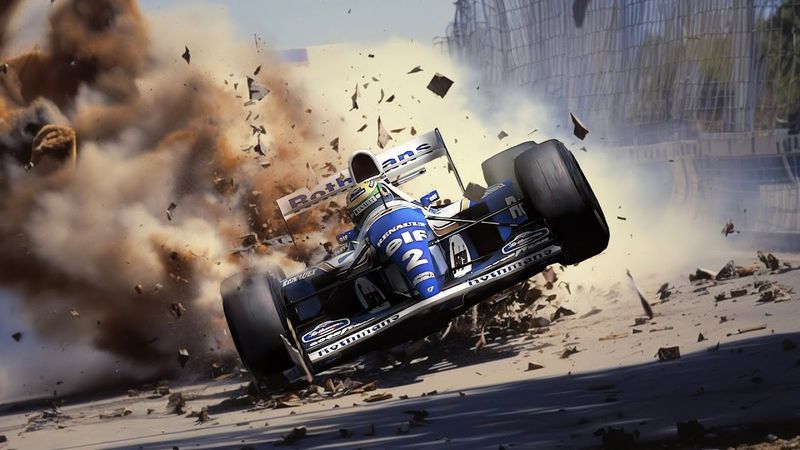
hurtling off the track just after the apex crashing into the unprotected concrete wall at a staggering speed of 190 miles per hour despite attempting to break the impact reduced his speed to 130 miles per hour leaving a trail of devastation the collision tore off the front right wheel and nose cone bringing the car to an abrupt halt leaving senna motionless within the wreckage the ferocity of the crash had sent the front right wheel spiraling into the cockpit
striking Senna's helmet.
In the immediate aftermath, Senna made a slight movement, sparking a glimmer of hope regarding his injuries.
Maybe he was okay.
Maybe we were all worried for no reason.
Fire marshals were the first to arrive at the scene, but medical personnel soon followed, working against the clock to save the fallen racing legend.
As Professor Sid Watkins rushed to the crash site in his medical car, an eerie certainty settled within him.
He knew it was Senna.
The extent of Senna's injuries was horrific.
A team of medics fought valiantly to stabilize him, but the odds were stacked against them.
Senna's car was eventually lifted away, but he was swiftly transported to Maggiore Hospital, where doctors battled to save his life.
The world watched and waited, hoping for a miracle, but it seemed that even the faithful would have their resolves tested.
At 2.55pm, 37 agonizing minutes after the crash, the race resumed.
The drivers raced around the track, but there was only one thing on everyone's mind.
Senna.
Five minutes later, the helicopter carrying Ayrton touched down at Maggiore Hospital, where doctors rushed him into intensive care for a critical brain scan.
At 3.10pm, his heart stopped once more.
and the racing world would prepare itself for the worst.
On lap 41, another terrifying incident unfolded, as a wheel flew off Michele Alberto's Minardi car, endangering Lotus mechanics.
Alberto, realizing the gravity of the situation, rushed to understand what had transpired.
The pit lane had witnessed two horrifying events, leaving everyone on edge.
For Professor Sid Watkins, the hours that followed were excruciating, as the race continued, seemingly endless.
This just wasn't important anymore, not when a driver was at death's door.
Finally, at 4.20pm, the race ended without further incident, bringing a fleeting sense of relief.
The drivers on the podium, Schumacher, Larini and Hakkinen, in that order, had no inkling of Senna's condition, yet their expressions hinted at the foreboding reality.
It later emerged that Senna had carried a furled Austrian flag in his car, intending to honour the fallen Ratzenberger after the race.
As the day wore on, the medical updates grew grimmer.
By the evening, the Imola Media Center was consumed by a pervasive sense of dread.
The world collectively held its breath, knowing that Senna would never race again and fearing the worst.
Ultimately, the news came, confirming the inevitable tragedy.
Ayrton Senna passed away, his official time of death marked at 2.17 p.m., and the world seemed worse for it.
A thorough investigation marked the aftermath of Ayrton Senna's tragic crash at Imola in 1994, and Italian authorities determined that a faulty modification to Senna's car's steering column made by Williams was the root cause.
Williams vehemently denied responsibility, contending that the steering column broke after the impact, not before.
Senna's teammate Damon Hill proposed a different theory.
He believed Senna, while fiercely attempting to stay ahead of Michael Schumacher,
had a rare error due to excessive aggression.
Hill had noticed signs of nervousness and tension in Senna before the race, and recounted that Schumacher, who was tailing Senna at the time of the crash, shared similar observations.
These explanations from the drivers only made Senna's death even harder to stomach.
He had been devastated by the events over the weekend.
No matter how skilled he was, he should not have raced.
In Brazil, a wave of grief and emotion swept the nation upon Senna's passing.
Over 3 million people are estimated to have lined the streets of São Paulo, paying their respects as Senna's coffin was solemnly transported from the airport to the cemetery.
His funeral drew dignitaries, celebrities, fellow drivers, and a national television audience.
The entire country observed three days of official mourning, with many public events postponed or canceled.
Across the globe, Senna's death ignited an outpouring of tributes and homages.
Races were dedicated to his memory, and various tracks named corners or sections in his honor.
At the subsequent Monaco Grand Prix, retired F1 world champion Niki Lauda announced the revival of the Grand Prix Drivers Association , standing as a tribute to Senna's legacy.
Immediate safety changes were instituted for the Spanish and Canadian GPs.
with a subsequent wave of enhancements encompassing redesigned tracks, improved crash barriers, tire barriers, heightened safety standards, increased sills on driver cockpits, and a limit on three-liter engines.
Senna should not have died, and yet he was gone in the blink of an eye.
The rest of the season would unfold with a downbeat atmosphere, with Schumacher winning his first world championship.
And yet, it was Imola that had changed F1 forever.
But despite the obvious demons haunting Imola, it would not be the track that would become known as a racing hell.
Oh no, that claim well and truly belongs to another famous circuit.