The Era of Hollow Male Power Fantasies
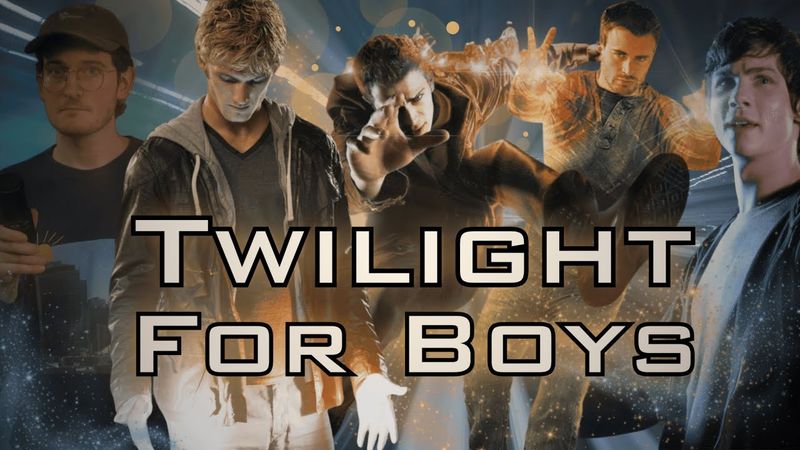
Download information and video details for The Era of Hollow Male Power Fantasies
Uploader:
DanPublished at:
6/20/2025Views:
29.2KVideo Transcription
From 2008 to 2012, Twilight released five films, each one building on the success of the last.
And everyone from me at 13 to Donald Trump at 66 was invested in this series.
It dominated pop culture, jump-started careers, and made it very clear what audiences did and didn't want.
Girls want Twilight.
Contrarians want not Twilight.
Which was stupid because the people who wanted not Twilight didn't want something instead of Twilight.
They just didn't want Twilight to exist for some reason.
For its entire run, producers scrambled to capture that other audience.
To try and make it happen, they took the two biggest genres of the early 2000s and just blended them together.
What we got was basically Jason Bourne meets Harry Potter.
Supernatural YA action movies starring hot male protagonists with abilities of some sort.
These gentlemen get no character development, they always have sex on the first date, and they're often suffering in what men interpret as silence.
I call this genre Twilight for Boys because they were released during the same five years as the Twilight Saga, one every single year, and also for better reasons that will become clear.
This was a five-year experiment in making trailers instead of movies.
Each film looked like it was building towards something, a world, a mythology, a sequel perhaps, but none of them ever landed.
It's because they weren't telling any story.
They were just teasing stories that they might one day tell.
The first of these was Jumper, technically a few months before Twilight, but spiritually arriving at the exact same moment.
Jumper was the blueprint.
From this point on, we would basically get a reskinned version of Jumper over and over and over again until they give up.
That comes in 2013 when the genre vanishes completely.
You never see another movie like this ever again.
But they happened and each one was a high-octane rush that got people into theaters.
These movies made money, but they were flawed in ways that I want to explore.
You gotta follow me through my jump scar.
In 2006, Doug Liman, the director of The Bourne Identity, was hired to bring Jumper, Stephen Gould's cult classic sci-fi novel about a teenager who could teleport, to the big screen.
They shot this thing in 20 cities across 14 countries, filmed in the actual Roman Coliseum, and they had Anakin Skywalker fighting Mace Windu, which was great sci-fi appeal at the time.
It had everything going for it except for an interesting story.
The Novel was good and it had good things going for it, but the studio scrapped like all of it, keeping only the main character and his ability to teleport.
Because of this, the movie opens with a long monologue exposition from, not trying to be a hater here, but the second worst deliverer of dialogue after Keanu Reeves, Hayden Christensen.
And then I jump back for the final quarter of the NBA Finals.
He plays David Rice, a kid whose mom bailed on him when he was five and whose dad took that as a green light to start dabbling in child abuse.
When he falls into a frozen river and gets trapped under the ice, something happens, and he suddenly finds himself in the wet part of this library.
Everyone at school thinks they just watched the weird kid die, but he's fine and just walks home to have a fight with his dad.
Home sweet home.
Who I thought was Woody Harrelson until my wife said it wasn't.
I googled it and she was right, but I also learned that Woody Harrelson was not in Guardians of the Galaxy.
Tough day for me.
During this altercation, David stress teleports back to the library where he becomes suspicious that something strange is going on.
He realizes that if he can see a place and then visualize it later, he can teleport or jump there.
So he runs away from home and catches a bus to New York where he robs a bank by jumping into the vault in the middle of the night.
Fast forward or jump a few years and we pretty much just get a trailer for the movie in the movie.
He's jumping from Egypt to London to Fiji, stealing cash, surfing, generally doing zero good in the world, living like a rich person.
And they point this out.
They hint that there's going to be character development at some point and it never happens.
This is like never an issue.
But to his benefit, that self-serving apathy has kept him hidden from Roland, played by Samuel L. Jackson with the most fucked up hair ever.
Roland is part of a secret religious order called the Paladins, whose mission it is to kill jumpers because... Only God should have the power to be all places.
which, if we're being technical, jumpers cannot do.
Still only one of them.
And also, if we're defending God's trademarks, maybe go after David for being uniquely qualified to end suffering and not doing it.
Roland has been hunting David since the heist.
When they finally meet, David confirms Roland's suspicions by failing to use a door properly, something that is never an issue again.
Roland attacks him with his lightning wires, but David escapes by jumping back home to Michigan for the first time in years.
But the hunt is on, as Roland now has a list of David's jump sites.
All of them.
Like, hundreds of them.
Way too many to be useful.
I could Google places and get the same tactical advantage.
Back in Michigan, David runs into Millie, who watched him die in 10th grade and reacts like he just moved away.
She spends most of this interaction in disbelief that he's a banker because he was just so bad at algebra, but she gets over it and after a short conversation, she agrees to hit up Rome with him, and there they have sex pretty much immediately.
They follow this up by breaking into the Coliseum, where David is once again confronted by Paladins and Griffin, a half-jumper, half-gamer character.
This leads to David's arrest, a surprise mom reveal, and an air buddy-in dumping of Millie.
From there, it's all jumper fights, reluctant alliances, and falling out that ends in Griffin dying in the most sequel-baiting way possible.
David defeats the Paladins, leaving Roland in a cave at Horseshoe Bend.
I would have finished the job.
We learn that his mom is also a Paladin and only abandoned him because the alternative was lightning wires.
She tells him that he's getting a head start and they wrap it up in a hug that I would have used to jump her to the bottom of the ocean.
And that's Jumper, a high-action sci-fi fantasy thrill ride that people just really didn't like all that much.
Could have been big, though.
Movies don't have to be good to get sequels, they just have to make money, and this one did.
It was good enough to build on, and they very well might have, if the world hadn't made it clear that they were looking for actual stories with characters.
I mean, honestly, David tries to deliver some much-needed exposition at one point in a natural way, and is met with a firm and direct, in-world, shut-the-hell-up.
My daddy...
That was a huge fan of the books when I was younger, and the 2008 film was probably the only one we're going to get, so I like it.
It's a good movie.
Don't be mean to me about that.
2009 gave us Push, which was sort of a partner piece to Twilight in many ways.
Both were made by Summit Entertainment and started production around the same time, with the intention to capture both ends of the market.
If Twilight was after the longing, emotionally raw, romance-hungry half, then Push was aimed squarely at the opposite.
They needed something with all the supernatural action and lust without the stuff that gets in the way of the supernatural action and lust.
And if you haven't seen Push, which I know you haven't,
Watch it.
It's a crazy movie that I cannot believe exists, and you can really see the connection to the vampire franchise it was unable to compete with.
Psychic powers, shadowy institutions, weird age gaps.
But the neon-soaked Hong Kong alleys of Push are a stark contrast to the forests of the Pacific Northwest, because Twilight understood that it's about vibes, and I don't want to chill here.
I want to chill here.
With him.
and the other one too, but I don't want him to talk.
Our main character is Nick, played by Chris Evans, giving us perhaps his worst performance ever.
He's a mover, their term for someone with telekinetic abilities, despite the fact that the first time we see this ability used is by someone who's literally pushing.
In this version of our world, people with psychic abilities were, get this, genocided by the Nazis in World War II.
I don't know if you can do that.
Experiments were run on them to try and enhance their powers and were largely unsuccessful.
After the war ended, government organizations called divisions popped up all over the world and continued the process of rounding up these L-Men who come with limited options for abilities.
I don't know if L-Men is that funny.
Movers move things with their minds.
Pushers influence people's thoughts and memories.
Watchers can see the future, but they have to draw it for some reason.
Bleeders scream really loud and it hoits.
Sniffers can see memories by sniffing and touching stuff.
And there's a couple others, but also not that interesting.
Anyway, Nick is a mover who uses his abilities to suck ass at gambling on the streets of Hong Kong.
He gets confronted by some division sniffers who let them know that he's on their radar, and they say, don't go anywhere, because now we know where you are.
And I don't know why they told him that.
Right as he's about to flee Cassie, a 13-year-old watcher shows up asking for help.
Their goal is to find someone named Kira, a pusher who is the only psychic to have survived the division's drug trials before she escaped their facility.
When they find her, it's revealed that she and Nick used to be a thing, but she's mad that he never found her after she was kidnapped, and they have sex in Ryan McPoyle's bathroom pretty much immediately.
But Kira isn't doing well, as the withdrawals from the Division drug are setting in, and soon she'll die without it.
Psychic warfare takes place, and it's loud, and it's nonsensical, and convoluted in a way that's simply not even worth trying to explain.
I'm so serious.
Watch Push.
It should be really easy.
I don't think I've ever seen a movie with this many watch-for-free options.
Kira turns on them after a pusher convinces her that her and Nick never dated and that nobody has ever been to Coney Island.
Nobody's been to Coney Island.
Bold claim.
A plan comes together with decoy drugs and memory wiping and Dakota Fanning getting drunk for literally no reason.
They get the division syringe, Nick injects it into himself, making the agents think that not only is he dead, but the drug is gone, and then they just leave, and it's revealed that the syringe was fake.
Nick had survived having injected himself with soy sauce, a substance that probably would have had a higher likelihood of killing him than the actual drug, which we know at least one person has survived taking, unlike soy sauce.
Cassie and Nick, now the owners of the real syringe, walk off triumphantly discussing their plan to trade it for her mother's freedom, which is something I didn't know until the moment they said were the stakes for this movie.
It very clearly sets itself up for the sequel that it never got, and I thank God every day that it didn't.
Okay, so I know there's nostalgia here, but hear me out.
Push was Summit throwing everything at the wall and seeing what would stick, but the film adaptation of Percy Jackson was a direct response to the end of the HPIP in theaters.
Chris Columbus, the director of the first two Harry Potter films, was brought on to direct the project, and characters were aged up to be a little bit more evergreen.
In the lead up to its release, people really thought this was going to be Harry Potter's true successor, but everyone immediately gave up on that idea once they actually saw it.
It was the worst movie I watched in preparation for this video, but it did shine in being more Mormon than Twilight, asking the question,
What if Greek mythology happened in America?
Our main character is Percy, a dyslexic, ADHD-having teen who has no idea that he's a demigod.
One of those things changes during a museum field trip when his substitute teacher turns into a winged demon creature and demands that he hand over a lightning bolt.
He doesn't know what the hell's happening, but his friend and a Latin teacher who are hiding animal parts under mobility aids scare it off before moving to transport Percy to Camp Half-Blood, a training camp for demigod children.
On the way there, Percy learns that Greek gods are real and still fucking humans, and that one of those humans is Percy's mom, who knows all of this but chose to just not tell him.
Before they get to the camp, his mom gets her shit rocked by a minotaur.
Percy wakes up a few days later, where his centaur Latin teacher explains that he's a son of Poseidon.
Something that's rare and dangerous, as the big three typically don't throw it around like that anymore.
Zeus declared that unless the lightning bolt is returned by the summer solstice, there will be war.
So Percy, Grover, and Annabeth, Athena's daughter, go on a cross-country journey to find the bolt, save Percy's mother, and stop war from breaking out.
On their quest, it's revealed that, um...
Um, you know, uh, I'm sorry.
Percy Jackson is so boring.
I'm going to rush this one.
They find the bolt.
They avoid the war.
The general audience consensus was that while it could have been successor to Harry Potter, it was just too kiddy to appeal to anyone outside of the rather young demographic that enjoyed it.
I didn't even remember seeing like fan art from this movie on Tumblr, and I was really on Tumblr.
But Percy Jackson is an outlier since they did release a sequel that I was forced to watch on the last day of school or something like 10 years ago, and I'm not going to watch it again.
Like the others, there were multiple movies planned, but people just did not want them.
I am number four, 2011.
This movie defines the year 2011 in my head.
Like it is, it is 2011.
By the time studios finally accepted that the Harry Potter throne had been claimed by Twilight and that wasn't changing, the saga was already coming to an end itself, presenting us with our very first Twilight successor hopeful.
I Am Number Four is about a teenage alien on the run from less handsome aliens called Mogadorians, or Mogs, who want to kill him and his superpowered counterparts hiding around the globe.
He's a brooding hot boy who does parkour and just wants to be a normal kid.
I hate being powerful and handsome and cool.
They love doing this so much.
It's like when Edward's flying between trees and generally being badass going, oh, this sucks.
This sucks.
Doesn't this look like it sucks, Bella?
And Bella's standing there like, I want to be a vampire so fucking bad, dude.
The only franchise that actually handles this well and is realistic about it is the Teenage Mutant Ninja Turtles.
More on that to come.
Back to number four, who goes by John Smith.
It's hard to tell if this story has too much or too little going on, but regardless of the answer, it focuses almost all of its energy into Michael Bay's bullshit and these silly-ass power reveals.
These things have no rules and seem to have unlimited uses.
He starts a car with this.
John is super fast, strong, durable, canonically bottle blonde, he can talk to animals, shoot lasers from his hands with varying intensity, move things with his mind, and he can copy the powers of any of his peers as well as recharge their abilities with his hands.
It's too much.
We meet Number Four as he's partying in the Florida Keys, and when his leg starts glowing, he knows that Number Three has been killed.
That means he's next.
The Mogs, who are hellbent on wiping out his species, are working their way through the alien refugees in numerical order.
Now that they're on their way, his guardian Henry, who was crafted by God to be on the CW, flees the state with him and heads to Ohio to hide out in the fictional town of Paradise.
Here, John meets a girl who invades his privacy by posting an entire page of photos of him on her blog, which Henry does not like.
And John returns the favor by going to her house and reading her diary.
When she protests, he just keeps doing it.
Around this time, her ex-boyfriend takes issue with John and has his boys attack him in the woods.
When he uses his powers to defend himself, an investigation is launched that reveals their location to the Mogadorians, who are just really...
bunch of silly guys.
With the help of a conspiracy theorist, an alien dog named Bernie Kozar, and number six, the leather-clad Australian badass who was likely promised a franchise, the battle for the fate of species that we as an audience have been given no reason to care about rages in the hall of their local high school until finally they win the day and are able to put some rocks together that shows them the location of the remaining alien children.
With that, we have a whole series locked and ready to go.
It had become quite clear that Twilight for Boys was not working, and it wasn't going to.
The genre began quietly wrapping up.
In 2012, Twilight would conclude its run, and The Hunger Games would release, giving rise to the teen dystopian empire.
But there was still one high-octane, male-led, supernatural thriller left to send the genre off with a bang.
Chronicle had everything working against it.
It was the final release for what was effectively a dead genre that people were sick of seeing.
It had a budget of just $15 million, a cast of mostly unknown actors, and was being directed by the not yet infamous Josh Trank.
It's fantastic.
Say that again?
Who co-wrote the script with the not yet infamous, for way worse reasons, Max Landis.
It was basically just poking the pile of Twilight for Boys roadkill and seeing if it twitched.
And luckily for everyone, it did.
With a box office return of 127 million and rave reviews from critics and audiences, we had a lot to learn from Chronicle.
The movie opens with a high schooler named Andrew filming himself in his bedroom, with his father shouting at him through the door.
This camera will act as our viewpoint for most of the film, with the only other perspectives being from other cameras around our cast.
Andrew is disillusioned with life in general.
His mother is dying of cancer in the next room, their family is being crushed with medical debt, and his father is pretty much taking all of this out on him.
His only friend is his cousin Matt, a cool guy who isn't afraid to tell Andrew when he's being weird, something all of you should be doing to people more often.
When Matt convinces Andrew to join him at a party, he connects with Steve, the coolest kid in school.
And the three venture into a hole containing some sort of crystal that gives them mysterious telekinetic abilities.
This is probably the scene that made Marvel think Josh Trank could be trusted to do the Fantastic Four.
As the three grapple with their newfound power and the responsibilities that come with it, they also grow closer as friends.
It's honestly the best representation of teenage boys hanging out that I've ever seen on film.
But as their skills grow, Andrew begins to exhibit incel-like tendencies, creating a rift between himself and others.
He considers himself an apex predator.
His friends make every effort to keep Andrew from self-isolating and be more responsible with his powers and stop doing this shit.
Which do not let me near that hole.
Because if I get in there, I'm gonna start running people off the road too.
But years of crushing trauma and the reality of his home life lead to a breakdown.
The spiral progresses until Steve's final pleading attempt to offer him support ends in Andrew killing him with lightning, which doesn't help.
Finally, when his dad discovers the videos of him and his friends flying around and attacks him over it, the fact that he has a camera, not the flying, doesn't even bring it up, Andrew goes full killdozer, murdering his adult neighbor bullies and robbing a gas station that catches fire.
When Andrew ends up in the hospital, the man of the house shows up again to assault him, this time with the advantage of being the only one conscious.
In his rage, he shouts at Andrew that his mother had died alone while he was out looking for him.
Andrew takes it well.
Matt senses that something is going down, and a battle of the two superpowered teens rages in the skies of Seattle, with Matt still, to the very end, trying to help his cousin, eventually killing him to save him from himself.
Chronicle is a near-perfect movie.
It's ambitious, it's creative, it's cool to look at, and it was everything Twilight for Boys should have been.
But it was a one-off, and Trank fought tooth and nail to keep it that way.
It could still happen, but it'll probably suck if we're being honest.
For now, Chronicle is a perfect ending to a deeply flawed collection of movies that were made explicitly to plant a flag saying, I was here.
You can't make a movie about teleporting.
We're gonna do something with it.
Not this, but something.
What I find so interesting is there's only one movie from this era that actually made a lasting impact, and that's because it was the most authentic portrayal of young men.
It wasn't glossy, it wasn't trying to sell you a franchise, and it definitely wasn't afraid to make you really uncomfortable.
It just told the truth, for better or for worse, and yet nobody learned from it.
Andrew is not a good guy.
His actions are irredeemable.
But what led to his condition is the very isolation and distraction from reality that young men subjugate themselves to every day, and that's only getting worse.
I want to clarify, I'm not some like, men's rights activist freak, but I am a regular dude who grew up when these films were releasing.
Twilight for Boys obviously failed because the movies weren't good.
But that failure was made worse because of how tone-deaf these studios were.
Instead of making stories that young men could relate to, like Chronicle, unfortunately, they made movies that they thought men would be distracted by.
The result was a bunch of flashy, half-finished movies that looked interesting but didn't say anything.
And they just kind of fell apart under their own weight.
We only got a small sample of these terrible movies, and that's all right with me.
They're like mozzarella sticks.
Delicious, absolutely.
But the body can only take so much, and they're not very good for you.
I do hope Jumper gets another chance, though, because it was the only one that had any potential, if we're being honest with ourselves.
Oh, shit, there's a bird in here.
Oh, shit, I left my jump scar open.
Oh, I better go check on that.
No, Percy Jackson 2 got in here.
I'm not watching this shit.
Similar videos: The Era of Hollow Male Power Fantasies

Бенди и Тёмное Возрождение: Глава 3 — пробуждение Вечной Машины и новые кошмары! Прохождение

Бенди и Тёмное Возрождение: Глава 4 — фабрика ужасов и встреча с монстром из чернил!
От создателей «Деньги любят тишину» и «Деньги любят движение» |Все сезоны «Жизни по вызову» на KION
"You're just fu*ked up" - DEXTER MORGAN EDIT | Michael C Hall -Crystal Castles - Suffocation(slowed)

Майкл Бэй - Режиссерские приемы и фишки (Ellgin)