
The Great Equalizer, Explained
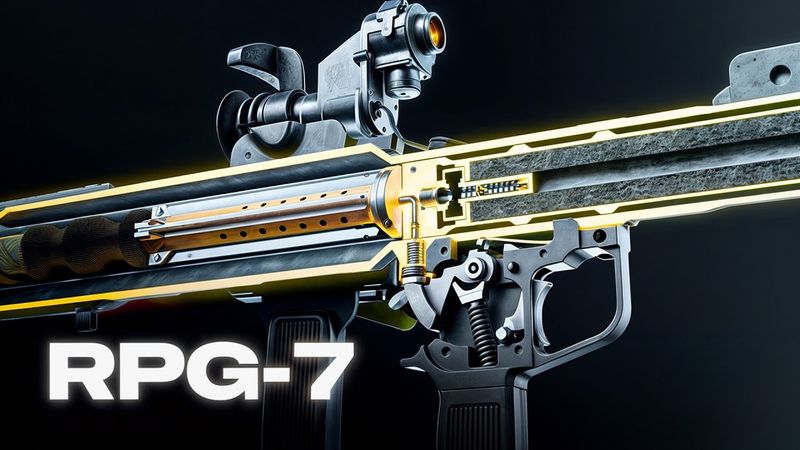
Download information and video details for The Great Equalizer, Explained
Uploader:
ECHOZEROPublished at:
6/28/2024Views:
885KDescription:
Video Transcription
In the late 1950s, the Soviet government directed focus at a special design bureau called GSKB-47.
Their purpose, develop and field state-of-the-art anti-tank weapons.
In 1961, a weapon entered service that would become one of the world's most notorious.
A weapon that was rugged, simple, and lethal.
That weapon was the RPG-7.
We are in the city center of St. Petersburg, where we are going to have a meeting with the local authorities.
emerging from the ruins of Eastern Europe, the story begins with the Soviet LPG-44, later known as the RPG-1.
The RPG-1 drastically increased the range infantry can engage a motorized column.
Needless to say, this was a drastic improvement over what came before it.
Although lighter and reloadable when compared to the German Panzerfaust, the RPG-1 had very limited armor penetration capabilities and significant hardware challenges.
In 1949, a new design emerged, the RPG2, and it surpassed its predecessor in almost every way, leading to the end of the RPG1's development and earning its developers the coveted Stalin Prize.
However, in the 1950s, tank armor was rapidly advancing and the Soviets needed solutions.
In 1961, after nearly a decade of iteration, the first RPG-7s were delivered to the Soviet Army.
The RPG-7 represented a significant leap forward, boasting an effective range of 500 meters and armor penetration of 300 millimeters, making it the most formidable rocket-propelled grenade launcher in the world.
Not only was the design refined, but it was also versatile and forward-thinking.
The RPG-7 was built from the ground up to accept a variety of warheads, including heat, fragmentation, thermobaric, and tandem charges, broadening its capabilities across different combat scenarios.
The steel launcher tube is 95 centimeters long and 40 millimeters in diameter.
and is partially wrapped in a protective covering, shielding the user from heat.
The RPG-7 features basic iron sights.
However, the RPG-7V variant includes a pre-installed optical sight.
The PG-07V is a battery-powered 2.7x magnified scope, enhancing precision and targeting over various distances under both day and night conditions.
Targeting was fairly straightforward.
The operator first positioned the tank's treads along this bottom line, and using the vertical lines to gauge distance.
The target is then centered and aligned with the corresponding horizontal range lines.
When the gunner is ready, the weapon could be fired.
Despite its apparent simplicity, the RPG-7 requires considerable training and skill.
US reports have highlighted the challenges gunners faced in estimating range and adjusting for windage.
Even experienced gunners often misjudged the range by 15 to 20%.
And contrary to typical projectiles that drift with the wind, the PG-7 rocket has a tendency to veer into the wind.
These idiosyncrasies significantly lower the first round hit probability and deviated from the initial Soviet expectations.
This is the original PG-7V rocket-propelled grenade.
It's comprised of a pre-assembled warhead and sustainer motor, along with a booster that the gunner screws on just before use.
When loaded into the launcher tube, a screw on the sustainer motor aligns with a cutout on the tube to ensure the KVM-3 fuse aligns with the firing pin.
Behind this faceplate is the trigger assembly.
To arm the weapon, the hammer is first cocked and held in place by the sear.
Disengaging the safety allows the trigger to be fully pulled.
A notch on the top of the trigger forces the sear to bend upward, releasing the hammer.
As it rotates, the hammer strikes a firing pin, igniting the primer and subsequently a series of propellant charges within the booster.
The combustion of these charges generates a high pressure gas that expands rapidly, pushing the rocket out of the tube at a velocity of over 115 meters per second.
The stabilizer blades housed within the booster deploy once the external cardboard casing burns off, ensuring aerodynamic stability.
Inertial forces trigger a fuse in the sustainer motor, igniting the solid rocket fuel.
As the solid rocket fuel burns, the hot gases are expelled out of these six nozzles, quickly accelerating the projectile to its top speed of 294 meters per second.
The PG-7V's warhead is a high explosive anti-tank heat round with a shaped charge that uses a copper conical liner, detonator, explosive, and an air-filled cavity to create a jet of molten metal that penetrates enemy armor mechanically.
The warhead is activated by this piezoelectric impact fuse.
This device generates an electrical charge when impacted, and that charge ignites the explosive.
When the explosive is set off, it causes the conical liner to invert, forming a narrow stream of molten copper capable of penetrating 300 to 500 millimeters of rolled homogenous steel, punching a hole directly into the cabin.
When you look closer at the VP7M impact fuse, it becomes clear just how technical this piece of equipment is.
Aside from generating an electrical charge when impacted, it also contains a self-destruct element.
If the warhead does not impact the target within four to six seconds after being fired, or roughly 900 meters, it self-destructs.
This is accomplished via a precise combination of springs, pistons, and bearings, all activated via inertial forces as the warhead spins towards its target.
Although not originally intended for use against helicopters, the Mujahideen and Taliban effectively repurposed the RPG-7 as an ambush weapon against them.
achieving a tragic level of success at times.
At longer ranges, they even leveraged the weapon's self-destruct mechanism in an attempt to catch helicopters with shrapnel as it self detonated.
Since it was first introduced, the RPG7's design has spawned numerous variants, each reflecting the unique tactical philosophies of the over 40 nations that still license the design.
In the 1980s, when the Soviet army was deployed to the mountains of Afghanistan, they were outfitted with the more modern RPG16s, 18s, and 22s.
Their enemy, however, possessed Chinese and Pakistani versions of the RPG7.
In many cases, the Soviet fighters preferred the captured RPG-7 models over their more modern kit, finding them lighter and equally as effective.
From the jungles of Vietnam to the deserts of the Middle East, the RPG-7 remains a global symbol of asymmetric warfare, bridging the gap between low tech and high impact.
Its legacy will undoubtedly continue to shape strategies and outcomes of future conflicts, reminding us that sometimes the simplest solutions can have the most profound impacts.
Similar videos: The Great Equalizer

Underworlds Direchasm Battle Report - Hedkrakka's Madmob vs The Crimson Court 4K!

The Remilia Beatdown - Touhou Anime
NATO's Front: Inside 🇵🇱 Poland’s Armored Infantry

Музыкальный генератор ИИ профессионального уровня — Mureka: эволюции музыки с моделью O1!

The SECRET to Pro-Level Sound Design