
The Indian Genius Nobody Understands
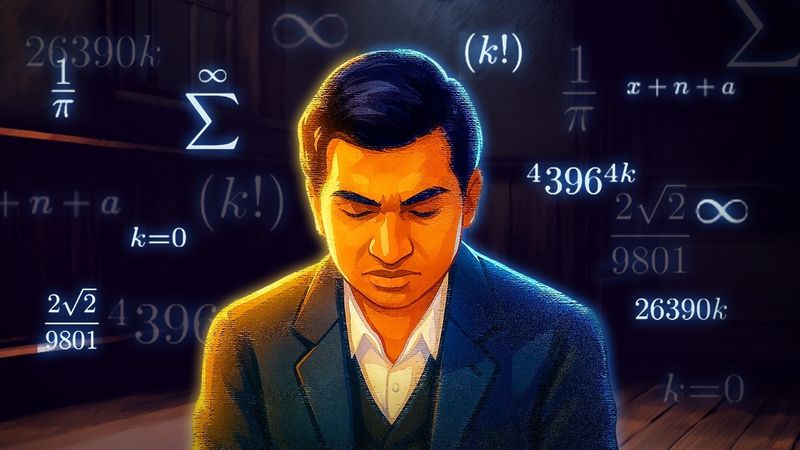
Download information and video details for The Indian Genius Nobody Understands
Uploader:
fernPublished at:
8/10/2025Views:
987.1KDescription:
Video Transcription
A strange letter arrives at the home of Godfrey Harold Hardy, a mathematician in Cambridge.
It's from a young man in India.
He says he's poor, never went to university, but he's written down some formulas and he's asking for feedback.
Some of these formulas are the most groundbreaking pieces of math Hardy has ever seen.
Complex equations that even the world's top mathematicians could spend pages trying to unpack.
The kind of work only a true genius could produce.
A genius unlike any other.
A poor boy from India obsessively writing down formulas, convinced they are messages from the gods.
Someone whose religious beliefs will clash with the world around him.
A man shadowed by death at every turn.
A mathematician whose creative genius likely doesn't stem from formal academic education, but from the lack of it.
Even today, to many, his mysterious formulas remain beyond full understanding.
This is the story of someone who might have won the world's highest honors if only things had gone differently.
This is the tragic story of one of the greatest minds in history, Srinivasa Ramanujan.
also known as The Man Who Knew Infinity.
This video is largely based on the book The Man Who Knew Infinity by Robert Kanigal.
And a quick heads up before we begin, in this episode we'll mention depression and attempted suicide.
If you don't feel well, don't be shy to get help.
Ramanujan grows up in a respected family.
They belong to the Brahmins, the highest caste in India.
The caste system plays a central role in Indian society.
Rooted in Hinduism, it dates back thousands of years and divides people into a five-tier hierarchy.
At the bottom are the Dalits, also known as the Untouchables, often forced into low-paid, stigmatized jobs like hand-cleaning toilets or collecting garbage.
At the top are the Brahmins.
They often work as teachers or priests.
Each caste is further divided into thousands of smaller sub-castes.
Ramanujan and his parents are Vaishnovid Brahmins, and they follow the rules that come with their caste strictly.
In India, being part of a higher caste generally means higher wealth, but there are exceptions.
Brahmins do not condone public displays of luxury.
What truly matters is living a life of mental or spiritual depth while remaining modest.
Ramanujan's parents are poor.
To make ends meet, the family often takes in sub-tenants for extra income.
This is the world Ramanujan grows up in.
He's a quiet, thoughtful child who loves being by himself.
When he first attends school, he hates it.
He doesn't like the teachers, and he resists a rigid system telling him what to do.
After he repeatedly skips school, the family hires a local police officer to escort him there.
Early on, his family moves frequently, forcing Ramanujan to switch schools again and again.
After the family finally settles in Kumbhakuram, he begins to excel in school, especially in math.
His classmates start coming to him for help, he breezes through exams in half the time, and before long, he's so advanced that he even challenges his teachers.
Around the age of 13, Ramanujan's math teacher tries to explain a basic concept.
Divide anything by itself, and the result is always one.
He says, Then Ramanujan speaks up.
But is zero divided by zero also one?
If no fruits are divided among no one, will each still get one?
Ramanujan isn't just a troublemaker.
His talent proves useful to the school as well.
When they need to assign 1,200 students to three dozen teachers, while factoring in special cases and individual needs, they turn to Ramanujan for help.
But his true talent goes way deeper.
As a student, he independently rediscovers the solution to the quartic equation, a major mathematical problem from Renaissance Italy.
He dives into advanced topics like infinite series far beyond the standard curriculum.
Most of his classmates, and even the teachers, rarely understood what he was talking about.
All Ramanujan wants is to go deeper and deeper into mathematics.
Then, one day at age 16, he gets his hand on a book, probably passed along by a friend from the local college library.
The book isn't exactly a page-turner.
It's basically a list of 5,000 equations and theorems lined up one after another with almost no explanation.
It was meant to help math students cram for a specific exam.
By the time Ramanujan gets a hold of it, it's already more than a decade old.
But Ramanujan becomes completely absorbed by the book.
He dives into its dense pages, studying those complex equations.
In math, proof is everything.
Mathematicians have to show, step by step, why equations like these are always true.
But Carr's book rarely provides any proof.
Instead, it leaves the reader to figure things out on their own.
For Ramanujan, every equation in this book is like a puzzle, begging to be solved.
He tackles them using his own methods, far from anything you'd find in academia.
The book leaves a deep mark on him.
But he doesn't just study the numbers.
He develops a kind of religious devotion to them.
Ramanujan is a devout Hindu with deep faith.
He often visits the local temple and takes part in ceremonies and rituals at home.
But his devotion goes beyond caste tradition.
He regularly prays to the family goddess, Namagiri, and is determined to follow what he believes to be her will.
The boy credits all his extraordinary mathematical abilities to the gods.
He doesn't see math as a human concept.
He sees it as a window into the deeper structure of the universe.
An equation for me has no meaning unless it expresses a thought of God.
Math explains our world, the entire universe really.
Ramanujan might have liked having a picture of a remote galaxy in his bedroom.
Well, you can, on a robust and beautifully designed metal poster like this one, by Displate.
It's easy to set up.
You just put the sticker on the wall, press the magnet on it, and the poster will hang nice and steady.
Thanks to the magnet, you can switch posters just as easily.
You can pick from over two million artworks, original art, and officially licensed designs from movies and video games.
For extra quality, check out Display Textra, posters with 3D printed details and selective gloss.
You can scan the QR code or click the link in the description and use the code FERN to get between 23 to 33% off.
And in just four to five workdays, you can have your own window into the universe right at home.
Shortly after discovering the book, he finishes school, with top marks, not just in math, but across the board.
The school's director even says he deserves more than an A+.
Ramanujan, he says, was off the scale.
Ramanujan is driven to become a great mathematician.
He's already something of a local legend for his uncanny math skills.
He even earns a scholarship to the college in his hometown.
But this is where things begin to fall apart.
For the first time in his life, Ramanujan faces real failures.
The college expects him to attend multiple different lectures, but he's beginning to lose interest in anything besides math.
While his professors lecture on Roman history, he's scribbling formulas, completely absorbed in algebra, trigonometry, and calculus.
This comes with major consequences.
Eventually, Ramanujan loses his scholarship, and a single term at college costs as much as his father earns in a month and a half.
His academic future is suddenly at risk.
His parents are now pouring what little money they have into his education.
He feels guilty and miserable.
The pressure to perform in every subject is mounting, but he's terrified it will take him away from the one subject he lives for.
Eventually, the strain becomes too much.
One day he walks away, dropping out of college.
At 18, he tries to study at a different college, but fails again.
By now, Ramanujan is in his early 20s and desperately searching for work.
And little by little, he begins to lose hope.
Everyone close to him knows he's a genius, but there seems to be no place for him in academia.
Around this time, Ramanujan's mother arranges a marriage for him.
His bride is just nine years old.
The marriage doesn't change much in his life.
They don't live together right away.
She stays with her mother to learn how to cook and manage a household.
But the pressure on Ramanujan to earn a living grows even heavier.
Day after day, he works in solitude, driven by ideas no one around him fully understands.
And wherever he goes, he keeps some things close, personal notebooks worn from use, packed cover to cover with equations and theorems.
Three of those notebooks survive, though he likely had more.
The first known one is written in green ink, packed with things like hypergeometric series and continued fractions.
It's organized into chapters by topic with theorems neatly numbered.
Ramanujan likely edited it, tidying up the rough sketches from an earlier version.
But over time, that order begins to fray.
When he runs out of space, he scribbles calculations on the backs of pages, using them for scratch work.
For Ramanujan, his notebooks are a vast collection of his discoveries, and he knows that these notebooks will be his ticket to a job related to math.
He presents them to influential people who might be able to help.
And eventually, it works.
Someone from the newly founded Indian Mathematical Society, Mpune, sees his potential and believes in his remarkable talent.
They agree to support him, allowing Ramanujan to focus entirely on mathematics.
And it doesn't take long for Ramanujan to publish his first paper in the Society's journal.
It's a piece on Bernoulli numbers, a sequence of numbers that shows up in an analysis.
It reveals his talent when dealing with infinite sums.
But still, no one truly understands his brilliance.
And the modest salary from the Society isn't enough.
He still has to work as a clerk at the port in Madras just to make ends meet.
So those close to Ramanujan urge him again and again to contact mathematicians in the West.
If no one in India could support him, maybe they would.
He starts writing letters, but nothing comes of it.
Then, finally, he writes to Godfrey Harold Hardy, a rising mathematician and fellow at Trinity College, Cambridge.
At this time, Cambridge is regarded as the center of mathematics in England.
Hardy is just 35, but already highly respected in the field.
For both Hardy and Ramanujan, this letter changes everything.
Hardy is nothing like Ramanujan, though he shares a deep passion for mathematics.
He doesn't believe in God, he's outspoken and never shy about sharing his opinions, especially when it comes to other mathematicians and their work.
Hardy is full of contradictions, strict and serious, but also kind and generous.
He claims not to care about untalented students, yet he never lets any of them fail.
There are plenty of things Hardy reportedly hates, the English climate, watches, and politicians among them.
But he also has his loves, cats, crossword puzzles, and most of all, cricket.
He doesn't just enjoy the sport, he adores it.
He plays it, watches it, and studies it, along with its champions.
At times, he's even seen running around the fellows' garden at Trinity, cricket bat in hand, frantically searching for its gloves just before a match begins.
And of course, Hardy is a gifted mathematician, widely regarded as one of the most influential British mathematicians of the 20th century.
His work plays a key role in shaping modern mathematics.
Ramanujan's letter arrives in 1913.
Hardy would later call it the most remarkable letter he ever received.
The first sentences are brutally honest.
Dear Sir, I beg to introduce myself to you as a clerk in the Accounts Department of the Port Trust Office at Madras on a salary of only £20 per annum.
I am now about 23 years of age.
I have had no university education.
Ramanujan writes that he's been doing mathematics in his spare time, and he doesn't shy away from being called a genius either.
I have not trodden through the conventional regular course, which is followed in a university course, but I am striking out a new path for myself.
I have made a special investigation of divergence theories in general, and the results I get are termed by the local mathematicians as startling.
To catch Hardy's attention, Ramanujan refers to a paper Hardy had published.
In it, Hardy referred to a decades-old prime number theorem.
He had asserted that a specific term's precise order has not been determined.
In the letter, Ramanujan disagrees, and he even provides a solution.
To Hardy, this sounds insane.
A poor clerk without a college degree claims he knows better than some of the most famous mathematicians in history.
But Ramanujan doesn't stop there.
He's attached at least nine pages filled with equations, hoping they might be published.
And, of course, he wants Hardy's feedback.
Hardy studies the pages, neatly arranged equations laid out in the style of Carr's book.
But the content is unlike anything he's ever seen.
The numbers and symbols are familiar, but their arrangement feels alien, as if they came from another world.
Some of the equations are crisp and clear, but seem outright impossible, like the one where Ramanujan claims that rather than infinity, the sum of all natural numbers can be written as minus 1 twelfth.
a statement that surprisingly turns out to be true, although not in the way we usually add numbers.
Instead, it relies on highly advanced number theory.
In Ramanujan's notes, there are hardly any explanations for what he has come up with.
Hardy's first reaction is suspicion.
This has to be some kind of hoax.
He sets the letter aside and picks up the newspaper, just like any other ordinary day.
But the letter continues to linger on his mind.
What if this poor Indian clerk is actually brilliant?
Hardy shows Ramanujan's letter to almost everyone around him at Cambridge.
He sends parts of it to experts in specific fields.
And he reaches out to a colleague, John Littlewood.
He's just two years older than Ramanujan.
But unlike him, Littlewood had received the finest education.
And like Hardy, he's already regarded as one of the leading mathematicians of his generation.
The two spend hours poring over the formulas.
After a while, they make a discovery.
Not every formula is new.
Even so, only a mathematician of the highest caliber could have produced work like this.
The more they analyze the work, the more dazzled they become.
Hardy and Littlewood are convinced that even the toughest exams wouldn't cover the kinds of theorems he's creating.
They're just too advanced.
Just before midnight, they reached their conclusion.
These formulas must be true, because if they were not, no one would have the imagination to invent them.
This isn't merely the work of an exceptional mathematician.
This is the work of a genius.
Hardy decides to write back.
He's thrilled by Ramanujan's ideas, but insists on something crucial, proof, rigorous step-by-step documentation showing how Ramanujan arrived at his formulas.
Hardy makes it crystal clear, without proper proof, the value of his work can't be properly judged.
But Ramanujan never truly learned how to provide proof.
His favorite book, a collection of formulas, rarely provided any, and the Indian education system at the time didn't emphasize that either.
Still, Hardy's letter is full of encouragement.
He writes that he's deeply impressed Ramanujan developed all of this without a college education, and that his work could in fact be published.
Hardy wants Ramanujan here, in England.
When Ramanujan learns of the invitation, his mind starts to race.
But he can't go, not because of his failed exams or missing degrees, but because of his faith.
As a Brahmin Hindu, Ramanujan isn't allowed to cross the sea.
For him and his family, these rules matter deeply.
If a devout Hindu like Ramanujan were to travel to England, he could be expelled from his caste.
He might no longer be welcome in the homes of his friends and family, or even be allowed to enter a temple again.
For now, Ramanujan is tied to India.
Still, with Hardy, there is finally someone who listens to him, someone who takes him seriously.
His letters move him deeply.
When he replies, he doesn't hold back his joy.
I have found a friend in you.
Ramanujan knows that he's smart.
What I want at this stage is for eminent professors like you to recognize that there is some worth in me.
Hardy and Ramanujan exchange letters for months.
Ramanujan tries to include proofs for some of his theorems, but they're often incomplete.
Hardy remains determined to bring him to Cambridge to nurture his talent and to finally talk in person about his extraordinary formulas.
But there's only one person with the power to let Ramanujan go.
His mother has always been a central figure in his life.
She's more than a parent.
She's a friend.
They enjoy each other's company.
They understand each other.
And for her, living by the rules of the Brahmin caste is essential.
She's firmly against the idea of her son crossing the ocean.
And for Ramanujan, her disapproval carries real weight.
But one night, Ramanujan's mother has a dream.
In it, she sees her son surrounded by Europeans.
She hears the voice of the goddess Namagiri, their family deity.
The goddess tells her not to stand in the way of her son's destiny, not to block the path to the purpose he was born to fulfill.
The dream leaves a deep impression on Ramanujan's mother.
To her, it's a clear sign, a message she can't ignore.
She listens to the goddess and gives Ramanujan her blessing to sail to Europe.
Meanwhile, Hardy and his colleagues do everything in their power to secure him a scholarship.
Somehow, they persuade Madras University to support him.
They provide him with funding for a two-year stay in Cambridge.
Nothing's stopping Ramanujan now.
He can finally go where the greatest minds in mathematics are.
On March 17, 1914, the 26-year-old boards a ship to Europe with Western clothes.
But his new life in England will be nothing like he imagined.
Eventually, this foreign country will break him.
When Ramanujan arrives in London, he's overwhelmed.
Nearly five million people live here, 10 times more than in Madras.
The city is fast, loud, and vastly different from Ramanujan's quiet life in South India.
In the early days, one of Hardy's colleagues looks after Ramanujan.
He even lets him stay in his home.
Later, Ramanujan moves to Hueyo Court in Cambridge, just five minutes away from Hardy.
In this unfamiliar world, Ramanujan faces new challenges.
He now eats with knives and forks, something he finds awful.
Hard metallic things penetrating the mouth, he says, and he struggles to remember the English names of the people he meets.
Still, those early days have their joys.
Spring arrives with beautiful weather, and for a moment, everything feels full of promise.
Ramanujan is simply happy to be in this mathematical heaven, where his ideas no longer draw puzzled looks.
Most importantly, he now gets to work closely with Hardy and Littlewood, the two elite mathematicians who sifted through his notes and saw the brilliance within.
Ramanujan meets with Hardy and Littlewood several times a week.
Hardy is especially eager to dive into Ramanujan's notebooks.
So day after day, they sit together, working through those strange but beautiful equations.
Now, with no ocean between them, it's finally easier for Ramanujan to explain his ideas.
He can show Hardy and Littlewood, face to face, the formulas he spent years developing through tireless effort and isolation.
Back in India, Ramanujan was always alone.
Just Carr's book, his own notes, and his relentless drive.
No one around him truly understood his work.
But now he has real companions.
Although he is living in an unfamiliar country, their presence more than makes up for it.
Most of the time, Ramanujan is tucked away in his or Hardy's room, lost in mathematics.
He's rarely seen outside, but when he is, people spot him waddling across the court in slippers.
Western shoes are too tight for him.
When Hardy studies Ramanujan's notebooks, he's fascinated with his intuitive approach to mathematics.
It's nothing like the methods of Cambridge-trained mathematicians.
Hardy is especially impressed by Ramanujan's insight into algebraic formulas and into the transformation of infinite series.
Some of his results are rediscoveries other mathematicians had found 50 or 100 years before.
Ramanujan often found new ways to obtain them.
But large parts of his notebooks consists of entirely new formulas.
At the time, Hardy and Littlewood are only beginning to scratch the surface of Ramanujan's work, and even decades later, mathematicians will still be wrestling with the depth and mystery of the formulas he left behind.
Hardy begins to understand how deeply, almost spiritually, Ramanujan connects with numbers.
There is a moment when Hardy visits Ramanujan by cab when he notices a number on it.
1729.
When he tells Ramanujan about it, he calls it a rather dull number.
Ramanujan, in fact, sees much more in it.
But what exactly does he see?
We invited Derek over from our good friends at Veritasium to help make sense of this.
Ramanujan's immediate response is that 1729 is a fascinating number because it's the smallest number that can be written as the sum of two cubes in two different ways.
Cubic numbers are just one number multiplied by itself three times.
So you can have one cubed, two cubed, three cubed, and so on.
Now you can start adding some of these together.
For example, one cubed plus two cubed equals nine, or three cubed plus four cubed equals 91.
If we list all numbers up to 100, what you find is that most numbers can't be written as the sum of two cubes at all.
And even if you can, you can only write it in one unique way.
The same is true for all numbers up to 500, 1000, or even 1500.
But that changes at 1729.
This is the smallest number that can be written as 1 cubed plus 12 cubed and as 9 cubed plus 10 cubed.
Ramanujan already knew about this number, and he recognized it as soon as Hardy mentioned his taxi.
In fact, mathematicians named these taxi cab numbers after that very conversation.
But Ramanujan's incredible grasp of numbers can perhaps be best seen with what he did with pi.
Pi is the ratio of a circle's circumference to its diameter.
But what makes it special is that it has an infinite number of non-repeating digits.
For centuries, mathematicians worked on finding better and better ways to write down pi.
In the 17th century, the famous German mathematician Gottfried Leibniz wrote down the following formula.
His formula uses an infinite sum over n. We can start approximating this by taking the expression and replacing n with 0.
Next, we add another term, but now we set n equal to 1.
And if you keep doing this, you get closer and closer to the true value.
If we broke it down and rearranged to find pi, the result would look something like this.
Theoretically, if we repeated this process all the way from 0 to infinity, the answer would be exactly pi.
But of course, writing down an infinite number of terms is impossible.
We have to stop somewhere, and that means our answer will just be an approximation.
The more terms we add, the better the estimate.
We can see this on a graph.
For each additional term, the result of the Leibniz formula bounces around, but it slowly gets closer and closer to pi.
Using this method, after adding the first 10 terms, we have an answer of 3.0418.
Well, that's not very good.
How about 1000 terms?
Now we get 3.1405.
Better, but still not great.
In fact, using the Leibniz formula, we'd need to add millions of terms together to get just a few correct decimal places.
This wasn't good enough for Ramanujan, and so he came up with his own formula.
What's remarkable about this expression is that by adding just one term, you correctly calculate the first eight digits of pi, which is better than the estimate we got from Leibniz's formula when we added a million terms.
The result is so good that looking at the graph from earlier, Ramanujan's estimate immediately sits right on top of the true value of pi at this scale.
You'd have to zoom way in to even see the difference.
Somehow, Ramanujan derived a formula for pi so powerful that even decades later, it was still used to correctly calculate millions of digits of pi.
And that's just one part of his legacy.
Other formulas have found surprising applications in modern physics, including areas like string theory.
Remarkably, part of his work is so deep and cryptic that mathematicians are still trying to understand it today.
We're huge fans of Veritasium.
A while ago, they published an amazing video on a special method Hardy, Littlewood, and Ramanujan came up with.
Go check it out.
Link is in the description.
Hardy sees Ramanujan's talent and wants to help him publish parts of his work, but he also knows it needs a lot of polishing, improving the English, refining the notation, shaping the results.
So Hardy steps in as Ramanujan's editor.
In 1914, Ramanujan publishes his first paper in England, a study on approximations of pi.
It's work he began back in India, and he likely could have gone on publishing directly from the notebooks.
But over time, Hardy encourages him to go further.
He wants Ramanujan to create new mathematics, using new methods he's teaching him.
So for now, Ramanujan sets the notebooks aside.
Hardy's guidance sparks new enthusiasm in Ramanujan.
Just a year later, he publishes nine papers.
One of them focuses on what he calls highly composite numbers, numbers with more divisors than any smaller number.
Hardy praises the extraordinary insight Ramanujan shows in the work.
One day, Ramanujan tries to explain the concept to a student and another mathematician.
As he flips quickly through the pages, sharing idea after idea, the mathematician struggles to keep up and ends up with a splitting headache.
Ramanujan is happy, his scholarship pays well, nearly four times the annual salary of an English industrial worker at the time, and he has something just as valuable as the money, the freedom to focus entirely on his mathematics.
Ramanujan goes on to publish one remarkable paper after another, with Hardy helping to polish the proofs and sharpen the presentation.
They even collaborate on projects.
But at the same time, life is growing more difficult for Ramanujan.
Ramanujan is in England at one of the worst possible times.
In 1914, World War I breaks out.
It marks the beginning of a dark chapter for Europe, and for England.
Ramanujan feels the impact as most students head off to war.
Many won't return.
Even Littlewood, with whom Ramanujan had grown close, leaves to contribute to the war effort.
In the years that follow, Ramanujan becomes increasingly isolated.
He withdraws, rarely leaves his room, and often works through the night.
On top of that, the English climate is harsh, especially for someone from South India, where it's never cold.
One cold winter's day in 1914, a student visits Ramanujan in his room at Trinity College, where he's now living.
The room is freezing, and Ramanujan sits close to the fire.
He tells his visitor it's been so cold he's had to sleep in his overcoat, wrapped in a scarf.
Concerned, the student checks to see if Ramanujan has enough blankets.
He finds them neatly folded and tucked away in the bed.
And then it hits him.
Ramanujan doesn't know how to use them.
When the student shows him how, Ramanujan is deeply grateful.
The war makes it harder for Ramanujan to follow his caste rules around food.
Before leaving India, he had promised his mother to stick to them, only vegetarian meals, prepared and eaten in the presence of Brahmins.
So Ramanujan mostly cooks for himself, simple things like rice, yogurt, and fruit.
But as the war drags on, ingredients become scarce, prices increase.
Eventually, he survives on little more than rice with salt and lemon juice.
Without proper nutrition, his health begins to deteriorate.
Through these difficult years, Ramanujan's relationship with Hardy becomes his anchor.
Hardy turns into the best friend Ramanujan ever had, and seeing his immense potential, Hardy pushes him, hard.
He wants Ramanujan to go further, to reach the full limits of his genius.
Ramanujan in turn becomes addicted to Hardy's praise.
He wants to live up to it, to prove himself worthy.
But that pressure only deepens the strain.
Unlike back home, there's no one here to remind him to rest, no one to cook while he works, no one to comfort him as his isolation and suffering grow.
His passion for mathematics, and even his bond with Hardy, can't fill those gaps.
By 1917, Ramanujan becomes seriously ill.
It's never clear what exactly he suffered from.
Some say tuberculosis, others suspect it's an intestinal disease.
Probably the missing nutrients were taking their toll.
When Hardy learns of this, he writes a letter to the university in Madras, stating that Ramanujan is suffering from an incurable disease.
Ramanujan is sent to a nursing home, but even while sick, he isn't an easy patient.
He stays picky about food, constantly complains about his aching body, and doesn't believe in medicine.
Even Hardy admits, It is very difficult to get him to take proper care of himself.
Over the next two years, Ramanujan sees multiple doctors and spends time in at least four different hospitals and sanatoriums.
During this time, letters from his family and even from his wife become fewer and farther between.
The silence weighs on him and he becomes more and more depressed.
Until one day, he simply can't take it anymore.
Ramanujan stands alone on the platform of a London Underground station.
A train approaches and Ramanujan throws himself onto the tracks.
A guard sees what's happening.
He rushes over and pulls the emergency switch.
The train screeches and comes to a halt just a few feet in front of Ramanujan.
Policemen drag him out of the station.
At the time, attempted suicide is considered a crime in England.
Ramanujan is arrested and brought to Scotland Yard.
Hardy gets called to the police station, and he uses all his charm and academic status to assure the policeman, this person is no criminal, but an absolute genius.
So they decide to let him go.
The officer in charge later admits that they didn't want to ruin his life.
Ramanujan returns to another nursing home.
Then, in February 1918, he receives a telegram from Hardy with news so unexpected he can hardly believe it.
Ramanujan has been elected a Fellow of the Royal Society, one of the youngest in history.
It's among the highest honors in science, reserved for those with truly exceptional insight.
Past Fellows include names like Isaac Newton and Charles Darwin.
Ramanujan is thrilled.
He writes back to Hardy, saying his words aren't enough to express his gratitude.
But Ramanujan is still seriously ill, now undergoing treatment for tuberculosis.
He suffers from high fevers and unexplained pain.
While still in the nursing home, Ramanujan receives news from Madras.
He's been offered a fellowship, 250 pounds a year.
It means he could return home to India and even come back to England occasionally for research.
By now, Ramanujan has likely had enough of Europe.
He accepts the offer and leaves Harding and Cambridge behind, a place that gave him so much but also left deep scars.
Ramanujan arrives in Bombay.
His mother is there to welcome him.
Back in Madras, Ramanujan finally reunites with his wife.
She had been 13 when he left.
Now she is 18.
When the secretary of the Indian Mathematical Society sees Ramanujan in Madras, he is shocked.
He looks awful, he lost weight, and his character changed.
He isn't cheerful and affectionate anymore, but depressed and cold.
Doctors advise Ramanujan to move somewhere cooler to support his recovery, so he relocates to a town near his birthplace, and later returns to the place where he spent most of his youth, Kumbhakonam.
This time, his wife is with him.
Doctors visit him, examine him, treat him, but his health continues to decline.
Through it all, he never stops doing math.
In January 1920, Ramanujan writes to Hardy one last time.
He shares what he calls a new invention, Mach theta functions, and includes examples.
These functions are extraordinary, mysterious, and for decades, no one will fully understand them.
They would become his final legacy.
By that time, Ramanujan is just skin and bones.
The pain is constant and intense.
His wife tends to him, placing hot towels on his legs and chest, trying to ease the suffering.
Even then, four days before his death, he still writes about math.
All I can tell you is that day and night he worked on sums.
He didn't do anything else.
He wasn't interested in anything else, just sums.
He wouldn't stop work even to eat.
We had to make rice balls for him and place them in the palm of his hand.
Isn't that extraordinary?
On April 26, 1920, Ramanujan falls unconscious.
His wife sits by his side, gently trying to feed him diluted milk.
By mid-morning, he passes.
He's just 32 years old.
For him, in this universe, maths was everything.
On his deathbed, he told me that his name would live for a hundred years.
Similar videos: The Indian Genius Nobody Understands

Rampur Madarsa: Murders, Gang**pe, Drugs | Shah's Bill Torn | Ahmadabad School | Ajeet Bharti LIVE

Bhaiya को ढूंढ़नी है नयी नौकरी | Bhabi Ji Ghar Par Hai |Full Ep 307|3May16|Angoori| @andtvchannel

Angoori ने क्या Start किया ? | Bhabi Ji Ghar Par Hai Full Ep 166 | 19 Oct 15 | Angoori @andtvchannel

Vibhuti को कोनसा Secret पता चला ? | Bhabi Ji Ghar Par Hai Full Ep 197 | 1 Dec 15 |Anita@andtvchannel

Story Of Noshir Gowadia- The Indian Scientist Behind US B-2 Bomber! Why Is He In Jail? China! Kinjal