The Motorsport That Killed Its Own Fans..
Download information and video details for The Motorsport That Killed Its Own Fans..
Uploader:
DailyFuelUpPublished at:
6/21/2024Views:
536.8KDescription:
Video Transcription
600 brake horsepower one single rule and zero safety measures these were three of the reasons why pretty much everyone loved group b unfortunately they're also three of the reasons it got banned it was straight up insanity and you're about to see
It was known for being one of, if not the most dangerous sport to ever exist.
Some of the fastest cars in the world, incredible title fights, spectators being heavily injured, and way, way too many fatalities.
This is how and why Group B became the world's most dangerous motorsports, and the legacy it left behind.
Now, I know, you're probably used to my videos being about F1, but I thought I'd try something a bit different this time.
Trust me though, if you enjoy F1, you'll definitely love Group B, especially if you liked my video about F1 in the 70s.
Group B was basically that, but on steroids, and with even fewer safety measures.
It was so incredibly dangerous, it made F1 look like a walk in the park.
I mean, remember, we're talking about the only motorsport in history to be banned.
With the innumerable deaths and injuries that came from it, it's no surprise.
This was down to the cars being crazy, the rules being crazier, and the spectators being the craziest you'll ever see.
I'll get into the details of that later, but trust me, the stories are genuinely hard to believe.
Before that though, I want to fill you in on what it was all about.
Group B was a rally category introduced in 1982 by the FIA.
Even though it only ran until 1986, it left an unforgettable legacy.
This is due to how different it was from other eras of rallying, and the way it captured fans both during the 80s and ever since.
It was the highest class of rallying at the time, and a lot of fans see it as the motorsport's golden era.
Of course, rallies had been taking place around the world decades before anyone had even heard of Group B.
The very first motorized car race was recorded in France on the 23rd of July, 1894.
Rallying was born shortly after, with the Monte Carlo rally really kicking things off in January of 1911.
Rallying started gaining traction almost instantly.
With the cars getting faster and faster as the decades rolled by, rallying championships were popping up around the globe, and most of them were independently run.
Long before the FIA were getting roasted every other Grand Prix weekend, they were slowly expanding their reach in the world of motorsports.
popularity of rallying was increasing they realized they weren't sanctioning any of these championships and they wanted to get in on the action in 1973 they created the world rally championship best known as the WRC this helped to boost the sport even more especially when they took over the rights for the Monte Carlo rally they continued to push it by adding more and more rounds to the calendar and before they knew it rally was becoming one of the most popular types of motorsports on the planet but it was quickly becoming one of the most dangerous to
These years gave us a few poster-worthy cars too, like one of my personal favorites, the original Audi Quattro, but also the Lancia Stratos and the Fiat 131 Abarth.
To be honest though, they weren't too wild yet, and that's because they were basically tuned road cars at the time.
If manufacturers wanted to enter a rally, they had to produce 5,000 of them.
This worked okay for a while, but eventually the FIA recognized that it was preventing the WRC from growing.
Before he turned into Senna's archenemy, the FIA president Jean-Marie Balestri wanted to attract more manufacturers to the WRC.
It's actually quite similar to what they're doing in F1 at the minute, trying to bring in more teams, lowering the budget cap, and implementing easier rules for 2026.
In 1982, though, Balestri did it the opposite way.
Instead of putting a limit on the team's budget, he told them they could spend as much as they wanted.
And instead of tweaking the rulebook, he basically just threw it out the window.
And with these two changes, group
Group B was officially born, and a whole new era of danger was about to unfold.
If the FIA were happy with how popular rallying was getting up to this point, they were about to be blown away.
It was like the Drive to Survive effect in the 80s, except Group B was actually good.
Cars could have whatever they wanted, whatever power, engine, drivetrain, turbos.
Design.
You get the picture.
There was literally just one rule.
But I'll get to that in a minute.
Balestri and the FIA thought the lack of guidelines would make the category more attractive for new manufacturers.
They lowered the amount of road cars the team had to build from 5,000 to just 200, making it far easier to do so.
On top of that, the rally cars were nothing like the road cars anymore.
But to make it even easier, if a manufacturer wanted to bring an update to their rally car, they didn't have to make another 200 cars.
That was treated as an evolution model, and they only had to make 20 more.
It was a massive success, and with names like Audi, Opel, Renault, and Citroen signing up, all it needed was for them to create crazy cars and go racing.
And that's exactly what they did.
Hello.
But, of course, it didn't take long for the manufacturers to start pushing the boundaries, as they invested more and more money, and piled resources into making their cars faster.
Group B essentially became a testing ground for the latest and greatest inventions.
It quickly produced new technologies like four-wheel drive, semi-automatic gearboxes,
and fancy turbos and superchargers.
With the huge jump in speed, the cars got harder to control and easier to crash.
The laid-back rules meant that the machinery in Group B was extremely diverse, too.
You had front-engined cars, mid-engined cars, four-wheel-drive Audis and rear-wheel-drive Lancias all competing against each other.
The feeling was that this was real motorsport.
At the same time, trends started emerging.
Manufacturers noticed that certain approaches were just better than others.
They recognized that lightweight composite material was the best for bodywork, that four-wheel drive was often the best option, and that mid-engine turbocharged cars were the way forward.
This combination made the cars far faster than their Group 4 predecessors.
They were producing up to 600 brake horsepower at certain events.
They could accelerate from 0 to 60 on a gravel road in just 2.3 seconds.
In 1983!
To put that into context, a 2024 F1 car does that in about 2.6 seconds.
That's three tenths slower than something with half the power, which looks like this.
And that's 40 years old!
Another part that most of us loved was that all the cars looked completely different.
Enter Audi and Lancia.
Audi introduced 4WD in 1982 with their Quattro, which also had a turbocharged engine that produced more power than its rivals.
This combo was successful straight away, and they won the manufacturer's title in the first year of Group B competition.
The driver's title was won by Opel, though, proving that they too had brought a top-class car.
But, unfortunately, these years had some massive accidents already, with Michelle Mouton crashing out of the 1982 Monte Carlo Rally in her Quattro.
She crashed into a stone wall at 70 miles an hour after hitting a patch of ice on the road.
Mouton injured her knee badly, and her co-driver Fabrizio Pins was concussed.
Not an ideal start, but it was nothing compared to the horrific crashes that were to come.
While Lancia finished ninth in the 82 season, it didn't take them long to get their act together.
The revised 037 had a two-litre, four-cylinder rear engine layout.
This made the car lighter, which was one of their main goals.
When you're driving a heavy car like this on the limit, it's obviously harder for the driver.
This led to some brutal crashes, calling safety into question straight away.
It was a massive problem.
In just over 50 events, there were five driver and co-driver deaths.
three spectator deaths, and dozens more seriously injured.
So it's no exaggeration to say it was one of the most dangerous motorsports on the planet.
Something had to change eventually, but I'll get back to that shortly.
Audi's new Quattro A2 wasn't much better.
It was seriously overweight, making it even harder to drive, especially through narrow stages with spectators standing everywhere.
Even after changing the car again mid-season to make it lighter, it was still seriously overweight compared to its rivals.
With Lancia coming from nowhere and making a seriously fast car, and Audi struggling with weight issues, it turned into one of the best title fights in rallying history.
The Quattro was brilliant on lower-traction events, where the four-wheel drive gave it a bigger advantage.
On the asphalt events, though, the rear-wheel drive Lancia excelled.
They traded victories throughout the year, making for an intense battle.
Fans fell even more in love with the sport, and in the end, Audi was beaten to the title by Lancia.
by just two points.
One of the best drives in Group B's history came from Ari Vatanen in the 1985 Monte Carlo Rally.
He came into the event as the complete underdog, but ended up beating favourite Walter Röhl and winning in his Peugeot 205 T16.
Well, I don't know about the pilot, but car was the best for sure."
Corsica in 1983 saw Marco Allende tear it up in his Lancia in one of their strongest results ever.
No team ever dominated, and the racing was always exciting.
Pity we can't say the same about F1 today, but it was kinda like Max and Lewis going at it in 21.
the fanbase grew, and people are still talking about the rivalry years later.
Let's hope Audi can come shake things up a bit in 2026 as well.
We'll have to wait and see, but back then, they definitely didn't give up easily.
I say that because the rivalry continued into 84, and Audi won the title after another hard-fought battle.
In the following years, though, it got even tougher, as Peugeot made their debut that same year, and immediately won the next two Drivers' and Manufacturers' Championships.
Ladies and gentlemen, the winner of Rally of the Thousand Lakes, and the world champion, 1985, Nimo Salonen, Deppu Harjot.
which were also the last two ever.
Peugeot's success only made the manufacturer war more intense, and saw the series get even more dangerous.
They had a rethink, and realized that the cars needed a change of approach.
They envisioned a car with better proportions, packaging, aerodynamics, and balance.
The result was the 205 Turbo 16.
I hope that before the cars start to have problems, they show how competitive they are.
It was shorter, had more downforce, and had a better weight distribution.
The drivers loved it, and it was successful straight away.
I remember when I tested in Corsica, and I stopped after a few accelerations and looked at Terry Harriman and said, look at this car, it's fast.
It just felt so good, it rendered me confident in that car.
The shorter car actually helped the drivers thread their way through the crowds of crazy spectators without hitting them.
Well, without hitting them as often, anyway.
Danger was never far away.
In its five short years, Group B continuously pushed the barrier of danger.
The sport got more popular, the engines got more powerful, and the aerodynamics got more advanced.
And as the cars got faster than they'd ever been before, the danger got out of control.
Remember I talked about the spectators earlier?
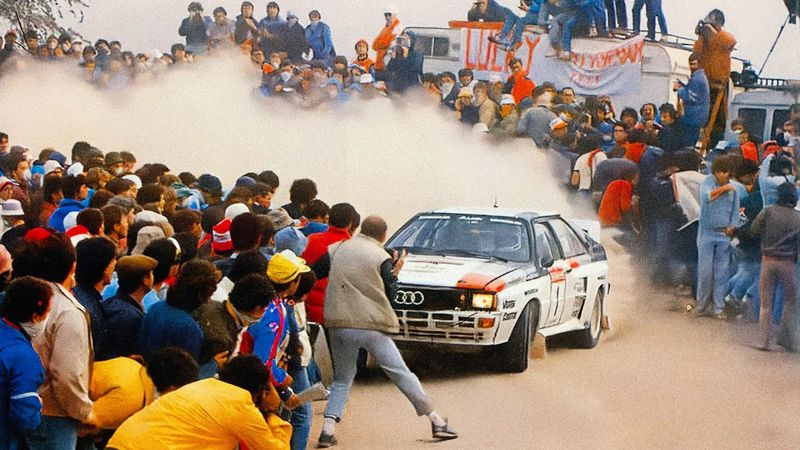
One of the most memorable things about this era was how the spectators acted at every rally.
The stages were held on public roads, and people were allowed to stand pretty much wherever they wanted, with absolutely no protection between them and the cars.
They weren't just standing right beside the road, though.
They were standing on the road.
As the cars approached them flat out, they jumped back at the very last second.
barely making room for the cars to go through.
Photographers risked everything to get the perfect shot, while other fans just enjoyed the thrill of getting as close to the action as possible.
When you look at F1 in the 50s, for example, they didn't care much about safety either.
And when I say they didn't care much, I mean they didn't care at all.
But even back then, the fans weren't stupid enough to stand in front of cars doing well over 100mph.
especially on gravel or snow, where the chances of a driver losing control are far higher.
It was just unbelievably dangerous.
And yet, it happened for five years straight.
And unsurprisingly, it wasn't without fatalities.
Obviously, with that sort of danger, accidents happen, and in Group B, they happened pretty often.
Not all spectators were able to jump out of the way in time, and it made for some pretty grim stories.
The official numbers state three spectators died and dozens more were injured.
Rumors say no one really knows the real numbers, but it was likely well over 50.
That's 10 a year.
Crazy.
There were plenty of reported occasions where a car would arrive into the service area after the stage, and mechanics had to pull several fingers out of the car's bodywork.
There was air intake behind the doors, and they were quite sharp to take the air into the coolers, into the engine.
We were trying to stay in the middle of the road.
I never went off there or anything, but they were just trying to touch the cars.
Fans had gotten so close to the action that the cars clipped them and actually cut off body parts.
The most horrific incident came at Corsica, and I'll give you the full details on that in a minute.
But first, I need to talk about Portugal.
Walter Rolls-Guattro nearly killed a cameraman.
He was inches away from him.
And away goes one television camera.
That's just one example of how many close calls there were, so imagine how many accidents weren't caught on camera.
Still, the FIA didn't see this as being bad enough to make any changes to the safety standards.
On top of that, the communication was terrible between the drivers, teams, and the rally organizers.
Whenever there was a crash, the medical teams didn't even know.
They often had to wait for another driver to pass the crashed car, finish the stage, and tell them what had happened.
Only then, the medics would head back down the stage, look for the crash site, and start trying to administer first aid to the drivers.
So, it wasn't uncommon for them to arrive too late.
The cars weren't exactly safe either.
I mean, motorsports in general was dangerous in the 80s, but Group B took it to another level.
The cars were made of aluminium frames and roll cages, which just bent and snapped in big crashes.
Exactly the opposite of what they're supposed to do.
So even when medics arrived at crashed cars, there wasn't much they could do anyway.
That's exactly what happened on the 2nd of May, 1985.
Attilio Bertica was driving his Lancia 037 in the Corsica rally when he lost control at high speed, flew off the road, and crashed at 93 miles an hour into a tree.
It smashed the cockpit, came into the driver's seat, and instantly killed him in one of the most horrific crashes imaginable.
His co-driver Maurizio Parasino survived, though, somehow uninjured.
It was the first death in the Group B era.
But the FIA didn't do much in response.
They treated it as bad luck.
Even though it was becoming obvious by now that this style of rallying was extremely dangerous, they allowed it to continue unchanged, even with the shocking standard of safety crews at the rallies.
And we thought the old F1 medical cars were bad.
Shortly after, at the 1986 Portuguese Rally, Joaquim Santos was flying through a tight special stage in his Ford RS 200 when he suddenly lost control, in the worst place
Now, unfortunately, I can't show you the entire footage, but I think you can fill in the blanks.
It's painfully obvious how dangerous it was.
I mean, look at where the spectators are standing.
On the outside of a corner, with cars coming round at over a hundred miles an hour, with no barriers in sight, it was ridiculous.
But nobody seemed to care.
Unfortunately, though, they paid the price.
The car snapped violently mid-corner, and before Santos could do anything about it, he found himself completely out of control.
He flew off the road and plowed straight into that crowd of people who were standing on the left.
It was the most brutal accident of the Group B era, killing three spectators and injuring more than 30.
It was complete carnage.
There was no crowd control, and the massive groups of people made it nearly impossible for medical crews to get ambulances to the scene of the accident.
Even the severity of this crash wasn't enough for the FIA to make changes.
They just didn't see it as being bad enough.
But the drivers were starting to think otherwise.
I've got my own conscience and I'm not prepared to drive between people.
at 120 mile an hour.
Just no way.
I'm not going.
No, you're not going.
Anyway.
Maybe.
I am only lunch here, but anyway, I'm not going.
Another five mile an hour more, and I would have been in them.
I mean, it's crazy.
And I mean, I don't want to continue.
Another RS200 crash happened at the 1986 ADAC Rally Hessen, and it was just terrifying.
Back then, F1 drivers did a lot more series hopping than they do now.
Switzerland's Marc Schürer was one of those F1 drivers who fancied himself in a rally car, so he entered this event in Hessen.
He was driving his Ford with co-driver and friend, Michael Wider.
The camera was following them closely, going flat out down a high speed section of the stage, before catching one of the worst crashes in motorsport history.
I'm just gonna warn you, like Santos' crash in the other RS200, this one is pretty horrific too.
He lost control, and spun off the road doing well over 150 miles per hour.
They spun backwards into a tree, destroying the car and causing it to instantly erupt in flames.
Co-driver Wider burned to death, and Shura was so badly injured, he spent three weeks in a coma and never raced in F1 again.
This crash highlighted just how dangerous these Group B cars were becoming.
If that wasn't bad enough, it somehow got even worse.
Exactly one year after Betteger died in Corsica, another tragedy unfolded in the exact same place.
But on the 2nd of May 1986, Henry Toivonen was leading when he suffered a horrific crash in his Lancia Delta S4.
The severity of the crash was brutal, with the car flying down the side of a hill that had no guardrail.
It landed on its roof, and the fuel tank exploded, killing both Toivonen and Cresto immediately.
The car burned to such an extent that only its space frame was left, and the cause of the accident was never fully understood.
Audi decided to quit Group B completely after this crash.
It was simply too much.
Toivonen's death obviously shook the rally well, as he had already won three races and was seen as one of motorsport's biggest talents at the time.
He also raced in British Formula 3 for Eddie Jordan's team, and Eddie said that his performances were incredible.
He even compared Toivonen to Senna, especially because they raced each other in F3.
In fact, I think we started by the first race at Thruxton, which was his first race, and we couldn't believe it, could not believe it.
He finished third in his first ever race.
In 82, we ran Senna, and quite honestly, he was very special straight away.
That was the first time he ever drove in Formula 3 was with us, and it was a similar type of feeling with Henry.
You can feel it, you know, this commanding position, this total confidence, this knowledge of their own belief.
Had he gone on a Grand Prix-style route instead of the rally program...
Nobody knows how good he could have been, other than the fact that he certainly would have been a Grand Prix winner.
As soon as the crash happened, and I mean just a few hours later, Balestri and the FIA decided it was time to take action.
They called an emergency meeting to discuss the future of the WRC, and it turned out to be one of the most influential meetings in motorsport's history.
Right there and then, they agreed that Group B couldn't go on.
It is evident that there is always an evolution of technique and we have put in place new regulations to limit the power of the car to 300 horsepower.
Henri Toivonen's unhappiness made the world of rallying stronger.
The national car racing organization called on Corsica to hold an emergency meeting that changed the whole image of the sport.
They were going to change the rules for the following year and vowed to never let Group B happen again.
Between stages for the 86 Corsica rally, Toivonen himself made some really sickening claims.
He admitted that it was completely ludicrous to be driving these cars in the way that they were, even though he was winning stage after stage in that event and leading by a huge amount.
The only thing is that this is a really crazy race.
We have now done over four hours of fast races, so basically the Jyväskylä Grand Prix today.
With a modern car like this, I don't think you can drive a race like this.
You have to drive properly.
You have to drive properly, and you don't have enough brains to do that.
It's pretty disturbing knowing that the drivers were aware of how hard they were pushing, and that if they had a big crash, they were basically guaranteed to get killed.
However, they still continued after this crash.
I guess rally drivers are just built differently.
Obviously, all motorsports is dangerous.
Always has been, and always will be.
Oh my heavens!
But there's no reason for it to be on a Group B level of danger.
There's no point saying that that was real motorsport and trying to diss modern safety standards for taking a lot of the risk away.
If safety never improved, I'm not sure motorsport would even exist anymore.
Something needed to be done, and the FIA's decision to ban Group B, as unpopular as it was, really was one of the key decisions that led to motorsport's current safety standards.
It's hard to blame one thing in particular for Group B getting banned, but most of the issues stem from one area.
The stupidity of the spectators on the road definitely didn't help, but there was nothing stopping them from doing it.
And as we all know, some people just like being stupid and taking unnecessary risks.
So if the FIA had changed the rules around this, there definitely would have been fewer injuries and deaths.
The cars were legendary, and were one of the category's main attractions, if not the biggest.
But there's absolutely no doubt that they were just too fast.
The quote I showed you from Toivonen is proof that even the drivers were thinking it.
Plus, the FIA investigated Group B later on, and the results told people what they suspected all along.
It proved that the reaction times of the drivers were far too slow to keep up with the speed of the cars.
Basically, the cars were moving faster than humans could process.
They even discovered that the driver's eyes couldn't focus quickly enough between the fast corners, and that this made them develop tunnel vision inside the cockpit.
So, when they were driving, they were super focused on one tiny thing right in front of them, like the end of the road they were driving on.
They couldn't see the steering wheel, the inside of the cockpit, the edges of the road, the spectators who were inches away from the car, or anything else.
It's just what you want when you're nearly doing 150 miles an hour through a sea of people.
At the end of the day, a lot of changes could have been made by the FIA to improve its safety.
They could have kept the cars exciting and just tamed them down a bit to actually make them drivable.
The biggest problem was the spectators, though.
It was like the FIA didn't care about them at all.
I mean, who lets people stand right beside a car doing 150 miles an hour, all while it's coming round a corner on dirt at 90 miles an hour?
It was just ridiculous.
If they even put barriers in or made people stand up on bankings away from the road, it would have prevented so many deaths and injuries.
But they just didn't care.
Even with the tragedy, Group B is remembered fondly, especially by the fans that lived through it.
The drivers loved it, too, for the insane cars and the adrenaline rush.
It was hard for them to go back to rallying slower cars after experiencing the adrenaline provided by the Group B monsters.
Group A was introduced after Group B's ban, and a lot more rules were brought in.
The power, weight and technology of the cars were limited.
This was to try and ensure it wasn't just a repeat of Group B's craziness, and the cars got safer and were a lot closer to the road car versions.
It gave the WRC what it needed, which was more safety.
Toyota, Subaru, and Mitsubishi defined this era with their legendary cars that have now become iconic.
Even though Group A produced some brilliant rallying, the sounds, the memories, and the footage of Group B drivers on the absolute limit are ingrained in everyone's heads.
Regardless of whether you're a massive rallying fan or not, Group B was something truly special.
It was a strange era of motorsports, and we owe a lot to the improvements that were made during that time.
The same goes for other Series 2, like F1, who had their own Group B-like era.
Its equivalent was definitely the 70s, where it sometimes looked more like the Wild West than a world-class, organized racing series.
That period saw crazy fast cars and outrageous crashes with very questionable safety measures.
If you want to see how the two compare and learn more about what really went down, you can watch this video I made on the absolute insanity of F1 in the 70s.
And as always, thank you for watching.