
The World Needs AI, But There's a Problem
Download information and video details for The World Needs AI, But There's a Problem
Uploader:
Bloomberg OriginalsPublished at:
4/22/2025Views:
632.2KDescription:
Video Transcription
When people talk about the cloud, this is kind of where we are now.
This is what they're talking about.
It's not in the sky, it's right here.
Anytime you touch an icon on your phone, anytime you book a flight, or anytime you watch a movie at night, you're using a data center.
There's a big division in the county about how data centers impact their lives, and I think that we've gone overboard.
We're trying to get balance.
We know we need data centers.
This phone I'm holding in my hand right now uses data centers, but that's not the point.
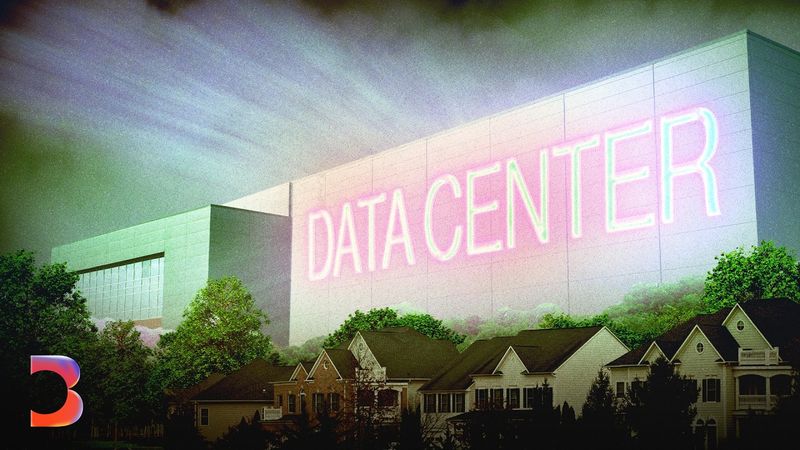
We're here in Northern Virginia because it's the red-hot center of data center development in the entire world.
About 13% of data centers globally are here.
A full quarter of the data centers in the US are right around us here in Northern Virginia.
If you care about the reliability of the electric grid, climate goals like shutting down coal plants, if you care about the development of AI, all of that is happening right around us.
If we can't figure out how to get it right here, how are they going to get it right anywhere else?
We're driving to Gainesville, where we're going to meet with a woman who lives right next to a data center development called Village Tech Park.
It's been criticized for being basically too big, too close to homes.
And there's another big development planned on the other side of her.
So she feels just sort of besieged, kind of surrounded by these big data centers.
Hey, I'm Josh.
Ari, nice to meet you.
Nice to meet you too.
Seeing the change over the years has just been drastic.
We knew the shopping centers were going to come.
We didn't mind those, but the data centers has been a complete shock for us residents here and in the area in general because the train's coming.
And that's gotten louder.
How has it gotten louder?
Because there used to be a lot more trees lining it.
So by them taking down all the trees, it's become a lot louder.
Would you ever consider moving?
Yes, we are looking to move.
Shortly after they started talking about the data center, we talked about it.
But unfortunately, I have a child who is in school, so we decided to stick it out until she graduates and then relocate someplace different.
So people sometimes ask, why is Northern Virginia the data center hotspot for the entire world?
And the reason is that in the last century, data processing companies came here because their customers, government agencies in DC, were here.
So they built data processing facilities.
And then as the internet developed, there was a good fiber network here.
There's a really strong, reliable, and relatively cheap power grid.
so data centers can hook up to electricity, which is the juice they need.
There's fewer natural disasters here, knock on wood, and lots of open land.
There's also been some tax break laws passed to encourage data center development around here.
When I got into the sector in the mid-90s and I was selling internet access, you know, every office in America I went into had a data center.
It was called a computer closet.
And as kind of the internet grew and people realized, I can't have this critical data, this application in some room where there's a pipe overhead and it could burst at any time.
And that's what gave rise to third-party data centers where customers could rent space and put their equipment in a purpose-built master plan type of building that would ensure that their data, their application would survive 100% uptime, would always be powered, would always be cooled.
Come on in.
Wow.
How tall is this?
This is about 20 feet up.
When it's all said and done, we'll be three feet higher in the space.
Okay.
Because that's where all of our cold air is going to be coming under the floor into the servers.
And that's why you need so much electricity also.
Correct, yeah.
And how many square feet is this?
This is about 20,000 to 21,000 square feet.
Wow.
So we'll have 10 data halls that are around the same.
So about 20 in my apartment, 20 in my New York City apartment.
Yeah, New York City might be a little bit smaller.
Yeah, yeah.
So over here is called our cold aisle containment system.
This is where all the cabinets are landed and lined up.
Why do you need a cold aisle?
Why does it got to be cold?
We have to make sure that they stay cold while the servers are all on inside of each rack.
We have to make sure all the output that they're doing is staying as cold as possible so they run efficiently.
How much electricity would this whole room consume?
Once this room is at full capacity, it can go up to four megawatts of power.
Okay.
Okay.
And four megawatts.
Help me out with that.
Well, like how many homes could that power?
Yep.
So if we break it down, one megawatt could power about three to 4,000 homes.
So this could power up to 12,000 homes.
Wow.
So what are we going to see out here?
So right now we're on the roof of this data center.
You can see it's filled with what we need to cool down all of those crack units or computer room air conditioners we saw inside of the data hall.
So these are called ACUs or air conditioned compressor.
They're kind of noisy.
uh yes they're very noisy that's why we kind of have the walls okay kind of boxes in the sound okay because we keep the resonance in mind so we try and make sure the sound is as buffered in as possible they would be louder during the summer time i was going to say it's kind of cold we should have brought our jackets why are they even running right now so they they're running on what's called a free cooling mode which means it's using the outside air instead of just big fans they're big fans big fans
Why is it so important that you have power continually?
If you didn't have power and the data center just shut down for a couple days, why is that a big deal?
Well, think about it.
So in data centers, we have healthcare, we have transportation, we have government.
Imagine a government shutdown, how chaotic that is.
Something like that happens in a data center, nobody can send an email, nobody can work.
Everyone loves to have the day off, but it has such a huge impact on the neighborhood, the city, the world.
I was elected in November 2023.
I wanted to run because I disagreed with the direction the county was going in, particularly with land use and with the placement of data centers.
The good thing, you know, data centers do generate revenue.
And last year, when we raised the C&P tax rate, we generated more money for the county and for our schools, but everything in moderation.
For us on the Board of County Supervisors, I'm saying we have to be the traffic cop.
We cannot approve a data center any and everywhere.
These are industrial warehouses.
They shouldn't be next to homes, schools, national parks.
They should be in areas that have enough power to run these facilities.
The land we give to data centers is land that other businesses aren't able to purchase.
It's also land that, you know, we're not able to use for housing or retail or any other development.
Virginia is a beautiful Commonwealth.
It's very scenic.
We have so much history here.
I'm afraid that that's going to be lost if we're just giving in to data centers' demands.
When you talk with legislators today, be clear that we're not against data centers.
We want them to be better.
Our morning started really early in a really cold, really dark parking lot where we met a group of data center opponents and we all got on a bus to travel here to Richmond where they're lobbying their lawmakers for what they would call responsible data center development.
In transportation, there are speed limits, there are safety standards, there are noise limits, and we're here to lobby about an industry in Virginia that is overwhelming us and there are no laws and standards.
We traveled with one woman, Olena Schlossberg, who's sort of at the center of this fight.
And she's been going toe-to-toe with the biggest data center developers for about the past decade.
That's really something I want to message the legislators, is the history books are being written right now.
And the question is, you know, what do you want the history books to say about you?
The first year we went, nobody knew about data centers.
What's a data center?
The next year we went, suddenly people are starting to go, oh, there's maybe something about data centers.
Oh, so the legislative review commission report finally came out and my favorite word was unconstrained.
Unconstrained data center development is what is risking our reliable energy and our clean air and clean water, the health and wellbeing of the state of Virginia.
So we're here in Data Center Alley.
This is Data Center Alley.
This is around 20 million square feet of planned data center development.
The digital gateway, you know, that looks so beautiful.
23 million square feet of data center development.
I mean, look at the size of these buildings.
They are massive.
And this is not enough, by the way.
They've got to build all the transmission.
But we don't even have the generation to plug the transmission into.
You can see the substation, the electric infrastructure here.
It's everywhere.
So here's another data center, here's another data center.
One after the other.
More transmission lines one after the other, substation one after the other.
What we see happening here in Virginia is becoming a national grid problem.
It's magical thinking how you are going to meet this kind of power demand never seen by mankind before.
We are at the precipice.
And now is the time.
There's no more excuses to hold the wealthiest corporations in the world accountable for the energy they need for their business model.
So hyperscalers are the big tech firms like Google, Microsoft, and Amazon.
Some of those types of companies want to build data center campuses that use five gigawatts of electricity.
That's a huge amount.
It's as much as entire cities like Miami or Atlanta.
Right now, Virginia, where Data Center Alley is, uses about five gigawatts of electricity for all of its data centers.
That's a lot, and enough to power about half the homes in the state.
So the power company that has to generate and transmit all that power, Dominion Energy, they say that this trend is going to continue and that data centers in development in its pipeline are going to require another 40 gigawatts.
Globally, the picture is the same, just with way bigger numbers.
There's 7,000 data centers built or in development across the world with energy consumption that's expected to top 2,900 terawatt hours annually by 2034.
That's almost double what the entire country of India uses each year.
A terawatt, by the way, that's a thousand gigawatts, and a gigawatt is enough to power about 750,000 homes.
So the world doesn't currently have enough electricity to meet all of that demand, and that's a problem.
In interviews with tech leaders, data center developers, energy companies, they say that there's years-long wait for businesses to connect to the electric grid, and it's also threatening Silicon Valley's efforts to lead the race to develop artificial intelligence.
How did AI change data centers?
The power requirement.
As soon as the power is available, it's taken.
So as soon as we can get power into a building, AI is all over it.
AI has turbocharged data center demand.
It really happened over the last two years.
I like to think about it as, you know,
pre-ChatGPT and post-ChatGPT, right?
Pre-ChatGPT, you know, you had strong data center demand that was being driven by technology adoption, right?
If you think about what a data center really represents, it represents the foundation for technology adoption.
And all of a sudden, ChatGPT came and people saw this technology and were like, wow, this is going to change the world.
And we need to figure out how to adopt it.
And this particular technology has a unique characteristic, which is
It can't run on CPU infrastructure, which is what the world lives on.
It's the type of computers that are in your home or in your office today.
It has to run on GPU infrastructure, which is kind of a parallel processing type of architecture, obviously most famously known by NVIDIA.
And because the power
factor of these GPUs is 5x, 10x the power factor of a regular data center CPU rack.
It's driven this incredible demand for data center capacity.
So I do think it's going to impact sustainability goals over the short term.
And we're going to be using a lot more fossil fuels.
I think it's kind of inevitable unless someone wants to put a pause button on this.
But ultimately, it feels like the utilities are committed to a long term renewable future.
Are there parts of data centers that you see as valuable or that you see as necessary?
Absolutely.
100%.
And it's not about being anti-data.
I like data.
I like technology.
But to allow it to grow with just no constraints, no guardrails, no accountability, the reality is that the community is the ones that are being asked to sacrifice.
And so something has to change.
My vision of the future is mixed.
We're at the beginning of, in my view, a multi-decade, multi-century engagement with technology.
It's the first time, certainly in human experience, that we've had this amount of power at our fingertips and kind of things are accelerating, right?
But I would hope that we don't lose our humanity in that respect and that we still want to engage with the world beyond the digital screen, beyond the digital experience, that the real experience is still better than
than a digital one.
And I certainly hope that we as a species make good decisions.
Similar videos: The World Needs AI

How A Tiny Country Became The 2nd Biggest Agricultural Exporter In The World
Inside OpenAI's Stargate Megafactory with Sam Altman | The Circuit

We Investigated Africa's Silicon Valley (It's not what we expected!)

Why the UK's Economy Stopped Working
This $3BN Mega-Dam Changes the Weather