
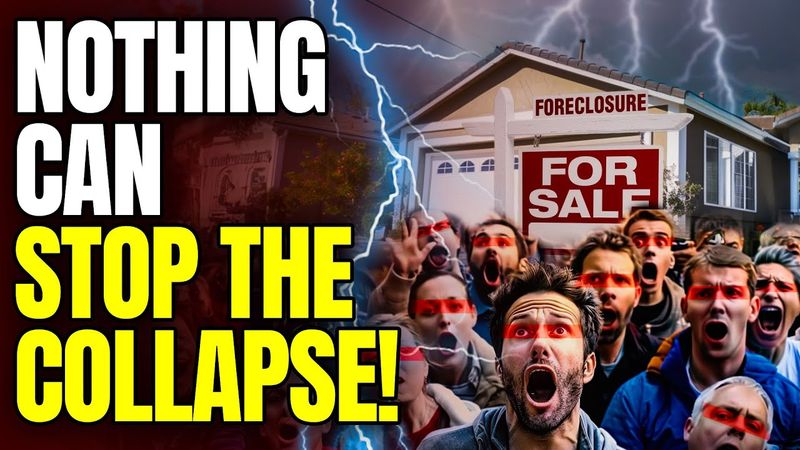
This Will Be The Mother Of All Housing Market Crashes!
Download information and video details for This Will Be The Mother Of All Housing Market Crashes!
Uploader:
Debacle EconomicsPublished at:
7/1/2024Views:
3.8KVideo Transcription
2024 will be a crash.
You talk about it being pretty bad.
I want to dive into the real estate aspect because you said home prices are so overvalued.
They'll never be priced at where they are right now.
I've heard you say that on podcasts.
You said that we should expect a 50% price correction on where we are right now.
That would be the highest in U.S. history, even greater than the Great Depression.
In the heart of the American dream, a nightmare is brewing as the once mighty U.S. housing market teeters on the brink of an unprecedented collapse.
The warning signs are flashing red and experts fear the coming crash could dwarf anything we've seen before, leaving millions of homeowners and investors struggling in its wake.
This is not a distant threat or a hypothetical scenario, but a clear and present danger that threatens to quaver the economic situation of the American housing landscape.
the numbers are as gobsmacking as they are sobering.
According to a recent report by the National Association of Realtors, existing home sales have plummeted by a jaw-dropping 28.4% year-over-year, the steepest decline since the depths of the Great Recession.
This is not a mere blip on the radar, but a full-blown crisis gathering momentum with each passing
The situation is equally dire when it comes to home prices.
The Case-Shiller U.S. National Home Price Index, a widely respected barometer of the housing market, released May 28, 2024, reports that annual home price growth increased in March 2024 by 6.5%.
That's relatively flat from the previous month, representing the sixth all-time high in the past 12 months.
Perhaps most alarming of all is the surge in payment delinquency rate.
A 2023 survey from Clever Real Estate found that 62% of homeowners sometimes struggle to make their mortgage payments on time.
About 5 million US households were estimated to be behind on their last month's mortgage
payment as of June 2023.
Homeowners between 40 and 54 years old made up over 1.8 million households late on payment.
Second in rank were roughly 1.5 million homeowners between 25 and 39 years.
As more and more borrowers find themselves underwater and unable to keep up with their payments, the stage is set for a wave of foreclosures that
could devastate communities across the country.
In this video, we will delve deeper into the factors driving this impending catastrophe.
We'll explore how skyrocketing interest rates and other unfavorable economic variables are exacerbating the situation and what that means for average Americans looking to afford a home.
For years, the U.S. housing market has been propped up by a toxic combination of low interest rates, loose lending standards, and speculative frenzy.
As easy money flowed into real estate, prices soared to unsustainable heights with the median home price reaching a record $363,300 in June 2021.
But sadly, the music has quelled and the party is over.
The Federal Reserve, facing the highest inflation in four decades,
has embarked on an aggressive campaign of interest rate hikes with the benchmark federal funds rate rising from near zero to over 5% in just over a year.
This has sent mortgage rates soaring to their highest levels in over a decade, with the average 30-year fixed rate now hovering around 7%.
The impact of these rate hikes on housing affordability has been nothing short of devastating.
According to a recent analysis by Forbes, the typical mortgage payment has skyrocketed by 46% in the past year, from $1,400 per month to $2,045 over the 12 months ending December 2022.
Likewise, the median total of costs and fees for such mortgages spiked almost 22% to nearly $6,000 in the same period.
And with mortgage rates rising to decades-old highs this week, the average monthly payment has almost certainly grown in 2023.
At the same time, rising unemployment is putting even more pressure on struggling homeowners.
As the economy slows and layoffs mount, many borrowers are finding themselves without the income they need to keep up with their mortgage
payments.
According to the Bureau of Labor Statistics, the unemployment rate jumped to 4% in February 2023, up from a historic low of 3.5% just a year earlier.
As more workers lose their jobs, the risk of a wave of defaults and foreclosures grows ever larger.
Unemployment inched up to 4% last month from 3.9% in April, even as some 250,000 people dropped out of the workforce.
While still very low by historical standards, that's the highest unemployment rate since January 2022.
In the fourth quarter of 2023, the unemployment rate averaged 3.8%, slightly higher than the rate of 3.6% in the fourth quarter of 2022.
The number of unemployed people was 6.3 million, up 5.9 million at the end of 2022.
Most of this modest increase in unemployment occurred in the latter half of 2023.
The potential consequences of a housing market crash are hard to overstate.
For millions of Americans, their home is their single largest asset.
the foundation of their financial security and the key to their retirement dreams.
If prices were to plummet by 20%, 30% or even 40%, as some analysts fear, it could wipe out trillions of dollars in household wealth, leaving countless families drowning in debt and struggling to stay afloat.
But the risks extend far beyond individual homeowners.
The housing market is a key driver of the broader economy, with spillover effects that touch every corner of society.
When home prices fall and construction activity dries up, it ripples through the entire economic ecosystem, from the builders and contractors who lose their livelihoods to the banks and lenders who see their balance sheets crippled by bad loans.
Perhaps most worryingly, a housing crash could trigger a broader financial crisis as the complex web of mortgage-backed securities and derivatives unravels.
Much like in 2008 when the implosion of the subprime mortgage market set off a chain reaction that brought the global financial system to its knees, a new crash could quickly spiral out of control, spreading contagion far and wide.
The parallels to the last housing crisis are eerie and unsettling.
Once again, we see a market that has been driven to unsustainable heights by a combination of easy money, lax regulation, and rampant speculation.
Once again, we see a generation of homeowners who have been lured into taking on more debt than they can afford based on the false promise of ever-rising prices.
We see a financial system that is deeply interconnected and vulnerable to shocks, with the potential for cascading failures that could bring the economy to a grinding halt.
But in many ways, the risks are even greater today than they were in 2008.
Since then, the US housing market has become even more financialized, with a greater share of homes owned by investors and speculators rather than owner-occupants.
According to a recent report, the number of renters living in single-family homes in the U.S. fell to 14.1 million in 2022, down 1.2% from 2021.
Despite the slight decline, single-family rentals remain the second largest rental housing type, representing 31.5% of all rental households.
These households surged from 11.3 million in 2006 to 15.2 million in 2016.
Since then, the number of single-family rental households has declined in five of the past six years.
Many of these homes are owned by large institutional investors who have been attracted to the market by the promise of steady rental income and the potential for outsized capital gains.
But what happens when the music stops and the rent checks start bouncing?
If large numbers of tenants are unable to pay their rent due to job losses or other financial hardships, it would set off a wave of defaults among these investor-owned properties, with potentially catastrophic consequences for the broader market.
This point underscores the fragility of the rental market.
While large investors may be better equipped to withstand financial shocks, the vast majority of small property owners who are more vulnerable to rent defaults could face severe financial strain.
If these smaller landlords begin to default en masse, it could not only disrupt the rental market but also contribute to a broader economic downturn as their financial troubles ripple through the economy.
At the same time, the U.S. housing market has become increasingly dependent on foreign buyers, particularly from China who have been attracted to American real estate as a safe haven for their wealth.
According to the National Association of Realtors, foreign buyers purchased $53.3 billion worth of US residential properties from April 2022 to March 2023, down 9.6% from the previous year, with Chinese buyers accounting for nearly a third of that total.
However, as tensions between the US and China have escalated in recent years, there are growing fears that this flow of capital could quickly dry up, leaving the housing market without a key source of demand.
All of these factors combine to create a perfect storm of risk for the US housing market, one that could easily dwarf anything we've seen before.
If prices were to fall by 20% or more, as some analysts fear, it could wipe out trillions of dollars in household wealth and trigger a wave of defaults and foreclosures that could cripple the banking system.
At the same time, a slowdown in construction activity could lead to job losses and a broader economic downturn, as the spillover effects of the housing crash ripple through the economy.
For ordinary Americans, the consequences of a housing crash could be devastating.
Millions of homeowners could find themselves underwater on their mortgages, owing more than their homes are worth, and unable to sell or refinance.
At the same time, a surge in foreclosures could flood the market with distressed properties, further depressing prices and making it harder for homeowners to recover their losses.
But the pain wouldn't stop there.
A housing crash could also trigger a broader financial
crisis as the complex web of mortgage-backed securities and derivatives unravels.
The risks are particularly acute for the millions of Americans who have poured their savings into real estate, hoping to build wealth and secure their financial future.
According to a recent survey by Gallup, real estate is the most popular long-term investment among Americans, with 36% of adults naming it as the best way to build wealth over time.
But if the housing market were to crash, many of these investors could see their nest eggs wiped out overnight, leaving them with little to show for years of hard work and sacrifice.
Ironically, the very policies that were put in place after the last housing crisis to prevent a repeat of the carnage may now be contributing to the risk of a new crash.
In the wake of the 2008 meltdown, regulators imposed a host of new rules and regulations on the mortgage market, from tighter underwriting standards to higher capital requirements for lenders.
But while these measures have undoubtedly made the system safer in some ways, they've also had the unintended consequences of making it harder for many Americans to access home ownership.
Over the past three decades, there's been a dramatic change in young adults living arrangements, with fewer forming their own households and more living with their parents or with roommates.
Fueled by economic and affordability constraints, these trends have limited young adults' ability to buy homes.
In recent years, that has changed slightly.
After young adults' homeownership rate declined from 45.0% in 1990 to 37.0% in 2015, it increased to 41.6% in 2021.
But once we adjust for changes in living arrangements, we find that the real homeownership gap between today's young adults and those of 20 years ago is more than three times higher than the measure of the traditional homeownership rate shows.
As more and more young people are priced out of the market and forced to rent instead of buy, it could create a feedback loop that further depresses demand and pushes prices lower.
While it's true that the housing market is not as fragile as it was in 2008, it would be a mistake to underestimate the risks that lie ahead.
The fact remains that the US economy is deeply dependent on the housing market's health and that any significant downturn could quickly spiral out of control.
Moreover, the factors driving the current slowdown in the housing market – rising interest rates, tight lending standards, and declining affordability – are also likely to make any future crash even more painful and prolonged.
As more and more homeowners find themselves unable to keep up with their mortgage payments, and as more and more properties fall into foreclosure,
it could create a vicious cycle of declining prices and rising defaults that could take years to unwind.
The walls are closing in, the ground trembling beneath the feet of striving Americans as the looming specter of a housing market apocalypse draws ever nearer.
The stakes could not be higher, and the time for action, if any, is now.
If the market were to crash, it would not just be a matter of lost wealth or economic disruption, but a profound blow to the highly revered American drain.
If you liked this video, hit the like button and help us spread the word.
And don't forget to subscribe to get notifications on our latest news and analysis.
In the meantime, check out one of these videos here to learn more.
Thanks for watching.
Similar videos: This Will Be The Mother Of All Housing Market Crashes
End of the Petrodollar Will Be the End of the USA as We Know It!

Desperate Reality to Job Market Collapse in the USA!

25 MASSIVE Corporate BANKRUPTCIES Primed to DECIMATE the US Economy!

Overwhelming Homelessness CRISIS Taking Over New York!
IMF Signals There’s Something MASSIVE Coming - DUMP The US Dollar Now!