
Whistleblower: 10-year-old Palestinian boy ‘gunned down’ after receiving food aid
Download information and video details for Whistleblower: 10-year-old Palestinian boy ‘gunned down’ after receiving food aid
Uploader:
MSNBCPublished at:
8/3/2025Views:
736.2KDescription:
Video Transcription
We're hearing new horrific firsthand accounts about a controversial aid organization in Gaza as starvation grips Palestinians after Israel's 11 week long blockade.
A report from the United Nations Human Rights Office says nearly 1400 Palestinians have been killed while seeking food.
and 859 were killed in the vicinity of aid sites run by the Gaza Humanitarian Foundation.
The GHF is a nonprofit based in Delaware and backed by the US and Israel.
Its stated aim is to get aid to Palestinians without Hamas stealing it.
The GHF has been criticized by humanitarian groups like Doctors Without Borders and Amnesty International as illegitimate and inhumane.
And now a former GHF contractor is coming forward with firsthand accounts of what he calls barbaric and un-American tactics used at these sites against unarmed, starving Palestinians.
U.S. Army veteran Anthony Aguilar has described numerous atrocities, including a young boy named Amir, he said, who was gunned down by the Israeli army moments after receiving aid at a GHF site.
A GHF spokesperson says, to date, none of our aid workers have engaged in any lethal engagement.
And Anthony Aguilar joins us.
Anthony, you're a retired Lieutenant Colonel in Special Forces.
You served in Iraq and Afghanistan for over two decades, and you joined as a security contractor to help distribute aid in Gaza.
What did you see on the ground when you were there?
Thank you for having me and good evening, everybody.
What I witnessed on the ground in Gaza can be described as nothing more than an apocalyptic wasteland.
It's human suffering.
And for anyone that says that there's no starvation or that the population of Gaza is not at the brink or has already crossed the brink of famine, that is irresponsible rhetoric and that is
that is only serving to starve the population even further.
The population is starving and the population is desperate and the population needs aid immediately.
Lieutenant Colonel, could you talk a bit about your timeline when you got to Gaza?
You recently retired, you got to Gaza, and what was the first warning sign that something was amiss in how the aid was being distributed?
And what were the rules of engagement that you were given as a security contractor on the ground?
Well, from my military experience, one of the initial concerns that I had once we got into Gaza was that we had not been given a clear and briefed and reviewed rules of engagement.
We had not received any standard operating procedures for the use of the non-lethal munitions.
We had not received any rules on escalation of force because we were going to be dealing with such a large population of civilians and primarily civilians.
We were not there as combatants.
We were not there as belligerents in the war.
We were there as those that were there to secure humanitarian aid and we would be engaging with the civilian population.
And without having the rules of engagement, escalation of force, standard operating procedures, that is a dangerous precedence.
Furthermore, all of us were in Gaza under a tourist visa.
So when we entered Israel, we entered on a tourist visa and we were expected to do our work in Gaza, armed, securing aid, and engaging with a very large starving population as tourists.
Anthony, can you tell us about the young boy, Amir?
So Amir was...
one of the Palestinians that came to site number two on the 28th of May.
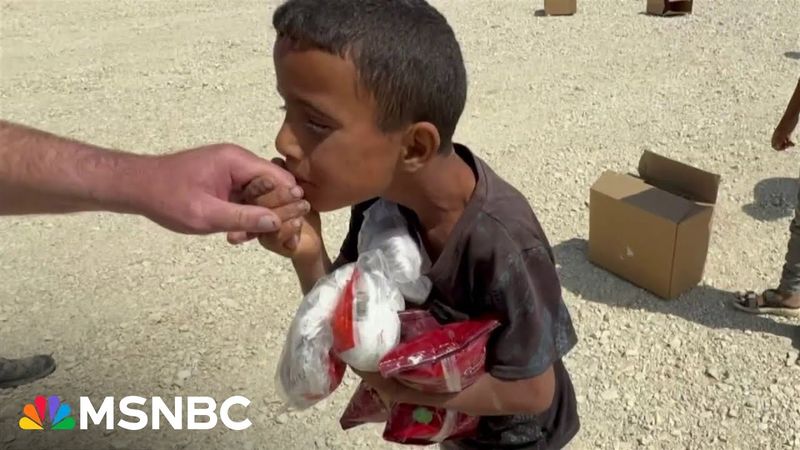
And as you can see in the pictures that were shown in the beginning, we later found out that he's 10 years old.
And I have a follow up with how we learned that.
This young boy, you know, in this photo, he looks to be, you know, maybe six or seven, emaciated.
He was with the crowd and he walked over to us and you see he's got his small items of aid.
He doesn't have a bag.
He's got some rice, some items that he picked up off the ground.
And he beckons to us.
There's another contractor standing next to me on my left.
And at first we thought maybe he was he was hurt or he needed assistance or he was he wanted more food, which we didn't have.
But he walked up to us and he just he extended his hand and he walked up.
You see that the contractor standing next to me and he he kissed his hand and then he kissed my hand and.
I then put my arm on his, I put my hand on his shoulder to comfort him, to tell him, you know, we care about you and the world's not gonna forget and you're not forgotten.
And when you think about, he was there with no parents, he was there with no one, he was there alone and
He set down the items that he had and he placed his hands on my face and his hands were very frail.
His fingernails were dry and cracked from the obvious malnutrition.
His skin tight and dehydrated.
And if anyone says that these children, these human beings aren't starving, shame on you because they are.
And I've seen it.
He then kissed me and he said, thank you in English and stepped back.
And I felt like maybe there's hope here.
Maybe that there's an opportunity that we can do good.
He joined the rest of the group that was leaving because at that point, the contractors began what had been the inherited practice of pushing the civilians off the site with tear gas and pepper spray and stun grenades.
which gets the group going, it makes them panic.
And as they're leaving the site, rushing on this particular site where the IDF had their position where they would shoot at the crowds to contain them along the route going back towards the coast.
From that particular spot, it's very difficult to see that
exit from where the IDF position is.
These sites were put in a very bad location.
It puts the IDF at risk.
It put us at risk.
And this young boy was amongst those that were gunned down on the road back to the Morag corridor to the coast.
And just two days ago, an NGO in Palestine who saw this photo took that photo and started searching, and they found his mother.
They were able to find his mother in Northern Nasser, which is an area of Southern communists north of the sites.
His father had been killed in an airstrike.
He was alone.
His mother has been looking for him since the 28th of May, the day that I saw him.
So he's still missing and his body has not been found.
And it just goes to show that the dehumanization and the brutality of this war
But this war that's being brought to these civilians and what these innocent, this civilian population is enduring is not in keeping with our values.
It's not in keeping with humanity.
It's not in keeping with the values that we as a world and we as a nation uphold.
And something needs to be done about it.
You come to us today, and it's very—you're doing—you're being brave, right?
We've seen a lot of Americans not be brave, a lot of people in very comfortable situations willing to go along with things that they knew were wrong.
How is it?
I mean, how are you doing it?
And also, I really do believe that being brave and speaking out for people is contagious and that there's a certain that if we keep doing this, that we will encourage others to do the same.
So tell me a little bit about how you made the decision to do it, because I'm sure this was not an easy decision to make.
I mean, it was not an easy decision.
There's the feelings of loyalty.
There's feelings of, you know, being a rat or a snitch, as I've been called.
And
know in just in just searching my soul i realized that very few americans very few westerners have been in gaza at all for the duration of time that i spent there and very few even beyond that much fewer have spent time on these actual sites and have seen this actual operation and have seen it through the lens of my experience of 25 years in the military but seeing things around the world and and
I felt that, you know, one, I had to go on the record to give this a voice, to stay anonymous, to stay behind a keyboard and just talk to the media in the shadows is not responsible.
So I knew that stepping up that I was going to get discredited, smeared, and I'm here for it.
I'm on the record.
I'm not hiding.
And I won't hide.
I'm not
speaking because this is my story.
I'm speaking because this is the story of a population of human beings that if we don't do something now, we are on a dangerous road and a day of reckoning is coming that as a world, we're going to see it.
And we have no excuse.
We have no excuse when everything comes to bear and this box is opened and we see inside.
We have no excuse as a nation.
We have no excuse as a world to look at this and say we didn't know.
We do know.
And I'm not looking for anyone's approval.
I'm not looking for the approval of paid spokespersons from the Gaza Humanitarian Foundation or a paid contract lawyer who wants to talk about, I don't know what I'm seeing on a certain site when I've been there.
So I'm here for consciousness and for doing what's right and American values.
America needs to know what we are doing in Gaza, what we are complicit in, and America's voice needs to stand up and put an end to it.
because a day of reckoning is coming, and right now we are on the wrong side of history.
Lieutenant Colonel, do you believe that you witnessed war crimes, not just the fog of war, as the IDF has said that this is not a policy?
Where did these orders come from?
Is it a systemic policy?
And how does it compare to when you served in Iraq and Afghanistan?
Complicated and complex environments require strong leadership and require strong morals.
It's very easy in a situation like this where the population has been dehumanized to see them running and scrounging for food and to see them as, it's very easy to go down that path of dehumanization and then just looking the other way.
The fog and friction of war is real, however.
The azimuth, the line that keeps us straight through that fog and friction is our morals and our ethics, humanitarian laws that we all abide by.
These aren't questionable.
These aren't things that have flexibility.
These are our guideposts.
The Israeli Defense Forces have been put in a very precarious situation in the South because the Gaza Humanitarian Foundation
put all three of the sites, the Southern sites, in the middle of combat zones.
Each of the distribution sites in the South are right in the middle of ongoing combat operations.
It puts the IDF in a very bad position tactically and operationally, and it puts them in a dilemma to where they're in their area of trying to combat Hamas, which is their mission.
They're also having to pretend with eight to nine to 15,000 hungry civilians
in any given day.
And when there's not strong leadership and there isn't a strong purpose, then this type of situation where we see the war bear on people, where the dehumanization becomes almost organic,
that this is what that becomes.
And up in Northern Gaza, they've been isolated for even longer.
No one can go in and out of the Nasserine corridor north in the Gaza city in Jabalia.
And when aid starts going in there, when the world has had enough and we start to go in to Northern Gaza, we're going to see things that are going to bring the world to their knees.
Mark my words.
We are going to see human suffering like the world has not seen in a long time.
And it's going to bring us to our knees.
And we have an opportunity right now to stop this and to do the right thing.
And if we don't, we are complicit in that.
And the world is going to see it.
And that day is coming.
Anthony, when you talk about doing the right thing, what do you mean?
What do you recommend?
And what advice would you give to other Americans who might be considering doing what you did, going over there as a contractor to provide aid?
I believed in the mission when we first set foot in Gaza, and I soon learned that this type of operation to this magnitude, providing humanitarian assistance at scale, this is not a weekend job.
This is not something you can throw together and wing it.
We have an organization that the United States has sponsored and been supportive of for 80 years this year, and that's the United Nations.
Now is not the time to turn our back or to scoff at the United Nations.
Now is the time to double down and support that effort.
Under the United Nations model, there was 500...
trucks going in every day delivering to 400 distribution sites with doctors medical assessments food water in in the mechanism right now with the food that we give them we give them no water none we give them no medicine we give them no formula no pampers no hygiene products nothing else but just dried food goods that require water to cook them and we give them no water
We are complicit in starving this population.
You saw the pictures.
You saw the pictures of Amir.
And that little boy is 10 years old.
And people are dying.
And it is not Hamas propaganda.
It is not some far left political propaganda.
And the United Nations is not some far left, unsalvageable organization.
They are effective.
The premise that the Gaza Humanitarian Foundation needed to go in because Hamas was taking all of the U.N. aid, that has been wholly unfounded, not just by USAID, not just by Israeli institutions within Israel, but European institutions as well have looked at it and said there's no evidence of that.
Humanitarian assistance should not be led by profiteers and for those that are doing a contract to make money.
Humanitarian assistance should be done by the organizations that are trained to do it, backed by the international community to do it, not abandoned.
All that food that's waiting out to go into Gaza, the Gaza Humanitarian Foundation keeps saying that we can do it.
They can't do it.
They don't have the capacity to do it.
They don't have the education and the skills and the ability to do it.
The United Nations needs to be reinstated or, excuse me, reallowed to go into Gaza and scale.
The Gaza Humanitarian Foundation needs to go away.
It is an organization that America doesn't even know how they're funded.
I was there, and I don't know how they're funded.
I don't even know what the organization exists.
It's this shadowy organization.
strange organization that's led by profiteers and finance managers and hedge fund managers.
And that's not humanitarian assistance.
That's profit.
And we use human suffering for profit.
Something's got to change.
Lieutenant Colonel Anthony Aguilar, thank you for joining us.
Similar videos: Whistleblower

Why you definitely SHOULD NOT share this JD Vance meme
Obama: Progressives made a 'mistake' in talking about what's wrong with boys
Hallie Jackson NOW - June 13 | NBC News NOW

DETAILS: Putin fires BACK at NATO, EU sends Ukraine $105B

Sam Claflin on new miniseries ‘Vanished’: ‘Plenty of twists, turns and surprises’