Why Afghanistan is still a conflict zone - HIR
Download information and video details for Why Afghanistan is still a conflict zone - HIR
Uploader:
CaspianReportPublished at:
12/1/2023Views:
706.3KDescription:
Video Transcription
It's been well over two years since the American exit from Afghanistan.
The Taliban rolled in shortly afterward and toppled the government in Kabul.
Most of the Afghan security forces didn't put up a fight.
But peace does not come so readily to a country at war for nearly five decades.
Even now, Afghanistan sees uninterrupted hostilities.
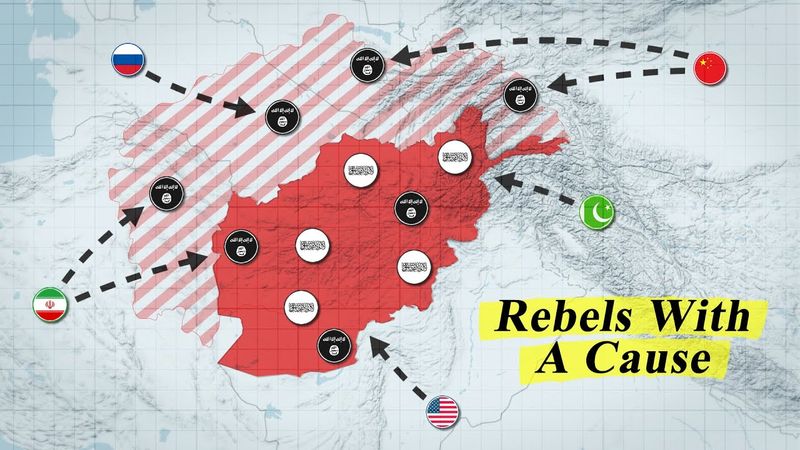
This time, however, the Taliban government is being targeted by its former partner in crime, a group calling itself the Islamic State Khorasan, or ISIS-K for short.
Our new partner, the Harvard International Review, has a terrific paper on this topic explaining the in-depth disputes that keep Afghanistan in a state of perpetual conflict.
But, while Taliban fighters have taken up pens and papers to do administrative work, ISIS-K has kept its guns close.
Afghanistan has seen roughly 400 attacks by ISIS-K since the Taliban takeover.
It's a war no one talks about, but it is a war nonetheless.
ISIS-K has attacked the Pakistani embassy in Kabul and made threats to China for its treatment of Muslims in Xinjiang province.
the stakes are high.
So much so that the United States has even allied with the Taliban to clamp down on ISIS-K, providing air support among other things.
So while the Taliban government has been puffing its chest and propagating tales of martial courage, it's about to find out that it is easier to conquer than to govern.
When ISIS-K attacked the Pakistani embassy almost one year ago, only 20 articles were released on it, and less than a quarter came from left-leaning outlets.
Yet, Afghanistan used to be on the front page of every newspaper.
But since the US withdrawal in 2020, and with other major conflicts breaking out from Ukraine to Israel, news outlets have had to make decisions about what to cover.
Doing so, however, makes it difficult to see how these conflicts might be connected.
This is the magic of Ground News.
Their platform pulls in more than 50,000 news sources from around the world and organizes related stories in one place so you can see how different outlets are covering it.
So, we partnered with Ground News to create a custom news feed for Caspian Report viewers.
Here, you can keep track of events around the world instead of relying on a few sources from a few countries.
The feed includes news about the Middle East, Afghanistan, Israel-Palestine, Russia, Ukraine, China, and lots more.
For example, two months ago, the US military ordered new interviews on the deadly 2021 Afghan airport attack.
Most people will not have heard about this story.
58 sources covered it, but most of them were from left and center-leaning publications.
I know this thanks to the ground news rating system, which gives you a general idea of how reliable an outlet is, who owns them, and if they have a political bias.
So if you want to keep up with geopolitical events happening around the world, you can use my link ground.news slash Caspian to subscribe to Ground News today to get 30% off with unlimited access to the Caspian Report feed.
Once you sign up, all you have to do is search Caspian Report.
Thanks again to Ground News for their partnership.
Tucked away in Central Asia, Afghanistan is a landlocked country bordering Pakistan, Iran, Turkmenistan, Uzbekistan, Tajikistan, and China.
History has been unkind to this part of the world, but geography has been somewhat generous.
Afghanistan is rich in natural resources like copper, iron, marble, talc, coal, lithium, chromite, cobalt, gold, and all types of limestones, gemstones, and precious metals.
Most importantly, Afghanistan is a corridor between the west and the east, holding great geopolitical significance.
Back in the days of the Cold War, when the Soviet Union still existed, Afghanistan was the only neutral country between communist forces to the north and east and capitalist forces to the south and west.
The belief was that whoever controlled Afghanistan could cast influence in either direction and undo the regional balance of power.
So, when the communists took over Afghanistan, it raised its strategic real estate.
Since then, Afghan history has been marked with conflicts feeding into conflicts.
After fighting one another for political power, the Soviets invaded and practically leveled the country.
Eventually, the Soviets left, and Afghans returned to fight amongst themselves, that is, until the American invasion and the resulting occupation.
But again, after the Americans withdrew their troops in 2021, the old Afghan pattern resurfaced.
The Taliban quickly took over the country and just as quickly, Afghans started killing Afghans.
The last remaining opposition was to the north of the country.
After subduing these, the Taliban rebranded the country as the Islamic Emirate of Afghanistan.
Since then, the new Taliban government has shifted priorities and focused on public services, economic stability and social issues at home.
It seems that the aim of the Taliban is no longer the export of jihad but to build a durable state.
It's a move that has made it somewhat easier for nations in the periphery to make deals with a Taliban-governed Afghanistan.
Lawmakers in Iran, China and Pakistan are in talks to recognize the Taliban as the legitimate government in power.
However, the Taliban's lax stance on Jihad has angered a different militant group called the Islamic State Khorasan.
In their view, the Taliban is as unrighteous and unfit to rule Afghanistan as the Americans.
The disagreement between the Taliban and ISIS-K lies in the name Khorasan.
The term Khorasan historically refers to a vast region located in the northeastern part of Iran, southern parts of Central Asia, and western Afghanistan.
During the Middle Ages, Khorasan was a prosperous place.
It served as a center for trade, culture, and learning.
The contemporary concept of nations and governments didn't exist at the time.
So, Khorasan was not a country in the modern sense, but it did have a loosely defined identity.
An identity that was decentralized and multi-ethnic.
And even though Khorasan was later piece by piece absorbed into the adjacent nation states, its cultural offsprings are arguably Uzbekistan and Afghanistan.
The former, however, underwent a widespread process of strict secularization and nationalization.
Afghans, especially those from zealous backgrounds, are thus the only ones still keeping the memory of Khorasan alive.
So, while the Taliban is content to keep its power within Afghan borders and get on with business, ISIS-K looks to revive bygone Khorasan.
To clarify, that means ISIS-K wants to use Afghan resources to ignite a second phase of conquest, one aimed against Iran, Uzbekistan, Turkmenistan, Tajikistan, Kyrgyzstan and possibly Pakistan.
That sounds insane, and it is.
Going for Khorasan would trigger nothing less than a total war involving regional and global powers, including the United States, China, Russia and others.
On the other hand, however, by hyping up the threat of total war brought on by ISIS-K, the Taliban gets to redeem itself as the lesser evil.
It also forces the nearby nations to collaborate with the Taliban and recognize it as the legitimate government of Afghanistan if they want to stop ISIS-K from going outside the boundaries of the country.
But whether ISIS-K is an exaggerated threat or not, its presence is real.
Until now, the group has launched nearly 400 attacks in the last 20 months, the deadliest of which was the 2021 suicide bombing of Kabul International Airport, which resulted in the deaths of 183 people.
Taliban fighters have responded with their own counterattacks but have thus far failed to dislodge ISIS-K.
For the Taliban leadership, it is clear that they must put an end to ISIS-K if they hope to gain any legitimacy for their rule in the eyes of the international community and Afghan society.
And so, the hostilities in Afghanistan continue uninterrupted, as they have for the past five decades.
The thing is, besides territorial ambitions, the Taliban and ISIS-K also have theological and ideological differences.
Understanding these distinctions is key to understanding the future of Afghanistan and what direction regional affairs are headed.
Initially, both the Taliban and ISIS-K fought for the same thing, an Islamic empire stretching from the Atlantic coast to the Indian Ocean, all the way to Central Asia and into the Balkan region.
That sounds overly ambitious, but then again, jihadists are not exactly the most rational folk.
Either way, the original ISIS in Syria and Iraq created geographical sub-departments to handle local objectives.
ISIS-K is one of those offshoots.
At first, the Taliban and ISIS-K combined their resources and worked towards conquering Afghanistan.
But once the Taliban came into power, they had a change of heart.
Global Jihad was no longer a priority.
Instead, Taliban officials began considering empirical and measurable developments like building hospitals, roads, irrigation, and all sorts of tangible projects.
The Taliban adheres to a sect of Islam known as Deobandism, which was formed in India with the aim of opposing British colonial rule.
The focus of Deobandism is to strengthen culture, since a society with resilient morals and cultures is not so readily colonized.
The premise is that since it is easier to bomb someone than to win hearts and minds, the most effective weapon in any conflict is not arms, but culture.
And so, shaping and molding the culture to one's liking is much like sharpening a sword.
This ideology was adopted by the Mujahideen during the Soviet invasion and later by the Taliban during the American occupation.
In line with the Deobandi teachings, the Taliban sought to strengthen and shape Afghan culture to their liking after gaining power.
However, as a concession to realism, the Taliban dropped the pursuit of a global Islamic empire through jihad.
it was no longer as important as it used to be, and once in power, it was no longer politically feasible.
The Taliban had fought for Afghanistan and the Pashtun community, and they had achieved that objective.
For them, the Jihad had ended in a sense.
Barbara Metcalf, a scholar from the University of California, classifies Deobandism as decidedly apolitical.
For Diobandis, politics is an empty box filled expediently and pragmatically depending on what seems to work best in any given situation.
And that is precisely what the Taliban is doing.
Despite being in power for years, the Taliban have not established a strict legal system or abolished the previous government's bureaucratic civil service.
Instead, they have adopted it.
The enforcement of the Taliban's brand of justice has also softened, and a flexible form of government has risen, at least compared to the much more rigid ideals of the Taliban from the past.
Meanwhile, for the Islamic State Khorasan, the Taliban's jihad concession and the way their bureaucracy and legal code are set up is simply unacceptable and unforgivable.
ISIS-K follows a different sect of Islam, widely known as Salafism.
However, unlike traditional Salafism, ISIS-K follows a hardline Salafist doctrine, one that prioritizes establishing and expanding an Islamic caliphate.
This is in stark contrast with the Taliban's worldview.
While the Obandis see Jihad as a way of preservation and a counter to imperialism, Salafis belonging to ISIS-K see Jihad as a tool for conquering and destroying all those with whom they disagree.
Most of all, ISIS-K wants to establish a caliphate and expand it through jihad.
For this, the Islamic State has adopted an activist nature, seeking to recruit jihadists for their ever continuing aim of establishing a caliphate.
This empire building ideology is in contrast to the Taliban who want to focus on the domestic issues plaguing Afghanistan as opposed to territorial expansion.
Seen in this way, ISIS-K is clearly much more radical than the Taliban.
In the eyes of ISIS-K, the Taliban are not strict enough in governance and have thus lost the credibility to lead Afghanistan.
This theological difference between radical deobandism and Salafism is at the core of the culture war between the Taliban and ISIS-K.
Arguably, ISIS-K is more like the Taliban from the early days, unchanged and unhinged.
As a result, the ISIS-K leadership has taken it upon itself to fight the Taliban and topple the government in Kabul, much like what the Taliban did against the United States.
But the similarities don't end there.
Like the Taliban before it, ISIS-K employs guerrilla warfare tactics across Afghanistan, including suicide bombings.
Still more, ISIS-K operates across international borders, hoping to trigger a response that can tilt the balance of power.
The attacks in Pakistan and Tajikistan are such examples.
Moreover, ISIS-K runs recruitment campaigns in India, Pakistan, and Central Asia, methodically looking for new recruits to join their ranks, preferably local fighters who dream of reincarnating Khorasan.
Since ISIS-K holds no significant territory or population centers, these transnational recruitment campaigns are vital for its growth.
For now though, the estimated number of militants in ISIS-K is only 600 to 4,000.
While the upper estimate presents a danger, it is still not nearly enough to conquer and hold territories in Afghanistan, let alone in the wider Khorasan region.
With so few militants, ISIS-K cannot hope to fight the Taliban in direct military confrontations which boasts an army of roughly 80,000 soldiers.
So instead, ISIS-K conducts guerrilla warfare, biding its time until it can gain enough support and militants to fight the Taliban on more equal terms.
But there is another, a more sinister rationale that stops the Taliban from taking more decisive measures against ISIS-K. As a former extremist group itself, the Taliban has deep-running ties with other extremist organizations such as Uzbek and Pakistani jihadists.
The foreign minister of the Taliban government, Sirajuddin Haqqani, even has strong connections with Al-Qaeda.
State-sanctioned cells of such organizations exist within Afghanistan, posing a constant regional threat.
The Taliban wants to let the jihadist groups continue operating on its soil since it is friendly with many of them but also because the Taliban fears blowback from its partners in crime.
On the other hand, the Taliban also want the extremist attacks to stop on Afghan soil.
This then places the Taliban in a precarious position.
If it takes a tough stance against ISIS-K, Al-Qaeda and other jihadist groups could rally around ISIS-K, giving the group more firepower and manpower.
Think of this like an excommunication for jihadist groups.
However, at the same time, if the Taliban lets ISIS-K go unpunished, domestic and international support will steadily die out.
As such, there is ever increasing pressure on the Taliban government to take a more determined and tough stance against ISIS-K.
Pakistan is one such country pressing the Taliban government to take action against ISIS-K.
In 2022, after not getting a suitable response from Kabul, Islamabad took matters into its own hands and conducted airstrikes against ISIS-K targets within Afghanistan.
Later that year, ISIS-K agents retaliated by attacking the Pakistani embassy in Kabul.
Each attack claimed dozens of lives.
Suffice it to say, a proxy war is ongoing between Pakistan and ISIS-K, with the Taliban being caught in between.
Still more complicated, China is also interested in fighting ISIS-K after attacks on Chinese nationals in Afghanistan.
These attacks have hampered China's mining ambitions in the country, but the stakes are still higher.
While the Taliban looks to appease Beijing and calls for Chinese investments to exploit mineral riches, ISIS-K has condemned China's treatment of Turkic Muslims in Xinjiang province through a stream of propaganda campaigns.
Not surprisingly, China has teamed up with Pakistan to counter ISIS-K.
Even America is on board with the plan.
Washington has cooperated with the Taliban by providing air support on a few occasions to combat ISIS-K. Additionally, American generals have discussed feeding intel to the Taliban to enhance its combat readiness.
Irrespective, this may be the only time the interests of America, China, Pakistan and the Taliban align without prejudice.
Backed by foreign powers, the Taliban has since stepped up its operations to eliminate key agents among the ISIS-K ranks as a way to incapacitate the organization.
One such operation resulted in the assassination of ISIS-K's intelligence officer and the architect of the 2021 airport bombing that killed 170 civilians and 13 American soldiers.
Still, there is a limit on how much foreign support the Taliban government can accept.
Openly siding with the Americans and going after ISIS-K could backfire.
So, the Taliban must navigate a tightrope between regional powers and homegrown extremists.
Despite this, the violent activities of ISIS-K continue, prompting the Taliban government to take more brutal measures.
In this conflict, born of differing ideologies, there is only the continuation of war.
The outcome is an endless stream of conflicts, each more ruthless than the one before.
And that's the thing with war.
It owes no loyalty, not even to the Taliban.
War always finds its way back home.
I've been your host Shirvan from Caspian Report.
Special thanks to Jack Wiss from Harvard International Review for researching this paper.
If you want to learn more about this topic or get better insight into geopolitical affairs, have a look at Harvard International Review.
They have an outstanding collection of essays from all parts of the world.
It's all on their website and it's totally free.
You'll find the link in the description.
In any case, thank you for watching and sagal.
Thank you.