
Why Bhutan is Building the Anti-Dubai
Download information and video details for Why Bhutan is Building the Anti-Dubai
Uploader:
The B1MPublished at:
7/9/2025Views:
871.2KDescription:
Video Transcription
Imagine a place where happiness isn't just a feeling, it's written into the constitution.
Where school and hospital visits don't come with a price tag.
And where there are no traffic lights.
Welcome to Bhutan, the land of the thunder dragon.
Tucked high in the Himalayas, it's a country unlike any other.
Deeply spiritual, stunningly beautiful and famously cautious about modern development.
But even paradise has its problems.
Young people are leaving this place in major proportions.
So how did Bhutan, a country that prioritises its people's happiness, find itself with so many of them leaving?
Despite everything it has going for it, people are leaving.
It is an existential crisis.
Young Bhutanese are heading abroad in search of better jobs, more opportunity.
And many don't come back.
So now, in a bold and unexpected move, Bhutan's beloved king is trying something different.
He's building a city.
But forget skyscrapers, yachts and supercars tearing up the strip.
This is a modern metropolis like no other.
One that fuses ancient wisdom with cutting-edge design.
A place built not for cars or commerce, but for mindfulness.
This is the story of a city that could save a nation.
Now, this is a construction channel and trust me, we are going to come onto it.
But first of all, I'm guessing you probably don't know very much about Bhutan and there's a good reason for that.
Bhutan has always done things differently.
For most of its history, it was effectively closed off from the outside world.
Even when tourism began in 1974, only a handful of visitors were allowed in.
Television and the internet didn't arrive until 1999.
Traditional dress is still commonly worn and even in the capital, most buildings use simple construction methods.
But why?
Well, I'm not an expert on this country so we got in touch with a Bhutanese monk to tell us more.
Hi everyone, I'm from Jamyanglodin Diaries and today I would like to take you on a brief journey into one of the world's most unique and peaceful countries, my homeland Bhutan.
Bhutan is a small Himalayan kingdom located between India and China.
It is known not just for its breathtaking nature but for its depth spiritual heritage.
Life in Bhutan is slow-paced, deeply spiritual and centered around community and harmony with nature.
In the West, material progress often drives daily life.
In Bhutan, we value balance between tradition and change, inner wellbeing and outer development.
That is Bhutanese way of life."
That way of life has given rise to one of the most unique ways to run a country in the world.
In fact, if you know anything about this place, then you'll probably know that where other countries fret about their GDP, Bhutan measures a much more important index – its gross national happiness.
The GNH was invented by Bhutan's fourth king in the 1970s and aims to measure the country's development holistically.
It's taken so seriously that it's even written into the constitution.
Unlike GDP, GNH values happiness and well-being of the people above economic growth.
It focuses on the preservation of environment, culture, good governance and spiritual values.
For us Bhutanese, it is not just a policy, it is a way of life.
We grow up believing that the purpose of life is not just to succeed, but to be kind, mindful and content.
Economic development is measured but strictly in a sustainable and equitable manner and it's even given equal weighting to other factors like environmental protection and the preservation of culture.
And in true Buddhist style, the GNH doesn't just apply to humans.
You won't find any abattoirs in Bhutan and don't even think about going fishing.
So if Bhutan is so great, why are people leaving?
Well, we asked someone who should know, Dr. Lottai Tushring, the governor of Mindfulness City.
Problems that Bhutan is facing is nothing unique or nothing different from any other country's problems.
We have demographic issues, we have population issues, we have economic problems, we have migration problems.
Ultimately, Bhutanese are talented, educated, sincere, hardworking people.
But given the fast-changing world, Bhutanese are also expecting high-paying jobs.
Bhutanese are more than willing to sacrifice even their lives for the country.
But when it comes to day-to-day living, we are human beings.
Bhutan may be rich in culture and spirit, but its economy is still largely agrarian and life can be tough.
Over recent years, that's led many of Bhutan's youth to find opportunities elsewhere.
So, in an effort to provide a space for the Bhutanese to flourish, in December 2023, the King unveiled this.
Gelifu Mindfulness City.
Spanning an area around the size of Hong Kong, GMC will be a self-administered state within a state.
The goal is to create a radical, start-up style city from which the wider country can learn and adopt new ideas.
But let's just stop there a minute, because we see a lot of these things.
New cities, new smart cities, new special economic zones.
Call them whatever you want, they all boil down to the same thing.
They're places where billions get splashed on overly extravagant skyscrapers.
Dubious claims about sustainability are made.
And the whole place ends up looking a lot more like a showroom than a functional city.
Mostly, they either work, like Dubai, or they fail measurably, like this one in Malaysia.
But either way, what makes this city so special?
Well, take a look around.
There's not a skyscraper in sight and you're much more likely to see an elephant crossing a stream than a Lamborghini tearing up a strip.
That's because this isn't a get-rich-quick scheme.
This is modern economic development, Bhutan style.
GMC will consist of a series of towns spread among the numerous rivers and streams of the region, all connected by a series of truly incredible bridges.
These monumental structures are not just ways to cross the river, but key focal points of the city.
One bridge houses a temple giving passers-by an insight into the lives of resident monks.
Another has a medical centre with doctors practising both western and traditional Bhutanese medicine.
The idea for these bridges comes from a Bhutanese structure, the Zong.
It's a kind of fortified monastery built in a strategic location such as a mountain pass or overlooking a river.
But the city's two biggest bridges far exceed anything found in traditional architecture.
This one,
contains an international airport.
Airport is being built over naturally flowing river.
The river will continue to flow and the fishes in that river will not even realize that the airport is built over that river, over their homes.
So this is a true example of how GMC is being built absolutely in harmony with its nature.
The terminal is designed in a diamond grid with locally sourced glulam beams making up the primary structural material.
The beams are colourful and call back to cations – decorated columns traditionally found in all kinds of Bhutanese architecture.
But they also have a really important structural function.
Airports need to grow in line with demand and the structures here are all modular, allowing them to be disassembled and added to as more space or facilities are needed.
As we all know, airports can be stressful places at the best of times but as you'd expect from a country which so heavily prioritises restfulness and mindfulness, that's been taken into consideration here as well.
The lush jungle canopy is brought into the building with trees providing shading and courtyards for visitors to stroll through.
But as well as all the usual teams, the construction of this airport is getting some very important help.
His Majesty said that this is going to be number one, of course, the first infrastructure project of GMC and will be the most important infrastructure of GMC.
His Majesty the King even said that he will take his sons and daughters to offer physical labor to build the airport.
So now more and more Bhutanese are coming forward.
Individuals, farmers, administrators, bureaucrats are coming forward and asking me when will that work start.
They also would like to come and offer their annual vacation and offer physical labor.
Some villagers are asking me to say when time comes, I should inform them so that they can make seasonal vegetable offerings.
They can make seasonal fruits offering.
But as if building an airport on a bridge wasn't enough, the last of these amazing structures is a hydroelectric dam.
Now, this is not your average dam.
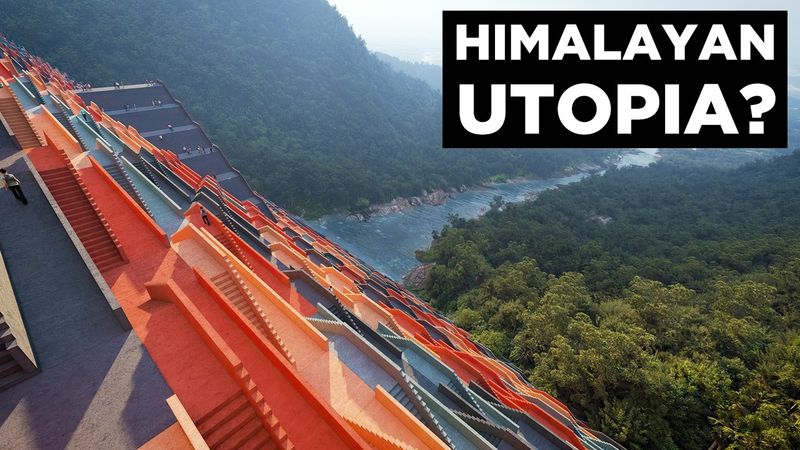
Inspired by India's ancient step wells, its facade is lined with bold, triangular terraces that invite people to walk across its face.
At its heart is something truly extraordinary – a temple, perched right in the centre of the structure, gazing out across the valley below.
While this one is particularly unique, dams are not actually that uncommon in Bhutan.
Around 99% of the country's energy comes from hydropower, making it one of the world's vanishingly few carbon-negative countries.
It underlines just how seriously Bhutan takes its environmental commitments.
This is a country where, by law, 60% of the land has to be covered in forests.
And again, whether it's trees on skyscrapers or eco-friendly cities in the desert, when it comes to questionable sustainability claims, we've seen it all.
Well, take another look at the city's skyline.
The reason it doesn't have skyscrapers is not just because Bhutan doesn't have a tradition of building them.
You won't find any building here above six storeys tall.
And that's all in an effort to reduce the amount of carbon-intensive materials like steel and concrete that the country uses.
And that's not all.
The idea of building in harmony with nature even extends to one of the city's greatest threats – flooding.
Jelafu sits here at the foot of the Himalayas.
Those rivers that run across the country are prone to flooding in monsoon seasons.
Now, if this was all about maximising profit, the way around that would be pretty simple.
You'd build right up to the edge of the river and then create an extensive network of sewers and storm channels to divert the water into and flush it out of the city as quickly as possible.
But the problem with that is that it's very resource heavy, more of that steel and concrete that we talked about earlier.
It also creates more of a human footprint in an area where people are trying to tread as lightly as possible.
The solution has been to create buffer zones around the rivers where paddy fields are going to be planted.
As well as providing the city with agriculture, the paddy fields are perfectly suited to absorb the excess water caused by flooding.
Instead of creating hard surfaces to remove the water, the city tries to turn itself into a sponge.
Elsewhere, permeable paving slabs and gardens are going to allow the city to absorb rainwater without relying on an extensive sewer system.
By reducing the amount of concrete and allowing nature into the city, it's also going to create corridors for nature and help the nation achieve its gross national happiness target.
So when is all of this going to happen?
Well, the plan is for the infrastructure works to be fully complete within the next 10 years.
But the authorities are more concerned with doing this properly than with doing it quickly.
They're also hoping that once works really do begin in earnest, the influence of the GMC is going to spread far beyond the southern plains of Bhutan.
These are very high demanding, unique projects that will require a similar level of technical skills.
Are we good enough?
Do we have enough?
No, absolutely no.
We are not good enough.
We don't have enough qualities, skills and numbers to match that demand.
We not just realize that, we also are willing to open up ourselves.
to get the global experts to do the job for us and be willing to work with them side by side and learn from them.
So when there is a similar structure, similar project being designed elsewhere in the world, 40, 50 years from now, Bhutanese will be consulted.
Bhutanese will go out to advise them and guide them.
This city is Bhutan's way of learning from the wider world.
And from the looks of it, the rest of the world has a lot to learn from Bhutan too.
Now let's give the last word to Jamyang Loden.
Take it away, mate.
There's a real sense of anticipation and faith in the project, not just as a city, but as a new chapter for Bhutan.
Thank you for listening.
I hope this message brings a little peace, curiosity and reflection into your day, from the heart of the Himalaya to wherever you are.
Don't forget that we're inspiring the next generation of builders through our investment into Brickboro, a fantastic LEGO subscription service.
You can learn more and get started today over at brickboro.com.
As always guys, if you enjoyed this video and you want to bring a little bit more happiness into your life, make sure you're subscribed to The B1M.
Here are a few fun facts about Bhutan.
Bhutan is the only country to measure gross national happiness.
Our capital Thimphu has no traffic lights.
We are the world's first carbon-negative country.
Plastic bags and tobacco are banned or heavily restricted.
And we protect our highest mountains because they are considered sacred.
Similar videos: Why Bhutan is Building the Anti
Tajikistan 4K - Scenic Relaxation Film With Calming Music
Tibet 4K - Scenic Relaxation Film With Calming Music
Oman 4K - Scenic Relaxation Film With Inspiring Music

Bulgaria 4K Ultra HD • Stunning Footage, Scenic Relaxation Film with Calming Music - 4K Video HD

We Had 72 Hours to Find Wild Tigers