Will the US sanction Putin's war economy? | BBC Ukrainecast
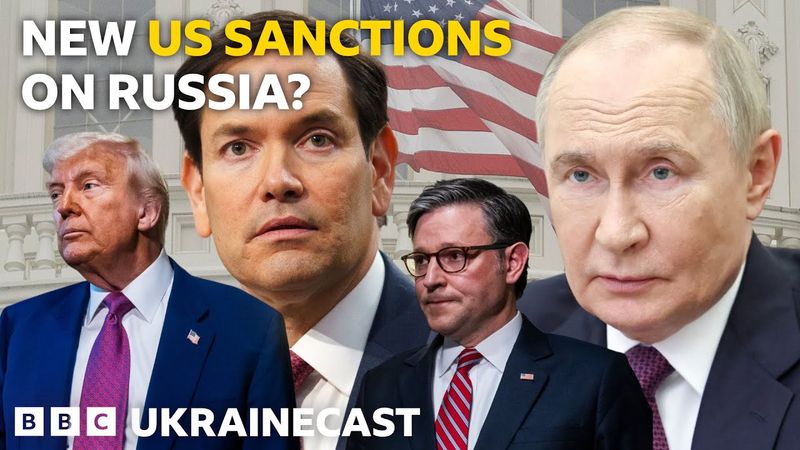
Download information and video details for Will the US sanction Putin's war economy? | BBC Ukrainecast
Uploader:
BBC NewsPublished at:
5/22/2025Views:
144Description:
Video Transcription
Hello, I'm Lucy Hockings, presenting the special edition of Ukrainecast, where we're answering your questions on the conflict in Ukraine.
There was so much hope pinned on that phone call, that two hour phone call that President Trump had with President Putin earlier in the week.
But has it really brought us any closer to peace?
Lots of you have also got questions on sanctions.
We're going to be answering all of those for you today.
We have an expert panel, a crack team with us today.
James Waterhouse is in Kiev.
Sumi Somerskanda and Vitaly Shevchenko with me here in the Ukrainecast studio.
So let's have a listen to this first one from a listener here in London.
Hey Ukrainecast, it's Anissa Jubo from London and I have a question about sanctions.
Those European countries who align themselves with the Coalition of the Willing are threatening Trump with tougher and tougher sanctions.
However, they struggle to get all Europeans on board, for example Hungary.
Now we hear Trump saying that he doesn't want to put any further sanctions on Russia because that could potentially jeopardize peace talks.
But we all know Russia in reality are not really interested in any peace talks at all unless they are forced.
And they are just playing Trump and trying to buy time and avoid those sanctions.
So in this environment, is it even possible to have any tough sanctions that actually has any impact on Russian economy and that could actually force Russia to the peace talks?
What do you say to that, Vitaly?
What are tougher sanctions that could be put on Russia that would actually work?
One possibility are secondary sanctions imposed on countries which still buy goods, fuels, hydrocarbons from Russia.
And Russia is still making billions selling its oil and gas to countries that have sanctioned Ukraine, for example.
So that's still going on.
When it comes to all the talks that we had last week and last Monday and before that,
In Turkey, in Saudi Arabia, in Russia, the net result is, well, I'm tempted to say zero, with the possible exception of a prisoner exchange that they apparently agreed in Istanbul.
But no ceasefire, no fresh sanctions, not even a meeting between any of the leaders involved.
involved over Putin or Trump or Vladimir Zelensky.
So it looks to me like Vladimir Putin is creating a smokescreen which some people are all too willing to accept as real negotiations.
And James, when it comes to sanctions, what are the Ukrainians calling for?
more sanctions, Lucy.
They have called for more sanctions since before the start of the full-scale invasion, to not only... Back then, it was to put Russia off from invading.
Now it's to try and force it to negotiate or make any kind of concession in any way.
I think we always knew, didn't we, that this would be a White House that wouldn't bring in new sanctions for Russia.
You know, there are more than around 6,500 penalties currently imposed by the US.
And I think this is why we're seeing Moscow look to...
work around Ukraine, work around Europe, try to improve their relationship with Donald Trump, try to get some kind of concessions when it comes to global finance, global banks, payments, unfreezing assets of those close to Vladimir Putin.
So I think that explains that behavior.
But if you're Ukraine, you cut a frustrated figure, I think.
I mean, I think ministers here are grinning and bearing it because all they can do politically
is reiterate their enthusiasm for peace, say they trust in Donald Trump to lead the way on that, and show that they are willing, because Ukraine cannot afford another falling out with the White House, because there is still scope for cooperation.
There are existing sanctions.
More military aid could be sold.
But if you look at the messaging coming out of Kyiv now, attentions once again turn to
the front lines, notably in the east, where I know we talk about the east a lot.
It is where the fighting is concentrated.
But we have seen a major road now captured by Russian forces.
Things really are starting to do deteriorate for the Ukrainians there.
And in terms of Europe, Sue Me, as always, it's about finding consensus, isn't it?
And then action.
It really is.
And I'll just say to James Vitale's points there, it's a difficult moment for sanctions, isn't it?
Because you see, after more than three years of war, the idea that Russia would be isolated on the global stage hasn't really come to bear, has it?
Because those secondary sanctions have not been put in place and Russia has been able to continue trade and continue bringing in, as you said...
billions of dollars, especially for oil and gas.
So that is one tricky aspect of it.
But, you know, I'm here usually to put on my Washington hat.
I'll put on my German hat for a moment because you have seen Germany front and center pushing with European partners
for tougher sanctions to bring Russia to the table and force Russia to peace, as Germany has said.
This is, in a way, in direct response to the fact, as James said, that they're not expecting further sanctions from the Trump administration.
There is the sense in Berlin, certainly, that this is going to be one of the only effective tools, or they hope effective tools, to try to move the peace process forward.
I will say, at the same time, we've seen an interesting development from the new chancellor, Friedrich Maatz,
during the entire campaign was very critical of his predecessor, Olaf Scholz, for not agreeing to send these Taurus long-range missiles to Russia.
Olaf Scholz at the time said this would be dragging Germany into the war.
Friedrich Merz had said these absolutely need to be sent to Ukraine.
If we're talking about the hardware that Ukraine needs
to be able to push Russia into position where they would have to negotiate.
Now he's backtracked on that a bit and said, well, there's a bit of strategic ambiguity that we need to use from our position.
We're not going to talk about whether we send these missiles or not.
So you see on the one hand from Germany the stronger talk on sanctions, and on the other hand, some discussion of what type of hardware Ukraine will still need to continue its position on the battlefield.
Well, we have had hot and cold messaging from President Trump when it comes to sanctions.
So I'm going to ask you, Nasumi, to put your US hat on.
Yeah.
Because we've had this question in from Peter.
I've been seeing reports that Republican senators have broad backing for additional sanctions, as well as upwards of 500% tariffs on imports from countries that buy Russian oil.
How likely is this to be imposed?
Can he do it without Donald Trump's backing?
Yeah, this is really interesting.
I mean, if you think about the fact that the president has been relatively cordial when speaking with Vladimir Putin, for example, he's made very clear, the administration has made clear that they don't want to use the same rhetoric that the Biden administration used with Vladimir Putin.
They have not called him a war criminal.
Secretary of State Rubio was pressed on this in Congress this week in a hearing, and he essentially refused to answer because they believe that that demonization of Vladimir Putin hasn't been effective, quite frankly.
But there are senators who do believe that it is important to continue to have some sort of leverage over Russia.
And that's why to this listener's question, this viewer's question, there is a bipartisan bill that has the support of about 80 senators right now that would put tough sanctions on Russia and secondary sanctions as well.
They're focusing particularly on China and its relationship with
with Russia.
And I found it really interesting.
I just pulled up some of the language of the bill.
It's Senator Lindsey Graham on the Republican side, Senator Richard Blumenthal on the Democrat side.
And there is a bit of massaging of the language to not perhaps be in conflict with the Trump administration.
They write, if it is more of the same, Russia can expect decisive action.
The U.S. stands ready to act, the Senate, if these games continue.
So there's a bit of room to maneuver there to say, well, the Trump administration is still working to try to make something happen.
But if it doesn't, we could see the Senate act in terms of sanctions.
James, what's the view at the moment from Ukraine on where America stands and how they've been handling things over the past week?
Well, I think, Lucy, I mean, how can we forget the Oval Office bust-up where we saw... We knew Donald Trump was going to be less sympathetic to Ukraine's cause.
We knew there was a growing Republican scepticism over Ukraine's ability to win this war and the merits of providing it with future aid.
But when we saw that argument...
That verbal dressing down that President Zelensky had to wear back in February, there was a bit of a unity, a rallying cry around him.
And I think back then, where things were more hostile, it fed into that existential threat that Ukraine faces.
I mean, there are people that are not fans of Zelensky here.
But they rallied around him because it was seen as Ukraine once again having to stand up for themselves.
That said, that's kind of been softened with political pressure for Zelensky to have to work with Donald Trump.
And I think there is political and also people you speak to.
They are supportive of that very idea because America has been Ukraine's biggest military backer.
And Ukrainians want and need that to continue to keep Ukraine in the fight.
James, Vitaly, Sumi, thank you so much.
Thank you for joining us for that small slice of the conversation that we're having on UkraineCast today.
And don't forget, if you want to listen to the full conversation that we'll be having, we're taking more of our listeners' questions.
You can find UkraineCast wherever you get your BBC podcasts.
Similar videos: Will the US sanction Putin
Will Putin stop bombing Ukraine? | BBC Ukrainecast
Will France derail Trump's Nato weapons plan? | BBC Ukrainecast
Has Trump cooled on Putin? | BBC Ukrainecast
Are Trump and Putin about to do a ceasefire deal? | BBC Ukrainecast
Has Putin changed his mind on meeting Zelensky? | BBC Ukrainecast