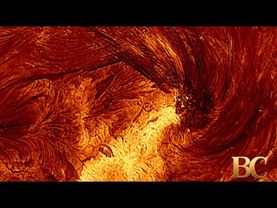
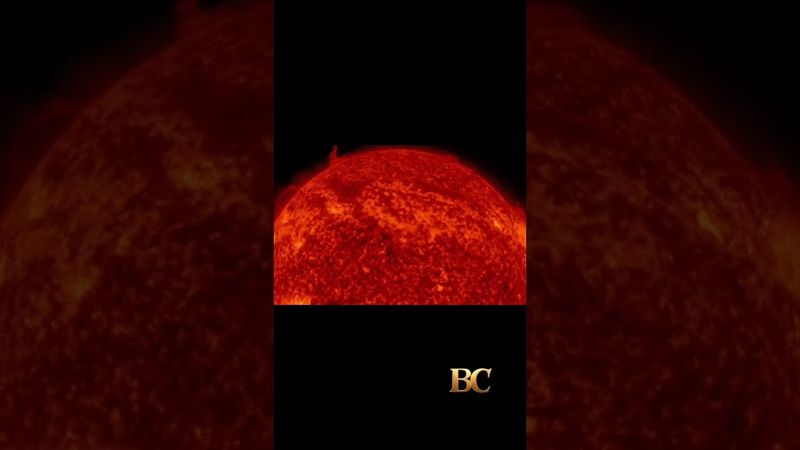
World’s most powerful solar telescope sees incredible coronal loops on the sun

Download information and video details for World’s most powerful solar telescope sees incredible coronal loops on the sun
Uploader:
B.C. BegleyPublished at:
8/27/2025Views:
4Description:
The Daniel K. Inouye Solar Telescope has captured the smallest magnetic loops ever seen in the sun’s corona, measuring as little as 13 miles wide. Observed after an X-class solar flare in August 2024, these tiny loops may be fundamental to the magnetic processes that power the sun’s most powerful flares. Scientists say this breakthrough lets them study the sun at previously unseen scales, potentially resolving individual loops for the first time, Space.com has reported. The findings were published Aug. 25 in The Astrophysical Journal Letters. However, proposed U.S. budget cuts could threaten the telescope’s future and the solar research it supports. read more: 👍 Like this video to stay updated on the smallest magnetic loops ever observed in the sun’s corona. 💬 Comment below—How do you think these discoveries could change our understanding of solar flares? 🔗 Share this video to inspire interest in solar science and space research. 💰 Support the channel by hitting the YouTube Thanks button, helping us continue covering breakthroughs in astronomy. 👉 Don’t forget to subscribe for more updates on solar physics and space exploration. Links for B.C. Visit My Website Follow Me On Facebook / b.c.begley Subscribe To My Patreon / bcbegley Watch Me On YouTube / @b.c.begley6007 Follow Me On Twitter / bc_news1 Watch Me On Rumble Follow Me On Gab Follow Me On Truth Social Follow Me On BlueSky Watch Me On TikTok / bcbegley #SolarTelescope #SunScience #MagneticLoops #shorts
Similar videos: World

World’s most powerful solar telescope sees incredible coronal loops on the sun
NASA’s Chandra Telescope Reveals Stunning X-ray Views of Black Holes and Star Clusters
‘Potentially hazardous’ asteroid Bennu contains dust older than the solar system

Mysterious fast radio bursts help astronomers pinpoint cosmic ‘missing’ matter
NASA’s Webb Space Telescope captures bright auroras on Jupiter