How to Invest for Beginners (Full Guide + Live Example)
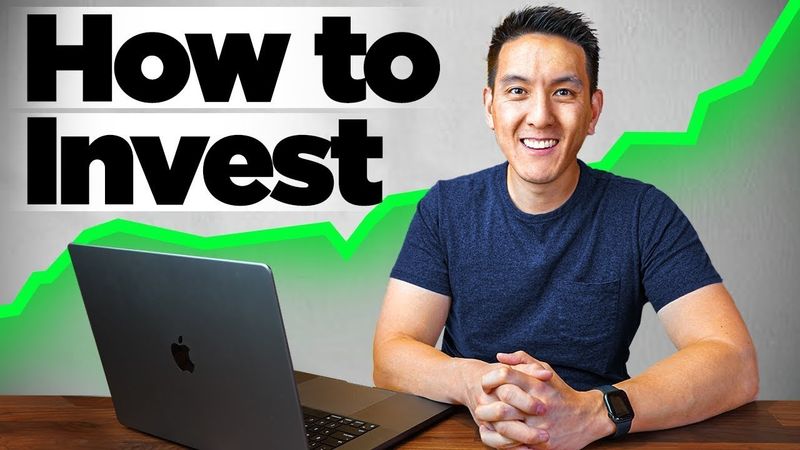
Download information and video details for How to Invest for Beginners (Full Guide + Live Example)
Uploader:
Humphrey YangPublished at:
1/27/2023Views:
1.3MDescription:
Video Transcription
So you've saved up some money and you want it to work for you.
You've probably heard of this term called investing, and that's the practice of allocating your money in a way so that it returns more to you in the long run.
However, if you are a beginner, it can be really overwhelming.
There's tons of terms you've probably never even heard of.
For example, bear versus bull markets, ETFs, index funds, limit orders, ticker symbols, the S&P 500, the list goes on.
I'm actually of the firm belief that investing doesn't actually have to be overwhelming.
So in this video, we're gonna show you why you should be investing, how you're gonna be investing and what to actually invest in.
And these are gonna be in terms that anybody can understand.
We'll also go over some basic beginner strategy and also talk through some frequently asked questions, as well as go through a live example of actually how to invest.
So if that sounds good to you, stay a while, listen, grab a drink, and let's get into why you should be investing.
All right, plain and simple, the reason why we want to invest is that we want our money to work for us.
So if you're actually saving your money right now in a savings account, for example, at a big bank like Chase or Wells Fargo or anything like that, the interest rates that they're paying you on your money is not very high.
Typically a bank like that might offer you 0.01% or even 0.15% on your money.
So let's pretend for a second that someone hypothetically gives you $1 million and you take that million dollars and you put it in Chase Bank in a savings account that yields you about 0.01%.
At the end of the year, that million dollars will have earned you $100.
In that case, your million dollars is not working very hard for you.
Imagine you were getting 10% on the money per year, that would be $100,000.
That's a huge order of magnitude different from your $100, which is the typical savings rate at a big bank.
Even 5% on a million dollars would be $50,000 a year, and I think that many people could live comfortably in retirement off of that money.
So investing can get our money to compound over time.
And the term compound interest refers to the interest that you earn on your own interest.
So this is kind of a confusing concept if you're new, but it can be illustrated by this example here.
Say you invest $1,000 and you get a 10% return.
At the end of year one, you're gonna have $1,100.
Now, when you start that next year, if you get 10% on $1,100, you'll end up with year two, at the end of year two, $1,210.
Now, pretend that this pattern continues for another 20 years.
Your money starts to earn money on the previous balance every single year.
So at the end of year 20, you're gonna have $6,727.
So just by putting $1,000 in and getting a return every single year, your money starts to grow and grow and grow, and that's called compounding.
Another reason we want to invest some of our excess cash instead of having it sit in a savings account is the concept of inflation.
The US has a central bank and that's called the Federal Reserve.
And that actually dictates the monetary policy for the United States.
But you just need to know that they are targeting a 2% inflation rate every single year for a healthy economy.
But I'm sure you've seen the news recently
Recently, the inflation reports are saying it's between 6% to 8% a year.
That means if our money isn't earning 6% to 8% a year, that money is losing value just by sitting in the account.
It's losing purchasing power.
All right, if you really wanna see inflation in action, all you have to do is look at the stamps that you buy for your letters.
In 1971, the stamp cost 8 cents to mail a letter.
As of this year, it's 63 cents to mail that same letter.
The mechanics are exactly the same.
The stamp allows your letter to be delivered anywhere in the United States.
But as time has passed, the stamp has just gotten more expensive due to inflation.
So that's also why we want to invest.
So let's get into how do we actually invest?
The first thing to understand about how to invest in the stock market is to understand that we can actually invest in a variety of things.
So you can invest in companies like investing in stocks.
So the better that a company does financially, the better that your investment is gonna do.
You could also invest in real estate, so your family may have bought a house in the 90s, and maybe they bought it for $100,000 at that time, but over time, nowadays, your family home is worth $1 million.
That 900K difference that you're seeing there is known as real estate appreciation, and appreciation is a term to describe what happens to your asset when it appreciates over time, so increases in value over time.
You could also invest in collectibles.
So Pokemon cards, for example, the first edition Charizard cards are going for like $20,000 these days.
But back in the 90s, the late 90s, when the Pokemon cards just came out, those cards were probably worth no more than $20.
Now, all of these investments do carry risk, and it can be pretty difficult if you're a beginner to figure out what to actually invest in.
But I promise you, if you just keep watching, we're gonna answer all of these questions.
For this video, we're gonna be talking about investing in the stock market, so investing in companies, as this is the most common type of investment and also has the most predictable returns over a long period of time.
I'm gonna define a long period of time as anything over 10 years, but the longer that you hold onto your stocks and investments, the better, and I'm gonna show you with a stock market example.
So this is the graph that represents the S&P 500, which is known as the top 500 companies in the United States.
And I'm gonna explain a little bit later in this video how to buy this exact market or this exact S&P 500 with just one purchase.
But what I wanna show you guys is what's really interesting here is that if we click on Max, we can see that this S&P 500 was started back in 1983.
And you can see that the general trend and the general direction is that it goes upward over time.
Now, sure, there are some dips and there's some valleys right here.
As you can see, famously in 2008, the market kind of had this little crash right here.
And same in the 2000s, it also, the dot-com bubble, it also crashed right here as well.
So sometimes there are periods where if you don't hold long enough, you could lose money.
So for example, if you bought in 2000, you sold in 2003 right here, you would have lost money investing in the S&P 500.
But
If you had held long enough, you can see that back over here in 2015, you would have made money on it because it's higher.
This number right here is higher than what it was back in 2003.
Historically, if you invest in the S&P 500 index, it typically returns between eight to 10% a year, and that's since the inception of the S&P 500.
So that means if you had put $100 of your hard earned money back in 1980, let's say you were alive back then and you invested it into the stock market, it would be worth $9,977 today.
Adjusted for inflation, $100 is worth $360 today, but that means that your money still would have gone up about 27 times in value just for investing.
And that's why it's so important to invest and grow your money so that you're not just leaving money on the table.
And honestly, investing is not that difficult, especially if we know what to invest in.
So let's actually get into what do we actually invest in.
All right, in terms of what to invest in as a beginner, I'm sure many of you have heard of your friends or family buying individual stocks.
So maybe your dad or your friend might put $100 into Coca-Cola stock or Tesla stock or something sexy like that.
The thing is though, is that investing in individual companies can take a lot of work.
Oftentimes they are more volatile in their returns and they're definitely like a more active style of investing.
Think of like a day trader.
A day trader is looking to maximize their returns on a daily basis.
So they might be looking at a stock's performance by minute, by hour.
And that's something that takes a lot of work, adds a lot of stress into your life.
And it's not something that as beginners, we wanna do.
A more passive style of investing will just involve buying all of the stocks in the stock market, kind of forgetting about our investment and just checking it once or twice a year and seeing our money grow over time.
And the way that we're going to do that is to invest in what's called an index fund.
So an index fund is something that a lot of financial advisors will put their clients into.
And basically it's a fund that is well diversified, tracks the stock market.
And as long as you invest in them over time consistently, the path to becoming a millionaire is almost guaranteed.
So what is an index fund exactly though?
So to understand what an index fund is, we actually need to talk about the fund that preceded it.
And that's actually known as a mutual fund.
A mutual fund is when many investors will pool their money together, they'll come together.
So let's say you have a million dollars and I have a million dollars.
We both give it to a mutual fund manager.
And that fund manager's job is to try to give us the best possible return.
They might raise more money from a bunch of different people.
And by pooling that money together, they then pick a selection of stocks based on their expertise to try to get you the highest return.
In exchange for this service, the money manager will charge a really high fee to its investors because the money manager is doing all the work.
And also the money manager has kids to feed and a house to mortgage or house mortgage to pay off as well.
So they need to get paid a pretty high fee.
So a mutual fund has a professional manager involved, but an index fund on the other hand is passively managed and it tracks an entire stock index.
A stock index is something like the S&P 500, which tracks all of the 500 top companies in the United States.
The NASDAQ is another example of an index.
And in the UK, they have something called the FTSE.
So they had the FTSE 100, which tracks the top 100 companies in the United Kingdom.
So an index fund would automatically track and invest all those companies in that specific index.
So all that we have to do as a beginner investor is buy that index fund.
So on the screen right now, I have the S&P 500 companies by weight.
Just to give you an example of what kind of companies are in the S&P 500, we can see that Apple right here is the world's largest valuable company.
It has a weighting of 6.14% in the S&P 500.
Microsoft is in here, Amazon, Alphabet, Exxon,
Visa, Tesla, Home Depot, you get the idea.
These are all larger, really, really large companies.
As we scroll down the list, you can see that the companies will start to get a little bit more unfamiliar.
For example, if we went all the way down to the 400s, I've never heard of Camden Property Trust, never heard of it in my life.
However, if you were to buy an index fund that tracks the S&P 500,
your money would get split proportionally among all of the S&P 500 companies that we see here.
So an example of an S&P 500 index fund would be like ticker symbol VFIAX.
So a ticker symbol is like an airport code.
So whenever you're landing at your airport, there's usually a three-letter code, for example.
So JFK would be John F. Kennedy Airport, or London Heathrow would be LHR.
Stocks and investments also have their own ticker symbols.
So if we scroll all the way to the top, we can see that ticker symbol for Apple is AAPL, Microsoft is MSFT, Amazon is AMZN, et cetera.
So index funds are passively managed, which means that they don't have a professional money manager, which also means that there are not super high fees for owning an index fund.
What the index fund does, it's just really a convenient way for you to invest your money and then get instant diversification among all of those holders
within the index fund.
It's definitely a really great beginner strategy because it kind of takes the guesswork and the work out of investing.
You just invest in everything.
And so if you want some more further evidence as to why you shouldn't pick individual stocks, consider the tech company Intel.
They were once a high flying stock back in the 2000s during the dot-com bubble.
But if you had chosen this individual stock back then, you can see by this chart that to this day, you would still not have broken through its all time highs back in 2000.
Now compare that performance to the overall stock market performance since 2000, which has four times since then.
So this is the danger of picking individual stocks.
While there is more reward sometimes, there is definitely more risk.
And so what we're looking for is consistent gains over time because that's just really nice.
Now everyone's goals and time horizon are very different when it comes to investing.
Investing is extremely personal, right?
So when I used to be a financial advisor, one of the first things that we would ask our clients is, hey, what's your risk tolerance and how long do you wanna be investing for?
Are you the type that's okay with really big risks and big swings in your account, or do you just want to see it steadily grow over time?
And this is something that you should definitely ask yourself before investing.
I would say the index fund strategy is very good for a beginner investor that's on the younger side.
However, if you are nearing retirement, let's say in five years, you might not want to invest in index funds because they could be too volatile for you.
And the reason is pretty simple is that if you're about to retire in five years, you need all the money that you can possibly get your hands on.
So it doesn't really make sense for you to risk your money in the market.
Now compare that to someone who's 20 years old who has 45 years left to retirement.
That person might have a higher risk tolerance because they have more time to kind of F up and mess up because even if they do mess up, they have more time to recover.
So the basic gist here is that if you are earning a consistent income, you should be setting aside a portion of that income and consistently investing over time.
Again, the average return for the market is typically around eight to 10% a year in the S&P 500.
But as you saw in my earlier example with the S&P 500 graph, that there are periods of time stretches like eight to 10 years where it might trade flat or you might actually lose some money.
I would say for the majority of people watching an index fund that tracks the S&P 500 is the way to go.
Now you're probably wondering to yourself, well, could the stock market ever go to zero?
Well, historically based on all the data, it probably will not go to zero.
Like for the stock market to go to zero, basically all hell has broken loose on planet earth.
and all of our financial systems have collapsed.
So if the stock market were ever to go to zero, let's just say we would have way bigger problems than just the stock market being zero.
I'm sure money would have no value at that point.
However, I'm not gonna rule it out.
Like there might be a 0.0000001 chance that it ever happens.
I never wanna say never on this channel.
So never say never, Justin Bieber.
J. Smith and JB, uh-huh.
But I don't think it's going to happen.
So is that a realistic risk that you should be worried about?
Probably not.
Okay, in terms of where to invest your money within what type of account, you usually want to do it in a retirement account or a brokerage account.
Now, a retirement account is something like a 401k, which is employer sponsored, which means that your employer usually sets it up for you and you can invest through their program.
Or there are also individual retirement accounts such as the IRA or the Roth IRA.
If you're in the UK, Canada or Australia, what I'm gonna do right now is put up the equivalent account types on the screen right now.
So in the UK, it's known as an SIPP or pension and the IRA is known as the ISA.
In Canada, they're known as RRSPs and the IRA is known as the TFSA.
And in Australia, they're known as superannuations.
Let me know if that's correct, you Aussies down there.
And then the IRA is simply an IRA.
Now, while I can't speak for the countries outside of the United States, the main advantage of investing in a retirement account is that there are usually some tax advantages.
Now, if you are investing within a retirement account, just know that the trade-off for those tax advantages is that you usually have to wait until you retire to withdraw that money.
So essentially you're locking up your money until retirement.
Not all the time.
There are some ways that you can get it out before retirement, but you'll usually have to pay penalties.
Now, if you don't want to invest in a retirement account, what you can do is simply invest in what's called a brokerage account.
And those are usually taxable on a year to year basis.
So back in the day before the internet, what you would do is you would call a stockbroker on the phone.
You know, you'd call him like this or like this, depending what age you are.
And that's kind of like the scene in the Wolf of Wall Street.
You'll remember that Leonardo DiCaprio, when he's trying to sell stocks to the phone, he's literally writing on a piece of paper that he's gonna sell this Aerotime Industries to this person over the phone.
And then he's gonna actually place the trade via paper and that's how it's gonna go.
Back then, you would need a broker to place your trades because the entire financial industry is heavily regulated.
And it's not like you could go to a company's website these days and just buy their stock.
However, these days, instead of contacting a broker, you have what's called just a brokerage account or a brokerage app.
And what you do is sign up for an account and then you can just place your trades electronically.
A brokerage is something known as like Fidelity, that's a brokerage, Charles Schwab, that's a brokerage, Robinhood, Webull, these are all examples of brokerages.
Now, if you aren't sure of how to place a trade within a brokerage like that, at the end of this video, we're gonna go through a live example of how to buy an index fund or an ETF using one of these apps.
Now first, let's actually answer the question of when you should start investing, because I think this is always a question that people have.
It's like, okay, am I too old to invest?
Am I too young to invest?
The short answer is that you should start investing as soon as you can.
The earlier you start investing, the better because you have more time to take advantage of those compound returns and more time to hopefully, if you mess up, you can make up for it.
Now, I will say that you should not start investing if you don't have at least three things done yet.
Number one, you should have all your high interest debt paid off.
And the reason is, is that usually high interest rate debt is anything over 10%.
So if you can get a guaranteed return of 10% by paying off your high interest rate debt, you should probably do that because that's guaranteed.
The trade-off is that, yeah, you don't invest in the market, but what if the market loses you money?
I'd much rather just be free of high interest rate debt before I start investing.
The second thing you wanna have established is an emergency fund.
So that's a fund that you set aside just for emergencies, and hopefully you have three to six months of your expenses saved in that account.
That's an account that you do not touch unless for emergencies.
And this is actually good to give you a lot of peace of mind before you start investing.
Lastly, only invest what you can afford to lose.
So for example, let's say you wanna buy a house in the next two years with your nest egg of money.
I probably would not be investing that in the market because what if the market takes a downturn and all of a sudden you can't buy that house anymore?
Investing does carry risk.
And while we have been going over a strategy that in the long-term nets you between eight to 10%, you know, in any given point you could lose money.
So that's something you just wanna keep in mind.
All right, so how much money should you start with?
In terms of how much money you wanna start with investing, this is where I have kind of a controversial take.
A lot of people are gonna say to invest whatever you have into the market.
And I think a more important condition on whether or not you should do that is that if you have a reliable way of generating more income, then you should be consistently investing into the market.
But if you only have, let's say, $100 to your name and you invest in the stock market, and let's say you get 10%,
that's $10 over the course of a year.
That's not a lot of money.
So your money in that case, when you only have $100, it's much better to invest that in yourself, build some skills, start a side hustle so that you can get more consistent income.
But if you are someone with a consistent salary, a consistent income, you don't have any high interest rate debt, and you have an emergency fund taken care of, that's when I would say start to set aside a portion of your income every single month or every single paycheck and invest that into the market.
If you're still having trouble trying to figure out how to make money, you should check out my video on how to go from zero to $100,000 within a year.
I just posted that on my channel not too long ago.
Okay, so let's go through a live example of buying shares on a brokerage app.
Now, obviously I changed clothes because I did record this the other day, but the recording got kind of messed up, so I'm doing it again now.
But in terms of the brokerage you choose, it doesn't really matter too much.
They're more or less the same across the board as long as they are one of the bigger brokerages like Fidelity or Charles Schwab or TD Ameritrade, et cetera.
All these platforms will take care of calculating the taxes for you.
The commissions are gonna be low or even zero for some of these.
And the only really big difference is the interface.
So it really just comes down to like personal preference.
I personally use Fidelity or Robinhood just because their interfaces are really easy to use.
And some of these brokerages, if you're not even signed up yet, you can get some free stocks when you use, for example, my links down below in the description.
So I'll leave those down below in case you wanna get some free stocks when you sign up for them, but it's definitely not required.
It's just something that's there.
Okay, so let's actually go through and buy some shares of a ticker symbol such as VOO.
That's an ETF that tracks the S&P 500.
All right, so you usually come up to one of these screens and I'm just gonna click on trade at the top left right here.
And then I'm just gonna type in VOO.
You can see that it's actually listed in my symbol or company names for the recent quotes, but I'll just type in VOO anyway, and it'll come up the Vanguard 500 Index Fund.
So we're just gonna click on that.
Now we're at this screen.
We can see that it's trading right now for $367.16.
I'm just gonna click on buy.
All right, once you get to this screen, this is where you wanna just choose buy for the action, as you can see here.
You can also press sell if you had some shares, but we're just gonna buy today.
So we're gonna click buy.
The quantity type here, you can choose to buy in shares or the dollar amount.
So I'm just gonna buy one share right here and just kind of show you how it works.
So it'll tell you that the estimated cost here is $367.10.
The order types is market or limit.
Now, these are a little bit complicated, but all you really need to know as a beginner is that market will make it so that you buy these shares as soon as possible.
So as soon as possible ASAP.
If you choose limit, that's when you actually have to set a limit price.
And that means the order will only go through if the price of that share is trading at the price that you specify.
So it's a little bit more, I would say customizable so that you get the perfect price that you want.
But for the sake of our example, we're just gonna use market.
And I'm just gonna click on preview order.
All right, so this is the order preview.
It just kind of goes over an overview of what you're about to buy.
And then once you're ready to buy here, you're just gonna click the place order button and we'll do that, confirming trade.
And boom, order received, and I have a confirmation number.
It's easy as that.
Now let's actually go through an example and buy with dollars.
Since I just showed you how to buy one share, let's actually buy $100 worth of VOO, because you can also do that too.
All right, so now we're back at that trade screen that I showed you earlier.
We're gonna click on buy, and then instead of shares, we're gonna choose dollars.
And let's say we only want to buy $100 worth of VOO.
We can just type in $100 right here.
And same thing, we're gonna place it as a market order.
And if we just preview this,
We can see that the order preview in this case, the estimated order value is only $100.
So we're basically buying a fractional share of VOO, which means we're not gonna get the full share.
We're probably gonna get like 100 divided by 366.
What is that?
We'll get 27% of one share.
So 0.27 shares of VOO.
I'm just gonna click on place order right here.
And boom, just like that, we've placed an order for some shares.
So that's exactly how that works within the Fidelity app.
And many of the other brokerage apps are gonna be very similar.
All right, guys, if you enjoyed this video, I hope that it was incredibly valuable and helpful as a beginner getting into investing.
Please share this with a friend if you think it would be helpful and make sure to check out the links down below in the description.
And also lastly, subscribe to this channel because we come out with new investing, personal finance, and really cool videos all the time.
And I hope to see you guys in a future video.
All right, peace.
Similar videos: How to Invest for Beginners

A Guide to Hedge Funds & How Much Investors Make!
How To Make A New Sequence In Premiere Pro

Абсолютно всё, что вам нужно знать о деньгах — рассказывает финансовый аналитик
How To Learn & Study Chess Openings

You NEED This for SURVIVAL - Don't let it go to WASTE!